LONGLISTED FOR THE HESSELL TILTMAN PRIZE
When 25-year old Private Johnson Beharry won the Victoria Cross in 2005 for bravery under fire in Iraq, he was the first person to win Britain's highest military honour since the Falklands war in 1982 and the first living recipient since 1969, when two Australians were given the award for action in Vietnam.
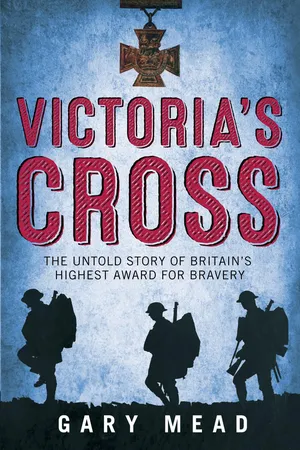
Born out of the squalor of the Crimean War in 1856 and the fragility of the monarchy at that time, the VC's prestige is such that it takes precedence over all other orders and medals in Britain. But while many books have been written about specific aspects of the VC and its recipients, none have asked why so many brave men who deserved the medal were denied it, and why no women have ever been awarded the VC, even though they are entitled.
Military historian Gary Mead's vivid and balanced account of the VC's life and times exposes the hypocrisy behind one of the UK's last sacred cows, and explores its role as a barometer for the shifting sands of political and social change during the last 150 years.
- English
- ePUB (mobile friendly)
- Available on iOS & Android
eBook - ePub
About this book
Information
Subtopic
Military & Maritime HistoryIndex
HistoryContents
Acknowledgements
List of illustrations
Preface
1 The Price of Courage
2 A Most Grand, Gratifying Day
3 Small Wars
4 Big War
5 Go Home and Sit Still
6 Bigger War
7 The Integrity of the System
Current Military Decorations
Select Bibliography
Notes
Index
Illustrations
Acknowledgements
Many people have helped steer this book safely into harbour after a long journey. I wish to thank the staff of the London Library; the National Archives; and the Royal Archives. I particularly thank James Nightingale of Atlantic, who edited it; Angus MacKinnon, formerly of Atlantic, who commissioned it and courageously defended it to his own superiors; Christopher Sinclair-Stevenson, my indefatigable agent and, if I may presume, friend; and finally my family.
Illustrations
| 1. | First presentation of the Victoria Cross by Queen Victoria, in Hyde Park, 26 June, 1856. Original watercolour signed by Orlando Norie, 1832–1901 (Courtesy of the Anne S. K. Brown Military Collection, Brown University Library) |
| 2. | Prince Albert, after George Baxter, 1804–67 (Yale Center for British Art, Paul Mellon Collection) |
| 3. | Captain William Cecil George Pechell (standing, third from right) and men of the 77th Regiment in their winter dress in the Ukraine, during the Crimean War, c. 1855 (Roger Fenton/Hulton Archive/Getty Images) |
| 4. | Thomas Henry Kavanagh being disguised during the Indian Mutiny, 1857 (Hulton Archive/Getty Images) |
| 5. | Ethel Grimwood, from My Three Years in Manipur, 1891 |
| 6. | Winston Churchill (right) with other captured prisoners of war during the Boer War (Time Life Pictures/Mansell/The LIFE Picture Collection/Getty Images) |
| 7. | Lord Kitchener, depicted on a poster in 1915 |
| 8. | Poster showing a flag-draped portrait of Frederick Roberts, 1st Earl Roberts, 1916 |
| 9. | John ‘Jack’ Travers Cornwell (© Imperial War Museum/Robert Hunt Library/Mary Evans) |
| 10. | William Avery Bishop (© Photo Researchers/Mary Evans) |
| 11. | Women politicians at the House of Commons, London, 5 December, 1935 (Central Press/Hulton Archive/Getty Images) |
| 12. | Violette Szabo with her husband Etienne Szabo, c. 1940 (Popperfoto/Getty Images) |
| 13. | Winston Churchill shakes hands with Wing Commander Johnny Johnson during an inspection of French airfields, 30 July, 1944 (© Bettman/Corbis) |
| 14. | Dame Margot Evelyn Marguerite Turner by Hay Wrightson (© National Portrait Gallery, London) |
| 15. | Lance Corporal Johnson Beharry poses for photographs at the unveiling of a new portrait of him by Emma Wesley at the National Portrait Gallery, London, 21 February, 2007 (Leon Neal/AFP/Getty Images) |
Preface
I may be accused of animus toward the recipients of the Victoria Cross, to whom I have referred. To this I have only to say that they are one and all personally unknown to me, and that I believe they are as much deserving of the honour as a great many men who have not obtained it, while, on the other hand, it is an unquestionable fact that there are hundreds of officers who have not got the order, who are much more entitled to it than those who have it.1
Hundreds of books have been published about the Victoria Cross, most a mélange of train-spotting and hero worship, compendiums of deeds of derring-do about one or other of the 1,357 (to date) VC holders.2 Others focus on particular battles, branches of the armed services, regiments, or the VCs of individual Commonwealth nations. There is also clearly an appetite for arcane minutiae regarding the Cross; but is it really any longer of significance – was it ever? – that the metal used to produce a VC comes from Russian, as opposed to Chinese, cannons captured in the Crimean War?3 To some extent all these books rely upon the official citations of individual VCs as published in the London Gazette. These citations are a splendid assortment of painstaking description and creative invention, some quite lengthy and others very brief. All are carefully crafted, with a suitable veneer of authoritative objectivity, a smoothed-out uniform tone that adopts a lofty indifference to perhaps the most pertinent question: ‘Did it really happen like that?’ A degree of scepticism is called for when reading these official accounts.
The military is well accustomed to this scepticism. In an effort to demarcate between someone who has done something remarkably brave and someone who ‘merely’ fulfilled their duty, they have long had their own informal distinction between a ‘good’ VC and a lesser one in order to winnow out the authentic hero. But what is an authentic hero? Is it someone who calculates the risks and nevertheless stifles their fears; or someone who is so angered that they lose all self-regard? Is it someone who merely does their duty? Or someone who did not act very courageously at all, but to whom granting a VC was a personal or political gesture? The annals of the Victoria Cross have a fair sprinkling of all three types.
There has always existed a written royal warrant, which sets out the terms on which VCs are to be awarded – the rules. But, in a very British fashion, rules are one thing, behaviour often quite different. In the nineteenth century the VC rules were regularly adjusted to accommodate recipients that some establishment figure believed should be recognized by the award of a VC, but who, strictly speaking, were ineligible. Equally important was the need for that figure to possess the clout to push home a revision to the warrant. Senior military officers pushed through some extremely dubious VCs, motivated by personal or political reasons. In the twentieth century this trend for ignoring the terms of the royal warrant, and implementing informal rules of eligibility, was carried even further and given more systematic force, not through a conspiracy but instead by that very British tendency, the following of custom-and-practice. This served to warp still further the definition of exceptional courage, bending it to serve a broad political purpose: that of boosting national morale and encouraging others to emulate the selected act, while simultaneously tightening distribution of the VC significantly, and in ways that utterly diverged from what was laid down in the royal warrant. This book asks how it is that, over more than a century and a half, the VC has mutated from its no doubt flawed but remarkably open and democratic origins, to become the tightly controlled, rather secretive, and undemocratic honour it has become today.
The kind of behaviour that is necessary to gain a VC today is not so much courage as madness; how else to describe a situation where those put forward for a VC are required to have risked a 90 per cent chance of death? When it was first created, the VC went to (usually) brave men. Today it still goes to brave men, but men who are carefully scrutinized for how their story will be judged by the media, assessed to determine if they are the ‘right’ character, and who are generally investigated far beyond their deeds in battle. Today, men are never chosen for a VC nomination by their fellows, even though they still have the right to do so. Women and civilians are also excluded, even though their eligibility is clearly stipulated in the most recent (1961) royal warrant. This book explores the anomalies, contradictions, injustices and absurdities that infuse the history of this deeply important symbol of British courage, national stoicism and patriotic pride. Ultimately, the distribution of the Victoria Cross is shaped by subjective decisions that intrude all along the route between the act of courage and the final pinning of the honour to a tunic. Courage possibly was never enough; it certainly is not today.
That the VC has deep symbolic meaning for British society cannot be doubted. Not only has the VC played a bit part in thousands of memoirs, novels, plays and poems, featured on postage stamps, in a nineteenth-century board game, in musical compositions, and even on railway engines.4 It is also, arguably, one of the two most instantly associative icons in the British mind that is attached to war – this cheap little cross represents ultimate courage, as the poppy stands for ultimate sacrifice. The VC, as with the poppy, has thoroughly embedded itself in the psyche, not just of Britain but also that of Commonwealth nations.
To win a VC today is an astonishing rarity which, given we have just been engaged in a war of considerable ferocity lasting thirteen years, is remarkable. You need first of all to be ‘lucky’ enough to find yourself in a situation where extreme courage is required, and prove yourself capable of demonstrating that degree of courage. Then you need to have the good fortune that your courageous act is noticed by a superior – even better, two superiors. After that, you must hope that your superiors are capable of writing up your brave deed in compelling prose – neither too simple nor too flowery, as the first will attract indifference and the second suspicion. It gets more difficult beyond that stage. You then need to be lucky enough that the write-up of your action gets passed upwards, and is not rejected by one or other higher officers through a chain of ever-more stringent oversight. If you are exceptionally lucky, your recommendation for a VC will reach the highest pinnacle, a special committee of very senior armed forces officers. They will then proceed to judge not just your action, your courage, your heroism, but also whether you are the right so...
Table of contents
- Cover
- Title Page
- Copyright page
- Dedication page
- Contents
Trusted by 375,005 students
Access to over 1.5 million titles for a fair monthly price.
Study more efficiently using our study tools.
Frequently asked questions
Yes, you can cancel anytime from the Subscription tab in your account settings on the Perlego website. Your subscription will stay active until the end of your current billing period. Learn how to cancel your subscription
No, books cannot be downloaded as external files, such as PDFs, for use outside of Perlego. However, you can download books within the Perlego app for offline reading on mobile or tablet. Learn how to download books offline
Perlego offers two plans: Essential and Complete
- Essential is ideal for learners and professionals who enjoy exploring a wide range of subjects. Access the Essential Library with 800,000+ trusted titles and best-sellers across business, personal growth, and the humanities. Includes unlimited reading time and Standard Read Aloud voice.
- Complete: Perfect for advanced learners and researchers needing full, unrestricted access. Unlock 1.5M+ books across hundreds of subjects, including academic and specialized titles. The Complete Plan also includes advanced features like Premium Read Aloud and Research Assistant.
We are an online textbook subscription service, where you can get access to an entire online library for less than the price of a single book per month. With over 1.5 million books across 990+ topics, we’ve got you covered! Learn about our mission
Look out for the read-aloud symbol on your next book to see if you can listen to it. The read-aloud tool reads text aloud for you, highlighting the text as it is being read. You can pause it, speed it up and slow it down. Learn more about Read Aloud
Yes! You can use the Perlego app on both iOS and Android devices to read anytime, anywhere — even offline. Perfect for commutes or when you’re on the go.
Please note we cannot support devices running on iOS 13 and Android 7 or earlier. Learn more about using the app
Please note we cannot support devices running on iOS 13 and Android 7 or earlier. Learn more about using the app
Yes, you can access Victoria's Cross by Gary Mead in PDF and/or ePUB format, as well as other popular books in History & Military & Maritime History. We have over 1.5 million books available in our catalogue for you to explore.