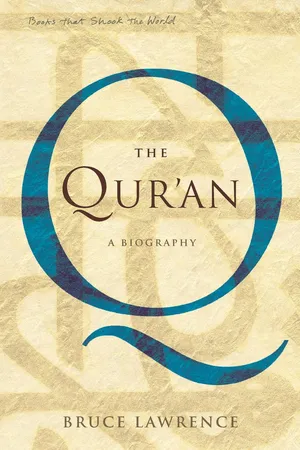
The Qur'an: A Biography is a beautifully written and authoritative account of one of the world's most famous, and most misunderstood books.
Few books in history are as poorly read or understood as the Qur'an. Sent down in a series of revelations to the Prophet Muhammad, it is regarded by the faithful as the unmediated word of Allah. It is revered by Muslims throughout the world, it inspires unparalleled levels of devotion, passion, fear and, sometimes, incomprehension.
In this book, the distinguished scholar Bruce Lawrence shows precisely why the Qur'an
is Islam. He describes the origins of the faith in seventh-century Arabia and looks at why the Qur'an needs to be both memorized and recited by its followers. Lawrence also discusses the book's many doubters and commentators and assesses its important influence in societies and politics today. Above all, Lawrence emphasizes that the Qur'an demands interpretation, and can only be properly understood through its history.
- English
- ePUB (mobile friendly)
- Available on iOS & Android
eBook - ePub
About this book
Information
Subtopic
Histoire des religionsCONTENTS

Acknowledgements
A Note on Translations
A Note on Romanization
Introduction
ARAB CORE
1 The Prophet Muhammad:
Merchant and Messenger
2 The Prophet Muhammad:
Organizer and Strategist
3 ’A’ishah:
Muhammad’s Wife and Custodian of His Memory
4 The Dome of the Rock:
Jerusalem Landmark, Qur’anic Icon
EARLY COMMENTARIES
5 Ja’far as-Sadiq:
Shi’ite Imam and Qur’anic Exegete
6 Abu Ja’far at-Tabari:
Sunni Historian and Qur’anic Exegete
LATER INTERPRETATIONS
7 Robert of Ketton:
Polymath Translator of the Qur’an
8 Muhyiddin Ibn ‘Arabi:
Visionary Interpreter of Divine Names
9 Jalal ad-din Rumi:
Author of the Persian Qur’an
ASIAN ECHOES
10 Taj Mahal:
Gateway to the Qur’anic Vision of Paradise
11 Ahmad Khan:
Indian Educator and Qur’an Commentator
12 Muhammad Iqbal:
Pakistani Poet Inspired by Qur’anic Motifs
GLOBAL ACCENTS
13 W. D. Mohammed:
Qur’an as Guide to Racial Equality
14 Osama bin Laden:
Qur’an as Mandate for Jihad
15 AIDS Victims and Sick Women:
Qur’an as Prescription for Mercy
Epilogue
Glossary of Key Terms
Further Reading
Index
ACKNOWLEDGEMENTS
My debts are too many to permit more than brief acknowledgement here. My first and enduring debt is to Ibrahim Abu Nab of Amman. A gifted translator, journalist and filmmaker, Ibrahim opened his heart as well as his home to me when I visited him back in the 1980s. We spent long evening hours reading, discussing and translating the Noble Qur’an. I have benefited from his insight into A Book of Signs (the Qur’an is at once the Noble Qur’an and A Book of Signs. See below pp. 8 & 15) and his reverence for its divine origins. I honour his memory by dedicating this book to him.
In several chapters I have used some of the privately circulated translations of Shawkat Toorawa. I am indebted to him for permission both to cite his lyrical renditions and to modify them slightly in this biography of A Book of Signs. Equally am I beholden to five of my former students, Rick Colby, Jamillah Karim, Scott Kugle, Rob Rozehnal and Omid Safi, for their extraordinary insight into the shaping and reshaping of this text. To my colleague, Ebrahim Moosa, who read the whole of the manuscript with the heart of a believer and the eye of a critic, I give special thanks. My life’s partner, Miriam Cooke, did so much that no words of mine are adequate. I invoke Rumi. Quoting the Prophet’s dictum, Mawlana once observed that ‘women totally dominate men of intellect and possessors of hearts’. May this book be its beneficiary!
A NOTE ON TRANSLATIONS
Notes on translation are as necessary with respect to the Qur’an as they are futile. No single translation in English satisfies. The closest is Thomas Cleary, The Qur’an: A New Translation (Starlatch Press, 2004), often cited, or paraphrased, in the chapters above. It completes his earlier, condensed effort, The Essential Koran (HarperSanFrancisco, 1994), which some may still prefer, if only because it, unlike the 2004 rendition, offers an introduction and partial commentary. The most satisfying English translations with commentary and/or textual apparatus are A. J. Arberry, The Koran Interpreted (Macmillan, 1955) and M. A. S. Abdel Haleem, The Qur’an: A New Translation (Oxford University Press, 2004). For those who want both an English translation and the Arabic original with which to compare it, Ahmed Ali has provided Al-Qur’an: A Contemporary Translation (Princeton University Press, 1988).
The Qur’an exceeds the efforts of the most skilled and dedicated translators. It must be heard to be appreciated in its Arabic cadences, its inexpressible rhythms, its calibrated scales. The most available partial recitations can be found in the audio CD that accompanies Michael Sells’ original, evocative study, Approaching the Qur’an: the Early Revelations (White Cloud Press, 1999).
For an insider’s introduction to the elements of traditional and progressive interpretation of the Qur’an, consult Farid Esack, The Qur’an: A Short Introduction (Oneworld Publications, 2002), and for the delights and dilemmas of teaching the Qur’an in the modern European or American university, see Jane D. McAuliffe, ‘Disparity and Context: Teaching Quranic Studies in North America’ in Brannon M. Wheeler (ed.), Teaching Islam (Oxford University Press, 2003), pp. 94–107.
Jane D. McAuliffe is also the General Editor for what will be the major reference work in English on the Qur’an for at least the next fifty years: Encyclopaedia of the Qur’an (E. J. Brill, 2001–2005). Its five volumes total slightly less than 2,700 pages, and include extensive cross-referencing as well as some illustrations in volume 2.
A NOTE ON ROMANIZATION
There are several styles for rendering Arabic words into English, and throughout I have followed the most popular usage, so that the Prophet Muhammad is spelt differently from Imam W. D. Mohammed, though both are the same word in Arabic, and most feminine names end with –ah, though they can also end with just –a. For those who know Arabic these choices are arbitrary, while for others they are minor details worth noting but without lingering on their importance.
INTRODUCTION
The Qur’an discloses key elements about itself. Specific verses clarify the meaning of its name, the affirmation of Islam as true religion, and the priority of peace.
1. The name Qur’an means recitation:
We have sent it down with truth,
and with truth has it come down,
and We have not sent you (Muhammad)
except as a herald and a warner.
And We have divided the Recitation (Qur’an)
that you may recite it to humankind at intervals,
and We have sent it down by (successive) revelations. (17:105–6)1
2. Islam is true religion:
The true religion with God is Islam. (3:19)
If anyone seeks a religion other than Islam,
it will not be accepted from him. (3:85)
Today I have perfected your religion for you,
and I have completed my blessing upon you,
and I have approved Islam for your religion. (5:5)
Whomever God desires to guide,
He expands his breast to Islam. (6:125)
And finally, in a rhetorical question:
Will not he whose breast God has expanded to Islam,
walk upright in a light from his Lord? (39:24)
Since the word ‘Islam’ means complete devotion or surrender (to God), the rhetorical question of the last verse lays down the fundamental duty incumbent on each Muslim: to ‘walk upright in a light from his Lord’.
3. Peace is the priority:
God summons humankind to the abode of peace (dar as-salam), both in this life and in th...
Table of contents
- Cover
- Title page
- Copyright page
- Dedication page
- Contents
Trusted by 375,005 students
Access to over 1.5 million titles for a fair monthly price.
Study more efficiently using our study tools.
Frequently asked questions
Yes, you can cancel anytime from the Subscription tab in your account settings on the Perlego website. Your subscription will stay active until the end of your current billing period. Learn how to cancel your subscription
No, books cannot be downloaded as external files, such as PDFs, for use outside of Perlego. However, you can download books within the Perlego app for offline reading on mobile or tablet. Learn how to download books offline
Perlego offers two plans: Essential and Complete
- Essential is ideal for learners and professionals who enjoy exploring a wide range of subjects. Access the Essential Library with 800,000+ trusted titles and best-sellers across business, personal growth, and the humanities. Includes unlimited reading time and Standard Read Aloud voice.
- Complete: Perfect for advanced learners and researchers needing full, unrestricted access. Unlock 1.5M+ books across hundreds of subjects, including academic and specialized titles. The Complete Plan also includes advanced features like Premium Read Aloud and Research Assistant.
We are an online textbook subscription service, where you can get access to an entire online library for less than the price of a single book per month. With over 1.5 million books across 990+ topics, we’ve got you covered! Learn about our mission
Look out for the read-aloud symbol on your next book to see if you can listen to it. The read-aloud tool reads text aloud for you, highlighting the text as it is being read. You can pause it, speed it up and slow it down. Learn more about Read Aloud
Yes! You can use the Perlego app on both iOS and Android devices to read anytime, anywhere — even offline. Perfect for commutes or when you’re on the go.
Please note we cannot support devices running on iOS 13 and Android 7 or earlier. Learn more about using the app
Please note we cannot support devices running on iOS 13 and Android 7 or earlier. Learn more about using the app
Yes, you can access The Qur'an by Bruce Lawrence in PDF and/or ePUB format, as well as other popular books in Théologie et religion & Histoire des religions. We have over 1.5 million books available in our catalogue for you to explore.