In
Babylon, Paul Kriwaczek tells the story of ancient Mesopotamia from the earliest settlements around 5400 BC, to the eclipse of Babylon by the Persians in the sixth century BC. He chronicles the rise and fall of dynastic power during this period; he examines its numerous material, social and cultural innovations and inventions: The wheel, civil, engineering, building bricks, the centralized state, the division of labour, organised religion, sculpture, education, mathematics, law and monumental building.
At the heart of Kriwaczek's magisterial account, though, is the glory of Babylon - 'gateway to the gods' - which rose to glorious prominence under the Amorite king Hammurabi, who unified Babylonia between 1800 and 1750 BC. While Babylonian power would rise and fall over the ensuing centuries, it retained its importance as a cultural, religious and political centre until its fall to Cyrus the Great of Persia in 539 BC.
- English
- ePUB (mobile friendly)
- Available on iOS & Android
eBook - ePub
About this book
Information
Subtopic
Ancient HistoryIndex
HistoryCONTENTS
| Acknowledgements | |
| List of Illustrations | |
| 1 | Lessons from the Past: An Introduction |
| 2 | Kingship Descends from Heaven: The Urban Revolution Before 4000 BCE |
| 3 | The City of Gilgamesh: Temple Rule Between c. 4000 and 3000 BCE |
| 4 | The Flood: A Caesura in History |
| 5 | Big Men and Kings: The City-States c.3000 to 2300 BCE |
| 6 | Rulers of the Four Quarters: The Bronze Heroic Age c. 2300 to 2200 BCE |
| 7 | Sumer Resurgent: The Dirigiste State c. 2100 to 2000 BCE |
| 8 | Old Babylon: The Culmination c. 1900 to 1600 BCE |
| 9 | Empire of Ashur: Colossus of the First Millennium c.1800 BCE to 700 BCE |
| 10 | Passing the Baton: An End and a Beginning After 700 BCE |
| Further Reading | |
| Bibliographic Notes | |
| Index |
ACKNOWLEDGEMENTS
My thanks are due to my brother, Frank Kriwaczek, for his help in accessing documents and journals that would otherwise have been unavailable to me, and as ever to my literary agent and good friend Mandy Little, for her invaluable support and wise guidance.
LIST OF ILLUSTRATIONS
Maps
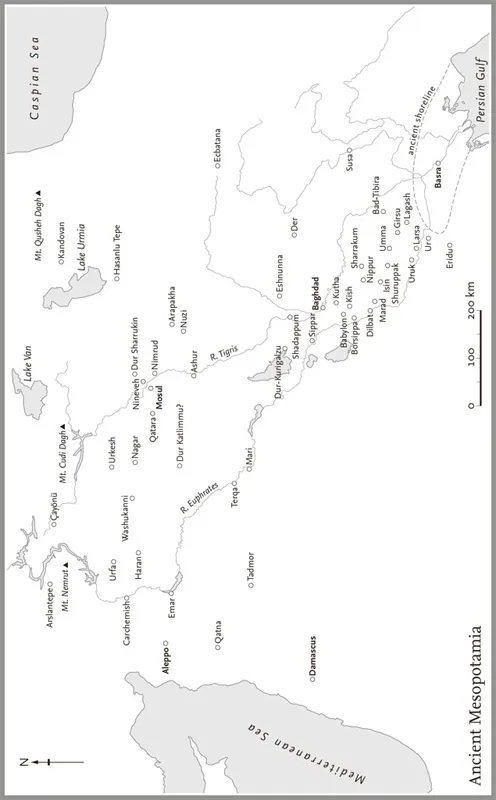
| 1. | Ancient Mesopotamia |
| 2. | The Fertile Crescent |
| 3. | The Sumerian City-States |
| 4. | The Empire of Akkad |
| 5. | Third Dynasty of Ur |
| 6. | The Old Babylonian Empire |
| 7. | The Assyrian Empire |
| 8. | The Neo-Babylonian Empire |
| These maps are purely indicative and omit many lines and landmarks for the sake of clarity. |
List of Photographic Illustrations
| 1. | Capricornus, the Sea-Goat, one of the very earliest named signs of the zodiac. It was anciently associated with Enki, also known as Ea, the god of civilization. The constellation is best seen on a northern autumn evening, when it lies above the southern horizon. |
| 2. | The emergence of writing: a simple aide mémoire from about 3100 BCE, one of the texts found in the archaic levels of the Eanna temple district of ancient Uruk. The clay tablet is shown on the left and its translation on the right. |
| 3. | Akkadian seal impression showing horse rider, from Kish, 2350–2200 BCE. |
| 4. | Cylinder seal impression showing horse rider, 2100–1800 BCE. |
| 5. | The Tower of Babel (Great Ziggurat of Babylon), plan and elevation, from the eroded stele. |
| 6. | As the Great Ziggurat of Babylon may have originally looked. |
| 7. | City map of Babylon in the seventh century BCE. |
| 8. | Neo-Babylonian map of the world. |
| 9. | Early Cuneiform Signs |
| 10. | Sign Combinations |
| 11. | Combinations of the Symbol for Head |
| 12. | As writing developed further and a pointed drawing stylus was replaced by a reed of triangular cross section, the signs became more schematic: |
| 13. | Over the centuries the signs were further simplified until it was no longer easily possible to recognize what they originally represented: |
| 14. | Frieze from Al ‘Ubaid, c. 4000 BCE / British Museum |
| 15. | Sumerian pull-along toy from the fourth millennium BCE / Oriental institute, University of Chicago |
| 16. | Sumerian Cylinder seal from around 3000 BCE / British Museum |
| 17. | Uruk era stamp seal and its impression, fourth millennium BCE / British Museum |
| 18. | Bevelled-rim bowl fourth millennium BCE / British Museum |
| 19. | The first known signature / Schøyen Collection, Oslo and London |
| 20. | The Lady of Uruk, c. 3100 BCE / Bridgeman Art Library |
| 21. | Upper tier of the Warka Vase, c. 3100 BCE / Bridgeman Art Library |
| 22. | Royal cemetery at Great Death Pit at of Ur, c. 2500 BCE / Illustrated London News, Mary Evans Picture Library |
| 23. | Servant’s cemetery at Great Death Pit at of Ur, c. 2500 BCE / Illustrated London News, Mary Evans Picture Library |
| 24. | King Sargon of Akkad, c. 2300 BCE / Bridgeman Art Library |
| 25. | Gudea of Lagash, c. 2120 BCE / British Museum |
| 26. | The Weld-Blundell Prism, c. 1800 BCE / The Ashmolean Museum |
| 27. | King Naram-Sin’s Victory Stele, c. 2200 BC / Musée du Louvre |
| 28. | The Stele of the Vultures, c.2500 / Musée du Louvre |
| 29. | Monument showing Shamash the Sun God, c. 1700 BCE / Musée du Louvre |
| 30. | Wall panel from the North Palace at Nineveh, c. 345 BCE, British Museum |
| 31. | Wall panel in Sennacherib’s palace at Nineveh, 701 BCE / British Museum |
| 32. | The Lion Hunt from a wall panel in Sennacherib’s palace at Nineveh, seventh century BCE / British Museum |
| 33. | Detail of above |
History which does not inform present-day concerns amounts to little more than self-indulgent antiquarianism
Quentin Skinner, Regius Professor of Modern History
at Cambridge University, Inaugural Lecture, 1997
1
Lessons from the Past:
An Introduction
An Introduction
They hanged Saddam Hussein on the first day of the Feast of the Sacrifice, ’Eid ul-Adha, 30 December 2006. It was not a dignified execution. Reading the newspaper reports of that grisly – and botched – act of barbarism, more revenge than justice, and seeing the mobile-phone video images distributed immediately afterwards, I cannot have been the only one to feel that the language of daily journalism was inadequate to encompass such extravagant, larger-than-life events.
The cruel tyrant’s army crumbles away. He himself escapes, disappears from sight for a time, but is eventually discovered, filthy and heavily bearded, cowering like an animal in a hole in the ground. He is taken captive, publicly humiliated, held in solitary confinement for a thousand days and put on trial before a tribunal whose verdict is a foregone conclusion. Hanging him, his exultant executioners almost tear off his head.
As in biblical times, God took to speaking to men again, instructing the makers of history. At a secret meeting between senior army officers in Kuwait during the run-up to the First Gulf War, Saddam had explained that he had invaded Kuwait on heaven’s express instructions: ‘May God be my witness, that it is the Lord who wanted what happened to happen. This decision we received almost ready-made from God… Our role in the decision was almost zero.’
In a BBC documentary, broadcast in October 2005, Nabil Sha’ath, Foreign Minister of the Palestinian authority recalled that ‘President Bush said to all of us: “I’m driven with a mission from God. God would tell me, ‘George, go and fight those terrorists in Afghanistan.’ And I did; and then God would tell me ‘George, go and end the tyranny in Iraq…’ And I did. And now, again, I feel God’s words coming to me.”’
It would have come as no real surprise had the conflict begun with a voice booming out from heaven, crying ‘O President Saddam,’ and continuing, as in the Book of Daniel, 4:31: ‘to thee it is spoken; The kingdom is departed from thee. And they shall drive thee from men, and thy dwelling shall be with the beasts of the field.’ It takes the language of the Old Testament, the Book of Kings perhaps, to depict the details of Saddam Hussein’s end in their full, almost mythic, dimensions. Thus:
It was the morning of the Sabbath, before the sun rose. And they brought him into the city, even unto the place of execution.
And they bound his hands and his feet as was the custom among them in the way of execution. And they reviled him saying, how are the mighty fallen, and may you be cursed by the Lord.
And they placed the rope about his neck and they reviled him again, praising the names and titles of his enemies, and saying, may God curse you, may you go down to hell.
And he replied, saying, Is this your manhood? This is a gallows of shame.
And again they spoke unto him, saying, prepare to meet God. And he prayed to God, saying, there is no God but the Lord.
And so they hanged him. And a great shout went up in the place of execution and in the streets and in the markets. It was the morning of the Sabbath, as the sun rose over the walls of Babylon.
Seeing George W. Bush’s Iraq War through biblical eyes is not just a writer’s conceit, the reaction of someone like me, introduced as a child to Middle- Eastern history by the Bible. Saddam too saw himself as a successor to the rulers of antiquity. He particularly modelled himself on Nebuchadnezzar II (605–562 BCE), conqueror and destroyer of Jerusalem and its temple, describing him, in a multiple anachronism, as ‘an Arab from Iraq’, who fought, like Saddam himself, against Persians and Jews. (Nebuchadnezzar was not an Arab but a Chaldean, there would be no Iraq for another two and a half millennia, and Judaism as we know it did not yet exist.) The emblem of the 1988 Babylon International Festival showed Saddam’s profile superimposed on Nebuchadnezzar’s; according to a New York Times journalist, the outline of his nose was lengthened to make him resemble the Mesopotamian king more closely. Saddam also honoured Hammurabi (c.1795–1750 BCE), the ruler of the Old Babylonian Empire renowned for his eye-for-an-eye legal code, and named the most powerful strike-force in the Iraqi army the Hammurabi Republican Guard Armoured Division; another unit was the Nebuchadnezzar Infantry Division.
The Iraqi leader was, said the BBC’s John Simpson, ‘an inveterate builder of monuments to himself’, undertaking great construction projects in conscious emulation of his illustrious predecessors. Giant images of the Iraqi leader showed him, like an ancient Sumerian monarch, carrying a building-worker’s basket on his shoulder, although the ancients would have been pictured bearing the first load of clay for brickmaking, while Saddam was represented bearing a bowl of cement. He began a massive reconstruction of the site of ancient Babylon, although his rebuilding, said one architectural historian, was ‘poor quality pastiche and frequently wrong in scale and detail… ’ Like the monarchs of antiquity, Saddam had the bricks inscribed with his name; thousands bore the rubric: ‘The Babylon of Nebuchadnezzar was rebuilt in the era of the leader President Saddam Hussein’. Never one to display unnecessary good taste, he had the text written in modern Arabic rather than Babylonian cuneiform.
The political reasons for Saddam Hussein’s concern to connect with the far distant, pre-Muslim, past of his country are plain. As in the case of the Shah of next-door Iran, who in 1971 famously declared his kinship with Cyrus the Great, founder of the first, Achaemenid, Persian Empire, any pitch for leadership of the Middle East demands that the pretender first neutralize the claims of holy Mecca and Medina in Saudi Arabia, the cities of the Prophet, to be the sole ultimate source of Islamic legitimacy.
There is much irony in the fact that Anglo-American Middle East policy, from Operation Ajax, the deposing of democratically elected, socialist, secularist Prime Minister Mohammad Mossadeq in Iran in 1953, to Operation Iraqi Freedom, the overthrow of secular nationalist dictator Saddam Hussein in 2003, has served in fact, if not intention, to ensure the continuing hold of Islam over nearly all the countries of the region. Thus inevitably boosting the claim of Salafi Islam, which looks to the immediate successors of the Prophet for its political models, to provide the only authentic principles on which to build a legitimate political system.
Perhaps Saddam – whatever else he might have been, he was neither stupid nor unperceptive – also recognized another, even greater, truth of Middle-Eastern power-politics. Our way of life and understanding of the world may have changed utterly since ancient times, but we flatter ourselves unduly if we think that our behaviour is in any way different, or that human nature has altered much over the millennia.
History tells us that the region the Greeks called Mesopotamia, because it lay ‘between the rivers’ Tigris and Euphrates, was fought over by Romans and Parthians, by Byzantines and Sassanians, by Muslims and Magians, until rank outsiders, Mongols and Turks, conque...
Table of contents
- Cover
- Title Page
- Copyright Page
- Contents
Trusted by 375,005 students
Access to over 1.5 million titles for a fair monthly price.
Study more efficiently using our study tools.
Frequently asked questions
Yes, you can cancel anytime from the Subscription tab in your account settings on the Perlego website. Your subscription will stay active until the end of your current billing period. Learn how to cancel your subscription
No, books cannot be downloaded as external files, such as PDFs, for use outside of Perlego. However, you can download books within the Perlego app for offline reading on mobile or tablet. Learn how to download books offline
Perlego offers two plans: Essential and Complete
- Essential is ideal for learners and professionals who enjoy exploring a wide range of subjects. Access the Essential Library with 800,000+ trusted titles and best-sellers across business, personal growth, and the humanities. Includes unlimited reading time and Standard Read Aloud voice.
- Complete: Perfect for advanced learners and researchers needing full, unrestricted access. Unlock 1.5M+ books across hundreds of subjects, including academic and specialized titles. The Complete Plan also includes advanced features like Premium Read Aloud and Research Assistant.
We are an online textbook subscription service, where you can get access to an entire online library for less than the price of a single book per month. With over 1.5 million books across 990+ topics, we’ve got you covered! Learn about our mission
Look out for the read-aloud symbol on your next book to see if you can listen to it. The read-aloud tool reads text aloud for you, highlighting the text as it is being read. You can pause it, speed it up and slow it down. Learn more about Read Aloud
Yes! You can use the Perlego app on both iOS and Android devices to read anytime, anywhere — even offline. Perfect for commutes or when you’re on the go.
Please note we cannot support devices running on iOS 13 and Android 7 or earlier. Learn more about using the app
Please note we cannot support devices running on iOS 13 and Android 7 or earlier. Learn more about using the app
Yes, you can access Babylon by Paul Kriwaczek in PDF and/or ePUB format, as well as other popular books in History & Ancient History. We have over 1.5 million books available in our catalogue for you to explore.