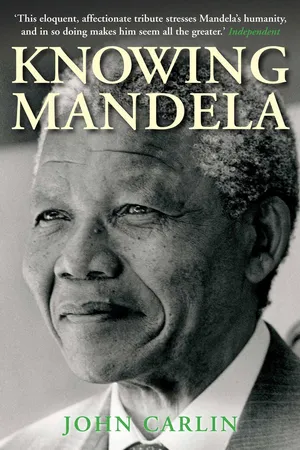
As Nelson Mandela was released from prison and the ensuing years saw the collapse of South Africa's apartheid regime, John Carlin ('one of the great post-apartheid chroniclers'
Financial Times) was the South Africa correspondent of London's
Independent newspaper. In his acclaimed
Playing the Enemy (filmed by Clint Eastwood as
Invictus) he told the story of Mandela's role in the Rugby World Cup of 1995, when Mandela's political genius transformed a sporting event into a moment that defined, unforgettably, a new nation.
In his new book, Carlin now offers an illuminating and inspiring personal account of the iconic figure who has come both to define post-apartheid South Africa and to represent the possibility of a moral politics to the world at large.
Knowing Mandela focuses on the years from 1990 to 1995, when Mandela faced his most daunting obstacles and achieved his greatest triumphs; it was the time when the full flower of his genius as a political leader was most vividly on display. Carlin spent those years reporting on Mandela's feats, trials and tribulations and was one of the few foreign journalists in South Africa to cover both his release from prison and his accession to the presidency four years later.
Drawing on conversations with Mandela and interviews with people close to him, Carlin has crafted a remarkable account of a man who is as flawed as he is gifted, neither superman nor saint.
Knowing Mandela offers a profound understanding of the man and what has made him the towering moral and political figure of our age.
eBook - ePub
Knowing Mandela
About this book
Information
Subtopic
Historical BiographiesCONTENTS
Preface | |
1. | The President and the Journalist |
2. | Great Expectations |
3. | Nelson and Cleopatra |
4. | Wooing the Blacks |
5. | The Bitter-Enders |
6. | A Hero to His Valet |
7. | White Tears |
8. | Magnanimity |
Acknowledgments |
PREFACE
This is a short book about a big man I was fortunate to get to know, Nelson Mandela. The story centers on the epic period, between 1990 and 1995, when Mandela faced his most daunting obstacles and achieved his greatest triumphs; the time when the full flower of his genius as a political leader was most vividly on display.
I spent those five years recording Mandela’s feats, trials, and tribulations as the South African correspondent for the London Independent and, as such, was one of the few foreign journalists there to cover both his release from prison, on February 11, 1990, and his accession to the presidency four years later. My proximity to Mandela throughout this decisive period in South Africa’s history allowed me to observe the man as closely as anyone in my position could reasonably have expected. I don’t presume to call him a friend, but I can safely say that he knew very well who I was, and read much of what I wrote, which fills me with pride.
After I left South Africa for Washington in 1995, I continued to study and think about Mandela in the course of interviewing many people who had been close to him as research for a number of film documentaries and for my previous book, Playing the Enemy, about his crowning political moment, a turning point in history masquerading as a game of rugby. I have accumulated an enormous amount of information, along with many telling anecdotes about Mandela that have shaped my perceptions about his private and public life.
I believe that, large as Mandela’s presence on the global stage has been, there’s still much more to say about the man, the quality of his leadership, and the legacy he leaves the world. My hope is that readers will come away from this book with a more profound understanding of Mandela the individual and of why he has been the towering moral and political figure of our age.
Yet he had his flaws and bore the scars of much personal anguish. His triumphs on the political stage were won at the cost of unhappiness, loneliness, and disappointment. He was neither a superman nor a saint. But this only serves, in my view, to magnify his achievement, placing him alongside men like Abraham Lincoln, Mahatma Gandhi, and Martin Luther King, Jr. on the sparsely populated pantheon of historical greats.
General Alan Brooke, Britain’s Chief of the Imperial General Staff during the Second World War, said of Winston Churchill, “He is quite the most wonderful man I have ever met, and it is a source of never-ending interest studying him and getting to realize that occasionally such human beings make their appearance on this earth, human beings who stand out head and shoulders above all others.”
To me, those words may as well have been said, with at least as much relevance, about Mandela. He is the one political leader I have encountered in more than thirty years as a journalist—reporting on conflicts all over the world, from bloody guerrilla warfare in Central America to bloodless battles of words in the U.S. Congress—who succeeded in up-ending the cynicism that tends to go hand in hand with the business of journalism. I arrived in South Africa after ten years in Latin America, sickened by the horrors wrought by murderous generals on their own people and by the puppet presidents put in place by Cold War powers. Mandela changed all that. Thanks to him, I left South Africa newly convinced that noble and enlightened leadership had not, after all, been erased from the roster of human possibilities.
Just about everywhere we look, our faith in political leaders has hit rock bottom; mediocrity, fanaticism, and moral cowardice abound. Nelson Mandela, who remained as generous as he was shrewd, despite spending twenty-seven years in jail, stands as a timely reminder and a timeless inspiration. Humanity is, and always has been, capable of great things, and there is always room and reason for us to do better.
With gratitude and affection, I submit this attempt to capture Mandela’s imperishable legacy in words.
August 2013
1
THE PRESIDENT AND
THE JOURNALIST
THE JOURNALIST
Condemned in 1964 to life in prison for taking up arms against the state, he was supposed to have died in a small cell on a small island. Yet here was Nelson Mandela, almost thirty years later, standing before me, no longer a prisoner of that state, but the head of it. Barely a month had passed since he had been elected president of South Africa when he welcomed me into his new office at the Union Buildings in Pretoria, wearing his large and familiar smile, enveloping my hand in his enormous one, leathery after years of forced labor. “Ah, hello, John!” he cried with what felt like genuine delight. “How are you? Very good to see you.”
It was flattering to have the most celebrated man in the world call me by my first name with such seemingly spontaneous exuberance but, for the hour I spent with him, in the first interview he did with a foreign newspaper after assuming power, I chose to forget that Mandela, like that other master politician Bill Clinton, seemed able to recollect the name of virtually every person he’d ever met. It was only later, when the glow of his charm had worn off, that I paused to consider whether his behavior was calculated, whether he had deliberately sought to beguile me, as he had succeeded in doing with every other journalist, every politician of every hue, practically every single person who had spent any time in his company. Was he an actor or was he sincere? I’d come up with an answer in due time, but the honest truth is that, back then, I, like all the others, was powerless to resist.
Six foot tall, commandingly upright in a dark, pencil-sharp suit, Mandela walked a little rigidly, but his arms swung loose by his sides, his air both jaunty and majestic, as he led me into his wood-paneled office—large enough to accommodate his old prison cell forty times over. The most urbane of hosts, he motioned me towards a set of chairs so finely upholstered that they would not have been out of place in the Palace of Versailles. Mandela, soon to turn seventy-six, was as gracefully at ease in his presidential role as if he had spent the past third of his life not in jail, but amidst the gilded trappings that his white predecessors had lavished on themselves to compensate for the indignity of knowing the rest of the world held them in contempt.
By a staggering turn of events, the man settling himself in his chair to face me had become quite possibly the most unanimously admired head of state in history. In truth, I was apprehensive. We’d met numerous times before. I had interviewed him; I had had plenty of chats with him, before and after press conferences and other public events since arriving in South Africa in January 1989, thirteen months before his release. Now, five and a half years later, on the morning of June 7, 1994, I felt intimidated. Before he had been a voteless freedom fighter, now he was an elected president. The great and the good had flocked from all over the world for his inauguration four weeks earlier here in these very Union Buildings, a vast brown pile perched on a hill above the South African capital that for eighty-four doleful years had been the seat of whites-only power. From this citadel, the apartheid laws had been enforced. From here, the chiefs of South Africa’s dominant white tribe, the Afrikaners, administered a system that denied 85 percent of the population—those people born with dark skin—any say in the affairs of their country: They could not vote; they were sent to inferior schools so they could not compete with whites in the workplace; they were told where they could and could not live and what hospitals, buses, trains, parks, beaches, public toilets, public telephones they could and could not use.
Apartheid amounted, as Mandela once described it, to a moral genocide: an attempt to exterminate an entire people’s self-respect. The United Nations called that “a crime against humanity,” but the former masters of the Union Buildings believed that they were doing God’s work on earth, and humanity be damned. With admirable logic, apartheid’s Calvinist orthodoxy preached that black and white souls inhabited separate heavens, rendering it morally imperative for the chosen few to respond to those who rose in opposition to God’s will with all the might that God in his bounty had awarded them. The ordinary black foot soldiers who rebelled were terrorized into submission, beaten by the police, sometimes tortured, in some cases assassinated, very often jailed without charge. The high-profile leaders, like Mandela, were punished with banishment to a barren island off the south Atlantic coast.
But Mandela endured and now, at last, he had stormed and taken the citadel. He never gloated in that hour we spent together, never came close to it, but the truth was that he had defeated apartheid’s God, had kicked the Afrikaner interpretation of Calvinist theology into the dustbin of history. The apartheid laws had been wiped off the books, democratic elections had taken place in his country for the first time and the party he led, the African National Congress, had won with two-thirds of the national vote. He was the chief now, the president on the hilltop. He had fulfilled his destiny and done so in classic style, playing the part of the hero who rebels against tyranny, endures prison with Spartan forbearance, rises again to liberate his chained people and, in a twist unique to Mandela, finally forgives and redeems his enemies. Little wonder the world regarded him as a giant. He, while never betraying any suggestion of arrogance or pomposity, was aware of the global esteem in which he was held. And he knew I knew.
He sensed that I was nervous, but didn’t show it, for that would have been impolite. He was aware of the effect he had on people. Everyone felt overawed in his presence, but Mandela took no delight in that. He wanted to be liked as much as he wanted to be admired.
So, he did with me as he did with everyone else: he strove to put me at ease by reducing himself to my terrestrial level, sending me a message, coded but clear enough, that he was just another toiling mortal, as I was. First, by greeting me as warmly as he did and showing he remembered my name and then, when we were sitting down, throwing me slightly, but again in a flattering way, by saying: “I must apologize. I feel certain we have obliged you to work very hard these last weeks.” In a distinctive mannerism of his, he held onto the “e” of the word “very,” adding an extra beat for emphasis. “Ve-ery hard.” He said it with cheery mischief in his eye and I thought, as I had done the very first time I had seen him close up, on the morning after he left prison, how regal yet how approachable he was.
I chuckled at his apology and replied in the same spirit, “Not as hard as you have been working, Mr. Mandela, I am sure.”
“Ah, yes,” he shot back, the smile widening, “but you were not loafing on an island for many years, as I was.”
I laughed out loud. Self-deprecation was another of the ploys he used in the attempt to undercut the uneasy awe that he inspired. There was a British quality to that. I always thought Mandela, in another life, would have made a perfect chairman of one of those Victorian-era gentlemen’s clubs that still exist in London. Very proper and correct, but superbly comfortable in his own skin. The impression was not accidental, for he had been taught by British missionaries as a child and, at the age of fourteen, as he would confess later, he knew more about the history of Britain, the battles of Hastings, Waterloo, and Trafalgar than he did about the Afrikaners’ conquest of the southern tip of Africa or the wars of his own Xhosa tribe. When he was born his family named him Rohlihlahla, which means “tree-shaker” or “troublemaker” in Xhosa; it was a teacher at school who later gave him the name Nelson, in honor of the British Empire’s most celebrated admiral.
Self-deprecation, as every Englishman since the time of Lord Nelson and before knows, is a subtle sport. There’s a bogus element to it. In making light of your own achievements you are also, by a happy whim, drawing attention to them. There was more than a dash of vanity behind the claim that he had been loafing on Robben Island, for we both knew prison had been no Bahamas vacation. I picked up on that hint of weakness, his need to preen, and in a way he might not necessarily have meant, that served his purpose, too. It humanized him more in my eyes. Whatever the case, the magic, intended or unintended, worked—I had been put at my ease. Not on a footing of social equality, exactly, but sufficiently to be able to set about the business at hand with the composure not to make a fool of myself.
I switched on my cassette recorder and the interview began. I launched into my first political question, and as I uttered my first words his face changed, his smile vanished, his features turned to stone. It was always the way with Mandela. As soon as the subject turned serious, as soon as conversation turned to his life’s mission, he listened with rapt, frozen concentration, his entire body stock-still. No more jokes now. But, happily, plenty of news.
He would leave office, he announced, after just one five-year presidential term. That was a bombshell right there. There had been suggestions in previous days that he would not be seeking re-election, but that was the first time he had publicly spelled out his intentions. It was quite a statement—a message to his country, his continent, and the world, an example to leaders everywhere who, whether popularly elected or after seizing power, all too often undermined the democracy they purported to uphold by succumbing to the vanity of imagining they were irreplaceable. Aware, rather, of his limitations, Mandela knew that come 1999, age would circumscribe his ability to do his job efficiently and he understood, too, that his talents lay not so much in day-to-day governance as in the symbolic consolidation of his country’s new-found unity. He would play the role more of a nation-binding monarch than of a hands-on administrator.
That was why he also told me that much remained to be done to make sure all the good work of the liberation struggle was not undone. Segments of the far right remained armed and restless, unhappy with their government’s decision to hand over power to the majority without a fight. Cementing the foundations of South Africa’s inevitably fragile new democracy, he said, would be his principal challenge in office. I noted, a little quizzically, that the old apartheid coat of arms with its spectacularly ironic motto—“Ex Unitate Vires” (Out of Unity Strength)—remained on his office wall. Mandela replied that this would go soon enough, but that his government would move gingerly on the renaming of streets, towns, and public monuments, avoiding what might have been the revolutionist’s temptation to trample on his defeated white compatriots’ symbols of identity and pride.
It was rich, strong journalistic material, yet as I reflect on that interview now, nearly twenty years later, it is not so much what he said that has endured most in my memory, but the brief gesture, ten minutes into the interview, when there was a knock at the door and a middle-aged white woman entered the presidential office carrying a tray of tea.
Mandela, on seeing her, interrupted himself in midsentence and rose to his feet: There was a lady in the room. He greeted her effusively. “Ah, hello, Mrs. Coetzee! How are you?” He stood bolt upright while she fussed about, placing the cups, milk, and sugar on the table, and then a bottle of water and an empty glass. Then he introduced me to her. “Mrs. Coetzee, this is Mr. Carlin.” I stood up—disgracefully, I had not done so. Then, the two of us shook hands. Mandela thanked her profusely for the tea, which was for me, and for the water, which she poured out for him. He did not sit down until Mrs. Coetzee left the room.
There had been a time, long before he went to prison, at the first law firm where he worked in the 1940s, when Mandela had been reprimanded by his white boss for drinking his tea from the same cups as the white employees. Mandela, who would later set up his own legal practice, had just arrived at the firm and had not understood that the tin cups were for the black workers, the porcelain ones for the white. But that indignity, together with the far greater ones he would endure later, had been forgotten now.
Mrs. Coetzee, whose name was classically Afrikaans, would have remembered those times. It was probable that, until quite recently, she had been responsible for administering the tea cup variation of “petty apartheid,” as they used to call it, here at her place of work. For, as I suspected when I saw her enter Mandela’s office (and would confirm later), she had been employed at the Union Buildings for some time. She had worked for Mandela’s two predecessors, F. W. de Klerk, South Africa’s last president, and P. W. Botha, a curmudgeon and a bully known by friends and foes as “the Big Crocodile.” Mrs. Coetzee had been, in short, a loyal servant of the apart-heid state. It would have been natural for Mandela to regard her as one more accomplice in the crime against humanity and to have treated her accordingly on becoming president by showing her the door.
And yet here he was, and here she was too. Not a glimmer of a grudge. He was all chivalry to this woman who would return the compliment a few days later by telling the local press that she had never been shown anything resembling Mandela’s respect and kindness by the Afrikaner kin under whom she had worked before.
The curious thing was that, rather than bask in his own munificence, Mandela marveled at Mrs. Coetzee. He had bestowed on her the gift of forgiveness but, as he saw it, she had been generous to accept it. Alluding to her directly, a half hour after she left the room, it emerged that he was as taken in his own way with her as she had been with him. I asked him whether, despite the troubling undercurrents of unrest among the white right, he was surprised at the degree to which ordinary white people appeared to have adapted to the political changes. He was excited by the question.
“You know, that is perfectly true,” he said. “Yes. Look at the lady who brought in the tea. Look at this! It is really unbelievable, the way they have just adjusted to the new position.” It didn’t seem to have occurred to him that she had adjusted in part because of the decency he had shown her. He had another explanation, a more practical one. “I think it is pe...
Table of contents
- Cover
- Title Page
- Copyright Page
- Contents
- Acknowledgments
- About the Author
Trusted by 375,005 students
Access to over 1.5 million titles for a fair monthly price.
Study more efficiently using our study tools.
Frequently asked questions
Yes, you can cancel anytime from the Subscription tab in your account settings on the Perlego website. Your subscription will stay active until the end of your current billing period. Learn how to cancel your subscription
No, books cannot be downloaded as external files, such as PDFs, for use outside of Perlego. However, you can download books within the Perlego app for offline reading on mobile or tablet. Learn how to download books offline
We are an online textbook subscription service, where you can get access to an entire online library for less than the price of a single book per month. With over 1.5 million books across 990+ topics, we’ve got you covered! Learn about our mission
Look out for the read-aloud symbol on your next book to see if you can listen to it. The read-aloud tool reads text aloud for you, highlighting the text as it is being read. You can pause it, speed it up and slow it down. Learn more about Read Aloud
Yes! You can use the Perlego app on both iOS and Android devices to read anytime, anywhere — even offline. Perfect for commutes or when you’re on the go.
Please note we cannot support devices running on iOS 13 and Android 7 or earlier. Learn more about using the app
Please note we cannot support devices running on iOS 13 and Android 7 or earlier. Learn more about using the app
Yes, you can access Knowing Mandela by John Carlin in PDF and/or ePUB format. We have over 1.5 million books available in our catalogue for you to explore.