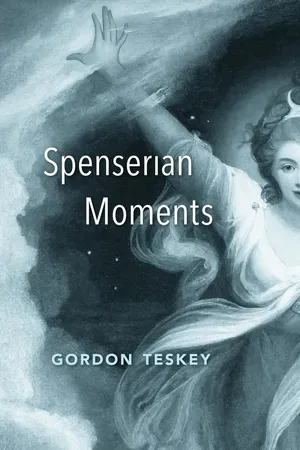
From the distinguished literary scholar Gordon Teskey comes an essay collection that restores Spenser to his rightful prominence in Renaissance studies, opening up the epic of The Faerie Queene as a grand, improvisatory project on human nature, and arguing—controversially—that it is Spenser, not Milton, who is the more important and relevant poet for the modern world.
There is more adventure in The Faerie Queene than in any other major English poem. But the epic of Arthurian knights, ladies, and dragons in Faerie Land, beloved by C. S. Lewis, is often regarded as quaint and obscure, and few critics have analyzed the poem as an experiment in open thinking. In this remarkable collection, the renowned literary scholar Gordon Teskey examines the masterwork with care and imagination, explaining the theory of allegory—now and in Edmund Spenser's Elizabethan age—and illuminating the poem's improvisatory moments as it embarks upon fairy tale, myth, and enchantment.
Milton, often considered the greatest English poet after Shakespeare, called Spenser his "original." But Teskey argues that while Milton's rigid ideology in Paradise Lost has failed the test of time, Spenser's allegory invites engagement on contemporary terms ranging from power, gender, violence, and virtue ethics, to mobility, the posthuman, and the future of the planet. The Faerie Queene was unfinished when Spenser died in his forties. It is the brilliant work of a poet of youthful energy and philosophical vision who opens up new questions instead of answering old ones. The epic's grand finale, "The Mutabilitie Cantos," delivers a vision of human life as dizzyingly turbulent and constantly changing, leaving a future open to everything.
eBook - PDF
Spenserian Moments
About this book
Information
Table of contents
- Cover
- Title Page
- Copyright
- Dedication
- Contents
- Note on References, Texts, and Quotations
- Epigraphs
- Introduction
- Part One: On Spenser
- Part Two: On Allegory
- Part Three: On Thinking
- Part Four: On Change
- Afterword: The Colossi of Memnon
- Notes
- Acknowledgments
- Credits
- Index
Trusted by 375,005 students
Access to over 1.5 million titles for a fair monthly price.
Study more efficiently using our study tools.
Frequently asked questions
Yes, you can cancel anytime from the Subscription tab in your account settings on the Perlego website. Your subscription will stay active until the end of your current billing period. Learn how to cancel your subscription
No, books cannot be downloaded as external files, such as PDFs, for use outside of Perlego. However, you can download books within the Perlego app for offline reading on mobile or tablet. Learn how to download books offline
Perlego offers two plans: Essential and Complete
- Essential is ideal for learners and professionals who enjoy exploring a wide range of subjects. Access the Essential Library with 800,000+ trusted titles and best-sellers across business, personal growth, and the humanities. Includes unlimited reading time and Standard Read Aloud voice.
- Complete: Perfect for advanced learners and researchers needing full, unrestricted access. Unlock 1.5M+ books across hundreds of subjects, including academic and specialized titles. The Complete Plan also includes advanced features like Premium Read Aloud and Research Assistant.
We are an online textbook subscription service, where you can get access to an entire online library for less than the price of a single book per month. With over 1.5 million books across 990+ topics, we’ve got you covered! Learn about our mission
Look out for the read-aloud symbol on your next book to see if you can listen to it. The read-aloud tool reads text aloud for you, highlighting the text as it is being read. You can pause it, speed it up and slow it down. Learn more about Read Aloud
Yes! You can use the Perlego app on both iOS and Android devices to read anytime, anywhere — even offline. Perfect for commutes or when you’re on the go.
Please note we cannot support devices running on iOS 13 and Android 7 or earlier. Learn more about using the app
Please note we cannot support devices running on iOS 13 and Android 7 or earlier. Learn more about using the app
Yes, you can access Spenserian Moments by Gordon Teskey in PDF and/or ePUB format, as well as other popular books in Literature & English Literary Criticism. We have over 1.5 million books available in our catalogue for you to explore.