An introduction to the principles and practices of soil and groundwater remediation
Soil and Groundwater Remediation offers a comprehensive and up-to-date review of the principles, practices, and concepts of sustainability of soil and groundwater remediation. The book starts with an overview of the importance of groundwater resource/quality, contaminant sources/types, and the scope of soil and groundwater remediation. It then provides the essential components of soil and groundwater remediation with easy-to-understand design equations/calculations and the practical applications.
The book contains information on remediation basics such as subsurface chemical behaviors, soil and groundwater hydrology and characterization, regulations, cost analysis, and risk assessment. The author explores various conventional and innovative remediation technologies, including pump-and-treat, soil vapor extraction, bioremediation, incineration, thermally enhanced techniques, soil washing/flushing, and permeable reactive barriers. The book also examines the modeling of groundwater flow and contaminant transport in saturated and unsaturated zones. This important book:
Presents the current challenges of remediation practices
Includes up-to-date information about the low-cost, risk-based, sustainable remediation practices, as well as institutional control and management
Offers a balanced mix of the principles, practices, and sustainable concepts in soil and groundwater remediation
Contains learning objectives, discussions of key theories, and example problems
Provides illustrative case studies and recent research when remediation techniques are introduced
Written for undergraduate seniors and graduate students in natural resource, earth science, environmental science/engineering, and environmental management, Soil and Groundwater Remediation is an authoritative guide to the principles and components of soil and groundwater remediation that is filled with worked and practice problems.
Chapter 1 Sources and Types of Soil and Groundwater Contamination
LEARNING OBJECTIVES
Identify the major use categories of surface water vs. groundwater
Discuss the current groundwater quality and the factors affecting groundwater quality
Understand the interactions between surface water and groundwater
Identify the major soil and groundwater contamination sources
Understand the terms relating to soil and groundwater contamination, including Superfund sites, brownfields, RCRA facilities, and underground storage tanks
Locate Superfund sites, brownfields, and/or RCRA facilities in an area of interest
Gain a general overview of soil and groundwater remediation
Develop a general understanding of the sources and types of soil and groundwater contamination in the United States and other regions of interest
Identify Internet resources related to global issues of soil and groundwater contamination and remediation
This introductory chapter will examine pollution problems (or contaminant sources) related to contaminated soil and groundwater. We will first take a look at the use of groundwater in comparison with the use of surface water in the United States. We should get a sense of what the general groundwater quality is in the United States and what factors affect it (detailed in Chapters 2–3). This chapter lays a foundation of future chapters regarding the assessment of such pollution problems (e.g. Chapter 5), and the remediation technologies to deal with these problems (Chapters 6–12). While our focus in this chapter is on the environmental problems in the United States, we will briefly introduce the global perspective of soil and groundwater contamination. To raise the awareness of such environmental problems, readers are encouraged to search relevant literature to get a better sense of the soil and groundwater pollution problems that are of primary concern at the local, regional, national, or global level. This chapter is concluded with remarks on the unique challenges of soil and groundwater remediation and the framework of environmental remediation.
1.1 Uses of Surface Water vs. Groundwater
Surface water, i.e. the water on the Earth's surface, occurs as streams, lakes, and wetlands, as well as bays and oceans. Surface water also includes the solid forms of water (snow and ice). Groundwater is the water beneath the surface of the ground which is stored in soil pore spaces and in the fractures of rock formations. In the discussion below, we will use primarily the US data to illustrate the withdrawals and uses of surface water and groundwater, and their spatial and temporal trends. Readers interested in the uses of surface vs. groundwater in a particular region of the United States or other countries should refer to available sources. In the United States, abundant and reliable data are readily available from the US Environmental Protection Agency (EPA) and the US Geological Survey (USGS).
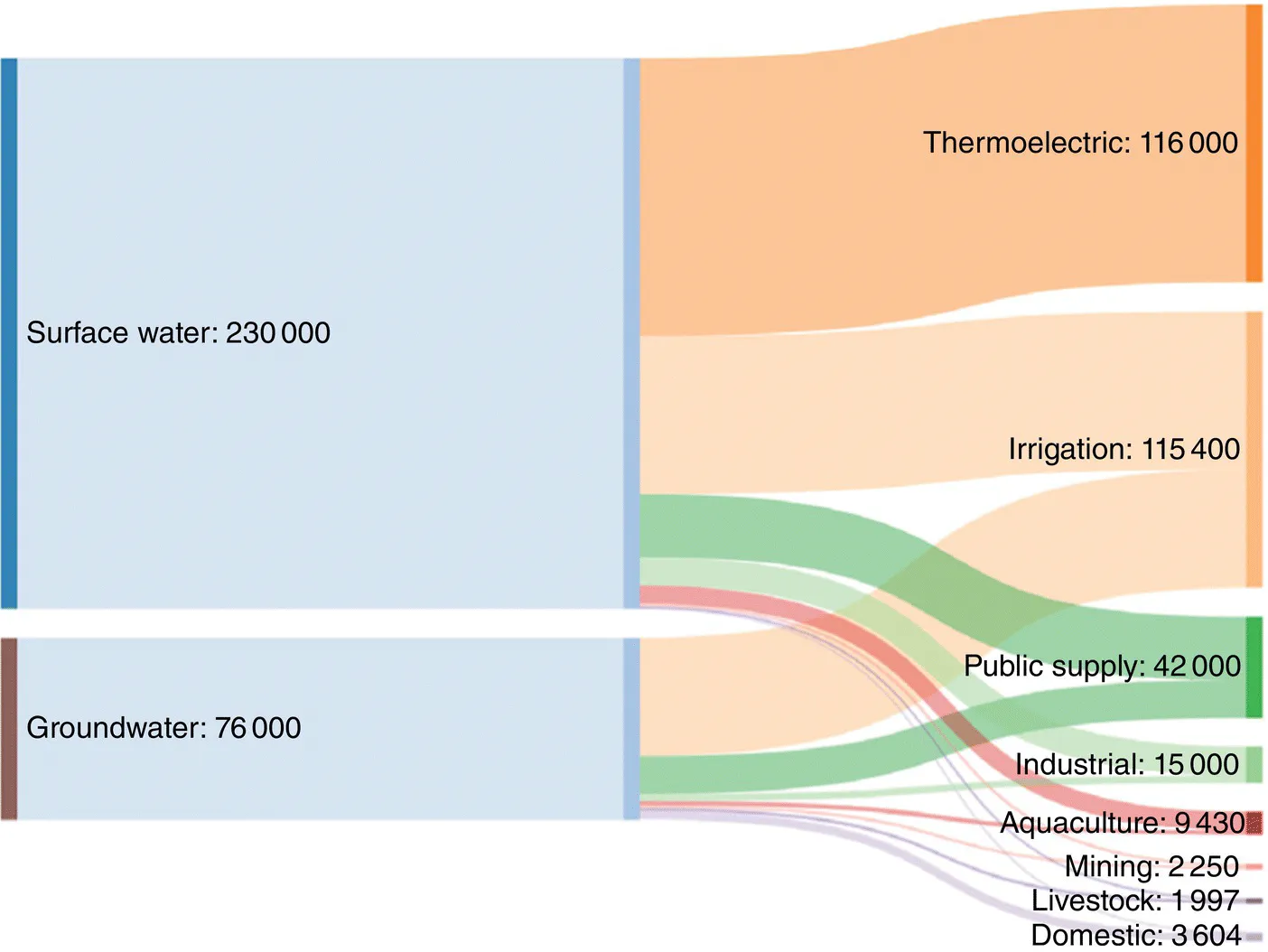
In the United States, fresh surface water and fresh groundwater withdrawals, reported in billion gallons per day (Bgal/d), were 230 and 76, respectively. Among eight categories of water use, thermoelectric power, irrigation, and public supply are the three largest, accounting for 49, 31, and 11%, respectively. The combined total of the other five categories is less than 10% including industrial (4%), aquiculture (2%), mining (1%), domestic (1%), and livestock (<1%) (USGS 2010) (Figure 1.1). In this text, public supply refers to water withdrawals by public and private water suppliers that provide water to at least 25 people or have a minimum of 15 connections. Public‐supply water is delivered to users for domestic, commercial, industrial, and public services. Domestic water use includes indoor uses (drinking, food preparations, washing clothes and dishes, and flushing toilets) and outdoor uses (watering lawns and gardens and washing cars) at residences. Domestic water is either self‐supported (well or captured as rainwater in a container) or provided by public suppliers.
Figure 1.1 Sankey diagram showing the use of fresh surface water and fresh groundwater among eight categories of water uses in the United States. Data are in million gallons per day.
Source: USGS (2010).
Since the estimated use of fresh surface water is over three times higher than that of fresh groundwater, it is no surprise that thermoelectric power, irrigation, public supply, industrial, and aquaculture use mostly fresh surface water. For fresh groundwater, however, about 67% withdrawn groundwater is used for irrigation followed by 18% for public supply. The percentage of the US population obtaining drinking water from public suppliers has increased steadily from 62% in 1950 to 86% in 2010 (USGS 2010). Most of the population providing their own household water obtained their supplies from groundwater sources. An interesting fact is that an estimated 43 million people in the United States, or 15% of the population, supplied their own water for domestic use. These self‐supplied withdrawals totaled 3 Bgal/d, or about 1% of the estimated water withdrawals for all uses in 2005. Nearly all (98%) of these self‐supplied withdrawals were from fresh groundwater (USGS 2009a).
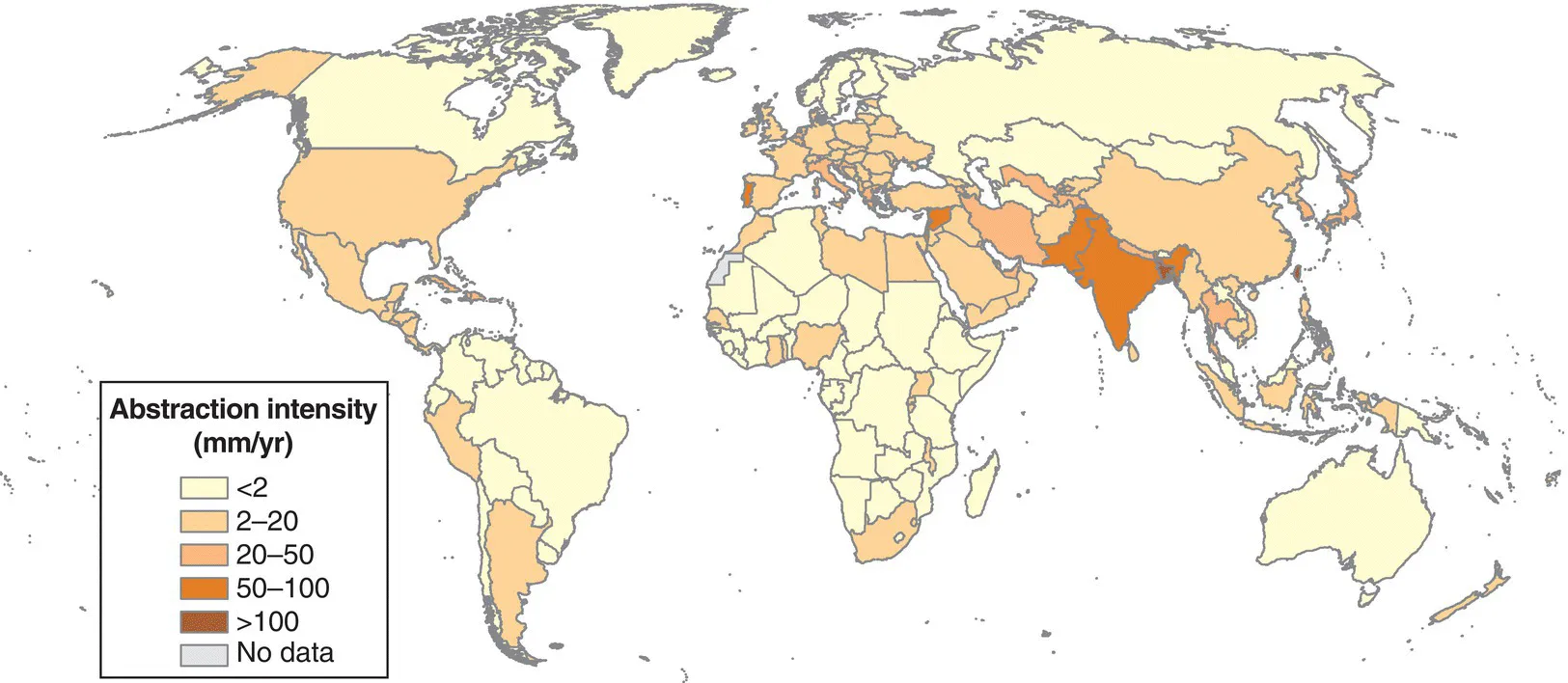
On the global perspective, the United States ranks the third in its abstraction of the groundwater. The 10 countries that abstracted the largest quantities of groundwater, in a decreasing order, are India, China, the United States, Pakistan, Iran, Bangladesh, Mexico, Saudi Arabia, Indonesia, and Turkey (Figure 1.2). Approximately 72% of the assumed total global groundwater withdrawal takes place in these 10 countries (Margat and van der Gun 2013). In fact, the abstraction of groundwater is highly concentrated in a limited number of regions, especially in Asia. The abstraction is relatively modest in Africa, where only Egypt abstracts more than 5 km3 per year, and in South America (except Brazil).
Figure 1.2 Intensity of groundwater abstraction by country for the year 2010, in mm/yr (1 mm/yr = 1000 m3/yr/km2).
If we further examine the water uses among different states in the United States, they vary both spatially and temporally. The available groundwater resources and the uses of groundwater resources are not evenly distributed geographically in the United States as well as other countries with large geographical areas. For example, more than half of the fresh groundwater withdrawals in the United States occurred in six states. In California, Texas, Nebraska, Arkansas, and Idaho, most of the fresh groundwater withdrawals were for irrigation. In Florida, 52% of all fresh groundwater withdrawals were public supply whereas 34% was used for irrigation (USGS 2010). Figure 1.3a shows the spatial variations regarding the total fresh groundwater withdrawals and use categories in top 25 states with the most withdrawals, and Figure 1.3b shows the temporal variations through a comparison of surface water ...
Table of contents
Cover
Table of Contents
About the Author
Preface
Acknowledgments
Whom This Book Is Written For
To the Instructor
List of Symbols
About the Companion Website
Chapter 1: Sources and Types of Soil and Groundwater Contamination
Chapter 2: Subsurface Contaminant Fate and Transport
Chapter 3: Soil and Groundwater Hydrology
Chapter 4: Legal, Economical, and Risk Assessment Considerations
Chapter 5: Site Characterization for Soil and Groundwater Remediation
Chapter 6: Overview of Remediation Options
Chapter 7: Pump‐and‐Treat Systems
Chapter 8: Soil Vapor Extraction and Air Sparging
Chapter 9: Bioremediation and Environmental Biotechnology
Chapter 10: Thermal Remediation Technologies
Chapter 11: Soil Washing and Flushing
Chapter 12: Permeable Reactive Barriers
13 Modeling of Groundwater Flow and Contaminant Transport
Appendix A: Common Abbreviations and Acronyms
Appendix B: Definition of Soil and Groundwater Remediation Technologies
Appendix C: Structures and Properties of Important Organic Pollutants in Soil and Groundwater
Appendix D: Unit Conversion Factors
Appendix E: Answers to Selected Problems
Index
IUPAC Periodic Table of the Elements
End User License Agreement
Trusted by 375,005 students
Access to over 1.5 million titles for a fair monthly price.
Study more efficiently using our study tools.
Frequently asked questions
Yes, you can cancel anytime from the Subscription tab in your account settings on the Perlego website. Your subscription will stay active until the end of your current billing period. Learn how to cancel your subscription
No, books cannot be downloaded as external files, such as PDFs, for use outside of Perlego. However, you can download books within the Perlego app for offline reading on mobile or tablet. Learn how to download books offline
Perlego offers two plans: Essential and Complete
Essential is ideal for learners and professionals who enjoy exploring a wide range of subjects. Access the Essential Library with 800,000+ trusted titles and best-sellers across business, personal growth, and the humanities. Includes unlimited reading time and Standard Read Aloud voice.
Complete: Perfect for advanced learners and researchers needing full, unrestricted access. Unlock 1.5M+ books across hundreds of subjects, including academic and specialized titles. The Complete Plan also includes advanced features like Premium Read Aloud and Research Assistant.
Both plans are available with monthly, semester, or annual billing cycles.
We are an online textbook subscription service, where you can get access to an entire online library for less than the price of a single book per month. With over 1.5 million books across 990+ topics, we’ve got you covered! Learn about our mission
Look out for the read-aloud symbol on your next book to see if you can listen to it. The read-aloud tool reads text aloud for you, highlighting the text as it is being read. You can pause it, speed it up and slow it down. Learn more about Read Aloud
Yes! You can use the Perlego app on both iOS and Android devices to read anytime, anywhere — even offline. Perfect for commutes or when you’re on the go. Please note we cannot support devices running on iOS 13 and Android 7 or earlier. Learn more about using the app
Yes, you can access Soil and Groundwater Remediation by Chunlong Zhang in PDF and/or ePUB format, as well as other popular books in Technology & Engineering & Environmental Management. We have over 1.5 million books available in our catalogue for you to explore.