'I beseech you to read this account'
-
Christopher Hitchens
A magnificent, harrowing testimony to the voiceless victims of North Korea.
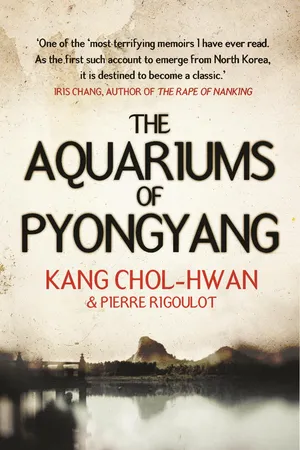
Kang Chol-Hwan is the first survivor of a North Korean concentration camp to escape the 'hermit kingdom' and tell his story to the world. This memoir reveals the human suffering in his camp, with its forced labour, frequent public executions and near-starvation rations. Kang eventually escaped to South Korea via China to give testimony to the hardships and atrocities that constitute the lives of the thousands of people still detained in the gulags today. Part horror story, part historical document, part memoir, part political tract, this story of one young man's personal suffering finally gives eye-witness proof to this neglected chapter of modern history.
- English
- ePUB (mobile friendly)
- Available on iOS & Android
eBook - ePub
The Aquariums of Pyongyang
About this book
Information
Subtopic
Social Science BiographiesIndex
Social SciencesCONTENTS
Preface for the Revised Edition
Introduction: North Korea—the World’s Last Stalinist Regime
1 A Happy Childhood in Pyongyang
2 Money and the Revolution Can Get Along
3 Next Year in Pyongyang!
4 In a Concentration Camp at the Age of Nine
5 Work Group Number 10
6 The Wild Boar: A Teacher Armed and Ready to Strike
7 Death of a Black Champion
8 Corn, Roaches, and Snake Brandy
9 Death at Yodok
10 The Much-Coveted Rabbits
11 Madness Stalks the Prisoners
12 Biweekly Criticism and Self-criticism
13 Public Executions and Postmortem Stonings
14 Love at Yodok
15 Sojourn in the Mountain
16 Ten Years in the Camp: Thank You, Kim Il-sung!
17 The North Korean Paradise
18 The Camp Threatens Again
19 Escape to China
20 Small-Time Prostitution and Big-Time Smuggling in Dalian
21 Arrival in South Korea
22 Adapting to a Capitalist World
Epilogue: Pursuing Aid for North Korea
PREFACE FOR THE REVISED EDITION
As reporter for Chosun Ilbo, South Korea’s leading daily newspaper, I have been covering issues related to North Korea since 2000. I’ve met and reported on approximately 500 North Korean refugees and defectors, those on the run in China and those who found freedom in South Korea. One of them told me, “At the peak of the famine in 1998, I saw numerous corpses strewn on the ground in front of the railroad station in Hamhung [a northeastern coastal city and the capital of South-Hamkyung Province]. People died so fast that hundreds of them had to be buried in mass graves at the Mt. Donghung Cemetery as coffins were in short supply.”
Almost all of the North Koreans I interviewed described similar incidents from the Great Famine in the late 1990s. People foraged throughout forests and on hillsides for edible herbs. Soon they had to resort to boiling tree bark and the roots of rice plants to make the tough fibers digestible. I was reminded of the horrendous times I went through in the Yodok gulag before I was released in 1987. I asked myself: “Has the entire country turned into a gigantic gulag? What would the prison camps look like now? What are my fellow gulag inmates enduring now in order to survive?”
I risked my life and fled North Korea in 1992 and sought refuge in South Korea soon afterward in order to expose to the world the unimaginable crimes committed in the political prison camps by the Pyongyang regime. At the age of nine, I had been taken to one of them in Yodok, South-Hamkyung Province, due to my parent’s alleged guilt by association to my grandfather. I was destined to spend ten years of grim residence there.
Upon reaching freedom in the Republic of Korea at the end of my journey, which took me first through China, I shed tears of joy. During the press conference that shortly followed, however, I was struck speechless by some of the questions asked of me by certain journalists. It was clear to me that those journalists were trying to squeeze out of me only answers they wanted to hear—“Did you concoct part of your story with the help of Seoul’s intelligence service?” That ridiculous question turned out to be just the beginning of my ordeal in the so-called free world.
No matter how hard I and other defectors from the North have tried since then, far too many people in Seoul have turned a blind eye to the truth about North Korea’s concentration camps. When the Koreans refused to believe us, perhaps I was naive to expect the international community to respond more sympathetically. No one paid any particular attention to us.
Here in South Korea, where I had sought asylum with high hopes, a growing proportion of the populace tend to believe that one can achieve peace only through reconciliation and cooperation. How can so many ignore Kim Jong Il’s brutal persecution of his own people? There seems no shortage of rationalizations for remaining silent in the face of the evil that lies a mere 40 miles to the north of Seoul.
The simple truth about Kim Jong Il and his astounding brutality is constantly distorted. In South Korea today, if you are opposed to Kim Jong Il, you are automatically branded a “reactionary”; if you support this despot you are thought to be a “progressive intellectual.” Witnessing this bizarre inversion of reality, those who have struggled to escape Kim Jong Il’s iron grip quickly begin to lose their optimism.
But at the end of the 1990s, the ember of hope was suddenly rekindled as huge numbers of North Koreans streamed across the borders into neighboring countries. Almost overnight, the international community came around to give its ear to the testimonies of freed North Koreans. Foreign media outlets competed with each other to interview North Korean refugees in China and hear their stories of the human rights atrocities inside North Korea. The United Nations Human Rights Commission has issued resolutions three years in a row since 2003, each time with increased conviction, condemning Pyongyang for its violations of international human rights. And yet amazingly, despite the international outrage, multitudes of Koreans in the South have never awakened from their moral slumber.
The South Korean government chose either not to show up for the UN vote (in 2003) or to abstain (in 2004 and 2005) from its resolution on North Korea’s human rights situation. In order to rationalize this disregard for its own citizens, the South Korean government claimed that doing otherwise could disturb the peaceful coexistence achieved through dialogue with Pyongyang. Such reasoning makes a mockery of an irrefutable fact: according to the constitution of the Republic of Korea, Koreans on both sides of the DMZ fall under the sovereignty of its government.
In neighboring Japan, North Korea-related news items in general are being rated higher than any other news on TV and memoirs by various North Korean defectors are hitting the bestseller lists at bookstores across the nation. In contrast, such books continue to collect dust on bookshelves here in Korea, and it no longer comes as a surprise that South Korean publishers shun manuscripts by North Koreans.
I have often wondered if our dream of delivering our kinsmen in the North from bondage was destined to sink into oblivion.
I found God in South Korea, but He seemed determined to not respond to my prayers. I asked the Lord: “Why do they have to go through all the pain they suffer? What are the sins they’ve committed to deserve such enormous suffering?” My heart broke anew each night as I contemplated their misery. “If you are a living God, why are you allowing all those precious souls to perish under an evil power? How much longer do my people have to endure this agony?”
And then one day out of a clear blue sky, the seemingly impossible happened. I call it a miracle for a nine-year-old boy-slave in a North Korean gulag to end up defecting to South Korea. But I did not know what to call it when I heard that the president of the world’s most powerful nation wanted to meet the author of a gulag memoir he had just finished reading. That was me!
On June 13, 2005, I met with President George W. Bush in the Oval Office for forty long minutes. I told the president about the plight of North Korean people, and we shared sincere opinions on how to save them.
Throughout the meeting with President Bush, it dawned on me that my God was, after all, a living God. I now realize that the Lord wanted to use President Bush to let the blind world see what is happening to His people in North Korea. With one simple stroke of God’s finger, the bleak reality, in which nearly no one cared about the ghosts of three million famished souls and hundreds of thousands more in the concentration camps in my home country, was instantly changed.
Since that meeting at the White House, I have received many emails from North Koreans hiding in China, all encouraging me and thanking the American president for caring about their fate. I don’t have a slightest doubt that the good news has also traveled all across the country inside North Korea giving the 23 million people long-overdue hope and encouragement. For the 200,000 political prisoners in the gulag, the news must have struck them as if they had an encounter with the Savior himself. Some inside North Korea said that this single event could wipe out years of anti-American propaganda once and for all. And in South Korea, the effects have been most visible on the youth who have been uninformed and, therefore, indifferent to the plight of their fellow Koreans in the North.
As for me personally, meeting with President Bush gave me such a visibility that I have been bombarded with requests for one public speech after another. I have been speaking out about human rights violations in North Korea with hundred-fold empowerment ever since.
Furthermore, I’ve met with several members of the National Assembly in South Korea who all became acutely interested in the human rights issues in North Korea. South Korean Representative Kim Moon Soo has even begun a campaign to encourage South Koreans to read The Aquariums of Pyongyang.
As Hitler slaughtered millions of Jews, the world did not want to believe it was happening. No one wished to imagine that the smoke and ashes blown to the village by the wind, day in and day out, actually came from the burning of human bodies within the concentration camps. Only after the genocide of six million Jews came to its grisly end did mankind eventually confront this gruesome tragedy.
Now the term “concentration camp” has become inextricably linked to Hitler’s holocaust. But how on earth could I ever explain that the same—and in fact far worse—things are being repeated in this twenty-first century in North Korea, a relic of a failed experiment in human history called communism?
In my home country, 200,000 political prisoners are being ruthlessly massacred in concentration camps and countless people are routinely rounded up and sent off to them every day. As it was with Hitler’s Nazi Party, Pyongyang’s Korean Worker’s Party provides no explanation whatsoever to the silent lambs on their way to the slaughterhouse. Are we to stand back and allow history to repeat itself? If the disciples of Jesus were to maintain their silence when they were called upon to shout with conviction, the very stones would cry out!
I believe that the time has come for the collective conscience of our world to speak out against the barbarity of the Kim Jong Il regime. Sending a strong message to this outpost of tyranny will neither worsen nor prolong the sufferings of North Korean people. It will simply scare Kim Jong Il into stopping his cruelty. I am afraid that if we fail to restrain this madman sooner rather than later, the same mankind that let Hitler have his way will have to face God’s judgment once again for failing to fulfill its moral responsibility.
On behalf of all those who are unable to do so, I want to thank President Bush for sharing with me the pain of millions of my fellow North Korean people who have perished from starvation in that huge concentration camp known as the Democratic People’s Republic of Korea. I also want to thank the readers of this book who will partake with me of my kinsmen’s sufferings. To all those whose names I cannot remember or even pronounce who helped this book to be published, I pray God to reward each and every one of them amply. My special thanks go to Deborah Fikes, one name I cannot forget, and my wife, Yun Hye Ryeon.
Lastly, I invite all of us to an unceasing prayer vigil for the early departed and for a hastened liberation followed by true democracy in my homeland.
July 4, 2005
Seoul, South Korea
Kang Chol-Hwan is Co-Founder of the Democracy Network against the North Korean Gulag. www.nkgulag.org

INTRODUCTION
North Korea—the World’s Last Stalinist Regime
November 1999. Weighed down by jet lag and four hours of interviewing, I let myself be driven around in silence. Kang Chol-hwan slips his favorite CD into the car stereo. “La Paloma” comes on, then “Nathalie,” played to the melody of “Yeux noirs.” He turns it up a notch. The music flowing from the two black speakers seems to inspire him. The audio system in his car must have cost him plenty; the sound quality is superb. I watch him smile and smoothly shift gears, mindful of not breaking the spell.
Before I know it we’re in Apkujong, the neighborhood where adolescents with too much money stroll into Gucci’s and Lacroix.
Red light.
Night has fallen by the time we pass Ciné House and The Muses, the fine restaurant where patrons once dined by candlelight, regaled by live operetta. I wonder why it’s closed down. Kang Chol-hwan slowly accelerates as we head up toward the Amiga Hotel. The apartment of our interpreter, Song Okyung, is only a few hundred yards away.
We’re in Seoul, Korea’s historic capital of 14 million inhabitants. Kang Chol-hwan has an e-mail account; he surfs the Internet; he skis; he worries about his Hyundai stocks. Kang Chol-hwan speaks Korean. He writes Korean using han’gul, a twenty-four-letter alphabet of ten vowels and fourteen consonants invented five centuries ago by King Se-jong.
In a word, he’s Korean. Yet he’s not from here. He comes from another country, one that’s also called Korea, but where no one drives Daewoos. No one has a stereo in their car. In the countryside, oxen draw pushcarts. There’s no Internet. No glossy magazines with pictures of gorgeous girls. No newspapers with different points of view. No chance to choose between the ten or twenty available radio signals, because the dial is permanently set to the official government station. One government channel on the television. To move around the country, a citizen first needs to get permission from the Party, then from the head of his or her work unit.
Kang Chol-hwan comes from the North, meaning north of the demilitarized zone that separates North and South Korea. The zone—four and a half miles wide and 150 miles long—outlines an enormous wound running through the heart of the Korean peninsula. Its two edges are lined with more than 300 miles of barbed wire, fencing, and antipersonnel mines, all keeping the country separated from itself.
How can Koreans stand this?
They can’t. They are all more or less sickened by this separation. Imagine this metallic barrier in America: if we take, for example, the thirty-sixth parallel as a boundary line, it would separate Nashville from Memphis and Oklahoma City from Tulsa. Raleigh-Durham and Greensboro–Winston-Salem would be turned into opposing border cities right in the middle of North Carolina.
Only the Germans can fathom the horror of such a rending, of people shot trying to flee, of artificially divided worlds becoming hostile to their core. Yet even between the two Germanys a few points of passage did exist; a few exchanges were possible. Eastern Germans could at least watch Western television broadcasts. In Korea, the separation is absolute: on one side are Koreans; on the other . . . also Koreans. Yet each side keeps to itself. Both countries forbid any crossing. If you have a brother in the North, you won’t hear from him. If you live here and your mother lives there, you would do well to forget about her for the time being. But don’t worry: the demilitarized zone probably has more soldiers per square foot than anywhere on the planet.
The states that lay down the law on each side of this rupture were created in 1948. After a colonial period that lasted for a generation—from 1910 to 1945—and ended when Imperial Japan crumbled under America’s atom bombs, Korea, much to the dismay of its citizens, was split in two. Its north was occupied by Soviet troops, the south by Americans.
Split is perhaps not the right word. Initially it was a matter of a double administration, a provisional guardianship designed to last until elections could be organized under the aegis of the United Nations. But elections weren’t held. They were never held. The rival administrations clashed, over which parties should be allowed to present themselves, over election dates, over the number of elected representatives. The disputes and delays served Stalin well, for he had no intention of withdrawing quickly. He was training a cadre of submissive political leaders in the north, building up an army, and organizing a well-publicized movement for agrarian reform by setting the poorest peasants against their landlords and rousing the support of numerous leftist parties around the world. Stalin’s men had hardly undertaken to effect agrarian reform, when the hour for collectivization was ripe.
All this time the United Nations was growing impatient. Meetings gave birth to conferences, accusatory communiqués to bittersweet responses—but 1945 ended without action, then 1946, too. A wave of refugees flowed from the northern to the southern zones. By 1947, it had became harder to flee. The Soviet-American military fraternity that had so recently battled fascism was now a distant memory. The cold war had begun.
The boundary between the two zones gradually became something akin to a border. To its north, “people’s committees” were formed and began drawing the outlines of a new state. In the south, the less enterprising Americans, who had chosen to build up a huge police force rather than a powerful army—as their Soviet rivals had done—were making little effort to create a government in their image, opting instead to leave power in the hands of the same bourgeoisie that had been compromised during occupation by its relations with the Japanese. Although Americans hadn’t any great reforms to trumpet, they did have the backing of the UN, and in the face of Soviet opposition to holding countrywide elections, they organized their own vote in the South. The elections, which were anything but general, left half the National Assembly seats unfilled. The Republic of Korea nevertheless was born. It elected Rhee Syng-man, an upright man who had fought against Japanese occupation, as president of the assembly. This was in August 1948. The response from the North came quickly. The following month, in Pyongyang, the northern zone’s largest city, the Democratic People’s Republic was proclaimed, with Kim Il-sung, a former local guerilla leader who had fought against the Japanese in Manchuria, at its head. Kim Il-sung was presiding over what was already a full-fledged state, rebuilt from roof to baseboard and equipped with a police force and army hefty enough to allow the Soviet army to pull out in the autumn of 1948, thereby depriving the American military presence in the South of its legitimacy. By the end of the following winter, the Americans were out, too.
What follows did not come fully to light until 1994, when Boris Yeltsin opened up the related Soviet archives. Kim Il-sung, it appears, was stamping his feet in impatience. He wanted immediately to throw his army into an assault on the South, which was poorly armed, poorly organized, and suffering under the harshest economic difficulties—not to mention harassed by a northern-backed guerilla movement. Prudent as always, Stalin waited another few months before giving the green light. On June 25, 1950, despite assurances from observers that an attack from the North was almost unthinkable, North Korean tanks broke through the line of demarcation along the thirty-eighth parallel. Seoul fell in three days, as the North Korean army stormed its way down the peninsula, making short work of Rhee Syng-man’s small South Korean army and its several hundred American advisors. North Korea soon controlled 90 percent of the peninsula.
This was the start of the Korean War, a conflict of incredible reversals. The American president, Harry Truman, reacted quickly. ...
Table of contents
- Cover
- About the Author
- Title page
- Copyright page
- Contents
Trusted by 375,005 students
Access to over 1.5 million titles for a fair monthly price.
Study more efficiently using our study tools.
Frequently asked questions
Yes, you can cancel anytime from the Subscription tab in your account settings on the Perlego website. Your subscription will stay active until the end of your current billing period. Learn how to cancel your subscription
No, books cannot be downloaded as external files, such as PDFs, for use outside of Perlego. However, you can download books within the Perlego app for offline reading on mobile or tablet. Learn how to download books offline
We are an online textbook subscription service, where you can get access to an entire online library for less than the price of a single book per month. With over 1.5 million books across 990+ topics, we’ve got you covered! Learn about our mission
Look out for the read-aloud symbol on your next book to see if you can listen to it. The read-aloud tool reads text aloud for you, highlighting the text as it is being read. You can pause it, speed it up and slow it down. Learn more about Read Aloud
Yes! You can use the Perlego app on both iOS and Android devices to read anytime, anywhere — even offline. Perfect for commutes or when you’re on the go.
Please note we cannot support devices running on iOS 13 and Android 7 or earlier. Learn more about using the app
Please note we cannot support devices running on iOS 13 and Android 7 or earlier. Learn more about using the app
Yes, you can access The Aquariums of Pyongyang by Kang Chol-Hwan,Pierre Rigoulot in PDF and/or ePUB format, as well as other popular books in Social Sciences & Social Science Biographies. We have over 1.5 million books available in our catalogue for you to explore.