Many people are passionate about sport, yet few give thought to its role and importance in their lives - let alone its relationship to Christian faith. This book examines the potential of sports and challenges readers to consider how it relates to their deepest passions, behaviours, and actions, while providing newcomers to the field with a framework to help consider the connection between sports participation and faith-based values.
Featuring academic writers from a range of disciplinary fields, including philosophy, theology, sports studies and education, Sport and Christianity: Practices for the Twenty-First Century sheds insight into the meaning of sports for Christians as participants and as practitioners. Divided into practises for the mind, for the heart, and for moral life, the numerous topics include the value of play in sports, sports as a means for dialogue between faith traditions, sports as a place to cultivate virtue and the Christian spiritual life, and prayer and religious experiences in sports The result is a text that promotes new ways of thinking about the sports-Christianity relationship while at the same time developing a deeper understanding of the place of sports in our everyday lives.
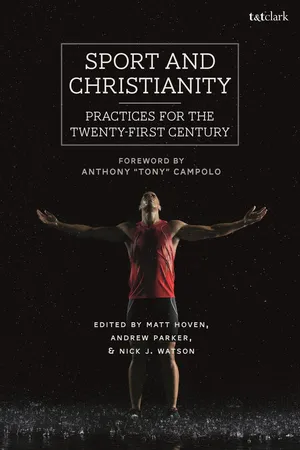
eBook - ePub
Sport and Christianity
Practices for the Twenty-First Century
- 216 pages
- English
- ePUB (mobile friendly)
- Available on iOS & Android
eBook - ePub
Sport and Christianity
Practices for the Twenty-First Century
About this book
Information
Part I
SPORT AND CHRISTIANITY: PRACTICES FOR THE MIND
Chapter 1
HOW MIGHT THEOLOGY OF PLAY INFORM THEOLOGY OF SPORT?
Why should we care about our sports?
As a theologian of culture, I have spent a significant part of my career reflecting on the Christian value of play, particularly the experiences of reading a novel or watching a movie. My doctoral dissertation was on a constructive theology of play (later published as The Christian at Play, 1983). This study has served me well. Throughout my career I have put various play experiences into dialogue with Christian theology, and I have done so as someone who enjoys play activities, himself, both as a participant and as a fan. With regard to sports, I enjoy bodysurfing in the Pacific Ocean near where I live. And with Michael Novak, I have also asked myself, how I can be 40, then 50, then 60, and now 70, and still care what happens to the Los Angeles Dodgers (Novak 1976: xi). I also have inherited the cherished rights to my father’s seats for the University of Southern California (USC) football games, something I have attended for over 60 years with quasi-religious devotion. Why is it that I am slightly depressed for an entire weekend when the Trojans lose? After all, isn’t it just a game? With Michael Novak, this question, in fact, might be the focus of my reflection in this chapter. Why should we care about our sports?
Learning from a theology of play
So though my focus for the last three decades has been on how one’s play experiences at the movies, or while reading a novel, might be theologically important for the Christian, I would like to take those insights and ask, “How might a theology of play inform a theology of sport?” For don’t playing a game of basketball, watching a movie, listening to Mozart, going to a U2 concert, binge watching a TV show like “Breaking Bad,” hiking in the mountains, bodysurfing, getting caught up in a football game, and playing hide-and-go-seek as children all share something in common? And if they do, what is it? And what results from it?
In The Christian at Play, I opened my book with two epigraphs. I have already mentioned the one from Michael Novak about being immersed in watching a baseball game such that it carries back into one’s ongoing life. The other is from the theologian Dietrich Bonhoeffer. In a letter that he wrote from prison to his friend Eberhard Bethge months before he was executed for his part in a plot to assassinate Hitler, Bonhoeffer asked:
I wonder whether it is possible (it almost seems so today) to regain the idea of the Church as providing an understanding of the area of freedom (art, education, friendship, play), so that Kierkegaard’s “aesthetic existence” would not be banished from the Church’s sphere, but would be reestablished within it? … Who is there, for instance, in our times, who can devote himself with an easy mind to music, friendship, games, or happiness? Surely not the “ethical” [person], but only the Christian. (Bonhoeffer 1971: 198)
For Bonhoeffer, play was understood as part of that area of freedom, along with the arts and friendship that could be associated with aesthetics. And even the extreme situation of Nazi German in 1944 could not cancel out its value and possibility for the Christian. We are to work for justice, but we are also meant to enjoy music and friendship and play, for this is God’s world.
Given life’s injustices, given the need to right life’s wrongs, which are “oft so strong” (How can we help the millions of immigrants from the Middle East who are seeking new lives anywhere that will have them? What should be our response to those in Kabul who are burying their dead, the funerals for the five Dallas policemen who were assassinated in cold blood by a sniper, or the innocent black man in Minneapolis who was stopped in his car for a broken tail light and tragically killed by the quick trigger of a policeman? And what of the protests in the United States in support of “Black Lives Matter” that are being held on campuses and in cities across the United States, including at Fuller Seminary where I teach?), who is it that can play? Bonhoeffer’s suggestion is a surprising one: it is particularly the Christian. Do we agree?
Given the growing racial and religious intolerance across the globe, who is it that can afford to pause and appreciate the beauty of a curving penalty kick by Lionel Messi that finds the upper corner of the goal, or a forty-foot shot by Stephen Curry of the Golden State Warriors? Can one really afford such aesthetic moments? How can one devote himself or herself in our troubled times to music or games or movies? Surely not the “ethical” person—the person whose very humanity is defined by acts of justice, but only the Christian, whose humanity is defined not by what we do, but by who we are, children of God. For Christians believe that play, as an event of the inventive human spirit, finds ongoing validation as an expression of humankind’s God-given nature alongside our actions on behalf of others in the world. Though the wrong, which is “oft so strong” must be addressed, the life of God’s creation and creatures also deserves celebration.
Two core questions
There are two core questions a Christian theologian might ask of culture—two questions that will define one’s understanding of a theology of sport as well: “What the hell are they doing?” is the first and perhaps the most common. This is the question which lies behind Andy Crouch’s 2016 editorial in Christianity Today where he challenges what he believes is the myth of engaging the culture, arguing that we should resist being bound and tempted by the culture around us—that is, we should resist being “conformed to this world” (Romans 12:2) and instead should “learn to care for what is lasting and valuable in our particular time and place, and begin to create alternatives to things that are inadequate and broken” (Crouch 2016: 33–34). Here is Kierkegaard’s “ethical” individual. It is consistent with Eugene Peterson’s paraphrase of Romans 12:2 in his The Message, where he includes in Paul’s warning concerning not becoming too well adjusted to our culture the phrase—“always dragging us down to its level of immaturity”—even though this is not in the biblical text. Peterson’s addition is a conclusion of those asking the question, “What the hell are they doing?” Certainly this was one question central to Bonhoeffer’s last five years of his life, when the wrong threatened to overpower everything else. In our context today, the question might be phrased—given Donald Trump, or Paris, or the poverty of Rio, should we even be thinking about, let alone participating in something as unimportant in the larger scheme of things as sports? Surely that could have been Bonhoeffer’s question too, as he sat in Hitler’s jail cell in a world hell bent on destruction. But surprisingly, it was not.
When applied to our reflection on play, “What the hell are they doing?” raises the tragic reality of a fallen world—a world of competition, violence, consumerism, power, sexism, racism, idolatry—a world of which sport is a part and which cries out for righteousness and justice, a world in need of redemption. As one surveys current studies in a theology of sport, much of the literature focuses here. As Robert Ellis rightly summarizes our contemporary situation, “There is this sinful sporting world” (Ellis 2014: 81). Shirl Hoffman’s wonderful study Good Game: Christianity and the Culture of Sports might also be mentioned in this regard (Hoffman 2010). The book seeks those “good” games, while offering a cautionary look at competitive sports today and noting much that is bad. For Hoffman, too, “the wrong seems oft so strong.” And he is no doubt correct. Professionalism in sport with its “win at any cost” attitude threatened even the Rio Olympics, as the drug scandals involving the Russian team, as well as other athletes, repeatedly revealed.
But there is also a second fundamental question central to the Christian theologian of culture, one that also pertains to the world of sport. That is, “What in heaven’s name is going on?” And which question one chooses to focus upon will, of course, shape one’s understanding of and response to the culture we live in—including our theology of sport. To ask, “What in heaven’s name is going on?” is to focus on play’s aesthetics, not its ethics. Rather than a hermeneutic of suspicion and separation consider Peter Leithart’s review of Robert Ellis’s The Games People Play in which he concludes, “Ellis’s tempered Victorianism might best be tempered further with a strong dose of Pauline and patristic and Puritan skepticism” (Leithart 2014). The question, “What in heaven’s name is going on?” invites a hermeneutic of engagement and appreciation. What is the compelling power of our play, including sport? For Ellis, as Leithart rightly notes, every “human activity [including our sport] can be done in union with Christ and in the power of the Spirit.” Rather than focus on the question of sin, this alternate question centers on play’s ability “to make us more fully human, more fully in the image of the playful, powerful, Creator.” When we are truly at play, we participate in God’s creative life; it is a foretaste of heaven.
The one question a theologian of culture asks, “What the hell are they doing?” looks at much in the sports’ world today and with Karl Barth cries, “Nein”—“No.” The other question we ask of culture, “What in heaven’s name is going on?” discovers in sport, what Friedrich Schleiermacher recognized as the sense and taste of the Infinite in the finite. With Paul Tillich it seeks to illuminate the spiritual lines that, otherwise, too often remain hidden within our human activity. There is, surely, Christian truth to be discovered in both perennial lines of questioning. The one focuses on how evil might be overcome—on redemption; the other recognizes in creation and creature that this is “my Father’s world.” The one filters its theological observations through Christology; the other, through creation, recognizing the Spirit’s presence not only as the paraclete, the Comforter, whom Christ has sent, but also as the Spirit of Life, sent from God the Creator to give breath, sustenance, and verve to his creation.
Perhaps a well-known example from the world of play can illumine this second option. C.S. Lewis, in his autobiography, Surprised by Joy, highlights a number of play experiences that were formative—even transformative, in his life: listening to his mother read to him from Beatrice Potter’s Squirrel Nutkin, playing with a toy garden he made in a biscuit tin, hearing Wagner’s music, reading Longfellow’s Saga of King Olaf or later in university, the Greek play Hippolytus. Lewis had a number of these sporadic play experiences that each seemed to him more real than ordinary life. He said these events produced in him stabs of “Joy.” When they first occurred, Lewis believed the “Joy” he experienced to be what he really desired. But as he grew up, he realized that his joy was actually only the by-product of something or someone more fundamental—“a pointer to something other and outer.” It was only when Lewis gave his full attention to his experience of play, and not to what it produced in him, that paradoxically play opened him outward to something external to the play experience—to the Transcendent. It was when Lewis became a player that such surprises of joy sometimes came, causing him to ask, “What in heaven’s name is going on” (Lewis 1955: 72, 168, 170).
This joy—“this pointer to something other and outer” as he described it—was only a distant longing until he read George MacDonald’s Phantastes, A Faerie Romance. As he read this book, he recounted that he was simply changed:
It was as though the voice which had called to me from the world’s end were now speaking at my side. It was with me in the room, or in my body, or behind me. If it had once eluded me by its distance, it now eluded me by proximity—something too near to see, to plain to be understood, on this side of knowledge.
Lewis went on to clarify that reading this fiction had been the occasion for him of a Divine encounter. He wrote: “That night my imagination was, in a certain sense, baptized; the rest of me [for Lewis this meant his intellect and will], not unnaturally took longer. I had not the faintest notion what I had let myself in for by buying Phantastes” (Lewis 1955: 238, 180–81).
Like all true players, Lewis had simply immersed himself fully in the play experience of reading MacDonald’s science fiction. He had no larger or ulterior motive. Rather in play’s parenthesis to life, entering fully into the story’s new space and time, freely accepting its “rules” as the operating procedures and caring about those in its world, he nonetheless found himself ushered into the Presence of that which was and is basic to all life, his own included. As Paul Tillich wrote of a similar play experience he had, when after being on the front lines in the First World War he stood in a Berlin museum before a Botticelli painting titled Madonna and Child with Singing Angels, “A level of reality was opened to me which had been covered up to this moment, although I had some feeling before of its existence.” Tillich, not unlike Lewis, understood himself to have had “an encounter with the Power of Being itself” (Tillich 1966: 27–28; cf. Tillich 1987: 12). What became crucial for both theologians in their lives and thought were these foundational encounters with the Divine that occurred not within the church or with explicit reference to Jesus Christ, but while at play.
But lest we get too far afield from our focus on a theology of sport, though the connection should be clear to most of you, let me give a final example from the world of sport of how we might consider play from the standpoint of “heaven,” not “hell.” It comes from an essay in the New Yorker by the American novelist John Updike. He wrote:
There is a goodness [he might also have said “a beauty”] in the experience of golf that may well be … a place where something breaks into our workaday world and bothers us forevermore with the hints it gives. (Updike 1972: 76–78)
Those familiar with Updike’s novels will immediately recall the conversation in Rabbit, Run between Harry, or Rabbit, and Eccles, the humanitarian minister with little, if any, faith in God who is cynically questioning Rabbit as to why he is so restless in life: “What is it? What is it [that you want]? Is it hard or soft? Harry. Is it blue? Is it red? Does it have polka dots?” Eccles is belittling Rabbit’s quest for transcendence amid the traumas of life, and Rabbit has no answer—that is, until he steps up to the tee and for the first time hits a perfect drive. “‘That’s it!’ Rabbit cries, and turning to Eccles with a smile of aggrandizement repeats, ‘That’s it’” (Updike 1960: 112–113).
Two potential criticisms
Play’s and, thus, sport’s fundamental anchorage in the Transcendent has, of course, not been without its critics. Theological arguments within the Christian community against this axiological orientation have usually taken one of two trajectories: (1) some have thought that such a claim reduces play to a “means to an end,” effectively aborting the play experience, and (2) others have claimed that play cannot have such restorative possibilities, for redemption is only in Christ Jesus and sin has blurred beyond recognition any revelatory possibility for the play experience. Let us look at each challenge in turn:
Does play become instrumental?
Although play has proven notoriously difficult to define, descriptors are more easily come by. Johan Huizinga’s description of play’s characteristics in his classic Homo Ludens (1938; EV 1955) remains the gold standard. He wrote:
Summing up the formal characteristics of play we might call it a free activity standing quite consciously outside “ordinary” life as being “not serious,” but at the same time absorbing the player intensely and utterly. It is an activity connected with no material interest, and no profit can be gained by it. It proceeds within its own proper boundaries of time and space according to fixed rules and in an orderly manner. It promotes formation of social groupings which tend to surround themselves with secrecy and to stress their difference from the common world by disguises and other means. (Huizinga 1955: 13)
Central to Huizinga’s description is the recognition that play is an activity that is freely entered into, complete in itself and outside “ordinary life.” Play is, in this sense, the complement of work. As such it is disinterested, though as a complement to work it adorns life and amplifies it. Put most simply, the whole point of play is playing. Most theologians of sport have stressed this point, noting play’s autotelic nature. As Lincoln Harvey observes, for example, “We should simply accept that play is what it is: it is radically unnecessary but internally meaningful. It is genuinely free from the serious business of life” (Harvey 2014: 69). But we also know the issue is more complex than this, for someone might play a game in order to work out, or to make a business contact, for a paycheck or an Olympic medal, but yet once in the game be captured by it, so that the sport activity becomes what it is, actual play.
But while Huizinga’s description is helpful, it is also limited, for play is also more than this. Written during the Nazi buildup when play was being manipulated for political purposes, Homo Ludens mistakenly sought to divorce play from the larger world. For though radically unnecessary, play’s meaning, nonetheless, extends beyond the playtime back into the everyday world (that is why Novak and I both remain sad when our sport’s teams lose). Theologians of play and sport have struggled to describe this paradox. I have described play as “non-instrumental, yet productive.” For this reason, I critiqued Jurgen Moltmann’s understanding of play which was printed in English as Theology of Play for instrumentalizing play. I wrote:
Moltmann’s hermeneutical predilections for promise over fulfillment, for ethics over aesthetics, and for mission over rest … cause him to ignore play’s self-contained meaning and inste...
Table of contents
- Cover
- Halftitle Page
- Title Page
- Dedication Page
- Contents
- Notes on Contributors
- Foreword by Tony Campolo
- Introduction
- Part I: Sport and Christianity: Practices for the Mind
- Part II: Sport and Christianity: Practices for the Heart and Soul
- Part III: Sport and Christianity: Practices for the Moral Life
- Conclusion
- References
- Scripture Index
- Subject Index
- Imprint
Trusted by 375,005 students
Access to over 1.5 million titles for a fair monthly price.
Study more efficiently using our study tools.
Frequently asked questions
Yes, you can cancel anytime from the Subscription tab in your account settings on the Perlego website. Your subscription will stay active until the end of your current billing period. Learn how to cancel your subscription
No, books cannot be downloaded as external files, such as PDFs, for use outside of Perlego. However, you can download books within the Perlego app for offline reading on mobile or tablet. Learn how to download books offline
Perlego offers two plans: Essential and Complete
- Essential is ideal for learners and professionals who enjoy exploring a wide range of subjects. Access the Essential Library with 800,000+ trusted titles and best-sellers across business, personal growth, and the humanities. Includes unlimited reading time and Standard Read Aloud voice.
- Complete: Perfect for advanced learners and researchers needing full, unrestricted access. Unlock 1.5M+ books across hundreds of subjects, including academic and specialized titles. The Complete Plan also includes advanced features like Premium Read Aloud and Research Assistant.
We are an online textbook subscription service, where you can get access to an entire online library for less than the price of a single book per month. With over 1.5 million books across 990+ topics, we’ve got you covered! Learn about our mission
Look out for the read-aloud symbol on your next book to see if you can listen to it. The read-aloud tool reads text aloud for you, highlighting the text as it is being read. You can pause it, speed it up and slow it down. Learn more about Read Aloud
Yes! You can use the Perlego app on both iOS and Android devices to read anytime, anywhere — even offline. Perfect for commutes or when you’re on the go.
Please note we cannot support devices running on iOS 13 and Android 7 or earlier. Learn more about using the app
Please note we cannot support devices running on iOS 13 and Android 7 or earlier. Learn more about using the app
Yes, you can access Sport and Christianity by Matt Hoven, Andrew Parker, Nick J. Watson, Matt Hoven,Andrew Parker,Nick J. Watson in PDF and/or ePUB format, as well as other popular books in Theology & Religion & Theology. We have over 1.5 million books available in our catalogue for you to explore.