On the bicentenary of the publication of Raja Rammohun Roy's Precepts of Jesus, R. S. Sugirtharajah situates Roy's compilation of the moral teachings of Jesus in its social, cultural and political context and analyses the hermeneutical issues it generated. In doing so, he documents the often acrimonious exegetical exchanges between Roy and the missionaries over the standing and status of the Bible; their often differing hermeneutical suppositions and strategies; their contradictory consturals of Jesus; and disputes about translations. Sugirtharajah addresses issues such as the place of the Precepts among earlier Gospel Harmonies, Roy's use of the Improved Version, a highly contentious Unitarian Bible, and his motives for translating his own Hindu texts. Sugirtharajah also demonstrates how Roy's work was a precursor to de-mythologization which the West took up later, and how Roy's identification of Jesus as an Asiatic, and his idea of a moral union between Father and Son, were routinely reused by later Indian writers. An additional feature is a critical look at Thomas Jefferson's The Life and Morals of Jesus of Nazareth, which appeared in the same year and which had a similar interpretative aim and aspiration. This volume also includes Roy's Precepts in full.
There have been popular perceptions of Roy as someone who strongly disapproved of various Christian doctrines and was highly rationalistic in his outlook. Sugirtharajah demonstrates that Roy was much more complex in his writings. His initial rationalistic energy and passion, displayed in his Precepts, gave way to something much more intuitively and emotionally based which, ironically, did not disturb the foundations of Christianity but made them stronger and safer for Christians.
Sugirtharajah brings to the fore a forgotten but significant work which raised important issues for biblical studies and the power relations between colonized and colonizer over the control of texts and interpretation. He draws lessons from this 19th-century colonial religious controversy for a postcolonial world where religious texts are manipulated to provoke religious hatred and violence.
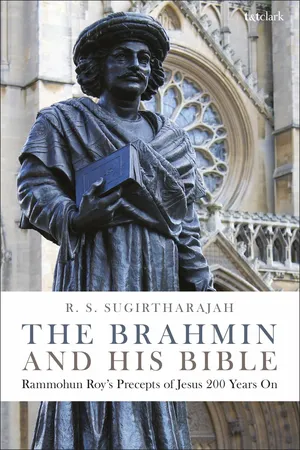
eBook - ePub
The Brahmin and his Bible
Rammohun Roy’s Precepts of Jesus 200 Years On
- 160 pages
- English
- ePUB (mobile friendly)
- Available on iOS & Android
eBook - ePub
About this book
Information
Chapter 1
TRIMMING THE TEXT, MUTILATING THE MESSAGE
Today with a clever combination of media manipulation and swooning adulation of his sycophantic admirers, Narendra Modi, the prime minister of India, is hailed as a global rock star. Before him, the first truly global Indian was Rammohun Roy (1772–1833), the principal focus of this volume. The activities of Roy, his social reforms, his espousal of Hindu theism and his controversial writings on Christianity were extensively covered in the print medium of America, Britain and France between 1818 and 1840 by high-ranking journals of the time. The Christian Register, a Unitarian weekly which had a massive circulation in America, has over one hundred references to his work.1 His tracts and books were also published both in Britain and in the United States. Adrienne Moore, who catalogued all references to Roy’s works in Western publications, has also listed the leading libraries which stocked his writings.
Roy’s momentous life story has been recounted eloquently elsewhere based on a succinct biographical note that he himself had left behind and on the recollections of those who knew him. His long bold struggle for religious and social reforms, especially his involvement in the abolition of sati, his plea for the right to property for Hindu women, his tireless attempts at restructuring educational matters, his agitation for journalistic freedom, his vernacular publishing in the form of Bengali and Persian weeklies, and his translation and interpretation of Sanskritic texts have drawn in equal measure much celebration and censure. The books on Rammohun Roy are too numerous to mention here.2
The purpose of this volume is to look at a work that caused much controversy during his life time but was drowned out by his other achievements and, very regrettably, after his death went unnoticed. The work in question is a slim but incendiary text he published in 1820 called The Precepts of Jesus. Its full title The Precepts of Jesus: The Guide to Peace and Happiness; extracted from the books of the New Testament, ascribed to the four evangelists with translations into Sungscrit and Bengalee.3 The Precepts was one of the rare books that managed to be both slim in size and hermeneutically huge at the same time. This thin tract, contrary to popular impression, was not primarily aimed at fellow Hindus. Roy had in his mind Muslims as well. He desired that the ‘common comforts of life’4 that the moral teachings of Jesus would bring should be extended to and enjoyed by Muslims, too. A number of times, he advised missionaries that without any ‘preparatory instruction’ the Musalmans (Roy’s phrase), who were strangers to the Christian world, would not benefit from the peculiar doctrines of Christianity.
Looking at The Precepts two hundred years after its publication, especially with the benefit of the tumultuous changes that have happened in biblical scholarship, it appears as a reasonably inoffensive text, but for the missionary propagators of the time this ostensibly anodyne text concealed materials which unsettled their cherished beliefs and doctrines. In a Christian propaganda-charged colonial Bengal when the missionaries were seriously engaged in proclaiming the uniqueness of the Christian Gospel and were involved in the business of rescuing the natives from their moral depravity, The Precepts proved to be textually toxic. It was a compilation of the moral sayings of Jesus, largely drawn from the first three Gospels, without the Jewish ancestry of Jesus; the critical events in his life such as birth, death and crucifixion; narratives related to the Roman imperial history; miraculous and supernatural events; and doctrinal allusions. It was a kind of Christian apocryphal Gospel, produced by a Hindu, as an alternative to the missionary version of Christianity. The Precepts was a continuation of the practice of the early Christians in creating gospels to meet new Christian pieties and, in Roy’s case, to address the non-Semitic and complex multicultural situation of India.
There is a vast and rich literature on the life and work of Roy but nothing of significant value on this small booklet. This volume will explore Roy’s use of the Bible mainly through this volume and the fierce exegetical exchanges that ensued between him and the Christian missionaries. Ironically, The Precepts was published by the Baptist Mission Press in Calcutta – the very denomination which hoped for his conversion and later turned against him.
The Precepts was primarily a personal premier and not composed with the noble notions of academic facticity and objectivity. But it had the wider public as the target. The Precepts simultaneously stripped Christianity of its strict stern image and challenged its doctrinal aspects which smacked of irrationalism, sectarianism and triumphalism. Roy was convinced that ‘no other religion can produce anything that [might] stand in competition with the precepts of Jesus’.5 He wrote that as the result of his ‘long and uninterrupted researches into religious truth’ he had realized that the ‘doctrines of Christ [were] more conducive to moral principles, and better adapted for the use of rational beings, than any others which had come to his knowledge.6 Roy wanted Indians to benefit morally, socially and politically from the ethical teachings of Jesus as well as European education, literature and science, but never envisaged nor encouraged conversion to Christianity.
Notes
1 A. Moore, Rammohun Roy and America (Calcutta: Satis Chandra Chakravti, 1942), 3.
2 The books on Rammohun Roy are too numerous to mention here. For a judicious evaluation of his life and work, see A.P. Sen, Rammohun Roy: A Critical Biography (New Delhi: Viking, 2012); V.C. Joshi, ed., Rammohun Roy and the Process of Modernization in India (Delhi: Vikas Publishing House, 1975); for a critical study of The Precepts, see R.S. Sugirtharajah, Asian Biblical Hermeneutics and Postcolonialism (Sheffield: Sheffield Academic Press, 1988), 29–53 and The Bible and Empire: Postcolonial Explorations (Cambridge: Cambridge University Press, 2005), 9–59.
3 The promised Bengali version appeared after Roy’s death. It was translated in 1859 by the Brahmo leader Rakhal Das Halder. It was called Jishupranita Hitopadesha, see Sen, Rammohun Roy, 187. There was no evidence of the Sanskrit version that had Roy promised.
4 Rammohun Roy, The English Works of Raja Rammohun Roy, ed. J.C. Ghose (New Delhi: Cosmo Print, 1906), 557.
5 Ibid., 615.
6 ‘Review: Hindoo Unitarianism’, The Monthly Repository 14, no. 165 (1819): 562.
Chapter 2
THE REFORMER AND HIS REASONS FOR COMPILING THE PRECEPTS
To everything there is a season, says the Preacher. To this one could add, to everything there are reasons. Briefly, then, the historical, political and theological factors that promoted Roy to come out with The Precepts of Jesus. Firstly, the political context: Roy’s collection of the moral sayings of Jesus appeared at a time when India was going through a remarkable period of political changes and upheavals. Moghul rule and Muslim dominance were on the wane. There was the menacing presence of the mercantile traders in the form of the East India Company, and the British were yet to become the rulers of India. Roy, who was troubled by the long subjugation of the Hindus at the hands of Muslims and disturbed by the ‘cruelty allowed by Musalmanism against Non-musalmans’,1 knew that the new invaders once they entrenched themselves would be in India for the long haul. The inadequacy of his ancestral faith to meet the challenges of the new situation soon dawned on Roy. Faced with such an impending change, Roy was earnestly seeking a sustainable religious tenet which was both moral and rational, and one that would sustain and benefit his fellow Indians during those trying times. He thought he had found one in the moral precepts of Jesus.
Secondly, the religious context of the nineteenth-century colonial Bengal. The prevailing state of two competing faiths – Hinduism and Christianity – was another compelling reason for Roy to assemble the moral sayings of Jesus. The Hinduism that was practised then seemed to be full of superstitious customs and, more lamentably, most Hindus were ignorant of their own faith and were not in the mood to receive a foreign religion. Christianity, propagated at that juncture, was another factor. Roy found it to be arrogant, austere, dogmatic and unappealing.
Roy was genuinely concerned that the popular Vaishanvism, the prominent sect in Bengal, had ‘sunk to a very low level of superstition, extravagance and immorality’.2 He dejectedly noted that the social conditions of his people were deplorable. The Hindus, in his opinion, ‘were in general more superstitious and miserable, both in performance of their religious rites, and in their domestic concerns, than the rest of the known nations on earth’.3 He found that the widespread Hindu subspiritual practices such as the rigid caste system, immolation of widows, and infanticide; the pitiable treatment of women; and the illiterate and exploitative priests were part of the ‘puerile and unsociable system’ of Hindu phenomena. Added to these were the useless dietary habits; rules regarding pollution, purity and auspicious times; and idolatrous worship, which made Hinduism not only ‘vain and useless’ but also pushed it into a ‘very low ebb’. This despicable state of affairs prompted Roy to realize that this ancient faith had not only no means within itself to promote ‘political interest’ or ‘patriotic feeling’ but also no intellectually and theologically astute Hindu leaders to explain and interpret Hindu faith. While he himself detested these Hindu customs, he felt sympathy for his fellow Hindus whose idolatrous, polytheistic, pantheistic practices pushed them back into history and believed, as such, they needed to be rescued.
Roy bemoaned that ‘there was darkness all over the land, and no man knew when it would be dispelled’.4 He realized that in order to lift his fellow Bengalis from this religious morass, they needed a different set of morals, both to rejuvenate them and to face the modern India which was in the throes of unparalleled changes. Roy recognized that the Hindus needed a coterminous set of moral teachings that would lift them up from their ethical misery. It was possibly against this background that Roy’s Precepts emerged. He was persuaded that Hindus needed changes ‘at least for the sake of their political advantage and social comfort’.5 Ironically, he found these moral changes in the teachings of Jesus – the very teachings which came with the invaders. He envisaged that these imported morals might promote harmony and coexistence among Hindus. A few years before his death, he confirmed to a friend what he had thought all along: ‘there is nothing so sublime as the precepts taught by Christ, and there is nothing equal to the simple doctrines he inculcated’.6 He was convinced that the ethical teachings of Jesus were ‘calculated to elevate men’s ideas to high and liberal notions of God’ and he was ‘desirous of giving more full publicity in this country to them’.7 He reassured his fellow Hindu Bengalese that following the precepts of Jesus did not mean becoming Christians but continuing to remain as Hindus but adopting the teachings of Jesus for the sake of peace and harmony and for gaining politica...
Table of contents
- Cover
- Halftitle Page
- Title Page
- Contents
- Acknowledgements
- Publisher’s note
- Introduction
- Chapter 1 Trimming the Text, Mutilating the Message
- Chapter 2 The Reformer and His Reasons For Compiling the Precepts
- Chapter 3 The Rajah and His Reduced Version
- Chapter 4 Publish and be Pilloried
- Chapter 5 The Bengali and His Biblical Engagements
- Chapter 6 Vedas and The Vethagamas
- Chapter 7 Gospel Harmonies, Bible Versions and Translations
- Chapter 8 Heathenish and Irrational Doctrines
- Chapter 9 Modest Proposals, Unexplained Propositions
- Chapter 10 To Convert or not yo Convert
- Chapter 11 The Mleccha and His Moral Codes
- Chapter 12 The Indian Reformer, The American President and Their Designer Gospels
- Chapter 13 Hermeneutical Achievements: Strengths and Shortcomings
- Chapter 14 Reading Rammohun Roy Today
- The Precepts of Jesus
- Bibliography
- General Index
- Scriptural References
- Imprint
Trusted by 375,005 students
Access to over 1.5 million titles for a fair monthly price.
Study more efficiently using our study tools.
Frequently asked questions
Yes, you can cancel anytime from the Subscription tab in your account settings on the Perlego website. Your subscription will stay active until the end of your current billing period. Learn how to cancel your subscription
No, books cannot be downloaded as external files, such as PDFs, for use outside of Perlego. However, you can download books within the Perlego app for offline reading on mobile or tablet. Learn how to download books offline
Perlego offers two plans: Essential and Complete
- Essential is ideal for learners and professionals who enjoy exploring a wide range of subjects. Access the Essential Library with 800,000+ trusted titles and best-sellers across business, personal growth, and the humanities. Includes unlimited reading time and Standard Read Aloud voice.
- Complete: Perfect for advanced learners and researchers needing full, unrestricted access. Unlock 1.5M+ books across hundreds of subjects, including academic and specialized titles. The Complete Plan also includes advanced features like Premium Read Aloud and Research Assistant.
We are an online textbook subscription service, where you can get access to an entire online library for less than the price of a single book per month. With over 1.5 million books across 990+ topics, we’ve got you covered! Learn about our mission
Look out for the read-aloud symbol on your next book to see if you can listen to it. The read-aloud tool reads text aloud for you, highlighting the text as it is being read. You can pause it, speed it up and slow it down. Learn more about Read Aloud
Yes! You can use the Perlego app on both iOS and Android devices to read anytime, anywhere — even offline. Perfect for commutes or when you’re on the go.
Please note we cannot support devices running on iOS 13 and Android 7 or earlier. Learn more about using the app
Please note we cannot support devices running on iOS 13 and Android 7 or earlier. Learn more about using the app
Yes, you can access The Brahmin and his Bible by R. S. Sugirtharajah in PDF and/or ePUB format, as well as other popular books in Theology & Religion & Biblical Criticism & Interpretation. We have over 1.5 million books available in our catalogue for you to explore.