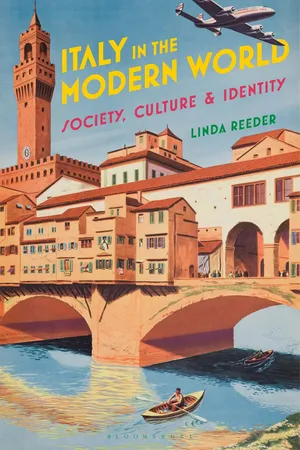
Providing a comprehensive history of Italy from around 1800 to the present, Italy in the Modern World traces the social and cultural transformations that defined the lives of Italians during the 19th and 20th century. The book focuses on how social relations (class, gender and race), science and the arts shaped the political processes of unification, state building, fascism and the postwar world.
Split up into four parts covering the making of Italy, the liberal state, war and fascism, and the republic, the text draws on secondary literature and primary sources in order to synthesize current historiographical debates and provide primary documents for classroom use. There are individual chapters on key topics, such as unification, Italians in the world, Italy in the world, science and the arts, fascism, the World Wars, the Cold War, and Italy in the 21st century, as well as a wealth of useful features for students, including:
* Comprehensive bibliographic essays covering each of the four parts
* 23 images and 12 maps
Italy in the Modern World also firmly places both the nation and its people in a wider global context through a distinctly transnational approach. It is essential reading for all students of modern Italian history.
- 344 pages
- English
- ePUB (mobile friendly)
- Available on iOS & Android
eBook - ePub
About this book
Trusted by 375,005 students
Access to over 1.5 million titles for a fair monthly price.
Study more efficiently using our study tools.
Information
PART ONE
Italians and the Making of Italy (c.1800–71)
Historians and the Risorgimento
The 150th anniversary of Italian unification in 2011 marked an occasion for reevaluating the meaning of the Risorgimento.1 The term “Risorgimento,” commonly translated as resurgence, generally encompasses the period between 1815 and 1861, when Italy emerged as a modern nation-state. Beyond its chronological and geographical meaning, the word has been inseparable from politics. The term first appeared in the late 1840s as a means to fuse the multitude of revolutionary and reformist movements into an inexorable force for Italian liberation. After unification, scholars, politicians, and critics used the term to attack, or defend, the legitimacy of the nation-state. In the last two decades, a new body of historical literature uncoupled the Risorgimento from debates about the success or failure of the liberal state. Rejecting the notion that the Risorgimento was a decisive break between one world and another, a wealth of new historical studies offers a more nuanced analysis of the social, cultural, and political processes that culminated in the creation of modern Italy.
Early Risorgimento histories mined the past for proof of Italy’s national destiny and for patriotic heroes. Two decades of revolutionary turmoil and the election of a seemingly progressive pope inspired the first histories. In chronicles of the revolutions of 1820s and 1830s, and biographies of Italian patriots and martyrs, historians unearthed evidence of the inevitability of Italian independence.2 After unification, these hagiographic and historic works took on a political cast. Scholars sympathetic to the moderates emphasized the astute political and diplomatic roles played by the Savoyard monarchy and Count Camillo Benso di Cavour in the process of unification. Those on the left highlighted the importance of the democratic revolutionary movements. By 1880, elements of the democratic histories had woven themselves into celebratory narratives privileging the role of moderate elites in the creation of a constitutional monarchy replete with unified Italy and a pantheon of founding fathers including Garibaldi, Mazzini, Cavour, and Vittorio Emanuele.
In the 1890s, historians challenged this optimistic vision. Surveying Italy at the end of the nineteenth century, historians wondered why the state seemed incapable of building a firm democratic base or claiming its place among the great powers of Europe. The central political tension of the Risorgimento—the struggle between regional authority and central state power—continued to plague the new state. In the first decades of the twentieth century, the idea of an unfinished or incomplete Risorgimento gained traction among moderates and Nationalists. The need to realize the dreams of the Risorgimento justified arguments for a stronger central state and imperial expansion.3
For much of the twentieth century, the historiography of the Risorgimento was held hostage by fascism. After 1945 two competing arguments emerged: a liberal vision arguing that the success of the Risorgimento and the liberal state proved fascism to be an aberration; a leftist interpretation claiming that the seeds of fascism were sown in the failure of the Risorgimento. Liberal historians embraced the ideas of the historian Benedetto Croce. Croce’s central thesis held that the ideals of liberalism, unification, and modernization embedded in the Risorgimento were realized in the liberal state. Fascism was an anomaly, born solely from the chaos and horror of the First World War.4 Throughout the 1950s and 1960s, most liberal historians followed Croce’s path, examining the financial, political, and social difficulties faced by nineteenth-century Italian liberal elite. Some lauded Cavour for his daring embrace of reform and diplomacy, while others applauded the pragmatism and economic savvy of the moderates. Liberals insisted that the idea that the elite’s failure to mobilize the peasantry proved the Risorgimento a failure was pure fantasy. Rosario Romeo, a leading liberal historian of the postwar era, argued that the prosperity of the liberal state depended on the exclusion of the peasantry. A few contended that Italy’s protectionist policies weakened the state in ways that thwarted the development of liberal institutions. In either case, liberal historians generally agreed that the unification of Italy was an astounding achievement, despite the challenges posed by geographic disunity, reactionary governments, poor fiscal decisions, or economic backwardness.5
Meanwhile, Marxist historians insisted that fascism proved the Risorgimento a failure. The historical narrative of the left was based on the prison writings of Antonio Gramsci, a political theorist and founding member of Italy’s Communist Party who spent over a decade in a Fascist prison. Gramsci’s thoughts on the Risorgimento appeared in the posthumously published collection subsequently entitled Prison Notebooks in 1947. According to Gramsci, the Risorgimento was an incomplete, or “passive,” revolution marked by political and institutional changes but not by structural transformations. The preunification social and political elites adapted to parliamentary rule and capitalism without altering existing social relations. In the decades following unification the liberal state remained weak, while social and geographic divisions widened, enabling fascism to take root.6 In the following decades, Marxist historians looked to the first decades of the nineteenth century for evidence to support Gramsci’s hypothesis, and to seek historical explanations for the failure of Risorgimento democrats to mobilize the peasantry, and realize a social revolution.7 In the 1960s and 1970s, Marxist historians widened the chronological limits of the Risorgimento, expanding into the late eighteenth century, without substantially altering the terms of the debate. The publication of the first and third volumes of the Storia d’Italia by Einaudi were informed by Gramsci’s theory of failure, reinforcing the image of Italian liberalism as conservative and limited in nature.
A notion of Italian exceptionalism emerged from both moderate and leftist historical interpretations. The Croce/Gramsci framework suggested that Italy alone of the European powers had failed to lay the foundations of a modern industrial nation, and embarked on its own unique path of development. Rejecting the liberal idealization of the founding fathers and the Marxist demonization of the Italian bourgeoisie, some historians conceived of the Risorgimento as a kind of historical accident. According to these scholars, unification was an unplanned process, a consequence of the bumbling responses of Cavour, and the moderate liberals to the threat of democratic revolution, the growing anti-monarchical sentiment, and the repressive restoration governments.8 Although the works of Denis Mack Smith in particular proved controversial in Italy, the body of work opened up new avenues o f research. By the 1970s, liberal historians acknowledged character flaws in their heroes, and Marxists recognized that the Risorgimento movement was not as elitist as some suggested.9
In the 1980s, a new generation of historians came of age within the academy transfiguring the history of the Risorgimento. Born after 1945, informed by the student movements and feminism, these scholars found arguments about Risorgimento victories or defeats irrelevant, and instead focused on understanding the social, economic, and political changes on their own terms. Mining new sources, appropriating new methodologies, and widening the range of historical subjects to include women, rural residents, workers, and elites, historians produced a wide range of works focusing on the how and the why Italian unification occurred. Scholars explored the multiple visions of resistance, liberation, renovation, and independence that spread through the Italian states. A united liberal Italy was just one of the many possible outcomes, not the driving force of the Risorgimento. These new works expanded the fields’ chronological and geographic boundaries and challenged assumptions about the nature of the Restoration and the Risorgimento.10
In the new histories, the Italian Restoration appears less repressive, and more as a conservative force of change. Focusing on processes of state formation, these new studies describe a world trying to come to terms with the post-1789 realities. While acknowledging that Restoration rulers did, at times, attempt to turn the clock back to squash political dissent, their efforts were generally short lived and followed by careful reforms seeking to stave off revolution by creating more liberal governments.11 Reconsideration of Restoration politics accompanied a reevaluation of Italian society. Scholars had long pointed to the absence of an Italian middling class, similar to the British industrial bourgeoisie, as one of the explanations for the Risorgimento’s failure to realize a social revolution. By abandoning north European models of class formation that identified the middle classes with industry, urbanization, and manufacturing, scholars discovered a distinct Italian middling class, linked by land, kin networks, and culture. The Italian inclination to rely on land for wealth and status was not a sign of backwardness but a rational response to material conditions. The rehabilitation of the Restoration uncovered a more diverse and dynamic Italy, where local elites, often in conjunction with governments, engaged in local modernization programs.12 These works deepened our understanding of the forces that shaped the Risorgimento, but did little to explain why an idea of creating an Italian nation took hold in the first place.
Intrigued by the question, a few historians began to trace the emergence of symbols and rhetoric of Italian rebirth shared by the reformers and revolutionaries. While historians agreed there was little evidence of the existence of a coherent political Nationalist movement in the first decades of the nineteenth century, new works suggested that there was evidence of a national-patriotic cultural movement.13 Analyzing early nineteenth-century novels, essays, and poetry, Alberto Banti found signs of an emerging national identity, anchored in a common past and culture. The cultural turn produced a wealth of new research on the nationalizing influence of cultural, scientific, literary, and intellectual associations. Considering the Risorgimento as a cultural revolution, spreading the idea of an Italian nation tied by blood, sentiment, and history suggests the existence of a much more expansive and fluid movement deeply embedded in a wider community. Without negating the importance of diplomacy, state building, secret societies, and political movements in the unification of Italy, these works help explain how diverse regional movements found common ground in a shared vision of an independent nation-state.14
The new approaches made visible women’s involvement in the Risorgimento, and the constitutive role gender played shaping Nationalist visions. Cultural approaches widened the definition of the political to include household and family. The erosion of the boundaries between public and private spaces brought new attention to women’s participation in the movement. Women hosted salons, published works promoting Nationalist ideas, joined patriotic societies, took to the streets during uprisings, and voted in plebiscites.15 Beyond women’s involvement in the Nationalist cause, scholars have explored the gendered nature of the Risorgimento project. At the center of the Cultural Revolution stood the conviction that independence and liberty could remake men and women. The Risorgimento was as much about transforming effeminate and decadent men into soldiers, citizens, and workers, and masculine women into mothers and wives, as it was about forging political boundaries.16
Tracing the cultural Risorgimento made apparent its transnational dimension. New research maintained mobility was integral to the creation of both an imagined and a physical Italy. Italian patriots were physically and intellectually linked to international communities. Donna Gabaccia’s work on the Italian diaspora pointed to the emergence of an “Italy” among emigrant communities in the Americas and Europe long before the notion of a unified state gained traction. More recently, scholars have explored the metaphoric and material importance of exile. Symbolically, exile was central to the Risorgimento imagination, and materially, the foreign communities provided sanctuary, money, and support.17
While recognizing the significant ways the works of cultural revisionism has reshaped the geographic and social landscape of the Risorgimento, not all historians are willing to reject conflict as integral to the process of unification. Italy was born out of wars that had winners and losers. In 2008, Eva Cecchinato and Mario Isnenghi published the first volume of a multivolume work on the history of Italy. In the collection of essays on the Risorgimento, Isnenghi and Cecchinato suggest that the emergence of a national culture, and political movements that shared vision of an independent nation, also created divisions. Isnenghi and Cecchinato stress the cultural, political, social, gendered, and geographic divides that characterized the Risorgimento process. The sixty-odd essays focus on social actors, key places, and representation and memory that incorporate the experiences of both the “winners,” the democratic and moderate patriots, and the “losers,” the reactionary movements led by crown and church, into the foundation of Italy.18
The new framework encourages historians to consider the evolving positions of institutio ns, governments, and people in relation to various forms of Italian patriotism. This insight has led to a reevaluation of the role of the church. Long seen as an intractable force of opposition, revisionist histories suggest that the institution played a more complicated role. Acknowledging that after 1848, the pope stood as a formidable enemy of the state; the anticlericalism of Italian independence did not mean that Italians jettisoned their beliefs or practices. Popular religion was instrumental in shaping support for Italian unification, yet we have little understanding of how the religiosity of the Risorgimento informed relations between church and state in the liberal era.19
Current historical trajectories revised the geography of the Risorgimento. The reactionary bent of the Bourbon monarchy went largely unquestioned, and the notion that southern Italians played a central role in the struggles for independence and liberation was generally dismissed. Reassessments of the Restoration and Italian nationalism suggest that southern Italians—wealthy, poor, rural, and urban—were sympathetic to revolutionary change and receptive to the idea of an independent Italy, although many opposed a state dominated by Piedmont. Scholars have revisited the “war of the brigantaggio,” the civil war that broke out in the aftermath of unification and long seen as the last gasp of ancien régime opposition. Returning to the archives and focusing on local events, scholars described how the wars of unification created local resistance, and how the brutality of the civil war sowed resentment toward the newly formed state. The deep social, cultural, and political divides between the South and North that mark the history of modern Italy were rooted in unification itself.20
The new histories of the Risorgimento reinvigorated the field, encouraging new methodological approaches, incorporating new sources, and erasing the notion that unification had created an ill-formed state, unable to develop in the same way as its European neighbors. By uncoupling the Risorgimento from the fate of the Liberal state and Mussolini’s dictatorship, the new historiography enabled historians to understand the process as a complicated, multilayered project.
Chapter 1
Italy in 1800
“The Italians are much more o...
Table of contents
- Cover
- Half-Title
- Series
- Title
- Contents
- List of Illustrations
- Part One Italians and the Making of Italy (c.1800–71)
- Part Two The Liberal State (1860–1914)
- Part Three War and Fascism (1914–48)
- Part Four The Republic
- Notes
- Selected Bibliography and Suggested Readings
- Index
- Copyright
Frequently asked questions
Yes, you can cancel anytime from the Subscription tab in your account settings on the Perlego website. Your subscription will stay active until the end of your current billing period. Learn how to cancel your subscription
No, books cannot be downloaded as external files, such as PDFs, for use outside of Perlego. However, you can download books within the Perlego app for offline reading on mobile or tablet. Learn how to download books offline
Perlego offers two plans: Essential and Complete
- Essential is ideal for learners and professionals who enjoy exploring a wide range of subjects. Access the Essential Library with 800,000+ trusted titles and best-sellers across business, personal growth, and the humanities. Includes unlimited reading time and Standard Read Aloud voice.
- Complete: Perfect for advanced learners and researchers needing full, unrestricted access. Unlock 1.5M+ books across hundreds of subjects, including academic and specialized titles. The Complete Plan also includes advanced features like Premium Read Aloud and Research Assistant.
We are an online textbook subscription service, where you can get access to an entire online library for less than the price of a single book per month. With over 1.5 million books across 990+ topics, we’ve got you covered! Learn about our mission
Look out for the read-aloud symbol on your next book to see if you can listen to it. The read-aloud tool reads text aloud for you, highlighting the text as it is being read. You can pause it, speed it up and slow it down. Learn more about Read Aloud
Yes! You can use the Perlego app on both iOS and Android devices to read anytime, anywhere — even offline. Perfect for commutes or when you’re on the go.
Please note we cannot support devices running on iOS 13 and Android 7 or earlier. Learn more about using the app
Please note we cannot support devices running on iOS 13 and Android 7 or earlier. Learn more about using the app
Yes, you can access Italy in the Modern World by Linda Reeder in PDF and/or ePUB format, as well as other popular books in History & Italian History. We have over 1.5 million books available in our catalogue for you to explore.