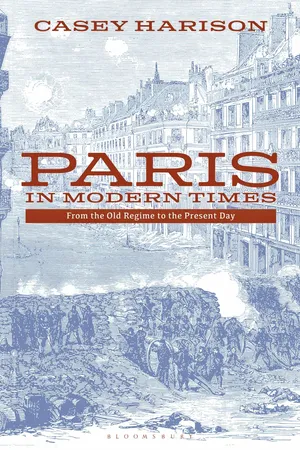
Drawing upon a vast body of historical scholarship, Casey Harison's Paris in Modern Times provides the first detailed academic history of Paris in the modern age.
Chronologically surveying Paris's history from the Old Regime of the late-18th century through to the present day, this book explores the social, economic, political and cultural developments that come together to tell the story of this iconic city. Each chapter has an introduction and illuminating 'sidebars' that touch upon the ways in which Parisian history has intersected with wider changes in France and beyond. The text, which also includes a wealth of images, maps, and a further reading section, takes the opportunity to place Paris and its history in a broader French, Atlantic and global historical context in order to cover an essential aspect of what has been such an important city the world over.
Paris in Modern Times is vital reading for anyone seeking to know more about the history of Paris or the history of France since the French Revolution.
- 360 pages
- English
- ePUB (mobile friendly)
- Available on iOS & Android
eBook - ePub
About this book
Information
1
Old Regime Paris: The City before 1789
Chronology
| 1763 | Place Louis XIV (now Place de la Concorde) inaugurated | |
| 1770 | Marriage of the dauphin (future Louis XVI) to Marie-Antoinette | |
| 1774 | Death of Louis XV—Louis XVI becomes king | |
| 1782–84 | Palais-Royal constructed | |
| 1783 | Flight of Montgolfier balloon | |
| 1787–88 | Assembly of Notables | |
| 1785–88 | Construction of Farmers’ Wall | |
| 1789 | French Revolution begins |
Introduction
In broad terms, Old Regime (ancien régime) describes the world before the start of the French Revolution in 1789. Of course, the phrase was used only after the Revolution had done away with many existing institutions, practices, and norms, and had inaugurated what historians have called a New Regime marked by comparatively open democratic and republican political institutions, the idea of laissez-faire economics, and human rights. The French Revolution was a “world-historical” event centered in Paris.
Paris, of course, has a history long pre-dating the modern era. The physical site of central Paris has been inhabited since 4200 BCE. The Parisii, a Gallic tribe who gave their name to the city, lived there in 100 BCE. When the Romans defeated the Gauls in 52 BCE, the place was known as Lutetia. The Catholic bishop Saint-Denis was martyred there in 250 CE. The name “Paris” was being used not long after. Clovis made it his capital in the early sixth century and it was the hub of a growing hinterland by the Middle Ages. The landmark Notre-Dame Cathedral was completed early in the thirteenth century and about the same time sections of the Louvre—another landmark—was being erected. Paris was occupied by English invaders from 1420 to 1436 and was beset by turmoil during the Wars of Religion, including the terrible Saint Bartholomew’s Massacre (1527). King Henri IV sought to end the strife partly by making Paris his capital, but was assassinated there in 1610. After the rebellion of the Fronde in the mid-seventeenth century, Louis XIV made nearby Versailles the administrative and royal capital of France. But, Paris remained the country’s cultural and historical heart.
The Old Regime that was pushed aside by the Revolution was changing or evolving well before 1789. In the seventeenth century, the French king Louis XIV represented what was later called Absolutism: a strong central government with a large, efficient bureaucracy loyal to the monarchy; reliance on mercantilist economic practices to generate revenues for use by the central state; large armies and police forces to fight the king’s wars and keep things in order; and the use of symbols to embody, almost cult-like, these elements in the person of the king. Absolutist France was a powerful state—perhaps the first modern “nation”—whose strengths compelled European neighbors to emulate her. Paris remained the great city of France, though not Absolutism’s center of operations: distrustful of the Parisian populace, Louis XIV built a fabulous palace at nearby Versailles to which he and the court moved in the late seventeenth century. Versailles, not Paris, was the capital of France. Even before the eighteenth century, Paris sometimes generated distrust and resentment among other French.
Though Paris was no longer capital of France, she was a center of so much else, including the eighteenth-century Enlightenment—the movement of ideas that underlay not only the Revolution, but many of the political and economic concepts that would help shape the Atlantic basin and then virtually every corner of the world. The philosophes who wrote about constitutions, republican government, and natural law and rights—Voltaire, Diderot, Rousseau—belonged to the city’s “Republic of Letters.” Their ideas and recipes for change were by and large founded on a belief in reason, rationality, and tolerance. Secular, rather than religious solutions for society’s problems, helped diminish the influence of the Catholic Church as well as religious reform movements like Jansenism. The Enlightenment and French Revolution were, among other things, reactions against established religion.
During the last decades of the eighteenth century, philosophes used critical analysis to undermine fundamental institutions of the Old Regime: monarchy, church, and nobility. France was on the verge of great change. The kings to come—Louis XIV’s great-grandson Louis XV and the latter’s grandson Louis XVI—struggled against the tide of change. The coming shock seemed to be symbolized in Paris in 1770 with a celebration for the marriage of the dauphin (the future Louis XVI) to Marie-Antoinette of Austria. This should have been a moment when king and “people” reasserted traditional bonds, replaying the give-and-take relationship that often characterized ties between monarchy and populace before 1789. Instead, when fireworks for the celebration were accidentally ignited, the crowd panicked, setting off a rush in which scores of persons were killed or injured. This seemed a bad omen.
POLITICS
1 Salons and the “Republic of Letters”
Paris had been the home of French kings since the Middle Ages. As France grew out from Paris and her hinterland (the Île de France), the city came to dominate the country politically, economically, and culturally. Parlements were judicial courts established in different parts of France, but the Paris Parlement, because of its proximity to the monarchy, had special authority. Louis XIV made nearby Versailles the capital in the seventeenth century and further centralized control of the nation. But the Revolution made Paris the capital once again.
Politics in Paris, and between Parisians and the royal government, reflected the tensions and ideas that helped produce the French Revolution of 1789. Throughout Parisian society, ideas and resentments were percolating that called for change. In the middle of the eighteenth century, a Parisian intelligentsia developed that took up the habit of meeting and talking together in salons. These people included well-known writers, philosophers, and political thinkers who met to socialize, share readings, and talk about the events of the day. We know something about the inner dynamics of the salons from epistolary (letter-writing) evidence. Parisian salons began in the seventeenth century but became an intellectual force in the two or three decades ahead of the Revolution. Many were organized and hosted by noble or upper-class women, though most attendees were male. The physical settings of salons in this “age of comfort” were apartments and hôtels, now furnished with heating, flush toilets, luxurious fabrics, and sofas in the lavish, Rococo style introduced to Paris during the eras of Louis XIV and Louis XV. There were many well-known Paris salons. One was hosted by Julie de Lespinasse, from humble provincial origins, whose salon was held at her comfortable hôtel on the Rue Saint-Dominque. Madame Necker (Suzanne Curchod), born in a Swiss canton and the wife of one of Louis XVI’s finance ministers, hosted a famous salon on the Rue Chaussée d’Antin. The salons were settings where philosophes like Voltaire, Rousseau, Montesquieu, Diderot, and d’Alembert came together to make Paris the capital of Enlightenment-era political dialogue. The salons were distinctive because of the important role played in them by women and because they became a model for modern political discourse. In the years before the Revolution they contributed to an emerging “public sphere” that helped make the idea of change—really, revolution—acceptable to a public that was becoming politicized. This was the “Republic of Letters” described by Dena Goodman without which many of the revolutionary developments in France and Europe after 1789 seem inconceivable.1
But conversation about change—some of it political, some of it only indirectly so—was happening at a more popular level, too. Robert Darnton located this alternate discourse among the “forbidden best-sellers of pre-Revolutionary France,” which were illegally published books and pamphlets circulating among the lower and middle levels of Parisian society. These “best-sellers” offered scandalous or lascivious portraits of well-known personalities. This was “charivari” in literature: words that sought to turn the world on its head, putting the low on top and the high at the bottom. This kind of message found a receptive audience among ordinary Parisians in the 1770s and 1780s.2
Did the words and ideas exchanged among high-flying philosophes and writers at Parisian salons, or surreptitiously in the “forbidden” literature on the streets, make revolution in 1789? At the very least, they played a role.
2 Jansenism, Freemasons, and academies
Talk about politics, the financial difficulties of the monarchy and the king’s relationship to Paris, along with the disruptive rhetoric of the Enlightenment, circulated not only among the “salonnières” and in the illicit literature of the streets, but also in sections of the Catholic Church, in masonic lodges, and in the literary and scientific academies headquartered in Paris.
By the mid-seventeenth century, there were 8,000–10,000 Protestants in Paris, including many German and Swiss who had moved to the city early in the eighteenth century. The Edict of Nantes of 1598 had designated Paris a Catholic city, and so there were no Protestant churches (though Protestants could worship at nearby Charenton). Unfortunately, many of the records describing Parisian Protestants were destroyed in the fires of the Commune of 1871. But as the historian of Paris David Garrioch discovered, we do know that the most popular personal names for Protestant male and female babies in Paris were, respectively, “Jean” and “Marie” (though this was true as well for Catholic babies).3
Jansenism was a dissenting position within Catholicism that drew its inspiration from the bishop Cornelis Jansen (1585–1638) and the writings of Blaise Pascal (1623–62). It gained a foothold among nuns at the Port-Royal abbey on Paris’s Left Bank in the seventeenth century, and then among other Parisian clergy in the eighteenth century. Jansenists drew upon both the Gallican tradition of independence from Rome and themes from the Protestant Reformation to promote an austere version of the Catholic faith. Opposed by the Jesuits, periodically persecuted under Kings Louis XIV and Louis XV, the Jansenists nonetheless offered a steady drum beat of resistance to the monarchy and established church that, like the ideas of the Enlightenment and the legal arguments plaguing the guilds, undermined traditional authority.
A handful of masonic lodges opened in Paris in the early 1700s, and by 1789 there were as many as 100 of them in the city. In some ways, Freemasonry served the same disruptive (perhaps unintentionally so) function as Jansenism: providing a venue and voice—secretive and public at the same time—to critique the established institutions of church and state, but also to insert a logic of “reason” and “rationality” into discussions about how to govern. Freemasonry differed from Jansenism because it had adherents across the Atlantic World, and though it was marked by elaborate rituals, it was not a religion like Catholicism. Its members tended to come from the bourgeoisie: merchants, bankers, and professionals such as lawyers and architects. Parisian Freemasons and Jansenists alike contributed to an emerging public opinion that was often critical of church, monarchy, and nobility.
Learned academies played an indirect political role in the pre-Revolution ferment. The first royal academy in France was the Académie Française, established in Paris in 1635 (it still exists) as a way for the monarchy to both protect traditional culture and keep an eye on writers and opinion. In the seventeenth and eighteenth centuries, other learned academies devoted to the protection of language, sculpture, architecture, and the propagation of scientific ideas were established in Paris and other French cities. Most of the members belonged to the nobility, clergy, and upper bourgeoisie. Though dependent upon the state, through their journals, papers, presentations, and prizes, the academies contributed to the climate of critical inquiry that coursed through Paris in the decades leading up to the Revolution.
3 Paris Parlement and pre-Revolution
The political distance between Paris and the monarchy ahead of the Revolution seemed greatest in the actions and words of the Paris Parlement. The Paris Parlement was the oldest and most prestigious such body in France, dating from the thirteenth century. It was a court, among whose functions was the obligation to ratify legislation coming from the king. This was an important duty that gave the institution considerable power. The Parlement’s jurisdiction covered not just Paris and the Île de France, but a great deal of territory through the northern and central sections of the country. Its members belonged to the Parisian elite: jurists and administrators coming mostly from the nobility. The Paris Parlement had long asserted its independence, sometimes inserting itself aggressively into the affairs of state. Its bold actions during the rebellion of the Fronde (1648–53), for instance, had been one of the reasons why Louis XIV had moved the court to Versailles, which became the de facto capital.
The Paris Parlement, sometimes working with other parlements across the country, sought something akin to the parliamentary system in England. Paris parlementaires posing as supporters of Parisian “rights,” argued with French kings about prerogatives and finances. This long, combative history reached a culmination just ahead of the Revolution. When the finance minister Charles-Alexandre de Calonne reported to Louis XVI that the government was going bankrupt, he was allowed to convene an Assembly of Notables with the task of re-structuring finances in order to restore solvency. In some ways, the convening of an Assembly of Notables—142 delegates, including parlementaires from Paris and across France—was a first step toward revolution. It was part of what historians later called the pre-Revolution. The Assembly met at Versailles in 1787 and 1788. During this period, Parisian parlementaires made their case to Parisians by emphasizing a language of liberty and calling for shared government, while at the same time accusing Calonne of “ministerial despotism.” The Republic of Letters and the pre-Revolution came together to undermine the monarchy. In turn, similar criticisms would soon be turned against the parlements themselves. The Paris Parlement, like so many of the institutions and customs of monarchical France, would not survive after 1789.
In the meantime, there was no agreement between monarchy and the Assembly of Notables. Crowds gathered in Paris to demonstrate against the king and burn the finance minister in effigy. In a bold move, a new finance minister, Loménie de Brienne (he replaced Calonne in April 1787), tried to abolish the parlements, including the Parlement of Paris. The ensuing protests led the king to another extraordinary act: calling a meeting of an Estates-General—a national convocation of delegates from the three Estates. The last time an Estates-General met was in 1614. But France’s political and financial problems had become so intractable, there seemed to be no other solution.
4 Revolutionary language of Enlightenment
Many of the persons who wrote and spoke the words of the Enlightenment that would have such impact across the world and help make the Revolution of 1789 were Parisians by residence and work if not always by birth. Paris was a gathering spot and clearinghouse for ideas and words in the eighteenth century. It was a magnet for thinkers and personalities from France and across the Continent and Atlantic. Benjamin Franklin and Thomas Jefferson spent...
Table of contents
- Cover
- Halftitle Page
- Title Page
- Contents
- Illustrations
- Maps
- Acknowledgments
- Introduction
- 1. Old Regime Paris: The City before 1789
- 2. Paris during the French Revolution and Napoleon, 1789–1815
- 3. Paris during the Restoration, 1815–1830
- 4. Paris during the July Monarchy and Revolution of 1848
- 5. Paris during the Second Empire, 1852–1870
- 6. The Commune of 1871
- 7. Paris from the Third Republic to Turn of the Century
- 8. Paris from the Belle Époque to the Great War
- 9. Paris from the Great War through Vichy
- 10. Paris: Post-War through de Gaulle
- 11. Paris from de Gaulle to Mitterrand
- 12. Paris from Mitterrand to the Present
- Chronology
- Notes
- Suggestions for Further Reading
- Index
- Imprint
Trusted by 375,005 students
Access to over 1.5 million titles for a fair monthly price.
Study more efficiently using our study tools.
Frequently asked questions
Yes, you can cancel anytime from the Subscription tab in your account settings on the Perlego website. Your subscription will stay active until the end of your current billing period. Learn how to cancel your subscription
No, books cannot be downloaded as external files, such as PDFs, for use outside of Perlego. However, you can download books within the Perlego app for offline reading on mobile or tablet. Learn how to download books offline
Perlego offers two plans: Essential and Complete
- Essential is ideal for learners and professionals who enjoy exploring a wide range of subjects. Access the Essential Library with 800,000+ trusted titles and best-sellers across business, personal growth, and the humanities. Includes unlimited reading time and Standard Read Aloud voice.
- Complete: Perfect for advanced learners and researchers needing full, unrestricted access. Unlock 1.5M+ books across hundreds of subjects, including academic and specialized titles. The Complete Plan also includes advanced features like Premium Read Aloud and Research Assistant.
We are an online textbook subscription service, where you can get access to an entire online library for less than the price of a single book per month. With over 1.5 million books across 990+ topics, we’ve got you covered! Learn about our mission
Look out for the read-aloud symbol on your next book to see if you can listen to it. The read-aloud tool reads text aloud for you, highlighting the text as it is being read. You can pause it, speed it up and slow it down. Learn more about Read Aloud
Yes! You can use the Perlego app on both iOS and Android devices to read anytime, anywhere — even offline. Perfect for commutes or when you’re on the go.
Please note we cannot support devices running on iOS 13 and Android 7 or earlier. Learn more about using the app
Please note we cannot support devices running on iOS 13 and Android 7 or earlier. Learn more about using the app
Yes, you can access Paris in Modern Times by Casey Harison in PDF and/or ePUB format, as well as other popular books in History & French History. We have over 1.5 million books available in our catalogue for you to explore.