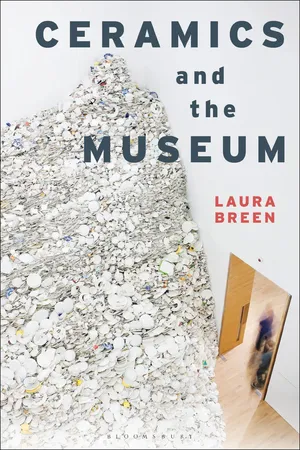
Ceramics and the Museum interrogates the relationship between art-oriented ceramic practice and museum practice in Britain since 1970.
Laura Breen examines the identity of ceramics as an art form, drawing on examples of work by artist-makers such as Edmund de Waal and Grayson Perry; addresses the impact of policy making on ceramic practice; traces the shift from object to project in ceramic practice and in the evolution of ceramic sculpture; explores how museums facilitated multisensory engagement with ceramic material and process, and analyses the exhibition as a text in itself.
Proposing the notion that 'gestures of showing,' such as exhibitions and installation art, can be read as statements, she examines what they tell us about the identity of ceramics at particular moments in time. Highlighting the ways in which these gestures have constructed ceramics as a category of artistic practice, Breen argues that they reveal gaps between narrative and practice, which in turn can be used to deconstruct the art.
- 256 pages
- English
- ePUB (mobile friendly)
- Available on iOS & Android
eBook - ePub
Ceramics and the Museum
About this book
Information
1
Showing Ceramics
When we consider showing as a discursive act, the central role it has played in the institutionalization of ceramic practice becomes clear. The evolution of ceramic exposition is enmeshed with the development of studio pottery and efforts to articulate its value. Display was used to negotiate studio practice's position in the artistic landscape and to consolidate the identity of the crafts in the post-war period. It also served to defend this territory as the divisions between artistic media dissolved in the 1960s and 1970s. Subsequent efforts to explore alternative narratives were played out in exhibitions and display spaces too. Since the late 1990s, some ceramicists have made showing part of the form and content of their works, lauding its potential to overturn existing ceramic stereotypes. However, this chapter demonstrates that showing has always operated in tension with other aspects of ceramic discourse, particularly when, as now, its existing identity and support mechanisms are under threat. It allows us to imagine other ceramic histories. And futures.
Towards a standard
Studio pottery internalized many of the values of the Arts and Crafts movement, especially William Morris's reframing of handmaking as an ideological activity: a means by which to resist the homogenizing forces of industry.1 From the outset, gestures of showing played a role in communicating these ideals to wider audiences, particularly with the founding of the Arts and Crafts Exhibition Society in 1887, which Walter Crane, the Society's president, argued would
give opportunity to the designer and craftsman to exhibit their work to the public for its artistic interest and thus to assert the claims of decorative art and handicraft to attention equally with the painter of easel pictures, hitherto almost exclusively associated with the term art in the public mind.2
Crane's statement reflected his view that it might both provide an antidote to the ‘poor taste’ of many of the industrial products shown in the exhibitions that grew up in the wake of the Great Exhibition of 1851 and, moreover, serve as a critique of the fine art emphasis of the Royal Academy.3 As is well documented, the time-intensive processes and materials they used raised the price of their products, placing them beyond the purse of the average person: only those of high social status might regard them as commonplace and employ them as intended. This led to a conflict between rhetoric and audience that was to have continued impact on ceramic practice. Nevertheless, at this stage, there was no ‘ceramics’, and studio pottery was simply regarded as one of many applications of ceramic practice.
The Exhibition Society endeavoured to list the names of all of those who had contributed to the making of an object in addition to the companies they worked for. Foregrounding collaborative enterprise, this approach diverged from existing modes of labelling both fine art and crafts. However, the fact that the Society adopted this strategy in an attempt to ensure the exhibits received artistic judgement suggests that they had still internalized modern ideas of authorship.4 By doing so, they shifted the focus from the consumer's interpretation to the reputation of the maker (or makers in this case). This is something that, Roland Barthes has argued, is complicit with capitalist ideology – the very thing the Arts and Crafts movement opposed – because it reinforces the notion of artistic genius.5
In the early twentieth century it briefly seemed that authorship might open the door to a broader view of art that centred on skilled production. In his 1909 Essay in Aesthetics, art critic Roger Fry proposed that our reaction to an object is intimately bound up with the emotion that the artist felt when conceiving it.6 He argued that only purely visual works that were able to transcend utilitarian form could achieve the holy grail of disinterested contemplation, which marked a work's success, denying agency to those working with utilitarian form.7 However, when Fry later recanted his position under the influence of fellow critic Clive Bell, his focus shifted from production to reception. Bell contended that ‘significant form’, determined by the aesthetic response to forms and the relations of elements such as line and colour, was the distinguishing characteristic of an artwork.8 Importantly for the nascent studio pottery movement, he also extended this insight to other areas of art practice including ‘matters of architecture, pottery, textiles’.9 The emphasis on visual perception also gave showing a greater role in a work's evaluation.
These ideas aroused the interest of V&A curator Bernard Rackham and his assistant Herbert Read and informed their 1924 book English Pottery. Extending Fry's earlier thesis, they made a case for handmade pottery as a mode of direct expression, which was comparable with painting or sculpture.10 They also produced a set of criteria against which to judge utilitarian forms. In keeping with their belief that ‘pottery is, at best, an abstract art’, this centred on fitness for function, appropriate materials, appropriate design and complementary, preferably abstract, decoration.11 They hoped that this aesthetic standard would elevate the critical appreciation of early English earthenware. However, they excluded highly decorative works from their model of pottery as an art form, suggesting that they might be better judged on their painterly values.12 In doing so, they spotlighted a perceived disjuncture between utilitarian and decorative works that was to become an increasingly contentious issue as studio pottery practice developed, particularly when it came to showing.
Although Rackham and Read's wrangle with taxonomy demonstrated the challenges that classification posed to those in their profession, contemporary practice was outside of their curatorial remit at the time. Yet display was already being used to distinguish art-oriented pottery from its utilitarian counterparts outside the museum. For one practitioner, William Staite-Murray, pottery was, as Rackham and Read described it, ‘an abstract art’ – a genre in its own right, which stood ‘between painting and sculpture’.13 Accordingly, he chose to exhibit with fine artists including Ben and Winifred Nicholson in the Seven and Five Society, presenting his work on plinths, with titles.14 This formed a stark contrast to both the ordered displays of historical decorative pottery specimens in museums and the massed ranks of wares in retail display. It invited the type of detached, aesthetic consideration that Bell considered the key marker of artistic value and which Bourdieu later argued was central to the establishment of ‘pure’ art theory: differentiating art-as-pure-signification from art-as-commodity form.15 This was a distinction that also sustained art market practices wherein the refutation of commercial interests was directly linked to the accumulation of symbolic and reputational capital and the associated (monetary and symbolic) profits.16
Julian Stair has retrospectively heralded Staite-Murray's incursion into the fine art gallery as a success story for studio pottery, which represented an opportunity to achieve parity with fine art.17 However, Imogen Hart has countered that pots might equally have been used to domesticate art, making it more saleable.18 Furthermore, as Tanya Harrod observed in The Crafts in Great Britain, there was no clear established exhibition system for the crafts during the interwar period, and ‘a single maker might exhibit or sell work in a New Bond Street gallery, at the Arts and Crafts Exhibition Society, with the British Institute of Industrial Art or at a humble agricultural show’.19 Studio pottery in particular – as the deliberations of Fry, Bell, Rackham and Read demonstrated – had no obvious home.
The tale of Staite-Murray's contemporary, Bernard Leach, highlighted the issues this indeterminacy could pose for those seeking to locate their practice. Leach was acutely aware of the power of exposition and had already given explicit instructions on how his uncle (the first director of the National Museum and Gallery in Cardiff) should display a crate of tea ceremony objects, which he sent from Japan. Providing drawings of how they should be arranged to convey Japanese aesthetic ideals, he even sent his friend Matsubayashi Tsuronosuke to the museum to lay the display out in 1924.20 It is unsurprising, therefore, that he used gestures of showing to shape the reception of his own work.
Like Staite-Murray, Leach exhibited art-oriented pots in galleries. However, he also sold less-expensive domestic wares in order to make ends meet. As all of his forms were ostensibly functional, he used context to distinguish between them: something that became key in 1927, when he produced concurrent exhibitions that showcased the two strands of his practice. One of these was devoted to Collectors' Pots and held at Paterson's Gallery in prestigious Bond Street; the other, for English Slipware … Ordinary Household Utensils at the more modest Three Shields Gallery in Holland Park. By reserving his collectors' pieces for the more illustrious venue, Leach created a hierarchical division between his functional and non-functional pottery, capitalizing on each venue's target audience. He further drew a distinction between earthenware, which was aligned with the ordinary, and stoneware, which was sold in the collectors' show. However, he was trying to reap the profits from two markets with incompatible value systems. For Bourdieu:
Producers and vendors of cultural goods who ‘go commercial,’ condemn themselves, and not only from an ethical or aesthetic point of view, because they deprive themselves of the opportunities open to those who can recognise the specific demands of this universe and who, by concealing from themselves and others the interests at stake in their practice, obtain the means of deriving profits from disinterestedness.21
Rather than ‘going commercial’, at this stage Leach attempted to differentiate between the symbolic and the commercial aspects of his own practice. Nevertheless, this made his economic interest apparent, diluting his personal brand and, therefore, reputational capital.
Just a year after the two shows, Leach turned against the collectors he had courted at Paterson's Gallery in his now infamous tirade, A Potter's Outlook. Appealing to fellow practitioners, he pronounced:
What have the artist potters been doing all this while? Working by hand to please ourselves as artists first and therefore producing only limited and expensive pieces, we have been supported by collectors, purists, cranks and “arty people” rather than by the normal man or woman … and consequently most of our pots have been still-born; they have not had the breath of reality in them: it has been a game.22
Trivializing attempts to separate art-oriented studio pottery from useful wares, he implied that producing individual works was inauthentic. However, the text also provided theoretical justification for his move towards production pottery at a time when he faced commercial troubles and should be read with that in mind.
Looking for a home
de Waal has identified the period of Leach's two shows as the genesis of a distinctive craft world.23 However, as Harrod has shown, ceramics continued to be shown alongside fine art and as part of high-end room sets in gall...
Table of contents
- Cover
- Halftitle Page
- Title Page
- Contents
- List of Figures
- Acknowledgements
- A Note on the Text
- Introduction
- 1. Showing Ceramics
- 2. Societal Shifters
- 3. Defining Exhibitions
- 4. Ceramic Practice and the Collection
- 5. Space and Place
- 6. Material and Process
- Conclusion
- Select Bibliography
- Index
- Imprint
Trusted by 375,005 students
Access to over 1.5 million titles for a fair monthly price.
Study more efficiently using our study tools.
Frequently asked questions
Yes, you can cancel anytime from the Subscription tab in your account settings on the Perlego website. Your subscription will stay active until the end of your current billing period. Learn how to cancel your subscription
No, books cannot be downloaded as external files, such as PDFs, for use outside of Perlego. However, you can download books within the Perlego app for offline reading on mobile or tablet. Learn how to download books offline
Perlego offers two plans: Essential and Complete
- Essential is ideal for learners and professionals who enjoy exploring a wide range of subjects. Access the Essential Library with 800,000+ trusted titles and best-sellers across business, personal growth, and the humanities. Includes unlimited reading time and Standard Read Aloud voice.
- Complete: Perfect for advanced learners and researchers needing full, unrestricted access. Unlock 1.5M+ books across hundreds of subjects, including academic and specialized titles. The Complete Plan also includes advanced features like Premium Read Aloud and Research Assistant.
We are an online textbook subscription service, where you can get access to an entire online library for less than the price of a single book per month. With over 1.5 million books across 990+ topics, we’ve got you covered! Learn about our mission
Look out for the read-aloud symbol on your next book to see if you can listen to it. The read-aloud tool reads text aloud for you, highlighting the text as it is being read. You can pause it, speed it up and slow it down. Learn more about Read Aloud
Yes! You can use the Perlego app on both iOS and Android devices to read anytime, anywhere — even offline. Perfect for commutes or when you’re on the go.
Please note we cannot support devices running on iOS 13 and Android 7 or earlier. Learn more about using the app
Please note we cannot support devices running on iOS 13 and Android 7 or earlier. Learn more about using the app
Yes, you can access Ceramics and the Museum by Laura Breen in PDF and/or ePUB format, as well as other popular books in Design & Art General. We have over 1.5 million books available in our catalogue for you to explore.