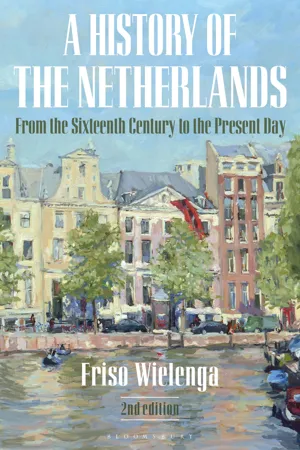
This is the most comprehensive history of the Netherlands available in the English language. It surveys Dutch history from the 16th century, when the nation took shape as a geographical, administrative and political entity, right through to the Netherlands of today. Examining domestic politics and wider international contexts, as well as economic and cultural history, Friso Wielenga provides a varied and in-depth investigation that will lead to a rich understanding of the country's past. The book also challenges misplaced preconceptions regarding political consensus and religious toleration in the country and offers a balanced assessment of developments across the early modern, modern and contemporary eras. This new edition includes: * One brand new chapter on the Netherlands since 1945
* Much more material on colonial history, slavery, the decolonisation of Indonesia and the contemporary legacy of colonialism
* Historiographical updates throughout
* A wealth of new images, maps, tables and figures This book is essential reading for anyone seeking a knowledge of Dutch history since 1500.
eBook - ePub
A History of the Netherlands
From the Sixteenth Century to the Present Day
- 360 pages
- English
- ePUB (mobile friendly)
- Available on iOS & Android
eBook - ePub
About this book
Trusted by 375,005 students
Access to over 1.5 million titles for a fair monthly price.
Study more efficiently using our study tools.
Information
CHAPTER 1
INTRODUCTION
The question as to when a country’s history began is often answered by a reference to the outbreak of a revolt, the proclamation of sovereignty or the moment of international recognition. Such responses do not help, though, in the case of Dutch history, and it is striking that there is no national public holiday on which to celebrate the founding of the nation. Dutch national bank holidays date from the late nineteenth century (initially Princess’s Day, later Queen’s Day and now King’s Day) or from the middle of the twentieth century (liberation from Nazi German occupation in 1945). No single heroic or symbolic moment during the Eighty Years’ War (1568–1648), during which the Netherlands took shape, has been commemorated through such a day.
This is understandable. At the beginning of the Revolt against Spain in the second half of the 1560s, the overriding issue was not the independence of a particular area but the retention of aristocratic privileges in an empire that was centralizing, against a backdrop of Protestant resistance to Catholic repression. Even when it became clear in about 1580 that the secession of a few Dutch provinces from Philip II’s Spanish Empire was inevitable and a division of the Netherlands into a northern and southern part was taking place (roughly the present Netherlands and Belgium), it was still not about the independence of a well-defined territory. It is striking, for instance, that during the 1580s the rebellious provinces twice offered their sovereignty to foreign royals. The northern provinces did not take charge of their own sovereignty until 1588, after these attempts had failed, and a federal republic was organized with independent provinces, towns and cities. Although it was dubbed the Republic of the United Netherlands, this name was never officially adopted.1
There was still no clarity about the ultimate borders of this loose alliance in 1588. They did not firm up until the 1590s, when the territory of the current Netherlands acquired an outline as a result of the military successes against Spain. This area consolidated in 1609, and around 1630, the current North Brabant and South Limburg were added. The war with Spain finally ended in 1648 with the Peace of Münster (an element of the Peace of Westphalia), and the Republic received definitive international recognition as an independent country.
The end result had little in common with the Revolt’s objectives dating from the second half of the sixteenth century. In fact at that time the word Revolt was never used. Recollections of contemporaries and the first history publications talked about ‘wars’, ‘troubles’, ‘riots’ and ‘wretchedness’. The concept was not coined until the eighteenth century, and its description as the Revolt evolved during the next century. It was not until then that a single story emerged from the chain of events, covering many decades and, according to Ernst H. Kossmann, that era was given ‘coherence, purpose, unity’.2 Historians now agree it was completely unforeseen and unintended that the struggle of the Dutch provinces against Spanish rule would create two different political units in the Netherlands, and that during the Revolt the concerns in the separate provinces, towns and cities were often about something else, with some for and some against the Spanish crown and others that changed sides. According to Anton van der Lem, the Revolt was ‘a long succession of coincidental and unpredictable events, of political, military and economic chain reactions’.3 It is consequently not surprising that the nature of the memories about it is primarily local and that to this day, commemorations remain geographically limited.
As late as the twentieth century, Protestants interpreted the Revolt as a deliberate national struggle for independence and for freedom to practise their religion. As we shall see in the following chapter, this simplified mythical picture departed from historical reality. Fables also developed about William of Orange (1533–84). He was said to have been the ‘Father of his Country’ and to have always pursued ‘national’ independence and consistently fought for it. There is no doubt that he took over leadership of the Revolt, which he paid for with his life in 1584, but for many years Orange did not want a split with Spain and certainly not a division between the north and the south of the Netherlands.4
Images of the Revolt such as these are part of nationalistic nineteenth-century historical writings and were dismissed long ago as incorrect. A number of insurgents advocated making Calvinism the only permitted faith, while others wanted religious tolerance and the principle – which was new at that time – of having multiple religions cheek by jowl in one governmental zone. If one contends that the religious issue was at the core, there is good reason for calling the conflict in the Low Countries a civil war, just as there were religious hostilities during this era in other European regions. Should we consider freedom to have been the key issue, however, a distinction needs to be made between those who initially wanted to retain their own – in many cases aristocratic – privileges, primarily old traditional liberties, which in this period of centralization, professionalization and bureaucratization were being jeopardized, and those who were fighting to be free from ‘Spanish tyranny’.5 In addition, during the decades of this struggle, the motives and objectives of the many players overlapped and shifted time and again.
In other words, the outcome of the Revolt was very different from its initial aspirations and goals, but looking back, it was without doubt the central factor in the creation of the Dutch state. At its end there was an internationally recognized Dutch Republic with more or less the same borders as the present-day Netherlands. Starting in the late sixteenth century, the Republic developed into a wealthy global trading power with outposts in every continent. It also took the international lead in culture and technology. The worldwide Dutch trading network that was built up during the Revolt has left traces that are visible to this day.
The Republic had a complex political decision-making process involving a great many people. The fundamental principle during the Republic was to seek agreement, not force decisions. The culture of compromise and negotiation that developed at that time is still part of the political scene in the Netherlands. This is not to say that consultation and consensus building have dominated Dutch political history – there are far too many examples of bitterly fought political struggles for that claim. Some will be discussed at length later in this book. What matters here is that Dutch political culture in later eras had many of its roots in the years of the Revolt and the early Republic, when ‘freedom’ and ‘tolerance’ became key Dutch concepts.6
The history of the creation of the state of the Netherlands, then, is closely associated with the Revolt, but this does not answer the question as to when Dutch history ‘began’, particularly since it is difficult to identify an exact date for the start of the Revolt. Histories of the Netherlands have long identified 1568 as the beginning, in reference to the failed military advance on three fronts in Dutch territory organized by William of Orange. It would now seem that this year was chosen primarily so that – working back from 1648 – one can talk about an ‘Eighty Years’ War’ (from which, in any case, twelve years have to be subtracted for the truce between 1609 and 1621).
From a different perspective, 1566 could be taken as the start, because it was in that year that the minor aristocracy submitted a petition to the Governor, Margaret, Duchess of Parma, asking her to suspend the anti-heresy edicts and convene the States General. Later that year there was an outbreak of iconoclasm, primarily in the provinces of Flanders and Brabant – Catholic churches were stripped of statues and paintings, and church buildings were commandeered for Calvinists to use. This unarguably made 1566 a year in which opposition to Spanish rule increased dramatically. One of the leading authorities on this period, A. T. van Deursen, writes that the Revolt became ‘a reality’ in that year.7
The exact date that the Revolt began, however, is not actually that important in the search for a ‘starting point’ for the history of the Netherlands. Many historians who have written about the Revolt begin in 1555, when Charles V abdicated as Holy Roman Emperor and his son, Philip II, became Lord of the Netherlands. In his major standard work on the Republic, The Dutch Republic: Its Rise, Greatness and Fall, 1477–1806, the British historian Jonathan Israel takes a longer run-up. He starts with the death of Charles the Bold, Duke of Burgundy, ruler of the Netherlands, and the succession of his daughter, Mary of Burgundy, who married Habsburg Maximilian of Austria in the same year. Charles the Bold’s death meant not just the end of the Burgundian Netherlands and the beginning of Habsburg rule, it also, importantly, gave the Low Countries the opportunity to reverse some of the centralization measures he had initiated. The effect was short-lived. During the first half of the sixteenth century, under Charles V, unification and centralization were pursued consistently, successfully and more forcefully than ever before. Jonathan Israel describes in detail this period prior to the Revolt – an obvious place to begin a comprehensive work that presents with animation and conviction the entire history of the Dutch Republic up to 1806. Horst Lademacher does not start his broadly based, wide-ranging Die Niederlande: Politische Kultur zwischen Individualität und Anpassung with a particular year, although his approach corresponds to Israel’s. He, too, begins with the late medieval unification policy of the Burgundies, which was continued by the Habsburg dynasty after Mary of Burgundy’s death in 1482.8
Against this backdrop, it is justifiable to start this overview of Dutch history in 1555, with a brief overture that began in the late fifteenth century.9 The literature on the country’s past since the sixteenth century is well-nigh inexhaustible and it would be going too far to produce a synopsis here. One is struck, though, by the modest number of publications that cover an extended period. The writings of Israel and Lademacher referred to above do span a number of centuries, but their bulk means they are not handy overviews. Besides, Israel stops at 1806 and addresses the late eighteenth century only very briefly, while Lademacher falls short when dealing with the years after 1945. Information about the period starting in the late seventeenth century is to be found in Kossmann’s The Low Countries 1780–1940. Piet de Rooy wrote about the Netherlands since 1800 in both Republiek van rivaliteiten and Ons stipje op de waereldkaart.10 Another important source is the publication by Maarten Prak and Jan Luiten van Zanden, Nederland en het poldermodel, which addresses the development of political institutions, government structure and the economy from the Middle Ages to today.11 The entire period from prehistory to the present is presented clearly but in summary form in Een kennismaking met de Nederlandse Geschiedenis by István Bejczy.12 Christophe de Voogd’s Geschiedenis van Nederland, originally written for publication in France and consequently with very much the character of an introduction for non-Dutch readers, is more broadly based.13 Han van der Horst’s successful but chunky Nederland. De vaderlandse geschiedenis van de prehistorie tot nu is more comprehensive and primarily based on narrative.14 James Kennedy recently published A Concise History of the Netherlands, starting in prehistory and ending in the present day.15 Overviews by foreign authors include Paul Arblaster’s A History of the Low Countries, Paul State’s A Brief History of the Netherlands and Michael North’s Geschichte der Niederlande, which are all readable and clear but concise.16 The history of Belgium, the Netherlands and Luxembourg is described by German historian Michael Erbe in Geschichte des niederländischen Raumes. His writing about the early modern period is convincing, but disappointing and too perfunctory when addressing the nineteenth and twentieth centuries.17 These, then, are the most important studies of Dutch history that cover a span of some centuries.
Of course there are also reference works and series with contributions from several authors. The fifteen-volume Algemene Geschiedenis der Nederlanden wins the prize for size but is now outdated.18 The handy three-volume Delta series Nederlands verleden in vogelvlucht, covering the period from the Middle Ages to the late twentieth century is more accessible.19 Geschiedenis van de Nederlanden edited by J. C. H. Blom and E. Lamberts serves as a very good companion. In common with a few other historical outlines, it describes the history of both the Netherlands and Belgium.20 Finally, mention should be made of Verleden van Nederland, part of a multimedia project of the same name, which has been written for a general readership.21
Summing up all these works, there is scope for a history of the Netherland...
Table of contents
- Cover
- Half-Title Page
- Title Page
- Contents
- List of Figures
- List of Maps
- List of Illustrations
- List of Abbreviations
- Preface
- 1 Introduction
- 2 Opposition and Revolt: The Creation and Consolidation of the United Provinces of the Netherlands, or the Dutch Republic (1555–1609)
- 3 The Republic in the Golden Age
- 4 A Second-rate Power: The Decline of the Republic in the Eighteenth Century
- 5 From Restoration to the Liberal Era (1813–1917)
- 6 Pillarization, Stability, Crisis and War (1918–1945)
- 7 The Netherlands after 1945: Reconstruction, Changes in Foreign Policy and in Political Culture, the Polder Model and the Challenge of Populism
- 8 Epilogue
- 9 Afterword
- Notes
- Timeline
- Bibliography
- Index of Names
- General Index
- About the Author
- Copyright
Frequently asked questions
Yes, you can cancel anytime from the Subscription tab in your account settings on the Perlego website. Your subscription will stay active until the end of your current billing period. Learn how to cancel your subscription
No, books cannot be downloaded as external files, such as PDFs, for use outside of Perlego. However, you can download books within the Perlego app for offline reading on mobile or tablet. Learn how to download books offline
Perlego offers two plans: Essential and Complete
- Essential is ideal for learners and professionals who enjoy exploring a wide range of subjects. Access the Essential Library with 800,000+ trusted titles and best-sellers across business, personal growth, and the humanities. Includes unlimited reading time and Standard Read Aloud voice.
- Complete: Perfect for advanced learners and researchers needing full, unrestricted access. Unlock 1.5M+ books across hundreds of subjects, including academic and specialized titles. The Complete Plan also includes advanced features like Premium Read Aloud and Research Assistant.
We are an online textbook subscription service, where you can get access to an entire online library for less than the price of a single book per month. With over 1.5 million books across 990+ topics, we’ve got you covered! Learn about our mission
Look out for the read-aloud symbol on your next book to see if you can listen to it. The read-aloud tool reads text aloud for you, highlighting the text as it is being read. You can pause it, speed it up and slow it down. Learn more about Read Aloud
Yes! You can use the Perlego app on both iOS and Android devices to read anytime, anywhere — even offline. Perfect for commutes or when you’re on the go.
Please note we cannot support devices running on iOS 13 and Android 7 or earlier. Learn more about using the app
Please note we cannot support devices running on iOS 13 and Android 7 or earlier. Learn more about using the app
Yes, you can access A History of the Netherlands by Friso Wielenga in PDF and/or ePUB format, as well as other popular books in History & European History. We have over 1.5 million books available in our catalogue for you to explore.