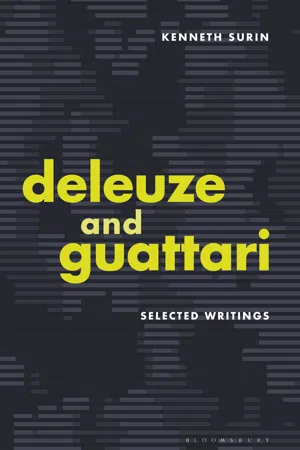
Representing a sustained engagement with the thought of Deleuze and Guattari, covering more than two decades and on a wide range of topics, from aesthetics and literature to capitalism and Marxism, Kenneth Surin takes politics as the thematic thread to this collection.
Deleuze and Guattari: Selected Writings tackles both central political issues, such as the State, globalization, and the citizen, as well as the political qualities of topics generally considered outside this realm, such as the animal, the image, and the literary. Surins pursues theoretical interventions inspired by Deleuze and Guattari's scholarship in relation to Marxism and specifically materialism and notions of political solidarity, which they did not engage with extensively or explicitly themselves, but which extend their critique along new lines of flight.
This book demonstrates the breadth and lasting relevance of Deleuze's and Guattari's legacy by tracing the affinities between Deleuze and both Marxist sociologist, Antonio Negri, and Raymond Williams, one of the founders of cultural studies as a discipline.
- 280 pages
- English
- ePUB (mobile friendly)
- Available on iOS & Android
eBook - ePub
About this book
Information
1
The “Epochality” of Deleuzean Thought …
The history of philosophy rather than repeating what a philosopher says, has to say what he must have taken for granted, what he didn’t say but is nonetheless present in what he did say.
Gilles Deleuze1
The history of philosophy has a doxa. This doxa issues in a characteristic gesture, somewhat ritualized in the way that such doxastic gestures tend invariably to be, which shows itself in the willingness of the historian of philosophy to traffic in commonplaces about the “epochal” qualities of the great philosopher, the possessors of such uniquely distinctive qualities most typically being said to include Descartes, Kant, Hegel, Marx, Nietzsche, and Heidegger. Thus, Descartes is “epochal” because he made Knowledge and Knowing predicates of the res cogitans, thereby supplanting divinitas as the “holder” of this predicate (here we are told that before Descartes Knowledge was basically a component of theological, as opposed to human, reason); Kant because he provided a reading of the so-called transcendentals—truth, goodness, and beauty (the focus of the three Critiques)—that did not invoke a supreme being as the transcendental of these transcendentals; Hegel because he gave us the most profound architectonic of forms, the most subtle structural logic of their modes of change and their interrelationships; Marx because he realized so powerfully that we now had to see the transcendentals as having their basis in a historically determinate social formation—namely, productive labor in capitalism; Nietzsche, because in a way without parallel, he saw everything, including divinity (and the will to truth, goodness, and beauty), as the product of an irreducible power of fabulation; Heidegger because he managed to tell the whole story of Western philosophy in terms of its decisive permeation by a certain myth of the logos (and its ancillary mythemes of the original, the identical, and the corresponding); and so forth. It is easy to say, of course, that such gestures of homage are the result of a simplifying propensity, not necessarily misleading or egregiously propagandizing, but simplifying nonetheless. What then are we to make of Foucault’s famous tribute to Deleuze, doubtless delivered somewhat tongue in cheek, but now adverted to in just about every discussion of Deleuze’s work, “Mais un jour, peut-être, le siècle deleuzian”?2
Is there any point in proposing the “epochality” of Deleuzean thought, in Foucault’s or some other way? And, perhaps more importantly, what would it be to make a proposal of this kind where Deleuze is concerned? Or is any such attempt doomed to have the character of a “phantasmology” (the term is Foucault’s), since it rests on the fantasy of a general philosophy of history marked by so-called “epochal” turning points—and, we could go on to say, there is no such thing as a general history of philosophy, because all such histories are founded on some dubious myth of origination, such as that of Plato as the “father” of philosophy (here one recalls Whitehead’s dictum that all philosophy is a series of footnotes on Plato)?3 Furthermore, it could be argued that this general philosophy of history is what it is only because it casts philosophy, problematically, as an attempt to tell again and again a certain kind of story about the world, the subject, and God, so that even those trying to tell a story without this triptych, nonetheless, end up by saving a place for their spectralized presences.4 These objections to a general philosophy of history do not however pose an insurmountable problem for the proponent of a Deleuzean thought. For it could be argued that the achievement of this thought lies precisely in the break that it makes with the axioms that underlie the “phantasmology” that is this general philosophy of history: Deleuze’s thought is a “reversed Platonism” with no need to do philosophy in a way that, say, begins from Plato and culminates in some later figure (e.g., Heidegger) who has to “end” philosophy by destroying the Platonic first principles (Plato as the father-mother who gives birth to abstraction, the transcending of sensuousness) from which philosophy begins (although Heidegger is of course undeniably important for Deleuze). This in fact is the gist of the account of Deleuze’s accomplishment given by Foucault in “Theatrum Philosophicum.”
Similar sentiments underpin the many other overlapping or parallel depictions of Deleuze’s achievement: it is said that he “overturned” Hegel; that he bypassed Sartre and Merleau-Ponty (saying hardly a printed word about them in the process); that in a manner akin to cutting the proverbial Gordian knot he “undid” psychoanalysis and semiology; that even though he had precursors (especially Nietzsche), he was the first to invent a truly “post-dialectical” philosophy; that he was the first to “theorize” a cinema of the sublime; that, motivated by his “reversed Platonism,” he produced profoundly original philosophical commentaries on Spinoza, Leibniz, Hume, Kant, Nietzsche, and Bergson; that he wrote innovative literary studies of Proust and Kafka; that he provided an unusual and suggestive interpretation of masochism; that he formulated, in his work on Francis Bacon, an aesthetics that may have been the first such to relate, in terms of a rigorous complementarity, the iterabilities of sense to the plexus of sensation. The list could go on.5
The assertion of “epochality” in the history of philosophy, however, cannot rest on the mere assertion of a difference between this or that thinker or this or that movement or system of thought. The occasion or system that produces the putative difference in question has to be accounted for before the import of the latter can be seen, and this is not done when one pays one’s respects to Deleuze merely by saying, however sagely or grandiloquently, that he “overturned” Hegel or whatever. Foucault, for one, did a great deal more than this (in “Theatrum Philosophicum”). But what Foucault did not do, and this is a troubling idealism in his otherwise remarkable assessment of Deleuze in this essay, is to show what it is about Deleuzean concepts that gave them their particular affinity for this century. For Foucault to tell us, even with the erudition and conceptual acumen so palpably displayed in “Theatrum Philosophicum,” that Deleuze, among other things, “reversed” Platonism is not by that very fact to tell us what it is about Deleuzean thought that expresses something different—something critically, indeed radically, different—about that thought and its relation to this century.
To posit a distance between Deleuzean thought and its Platonic or Cartesian or Hegelian counterparts is not by that fact alone to account for the centrality of that thought for this century. To do this one has, at the very least, to delineate something like the imaginary or the épistémè (the Foucauldian resonance here is certainly not inadvertent) of le siècle deleuzian, and then set out those aspects of Deleuzean thought which have a peculiar saliency for this épistémè or imaginary. The thought that is “Deleuzean” has to be read in terms of the épistémè, but, equally, the épistémè has to be approached in terms of the thought. It is this reciprocity and congruence between Deleuzean thought and the imaginary constitutive of his century that will give substance to the claim that there may come a time when the name of Foucault’s friend and colleague will function emblematically as one of the names for “our century.”6
Hegel told the story of philosophy as the story of the emergence of abstraction from the immediacy and concreteness of the sensuous order. Moreover, he told this as a story for an age—the age of which he was a denizen, namely, “modernity”—that was beginning to be synonymous with the exponential proliferation of abstract forms. It is fashionable to depict Deleuze as an anti-Hegelian, and indeed there are statements in his works that lend an air of incontrovertibility to judgments of this kind. But at best this tells only a part of the story. Granted that Deleuze and Guattari’s Capitalisme et schizophrénie can be viewed as an immense “unwriting” or conceptual unraveling of Hegel’s Phenomenology of Spirit.7 To say this, and only this, however, is to overlook the fact that Deleuze is like Hegel (and Spinoza and Leibniz of course) in being one of the great producers of an architectonic for the organization of the sensuous; like them Deleuze undertook this as a “project” of immense conceptual orchestration, one that, by virtue of being conceptual, necessarily involves movement beyond the percepts and affects that constitute the sensuous. In the case of Hegel this movement beyond the sensuous takes one inevitably into the universal, whereas in the case of Deleuze the universal is deliberately bypassed, and abstraction, the movement beyond the sensuous, takes the Deleuzean thinker into the realm of the multiple and the singular.
But what is it about the epoch that favors or calls for an orchestration of the sensuous that involves the multiple and the singular, as opposed to the universal? Here it is important to say something about the image of thought sponsored by our epoch, before trying to connect up this image of thought with Deleuze’s philosophy.
This is an age that has witnessed, and ostensibly will go on witnessing—not just in the idioms that go by the names of so-called theoretical formulation, but also in the domains of everyday life—a huge growth of new forms of movement, change, and juxtaposition or adjacency. This development has been accompanied by the emergence of new and very different subjectivities and potentials: a relative short span of time separates, say, Bertrand Russell or T.W. Adorno (designating here not so much individuals as types of consciousness) from Monique Wittig or Hakim Bey (again signifying forms of consciousness), but they are eons apart in terms of their intellectual (and “affective”) distance from each other. (The distance of Adorno and Russell from someone like Dennis Rodman or Arnold Schwarzenegger would seem to be more obvious if not impressive; it is hard, for example, to imagine Adorno surfing the internet or the co-author of Principia Mathematica wearing a pair of Nike sneakers—something many a sedate and decorous college professor would do today.)
This, moreover, is the time of a rapid and seemingly inexorable development of new forms of knowledge, knowledges that are no longer predicated on principles, amounting to axioms for “right judgment,” that invoke notions of the true, the false, the erroneous, and so forth. Instead, these new knowledges point in very self-conscious (the preferred term in some quarters is “self-reflexive”) ways to their beginnings in an irreducible fictiveness or fabulation. The emergence of these new knowledges has been accompanied, concomitantly, by the rise of a whole range of sciences, based on the creation of “nonstandard” logics and topologies of change and relation, and typically devised to deal with situations that have the character of the irregular or the arbitrary.
These new logics and topologies concern themselves not only with the structural principles of change and process, but also with surfaces, textures, rhythms, connections, that is, items possessing fractalized forms that can be expressed and analyzed in terms of such notions as that of “strings,” “knots,” “flows,” “labyrinths,” and so forth. The “rhizome,” probably the best-known figure in the conceptual repertoire developed by Deleuze and Guattari in Mille plateaux, has quite obvious affinities with these by now commonplace categorizations of the fractal sciences. The time of “rhizomatic structures” may indeed be the time of an invention of a “new” Baroque, as Deleuze himself has pointed out in his book on Leibniz.8 This “new” Baroque, and its accompanying burgeoning of “asystemic” but still interrelated forms, has not only coincided with a reconfiguration of the human sensorium and a further and even more extensive elaboration of our sensibilities: just as significantly, the new logics and topologies associated with it are also generating principles of integration that allow radically different mechanisms to function in concert. Computer and cybernetic technologies, the nervous system, commodity production, speech and semiosis—areas before constituted on the basis of divergent and even incommensurate logics and conceptual idioms—are now being orchestrated in terms of a language that renders them “isomorphic,” fundamentally congruent.
The “cyberspaces” of the writings of William Gibson, Bruce Sterling, Neal Stephenson, and others represent in many ways a culmination, impressed more and more deeply into our cultures, of these integrations and “concerts.” Indeed, “cyberspaces” have striking affinities with “the fold” that Deleuze takes to be the defining feature of the Baroque.9 (Incidentally, the intellectual career of Michel Serres can be seen as a parallel to that of Deleuze’s, inasmuch as it is largely, but of course not entirely, an attempt to speak rigorously of the conceptual dimensions that subtend these new transformations in science and logic.10)
Along with the shifts and transformations associated with this new historical phase, capitalism itself is being transformed yet again. In its current manifestations capitalism is becoming more abstract, more “diagrammatic,” because only in this way can it ensure that every and any kind of production—even that of a “precapitalist” variety—is mediated by it and placed at the disposal of accumulation. This latest phase of capitalist development has been depicted and analyzed under a variety of by now well-known titles: “advanced capitalism,” “late capitalism,” “disorganized capitalism,” “integrated world capitalism,” “globalized capitalism,” “post-Fordism,” etc. The movement to this current phase, marking the collapse of the previous world economic order, is manifested in several different registers. These include the creation of an international division of labor, the increasingly significant role of transnational corporations in the composition of capital, the rise of an international debt economy, the introduction of flexible manufacturing systems and labor processes, the rapid growth (especially in the economies of the peripheral and semiperipheral nations) of standardized markets and patterns of consumption, the emergence of decentralized and so-called informal economies, the development of complex securities and credit systems, the transformation of the capitalist state, the inauguration of a new semiotics of value, and so forth.11
It is now something of a commonplace for economic theorists to argue that this shift to a new paradigm of production and accumulation can be seen as a response to the collapse of the preceding system of capitalist development, a system that had prevailed since 1945. In the account given by Samir Amin, an account whose lineaments are to be found in just about every other narrative given by theorists of the post-war world-system, the post-war system had three focal points: Fordism in the countries of the west, Sovietism in the countries of the eastern bloc, and developmentalism in the so-called third world.12 The collapse of this world-system in the 1970s produced yet another mutation in capitalism, and the conceptual innovations brought about in Capitalisme et schizophrénie can be seen as part of an attempt to think this mutation in terms of a reciprocal movement, the modus operandi of which is to imbue thought with life by bringing this mutation—“homeopathically”—into thought. This mutation launches thought, but also, in a kind of ceaseless oscillation, rescues this mutation from a life of the undead (this being capitalism’s decisive accomplishment) by bringing thought to it, so that this mutation and all that it involves can then be supplanted by a different and creative life that cannot be mistaken for its shadow, the zombie world of capital. How does the conceptual cartography furnished by Capitalisme et schizophrénie accomplish this?
Hypercapitalism—the strategic but still chaotic “response” of capitalism to the collapse of the post-war Keynesian and Fordist world-system—poses, unavoidably for all those who purport to be historical or political materialists, the question of its relation as a phenomenon to the lexicon or axioms that can be said to constitute marxism.13 How will we know that capitalism in its current manifestations is congruent with the axiomatic that is marxism? This compliance or congruence can only be established through a principle, a second-order principle, which cannot of necessity be “marxist,” and this because the applicability of marxism to the domain that is called capitalism (or hypercapitalism in its present manifestation) can only be specified metatheoretically, that is, from beyond the range of the theoretical armature whose name is “marxism.” It is this metatheoretical or “transcendental” specification that informs us in virtue of what conditions and axioms is this domain (i.e., capitalism) governed by this axiomatic (i.e., marxism), and Capitalisme et schizophrénie gives us precisely the kind of metatheoretical schema that enables the political materialist to connect up the algorithm that is marxism with the cultural and economic phenomenon that is hypercapitalism.14
This metatheoretical schema has at its heart a couple of axes—“deterritorialization” and “reterritorialization”—that enable the authors of Capitalisme et schizophrénie to understand the logic of capitalism in terms of two complementary sets of practices. Deterritorialization is the movement that decomposes geographical spaces, individual and collective identities, value systems, etc., while reterritorialization is the counterpart movement that...
Table of contents
- Cover
- Halftitle Page
- Title Page
- Dedication
- Contents
- Preface
- Acknowledgements
- Glossary
- 1 The “Epochality” of Deleuzean Thought …
- 2 Deleuze’s Three Ontologies
- 3 Was Deleuze a Materialist?
- 4 Force as a Deleuzean Concept
- 5 On Producing the Concept of the Image-Concept
- 6 “A Question of an Axiomatic of Desires”: The Deleuzean Imagination of Geoliterature
- 7 “Existing Not as a Subject but as a Work of Art”—The Task of Ethics? or Aesthetics?
- 8 The Socius and Life
- 9 “1000 Political Subjects …”
- 10 The Radical Event?
- 11 On Producing (the Concept of) Solidarity
- 12 What Is Becoming-Animal? The Politics of Deleuze and Guattari’s “Strange Notion”
- 13 The Society of Control and the Managed Citizen
- 14 The Undecidable and the Fugitive: Mille Plateaux and the State-Form
- 15 “Reinventing a Physiology of Collective Liberation”: Going “Beyond Marx” in the Marxism(s) of Negri, Guattari, and Deleuze
- 16 Mao’s “On Contradiction,” Mao-Hegel/Mao-Deleuze
- Notes
- Bibliography
- Index
- Imprint
Trusted by 375,005 students
Access to over 1.5 million titles for a fair monthly price.
Study more efficiently using our study tools.
Frequently asked questions
Yes, you can cancel anytime from the Subscription tab in your account settings on the Perlego website. Your subscription will stay active until the end of your current billing period. Learn how to cancel your subscription
No, books cannot be downloaded as external files, such as PDFs, for use outside of Perlego. However, you can download books within the Perlego app for offline reading on mobile or tablet. Learn how to download books offline
Perlego offers two plans: Essential and Complete
- Essential is ideal for learners and professionals who enjoy exploring a wide range of subjects. Access the Essential Library with 800,000+ trusted titles and best-sellers across business, personal growth, and the humanities. Includes unlimited reading time and Standard Read Aloud voice.
- Complete: Perfect for advanced learners and researchers needing full, unrestricted access. Unlock 1.5M+ books across hundreds of subjects, including academic and specialized titles. The Complete Plan also includes advanced features like Premium Read Aloud and Research Assistant.
We are an online textbook subscription service, where you can get access to an entire online library for less than the price of a single book per month. With over 1.5 million books across 990+ topics, we’ve got you covered! Learn about our mission
Look out for the read-aloud symbol on your next book to see if you can listen to it. The read-aloud tool reads text aloud for you, highlighting the text as it is being read. You can pause it, speed it up and slow it down. Learn more about Read Aloud
Yes! You can use the Perlego app on both iOS and Android devices to read anytime, anywhere — even offline. Perfect for commutes or when you’re on the go.
Please note we cannot support devices running on iOS 13 and Android 7 or earlier. Learn more about using the app
Please note we cannot support devices running on iOS 13 and Android 7 or earlier. Learn more about using the app
Yes, you can access Deleuze and Guattari by Kenneth Surin in PDF and/or ePUB format, as well as other popular books in Philosophy & Aesthetics in Philosophy. We have over 1.5 million books available in our catalogue for you to explore.