This thought-provoking collection analyses the European Community's external relations between 1957 and 1992, with a particular focus upon their broader impact and global significance. Reconceptualizing the long arc of the EC's international role, from its inception in the 1950s to the end of the Cold War, the chapters identify and assess the factors that either supported or impeded Europe's international projection within this period.
Organized into three parts, the authors investigate the EC's relations with key countries and world regions, discuss its activities within key policy areas, and offer reflections and conclusions on the various arguments that are put forward. Each chapter considers the entire period from 1957-1992 to identify and explain overarching trends, key decisions and historical conjunctions through scholarly literature, key debates and original discussion of each topic or policy issue. A final chapter situates the main findings within wider contexts, situating the EC in Cold War history. Bringing together international history and international relations, this project allows for cross-disciplinary dialogue and the careful discussion of key concepts, analytical approaches, and empirical findings. Filling a gap in our understanding of the early development of the EC's role as an autonomous global actor, this book holds important messages for the modern day, as the EU's position in global politics continues to shape the world.
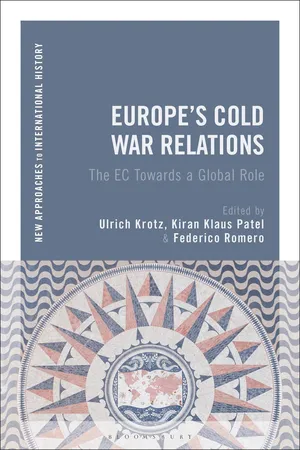
eBook - ePub
Europe's Cold War Relations
The EC Towards a Global Role
- 312 pages
- English
- ePUB (mobile friendly)
- Available on iOS & Android
eBook - ePub
Europe's Cold War Relations
The EC Towards a Global Role
About this book
Information
1
The History of the EC and the Cold War: Influenced and Influential, but Rarely Center Stage
The European Community (EC) was, from its very outset, influenced and shaped by the Cold War. The success of the integration process, meanwhile, was not unimportant for Western Europe’s role and position within the Cold War, especially during the latter stages of the East–West struggle. By the mid-1980s, if not earlier, the EC began to exercise a strong power of attraction over the neighboring states of Eastern Europe. This undoubtedly would profoundly affect their trajectory once the Berlin Wall fell, but is also likely to have been of some importance to both governmental and dissident attitudes and behaviors during the final years of the Cold War. But despite this pattern of mutual influence, to study the place of the Cold War in EC/EU foreign relations is to become aware of the highly indirect nature of the relationship between the two processes. To resort to a photographic metaphor, the Cold War is present in most historical snapshots that could be taken of the EC or of collective European decision-making during the 1958–1990 period. But it is seldom in focus, rarely at the center of the picture. Instead, it is normally a somewhat blurred background presence—undoubtedly significant, and almost certainly having an effect on other elements within each photo, but hard to look at clearly or to analyze with any degree of precision.
As a result, the easiest way to discern the influence of the Cold War on the EC is to focus instead on one of the EC’s key bilateral relationships—tracing the way in which this relationship was affected by the Cold War factor. This is perhaps most obvious when looking at the interaction between the European Community and the Socialist bloc, as Angela Romano does in her chapter. But the Cold War’s effect would also be detectable in the Community’s interactions with the United States, with the People’s Republic of China, or with its partners in the developing world, especially in Africa. As such, there will be much about the Cold War in the various geographically focused chapters of this volume, as well as in Wilfried Loth’s examination of the security dimension of the EC foreign policy.
Instead, this chapter’s focus will be threefold. Its first task will be to briefly review the existing literature on European integration and the Cold War, noting the way that most historians, and indeed most political scientists, have tended to downplay the mutual interaction of the two—although there has lately been some evidence of change in both disciplines. The second section will then seek to justify the claim that the Cold War and European integration were of importance to each other; before the third explains why their interaction was nevertheless seldom straightforward or direct. This final section will acknowledge the important change that occurred in the 1970s, when the EC began to equip itself with the policy mechanisms and instruments to enable it to become more of an actor in the Cold War. At much the same time, its readiness to adopt such a role also increased significantly. But the chapter will go on to argue that even in this later period, the Cold War remained secondary with regard to the Community’s priorities and mechanisms—an observation that only makes all the more remarkable the centrality that the Community/Union would assume in the post-Cold War reunification of the European continent. The bit-part actor in the Cold War drama would only move center stage once the East–West conflict had come to an end.
A Belated Recognition of Interconnection
Both the political science and the historical literature on the origins and early development of the European Community took their time to recognize the interconnections between the Cold War and the European integration process. In the former, the main theoretical debates about the roots of integration centered on the institutions and policies of the early integration process, much more than on their wider international context.1 There was little about the East–West struggle in the writings of the neo-functionalists, the intergovernmental institutionalists, the historical institutionalists, or the constructivists. The rather more numerous International Relations (IR) specialists who worked on the Cold War, meanwhile, took little interest in European integration, regarding it, to the extent that they noticed it all, as a low-policy and primarily economic issue of scant relevance to the decisive superpower standoff.
It was really only with the ending of the Cold War that the situation began to change. First, the doyen of realist political scientists, John Mearsheimer, published a prominent piece in 1990 which effectively predicted the end of European stability now that the Cold War had come to an end, dismissing any notion that the integration process itself had contributed to the “long peace” and could sustain it in the future.2 This publication was followed by Sebastian Rosato’s attempt to build on such ideas, setting out the theory that the integration process had been a product of the Cold War and was hence doomed to collapse once the Cold War had come to an end.3 This provoked a strong retort from scholars convinced neither by Rosato’s interpretation of how the integration process had evolved, nor by his analysis of its more recent difficulties.4 The debate, however, did have the indisputable merit of forcing political scientists at least to consider the Cold War factor—even if they doubted the overall explanatory power that Rosato claimed.
Historians were equally guilty, until comparatively recently, of ignoring any potential interplay between the East–West conflict and the emergence and development of the European Community/Union. An extensive literature developed on each with, in the case of Cold War history, a sizable literature on the European dimensions of the Cold War.5 From the early 1990s onwards, this work succeeded in reasserting an important degree of European agency and disproving the impression—sometimes conveyed by some of the earlier superpower-focused literature—that the countries of Europe had simply been pawns of Moscow and Washington. The integration literature, meanwhile, was able to move on from its initially somewhat sterile attempt to identify a single explanatory cause, into a much richer and more varied literature about the dynamics that caused both the start and the subsequent evolution of the process.6 But to a very large extent, the two literatures existed in parallel without any form of engagement between them. The occasional episode featured prominently in both the integration literature and the Cold War: the Marshall Plan would be one example, the doomed European Defence Community (EDC) another. Such points of intersection, however, constituted the exceptions that proved the rule.
Over the last decade or so, a substantial improvement has taken place. Chapters on European integration have crept into some of the best overall studies of the Cold War.7 The literature on the end of the conflict, moreover, has begun to acknowledge that the attempts by Western Europe’s states to integrate their economies and even to some extent their foreign policies did have important implications for the diplomacy of 1989–1990 and its aftermath.8 Detailed studies, moreover, have begun to look at the way in which the Community institutions began to interact with those of the Eastern bloc and, more intriguingly still, the effects this may have had on the communist regimes themselves.9 More generally, there also seems to be a willingness to perceive Cold War preoccupations and concerns as part of the panoply of factors that shaped European states and their engagement with the integration process. Eirini Karamouzi’s work on Greece would be a clear case in point, identifying Cold War considerations at work both in Athens’ decision to apply and in the manner in which this application was received in Brussels, but stopping well short of any claim that such geopolitical calculations were incompatible with multiple other economic, institutional or political rationales.10 The Cold War factor may still lurk more towards the margins of the Community snapshots referred to earlier. But in a lot of the more recent literature, it has been rather less out of focus, its interconnections with other factors of importance distinctly more apparent as a result.
Mutual Influence
The European Community was born into a Cold War-dominated world. The Schuman Plan of May 9, 1950, normally regarded as the foundational moment of Community Europe, coincides with a high point of the East–West conflict, and a moment, furthermore, when Europe was the unquestionable epicenter of the struggle—the prime battleground.11 Josef Stalin still ruled Russia, the two rival German states had just come into being, and the fear of both Soviet invasion and communist subversion were prominent features of the Western European context. The North Korean invasion of South Korea just one month later would trigger a major war-scare in Western Europe and encourage the United States to redouble its efforts to protect European security by means of the North Atlantic Treaty Organisation. In December 1950, General Dwight Eisenhower would be announced as the first Supreme Allied Commander Europe (SACEUR), responsible for coordinating the Western military response should the Soviets attack. Between 1955 and 1957, the Treaties of Rome establishing the European Economic Community (EEC) and Euratom were negotiated against an international backdrop that included the Suez Crisis and the Soviet suppression of the Hungarian revolution of 1956.12 The early years of the EEC after its start of operation in 1958 were played out on a continent cut in half by the Cold War and still strongly affected by the military, ideological, political, and economic contests between capitalism and communism. The first decade of the EEC was thus punctuated with major Cold War crises, from that over Berlin from 1958 to 1961, to the suppression of the Prague Spring in 1968, passing via the Cuban Missile Crisis of 1962 and the escalation of the Vietnam War from 1964 onwards. It would have been remarkable had this wider setting not had some bearing or influence on the manner in which European integration developed.
The intellectual origins of the drive for European unity predate the East–West conflict, of course.13 Moreover, some of the issues that European integration was designed to address, such as the underlying interdependence of European economies, had little or nothing to do with the Cold War. The huge potential for intra-European trade would have existed with or without the Cold War; the distribution of the key raw materials needed for continental European heavy industry across eastern France, western Germany, the south of Belgium and the whole of Luxembourg would have been a reality in the absence of any external Soviet threat.14 Likewise, the widespread urge to prevent a recurrence of that extreme nationalism which had led to two World Wars—and to establish a framework within which Germany could be rebuilt—was an entirely understandable consequence of Europe’s recent history and in no way related to the struggle with communism.15 It would hence be inaccurate to argue that European integration was a direct product of the Cold War. Nevertheless, the manner in which it emerged, its early timing, and some of the key features of the fledgling integrative structures were profoundly shaped by their Cold War environment.
A clear example would be the influence of the Cold War on France’s struggle to devise a response to its German problem—in other words its deep sense of insecurity vis-à-vis its powerful eastern neighbor. Broadly defined, the “German problem” for France went back at least to 1870 and the establishment of a united Germany, if not substantially earlier.16 But the precise manifestation of the German problem that triggered French action in 1950 was significantly shaped by the early Cold War. France, after all, had had a clear approach to dealing with Germany’s potential power after 1945—its strategy centered on preventing the re-emergence of a strong German state. However, this ambition had been swept aside by the United States and Britain—both of which had perceived the dangers of communist takeover if the Germans were denied any prospects in the post-war world and had realized the utility of a strong and prosperous West Germany as a frontline state in the developing Cold War. They had hence dropped their own earlier flirtations with a punitive approach to Germany and started to reconstruct a viable and potentially prosperous West German state. French protestations had been to little avail; French hopes of playing upon the Soviet Union’s similar suspicions of a reborn Germany were thwarted by the growing East–West divide. By 1947 and the start of separate Western discussions about how to rebuild the western zones of Germany, French policymakers were thus forced to engage in a desperate search for an alternative strategy to solve their German problem. This strategy was unveiled on May 9, 1950 with the Schuman Plan.17
Similarly, Konrad Adenauer’s acceptance of the French offer in 1950 (and much of his subsequent European policy) would be impossible to understand without reference to the Federal Republic’s vulnerable position as a state divided by the Cold War but in a still highly precarious position within the incipient Western bloc. Economically, West Germany had no incentive to accept the Schuman Plan—not even the most ardent disciple of Alan Milward has been able to suggest a strong commercial motivation for Bonn’s decision. Instead, the German chancellor’s choice was deeply political.18 One motivation, of course, was to escape from the legacy of World War II, regaining a degree of international respectability and beginning the slow process of Franco–German reconciliation. But equally important was the desire to bind Germany firmly to the West, thereby ruling out either a situation in which the former occupying powers concocted some sort of deal about Germany’s fate over his head, or an attempt by a subsequent West German government to gain reunification in return for neutrality. This could best be achieved by throwing off West Germany’s pariah status and instead establishing strong and enduring links with his Western neighbors—an option that suddenly became possible ...
Table of contents
- Cover
- Halftitle Page
- Title Page
- Contents
- Illustrations
- Contributors
- Acknowledgments
- List of Abbreviations
- Introduction: EC External Relations—Towards a Global Role
- 1. The History of the EC and the Cold War: Influenced and Influential, but Rarely Center Stage
- Part One: World Regions
- Part Two: Policy Fields
- Part Three: Reflections and Conclusions
- Index
- Imprint
Trusted by 375,005 students
Access to over 1.5 million titles for a fair monthly price.
Study more efficiently using our study tools.
Frequently asked questions
Yes, you can cancel anytime from the Subscription tab in your account settings on the Perlego website. Your subscription will stay active until the end of your current billing period. Learn how to cancel your subscription
No, books cannot be downloaded as external files, such as PDFs, for use outside of Perlego. However, you can download books within the Perlego app for offline reading on mobile or tablet. Learn how to download books offline
Perlego offers two plans: Essential and Complete
- Essential is ideal for learners and professionals who enjoy exploring a wide range of subjects. Access the Essential Library with 800,000+ trusted titles and best-sellers across business, personal growth, and the humanities. Includes unlimited reading time and Standard Read Aloud voice.
- Complete: Perfect for advanced learners and researchers needing full, unrestricted access. Unlock 1.5M+ books across hundreds of subjects, including academic and specialized titles. The Complete Plan also includes advanced features like Premium Read Aloud and Research Assistant.
We are an online textbook subscription service, where you can get access to an entire online library for less than the price of a single book per month. With over 1.5 million books across 990+ topics, we’ve got you covered! Learn about our mission
Look out for the read-aloud symbol on your next book to see if you can listen to it. The read-aloud tool reads text aloud for you, highlighting the text as it is being read. You can pause it, speed it up and slow it down. Learn more about Read Aloud
Yes! You can use the Perlego app on both iOS and Android devices to read anytime, anywhere — even offline. Perfect for commutes or when you’re on the go.
Please note we cannot support devices running on iOS 13 and Android 7 or earlier. Learn more about using the app
Please note we cannot support devices running on iOS 13 and Android 7 or earlier. Learn more about using the app
Yes, you can access Europe's Cold War Relations by Ulrich Krotz, Kiran Klaus Patel, Federico Romero, Ulrich Krotz,Kiran Klaus Patel,Federico Romero in PDF and/or ePUB format, as well as other popular books in History & 20th Century History. We have over 1.5 million books available in our catalogue for you to explore.