Through a radical reading of Hegel's oeuvre, The Architecture of Freedom sets forth a theory of open borders centered on a new interpretation of the German philosopher's related conceptions of language and the aesthetic, mastery and servitude, and subjectivity and the state.
The book's argument turns on Hegel's identification of "Africa" as a fluid, utopic space enabling the traversal of the East-West binary. As Hegel's figure for the non-historical, Africa emerges as the negativity that propels the movement of the dialectic in time.
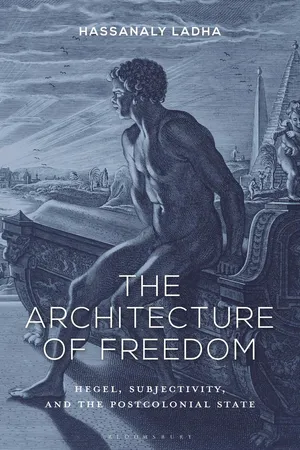
Mirroring the "shrouded" continent's relation to history, Kantian "architectonics" step out of the realm of logic in Hegelian thought and drive the historical unfolding of the aesthetic. In a foundational move, Hegel hypostatizes the aesthetic entanglement of built and linguistic form as the colossus of Memnon, an African warrior memorialized in ancient architecture, myth, and art. Reaching for freedom, the Memnon marks the architectonic modality through which the African slave, at the telos of history, will fulfill the spiritual promise of the human and bring about the politically mature state.
The book examines the syncretic figure of the Memnon and slave across Hegel's lecture courses, the Phenomenology of Spirit, the Encyclopedia, and the Philosophy of Right. Ultimately the book calls for a reassessment of a range of Hegelian philosophemes across disciplines in the humanities. This book will be of particular interest to scholars in philosophy, postcolonial and African studies, political theory, architecture, and historiography.
eBook - ePub
The Architecture of Freedom
Hegel, Subjectivity, and the Postcolonial State
- 320 pages
- English
- ePUB (mobile friendly)
- Available on iOS & Android
eBook - ePub
About this book
Information
PART I
HEGEL’S MEMNON
For Hegel the material, nonverbal art of architecture cannot be conceptualized without the discursive medium of language, particularly in its aesthetic manifestation as poetry. Similarly, the immaterial, verbal art of poetry, suspending referentiality and so isolating the pure form of phenomenality, cannot be thought without reference to the apparently enduring division and ordering of space through the act of building. Material, non-verbal buildings and immaterial, verbal figures, the latter a defining characteristic of poetry, thus mark oppositional forms of the aesthetic; even so, they share a common aesthetic function, both generating an infinite range of possible meaning.
Architectural historians have studied buildings as figures of religious, political, aesthetic, or other meaning in diverse traditions and periods. Similarly literary historians have investigated the ways in which architecture functions as a figure for meaning in poetry across languages and cultures. Scholars in both disciplines have assumed that architecture can serve as a figure without interrogating the relation between built and verbal figures as radically different forms of the aesthetic. The task, for scholars in architecture and literature alike, is to define their object of study in relation to the aesthetic. How does the dialectic of architecture and poetry, as formally oppositional but functionally similar modalities of art, inflect the category of the aesthetic? Given their entanglement within the field of the aesthetic, how do these two art forms each inflect the conception of the other?
The most comprehensive treatment of these questions occurs in Hegel’s Aesthetics, where he explicitly identifies architecture and poetry as “oppositional arts” marking the conceptual limits of the “aesthetic.” Hegel opposes these two art forms particularly in their relation to matter: in its essential mode as an “enclosure” for a body, architecture materializes a line that divides externality and interiority, doubling and displacing its corporeal demarcation; by contrast, poetry posits the dissolution of this line through an attempt at rarefied, incorporeal articulation. In its characteristic or “proper” pyramidal form, architecture reproduces the “corporeal shell” of a preserved corpse forever sealing off a dark, interior space of departed soul and mind, hence referring to lost and indeterminate spiritual or intellectual meaning; by contrast, poetry posits the dissipation of a living body in the exteriorizing and immediately vanishing voice of enunciated or written signs. But architecture nonetheless finds “articulation” in the verbal signs of present, living interpreters; thus, ancient, enigmatic monuments attain to an infinite succession of brief and partial meanings. Likewise poetry, even as it aims to dispense with the living body, ultimately reasserts and accentuates its corporeal foundation and materiality.
Together performing the dialectical production and cancellation of the body as an “architectonic” line, architecture and poetry propel the circuit of the aesthetic, making possible its historical progression as a materialization and dissolution of such lines over time. Surfacing in non-verbal buildings gesturing at indeterminate content and in the poetic disassembly and “reconstruction” of discursive, given structures of meaning, the architectonic isolates the spatial and temporal difference and also the “mechanical,” but nonetheless unstable arrangement underlying all human productions. Associated in Hegel’s oeuvre with both the “instinctive” work of building and the symbolic manipulation of the “psychophysiologically” resonant voice, this mechanical function of the intellect, which Hegel calls “memory” [Gedächtnis], makes possible the externalization of thought, whatever its content, as the non-representational, fluid line of the architectonic.
Under the name of the “work-master” [Werkmeister], the architectonic in Hegel’s work takes the form of the spirit as laboring hand, builder, and logician—and of spirit in its wholeness as the artificer of narrative history [Geschichtserzählung] across its artistic, religious, and philosophical dimensions. Above all, the architectonic marks the aesthetic basis for the delimitation of any category of thought, hence its internal heterogeneity and potential for evolution. Hegel’s narratives identify the Werkmeister with Egyptian architecture and the “architectonic” memorial to Memnon, a colossal structure producing a wordless “voice” when struck by the light of the sun. As the bridge from symbolic architecture to sublime poetry in the Aesthetics, the Memnon—in its interplay of monumental building and the human voice and, equally, of light and sound, respectively, the media of architecture and poetry—figures the coimbrication of the two art forms and hence the essential dialectic of the aesthetic. And as a mythopoeic figure, the Memnon instantiates the impingement of aesthetics upon history, marking the self-conscious and self-reflective symbolism of Hegel’s own historical narratives.
Reading the lecture courses alongside his written texts, we will trace Hegel’s relation of architecture, the quintessence of seemingly static and enduring form, to the “architectonic” as the principle of dynamism that, traversing the physical and discursive realms, underwrites a mode of resistance to entrenched forms and categories of history, proving concepts and categories identifiably Hegelian in inspiration to be, in fact, falsely so in their rigidity and endurance.
CHAPTER 1
THE FIGURE OF HISTORY
In the Phenomenology of Spirit and the published text of the Encyclopedia of the Philosophical Sciences, Hegel frequently dispenses with historically specific proper names, reserving references to actual religions, cultures, and material artifacts for his more provisional and supplementary remarks and lectures.1 The elision of proper names and their geographic, cultural, and periodic specificity in favor of more general, figuratively suggestive terms lends a polysemic quality to the written texts, where the narrative mode traverses a wide range of religious, ethnic, linguistic, and cultural categories. For instance, Hegel figures his narrative of spiritual progress from East to West—through anthropological and psychological forms and aesthetic and religious history—as the sun's daily arc through the sky. Readers of Hegel have noted this central narrative frame, but have not accounted for its obviously figural nature or for the relation of figure and history as mutually inflected aesthetic forms. Such oversights reflect a frequent blindness to the aesthetic dimension of Hegel’s writing and, more seriously, critical misunderstanding of his painstakingly developed position, foundational for any reading of his work, on the relation of aesthetics, language, and history.2
A decisive instance of Hegel’s narrative mode is the section in the Phenomenology of Spirit entitled “Religion,” which marks the birth of artifice in religious history. In a series of beautifully crafted passages, Hegel characteristically figures the evolution of spirit as a diurnal movement from the “light of sunrise,” associated with “immediate consciousness or sense-certainty,” to the “depth of night,” which belongs to the inward-turning and “self-knowing” spirit freed from externality and contingency.3 The diurnal figure in Hegel’s text accords with at least the initial progress of historical religion from the worship of “formless” light at dawn to the reverence of lit and shadowy forms objectified by the light of the sun.4 But the relation of figure and history in Hegel’s text evolves from any apparent congruity as spirit moves through various modes of religious expression: from “Luminous Essence” [Das Lichtwesen] to “Plant and animal” [Die Pflanze und das Tier] to, finally, “The Work-master” [Der Werkmeister], where religious artifice, in the form of architecture, first divides spiritual from physical light and, consequently, figural meaning from the illuminated matter and external forms of history.5 How does this admittedly difficult text, interrogating its own figurative mode, relate its use of figures to its status as a history?
To begin with, artifice, which Hegel defines broadly as the “formation of material at hand” [das Formieren eines Vorhandenen], originates with instinctive or pre-conscious construction akin to the activity of “bees building their cells.”6 The medley of the organic and inorganic in the latter phrase marks aptly the transitional moment between the worship of plants and animals and the construction of inorganic forms such as pyramids and obelisks. These “crystal” forms, manifesting the pure lines and planes of geometric space, contrast with the “formless” space of deified light posited in the first moment of religion, where God as light, or the indeterminate matrix of space, contrasts with darkness, or pure negativity and nothingness.7 Opposed to this formless, indeterminate position, abstract, geometric architecture ends the identity of spirit and light, drawing meaning only from the absence or shadows of the sun: the pyramids, in their sealed darkness, house the spirit only negatively as departed spirit; and obelisks translate the sun’s spiritual significance only into shadowy forms cast in the sun’s external light:
Either the works produced receive the spirit only as a foreign, departed spirit that has abandoned its living penetration of reality, and, being itself dead, enters into these lifeless crystals [as with the pyramids]; or they have an external relation to spirit as something which is itself there externally and not as spirit—they are related to it as to the rising light which throws its significance on them [as with obelisks].8
Dividing spiritual meaning from externality and illuminated matter, these structures locate meaning neither within nor outside their confines, since both interiority and externality lack intellectual content. By materializing a division that betrays the loss or instability of meaning, architecture dispels the accord and continuity of content with historical substance, fact, or form.
Hegel’s narrative then turns to the entanglement of organic and inorganic forms in the stylized and geometric shapes of ancient columns and temples.9 The artificial work at this stage, even though it includes animal images and statues, remains architectural, falling under the rubric of “habitation” and “dwelling” [Behausung, Wohnung] because, like all architecture, it cannot fully harmonize its external form with its content, the form of the house to what is housed.10 Form blends partially with content, but remains always superfluous to any particular meaning.11 From the architectural “formation [Formierung] of material” emerges the producer’s knowledge of itself as a self distinct from plant and animal life; this self-consciousness remains limited, however, since the resulting work “still” “lacks speech.”12 Here speech is the discursive channel for meaning that, fully rarefied, overcomes the difference between interiority and exteriority—the very difference first separating meaning and fashioned matter.13 While Hegel alerts us to a potential dialectical progression from engraved stone to spoken language, he predicates any such progression, crucially, on light:
Diese Wohnung, die Seite des allgemeinen Elements oder der unorganischen Natur des Geistes, schließt nun auch eine Gestalt der Einzelheit in sich, die den vorher von dem Dasein abgeschiedenen, ihm inneren oder äußerlichen Geist der Wirklichkeit näherbringt und dadurch das Werk dem...
Table of contents
- Cover
- Halftitle Page
- Title Page
- Dedication Page
- Contents
- List of Illustrations
- Preface
- Introduction
- Part One: Hegel’s Memnon
- Part Two: Africa and the Idea of Freedom
- Select Bibliography
- Index
- Imprint
Trusted by 375,005 students
Access to over 1.5 million titles for a fair monthly price.
Study more efficiently using our study tools.
Frequently asked questions
Yes, you can cancel anytime from the Subscription tab in your account settings on the Perlego website. Your subscription will stay active until the end of your current billing period. Learn how to cancel your subscription
No, books cannot be downloaded as external files, such as PDFs, for use outside of Perlego. However, you can download books within the Perlego app for offline reading on mobile or tablet. Learn how to download books offline
Perlego offers two plans: Essential and Complete
- Essential is ideal for learners and professionals who enjoy exploring a wide range of subjects. Access the Essential Library with 800,000+ trusted titles and best-sellers across business, personal growth, and the humanities. Includes unlimited reading time and Standard Read Aloud voice.
- Complete: Perfect for advanced learners and researchers needing full, unrestricted access. Unlock 1.5M+ books across hundreds of subjects, including academic and specialized titles. The Complete Plan also includes advanced features like Premium Read Aloud and Research Assistant.
We are an online textbook subscription service, where you can get access to an entire online library for less than the price of a single book per month. With over 1.5 million books across 990+ topics, we’ve got you covered! Learn about our mission
Look out for the read-aloud symbol on your next book to see if you can listen to it. The read-aloud tool reads text aloud for you, highlighting the text as it is being read. You can pause it, speed it up and slow it down. Learn more about Read Aloud
Yes! You can use the Perlego app on both iOS and Android devices to read anytime, anywhere — even offline. Perfect for commutes or when you’re on the go.
Please note we cannot support devices running on iOS 13 and Android 7 or earlier. Learn more about using the app
Please note we cannot support devices running on iOS 13 and Android 7 or earlier. Learn more about using the app
Yes, you can access The Architecture of Freedom by Hassanaly Ladha in PDF and/or ePUB format, as well as other popular books in Philosophy & Architecture Criticism. We have over 1.5 million books available in our catalogue for you to explore.