Winner of the Alec Nove Prize in Russian, Soviet, and Post-Soviet Studies
Winner of the BASEES George Blazyca Prize
In 1945, just six years after coming to power, the Slovak People's Party (SLS) was disbanded as a 'criminal organisation' and its leader - Jozef Tiso - hanged for treason. What made it possible for the SLS, initially founded in 1905 by priests to represent the Catholic Slovak minority residing in the north of the Kingdom of Hungary, to form an openly pro-Nazi government in 1939? And what put Slovakia on the path to a 'fascism' that would see more than 45,000 Jews deported to their deaths in 1942?
To answer these questions, Thomas Lorman draws on more than a decade's research in archives across the region in Hungarian, Slovak and Latin, and studies the party's formative years in depth for the first time in English. Lorman examines the various strands which fused to form the party and its popularity, including a complex and nebulous nationalism, Catholicism and a resounding mistrust of liberalism and 'modernity'.
The Making of the Slovak People's Party is a vital and timely study of the genesis and success of far-right movements that will be essential reading for all scholars working on 20th-century Eastern European history, nationalism and the interplay of religion and politics.
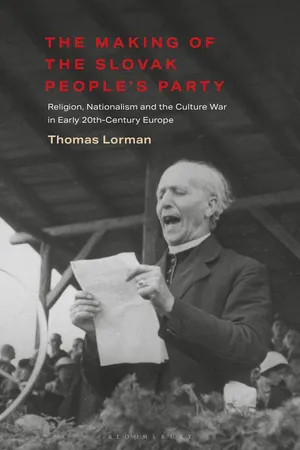
eBook - ePub
The Making of the Slovak People’s Party
Religion, Nationalism and the Culture War in Early 20th-Century Europe
- 320 pages
- English
- ePUB (mobile friendly)
- Available on iOS & Android
eBook - ePub
The Making of the Slovak People’s Party
Religion, Nationalism and the Culture War in Early 20th-Century Europe
About this book
Information
1
The Liberal Onslaught
The term ‘culture war’ is now employed to describe conflicts throughout the world that have little to do with the state and nothing to do with the Catholic church, but the term itself also has a specific historical meaning and a specific historical context. As Christopher Clark and Wolfram Kaiser explain,
There had always been intermittent institutional friction between church and state in central and western Europe, but the conflicts that came to a head in the second half of the nineteenth century were of a different kind. They involved processes of mass mobilization and societal polarization. They embraced virtually every sphere of social life: schools, universities, the press, marriage, and gender relations, burial rites, associational culture, the control of public space, folk memory, and the symbols of nationhood. In short, these conflicts were ‘culture wars’, in which the values and collective practices of modern life were at stake.1
The most famous of these conflicts was initiated in Prussia, later Germany, by Otto von Bismarck who ‘launched a salvo of laws intended to neutralize Catholicism as a political force’ and in doing so triggered what one of his supporters called a ‘struggle of culture’ (German: kulturkampf). Other states in Europe also launched their own assaults, notably France, where ‘anti-clericalism’, the desire to reduce the privileges and influence of the Catholic clergy, had periodically burst forth since the 1789 revolution and reached fever pitch during the third republic from 1871. Likewise, unified Italy had expropriated the Papal States from the Pope and ‘imprisoned’ him within the walls of the Vatican.2
Hungary had also witnessed its own anticlerical outbursts, notably during the reign of Joseph II, 1780–1790, and again during the ‘Age of Reform’ from 1825 to 1848 when an earlier generation of liberals had launched what Gabriel Adriányi has described as ‘a battle against the church’. The bishops’ refusal to permit the blessing of ‘mixed marriages’ or allow any of the offspring of such marriages to be raised outside the faith evoked particular ire, but no practical solution.3 It was not, however, until the 1890s that the culture war burst forth in Hungary when the government made clear its determination to curb the power of the Catholic church and impose its authority on the private lives of all of the country’s inhabitants by reforming marriage, regulating the religious upbringing of children and assuming the responsibility to record all births, deaths, and marriages. Confronted by furious resistance, Prime Minister Sándor Wekerle twice felt compelled to submit his resignation. Fresh elections were also required to firm up the government’s support and dissuade the Habsburg emperor, Franz Joseph, from wielding his veto. Ultimately, however, the government’s determination to enact reform proved irresistible and laws XXXI-III were placed on the statute book in the spring of 1894.4
From that point on the state made civil marriage obligatory. It authorized all marriages (and divorces), with the bridal couple required to visit the office of a local official prior to the now optional religious ceremony. Likewise, the state would, from this point on, prevent children being automatically instructed in the Catholic faith if only one of their parents adhered to the Church of Rome. Finally, the responsibility for recording all births, deaths, and marriages would no longer be the responsibility of clergymen, but would instead be carried out by trained and supposedly impartial state officials.
It is tempting to dismiss these reforms as merely symbolic. The obligatory visit to the mayor’s office on the day of the wedding was easily incorporated into the series of rituals that still invariably included the solemnization of the marriage ceremony in church and temple. Marriages between Catholics and non-Catholics also remained exceedingly rare, particularly in rural areas, and it made no practical difference to most people whether the details of their life were stored in their local church or a government office.
Such dismissiveness would, however, miss the larger point and ignore the larger context. The Catholic church had always relied on the state to preserve its supremacy, and when the state turned against the church, as the culture wars that had already broken out elsewhere in Europe once again demonstrated, the consequences for the faithful could be horrendous. Moreover, the Wekerle government’s reforms came at a time when the established denominations of Europe were convulsed by a ‘crisis of religion’, provoked by doubts about whether the Christian picture of God was believable. A persuasive re-dating of the history of the world, the widespread acceptance of Darwin’s (and others’) theory of evolution, as well as radical reinterpretations of the Bible that described much of its content as symbolism rather than fact, together raised the disturbing question of whether the faith was actually supported by evidence.5
Some Christian churchmen responded by adapting their theology, the Vatican did not. Its Syllabus of Errors issued in 1864 insisted that ‘a great war is being waged against the Catholic church’ and included among the enemies of the faith not only such obvious targets as ‘pantheism, naturalism and absolute rationalism’, and the ‘pests’ of ‘socialism [and] communism’, but also the claim that ‘the civil authority may interfere in matters relating to religion, morality and spiritual government’.6 Likewise, in 1893, as the Wekerle government’s reforms were making their way through parliament, the Vatican informed the local hierarchy in Hungary that ‘considering the direction in which your country is going … it is greatly to be feared that there is impending evil far more harmful to religion’. Indeed, as Robert Nemes has observed, ‘Liberals and Catholics alike rapidly turned the dispute … into a referendum on the liberal vision of progress and patriotism.’7 Encouraged by the magnitude of the stakes involved, as well as the uncompromising and alarmist rhetoric of the dispute’s chief protagonists, it is understandable that Catholics throughout Hungary responded to the new legislation with a fury that now seems exaggerated.
Thus, even if the reforms were largely symbolic, symbolism mattered, particularly in a country where illiteracy was rife and gesture politics predominated. The above reforms replaced the church with the government office as the place where Catholics in Hungary got married, where the faith of their offspring was to be determined, and where the details of their lives would now be recorded, stored, and potentially exploited. Just as the intel lectual authority of the clergy was sapped by an onslaught of scepticism and criticism, the new legislation ensured that temporal authority had visibly begun to seep away from the priest to the politician and the government official.
That seepage was particularly problematic in northern Hungary, where both the local population and the local clergy tended to be Slovak speakers, while local officials, whether elected or appointed, were invariably Magyars, either by birth or inclination. According to one contemporary source, of the 46,449 officials in Slovakia, no more than 300 were ethnic Slovaks, and only 132 openly proclaimed their Slovak identity.8 Not surprisingly then, Slovak Catholic publicists reacted to the new legislation with particular vitriol, as power was perceived to have been ceded from the Slovak-speaking priest to the Magyar-speaking official. Even Slovak Protestants condemned the new legislation, for they also noted what even Catholic Magyars who criticized the government’s legislation ignored: that the Wekerle government’s reforms constituted an assault on both the Catholic faith, and Slovak language and culture.9
For example, the rather staid Katolícke noviny, which served as the in-house journal of the Slovak-speaking Catholic clergy, responded to the new legislation with a passion it had never previously displayed. Among the broadsides that the paper directed against the new legislation were a series of twelve articles that denounced not only the government’s reform of marriage policy, but also its entire governing philosophy. That philosophy was summed up in a single word that served as the title of the entire series: ‘Liberalism’.10
Revealingly, the author of these articles, Juraj Gogolák, a Slovak priest best known for his publications aimed at children, and who contributed to various periodicals under the pen name Irievič, placed his criticisms of the marriage reform within a far broader condemnation of the government’s policies. In particular, he denounced their impact on the faith, morals and culture of Hungary’s Slovak-speaking minority. Gogolák singled out the supposedly new-found popularity of taverns and the scourge of drunkenness, the growing influence of ‘liberal-Jewish and freemason newspapers’, the rise of socialism, materialism and atheism, the spread of ‘unnatural’ technological innovations and urbanization, the apathy of the clergy, and ‘the destruction of the maternal, native languages of one’s fathers.’11
In the concluding lines of his final article, Gogolák also spelled out to his Slovak Catholic readership that this assault on both the Catholic faith and Slovak culture demanded a political response. ‘We must’, he proclaimed, ‘drive liberalism out of the church and out of politics. We demand that in politics Christian doctrines are asserted and not liberal mumbo-jumbo. Whoever, therefore, is in good conscience with the Catholic church must join the ranks against liberalism. And may God help us in this struggle.’12
Gogolák’s impassioned call heralded a remarkable half-century of Slovak Catholic activism. Four years prior to Gogolák’s articles a meeting of senior government officials who oversaw the Slovak-populated counties of the north of Hungary concluded that Slovak Catholics were reassuringly immune from all forms of agitation.13 In 1894, however, the territory which would, after 1918, become Slovakia, and which was then referred to in the Magyar language as the ‘highlands’ (Magyar: felvídék), became one of the centres of resistance to the new legislation and one of the most bitterly contested fronts in Hungary’s own version of the pan-European culture war. Mass meetings that were held in protest at the new laws attracted in excess of 10,000 attendees. By the end of the year a new opposition party, the Catholic People’s Party (Magyar: Katholikus Néppárt, hereafter KNP), had been established with the Slovak highlands as one of its bastions of support and Gogolák’s Katolícke noviny as one of its loyal journals. Then, ten years later, as the KNP prepared to enter into a government coalition with many of the politicians who had supported the earlier anticlerical legislation, dissident Slovak Catholics formed a new party to carry on their culture war against Hungarian liberalism. That party, the SĽS, over the forty years of its existence remained, in essence, an anti-liberal party driven by the same anger that had inspired Gogolák’s fury in 1895. Its leadership was convinced that it was fighting an ongoing culture war against each successive government, first Hungarian and then – after 1918 – Czechoslovak to defend both the Catholic faith and Slovak culture.
Clearly, the liberalism which Gogolák, the Katolícke noviny, and later the SĽS struggled against was not one akin to Western models of liberalism. Classical liberalism was led by the middle classes, extolled the value of meritocracy, and was wedded, (at least theoretically) to the principle of free speech. Hungarian liberalism was none of these things. As elsewhere in Central Europe, liberalism in Hungary before 1918 was grounded in a distinct historical tradition: it was enacted by a narrower social elite, and it was driven by a larger nation-building project. It was led by the nobility, upheld hereditary privileges, and was prepared to silence its critics with censorship and imprisonment for ‘agitation against the state’. At times it degenerated into crude chauvinism and blatant self-interest. Some scholars have even rejected the term ‘liberal’ being applied to the regime which governed Hungary up until 1918. The disgruntled émigré historian Oszkár Jászi, for example, set the tone for much later scholarship when he declared in his book on the dissolution of the Habsburg Empire that the ruling party in Hungary ‘had nothing liberal in its character except its benevolent attitude towards Jewish finance and big business’.14 As László Katus has also pointed out, in pre-First World War Hungary ‘liberal equality remained a fiction even within the traditional elite’, which retained a nationalist, hierarchical even messianic outlook that some scholars have termed ‘conservative liberalism’, ‘revisionist liberalism’ or even ‘the illusion of liberalism’.15
There are, however, scholars who have recognized the expansiveness of the liberal project in Central Europe, and the fear it could arouse in more militant Catholics. As Michael Gross ha s put it, liberalism in this part of Europe was ‘not simply … a political movement and set of economic principles but more broadly … a body of cultural attitudes and social practices’ characterized by an ‘affinity for the new, an orientation towards the future, a belief in progress’, as well as a hostility to ‘feudalism, absolutism and religious orthodoxy’.16 Writing almost forty years before Gross, Hugh Trevor-Roper also highlighted the polarizing power of the European liberal project, pointedly noting that the triumph of liberalism had ‘victims as well as victors, and the victims did not surrender quietly’.17
Successive governments in Hungary from the 1860s onwards certainly showed little concern for the victims of their policies. Instead, they revelled in their ability to impose their authority and their values upon the country, which included curbing the privileges of the Catholic church. Gogolák was, therefore, correct, when he asserted that the government’s ‘anti-clerical’ legislation was merely the latest manifestation of the government’s ongoing project to transform the country. Prime Minister Wekerle made exactly the same point when, in introducing the draft legislation in parliament, he declared that ‘twenty-five years of experiences and – dare I say it – successes speak in favour of these laws’.18
The historical context
In reality, Hungarian liberalism was inspired by a longer history, one which fuelled not only the government’s determination to transform the country, but also made Slovaks such as Gogolák s...
Table of contents
- Cover
- Half-Title
- Series
- Title
- Contents
- List of Illustrations
- Acknowledgements
- Note on Terminology
- Introduction: In the Name of God
- 1 The Liberal Onslaught
- 2 A New Opposition
- 3 The Birth of the Party
- 4 Purging the Party
- 5 Turning against Hungary – Turning against Czechoslovakia
- 6 A Path to Fascism?
- Conclusion: The Other Culture War
- Notes
- Bibliography
- Index
- Copyright
Trusted by 375,005 students
Access to over 1.5 million titles for a fair monthly price.
Study more efficiently using our study tools.
Frequently asked questions
Yes, you can cancel anytime from the Subscription tab in your account settings on the Perlego website. Your subscription will stay active until the end of your current billing period. Learn how to cancel your subscription
No, books cannot be downloaded as external files, such as PDFs, for use outside of Perlego. However, you can download books within the Perlego app for offline reading on mobile or tablet. Learn how to download books offline
Perlego offers two plans: Essential and Complete
- Essential is ideal for learners and professionals who enjoy exploring a wide range of subjects. Access the Essential Library with 800,000+ trusted titles and best-sellers across business, personal growth, and the humanities. Includes unlimited reading time and Standard Read Aloud voice.
- Complete: Perfect for advanced learners and researchers needing full, unrestricted access. Unlock 1.5M+ books across hundreds of subjects, including academic and specialized titles. The Complete Plan also includes advanced features like Premium Read Aloud and Research Assistant.
We are an online textbook subscription service, where you can get access to an entire online library for less than the price of a single book per month. With over 1.5 million books across 990+ topics, we’ve got you covered! Learn about our mission
Look out for the read-aloud symbol on your next book to see if you can listen to it. The read-aloud tool reads text aloud for you, highlighting the text as it is being read. You can pause it, speed it up and slow it down. Learn more about Read Aloud
Yes! You can use the Perlego app on both iOS and Android devices to read anytime, anywhere — even offline. Perfect for commutes or when you’re on the go.
Please note we cannot support devices running on iOS 13 and Android 7 or earlier. Learn more about using the app
Please note we cannot support devices running on iOS 13 and Android 7 or earlier. Learn more about using the app
Yes, you can access The Making of the Slovak People’s Party by Thomas Lorman in PDF and/or ePUB format, as well as other popular books in History & 20th Century History. We have over 1.5 million books available in our catalogue for you to explore.