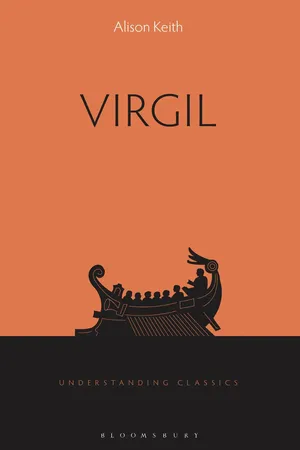
The works of Virgil (70–19 BCE) define the 'golden age' of Latin poetry and have inspired a long tradition of interpretation and adaptation that starts in his own time and extends to important modern authors. His ascent from the lesser genre of pastoral (the Bucolics) through a more ambitious didactic mode (the Georgics) to the soaring heights of epic (the incomparable Aeneid) shaped the canonical writings of other authors, from his younger contemporary Ovid through the medieval writers Dante and Petrarch to the early modern poets Spenser and Milton and well beyond. Virgil, as Alison Keith shows, has never gone out of critical or popular fashion.
This wide-ranging introduction appraises a figure of central importance in the history of Western music, art and literature. Offering close readings of the Bucolics, Georgics and Aeneid, Keith places Virgil and his poetry in historical context before tracing their impact at key moments in the culture of the West. Emphasis is placed on Virgil's reception of the classical literary and philosophical traditions, and on how his poetry has attracted modern interest from writers as diverse as T. S. Eliot and Ursula K. Le Guin.
eBook - ePub
Virgil
About this book
Information
1
Life and Times

Publius Vergilius Maro (70–19 BCE) was the most celebrated poet of his time and so he remains today: the most famous classical Latin poet, author of the Aeneid and conduit of classical epic and pastoral verse to Europe and the western artistic tradition. His poetry was widely read and immensely popular already in his own lifetime, when he was acclaimed the Roman Homer, and interest in his life and habits was intense and continuing. As a result, we possess a good deal of contemporary anecdotal evidence about his life as well as a number of ancient biographies, most of them probably derived from the lost Life of Virgil by Suetonius (c. 70–130 CE, biographer and imperial bureaucrat), which was included in the section ‘On Poets’ in his Lives ‘Of Famous Men’ and probably formed the basis of the life appended to Donatus’ (lost) commentary on Virgil’s complete works.1 We thus have richer and more abundant evidence for Virgil’s life than for any other Latin poet of classical antiquity.2
Classical scholars have shown, however, that ancient biographers had different standards of evidence and historical accuracy than we do today and so we cannot always take the claims of the ancient biographies at face value.3 Much of the material preserved in the ancient Lives is obviously based on inferences drawn from biographical reading of Virgil’s poetry – not only of his pastoral collection Bucolica (often called Eclogues after the individual selections) and his four-book disquisition on farming entitled Georgica, but also of a host of works collected in the Appendix Vergiliana, which scholars no longer consider authentically Virgilian. This interpretive strategy was current in antiquity at least as early as the Hellenistic period, when Aristotle’s students and the scholars working in the Mouseion in Alexandria began to compile biographies of the archaic and classical Greek poets.4 Modern scepticism concerning the validity of this procedure notwithstanding, Virgil and his earliest readers will have been schooled in the ancient literary critical convention of deducing the details of an author’s life from his textual corpus.5 Indeed, Virgil manifestly invites autobiographical interpretation at various points in B. (Ch. 2.2) and G. (Ch. 3.2). By testing the ancient biographers’ statements with scrupulous care against quotations both from Virgil’s own works and from surviving non-Virgilian texts and documents, we can often confirm, contextualize and/or discount the information our poet and his biographers provide.6
Virgil lived through the final series of military and political crises that brought an end to nearly 500 years of republican government in ancient Rome. The period of Julius Caesar’s dominance, from his embattled consulship of 59 BCE and subsequent tenure of a provincial military command in Gaul (58–50), culminated in the civil wars of 49–46, in which he crushed his republican opponents, and ended in his dictatorship (46–44) and assassination on the Ides of March 44. Caesar’s murder sparked the renewal of civil war between the republican forces (led by the tyrannicides, Cassius and Brutus) and his heirs (the triumvirs Marc Antony, Octavian and Lepidus), which resulted in the defeat of the republican army at Philippi in 42. But another decade of civil war ensued as the triumvirs campaigned not only against the remnants of the republican party (who rallied in Sicily under Pompey’s son Sextus, until his defeat at Naulochus in 36), but also against one another (Battle of Mutina, 43; Perusine War, 41; Pact of Brundisium, 40; Treaty of Tarentum, 37; etc.). Octavian and Marc Antony finally broke off relations in 32 and confronted one another at the Battle of Actium in September 31. After his defeat of Antony and Cleopatra there, Octavian invaded and annexed Egypt, before returning to Rome and celebrating a triple triumph in August 29, commemorating his conquest of Illyricum, victory at Actium and annexation of Egypt. Even after his ‘restoration’ of the republic and receipt of the title ‘Augustus’ in 27, there remained residual resistance to his supremacy, as evidenced by the abortive conspiracy of Varro Murena in 23, among others.7
Virgil was an eyewitness to much of the conflict, having lived in Rome for about a decade from the mid-50s to the mid-40s BCE, and then perhaps losing his family estate in the confiscations after the Battle of Philippi at the end of the 40s, when he met some of Octavian’s most prominent political operatives. He composed his first two collections of poetry, Bucolica and Georgica, during the uncertainty and upheaval of the triumviral period, completing the Georgica shortly after the Battle of Actium, and he worked on the Aeneid throughout the 20s. Nor did he live long enough to see Caesar’s ruthless great-nephew Octavian transform himself fully into the accomplished elder statesman Augustus, who celebrated the renewal of the state in the ‘Secular Games’ of 17.
The ancient lives agree that Virgil was born on the Ides (15th) of October in the year 70 BCE. Donatus (VSD 3) reports that the poet was born in a small village called Andes, near Mantua, to parents of humble background. The biographers record the name of Virgil’s mother as Polla Magia, while the conventions of Roman nomenclature confirm that his father’s family name was Vergilius. The Latin spelling of Vergilius, with an initial ‘e’, was changed in the Christian middle ages to ‘Virgilius’ as a pun on his ‘virginal’ character (see below), and English orthography traditionally retains the initial ‘i’. The ancient biographers report that Virgil’s father was of lower social status than his mother, but modern scholars have been sceptical of these reports of his humble background, in part because lowly origins are a conventional feature of ancient biographies.8 A more substantive indicator of Virgil’s class background can be found in the detail of his cognomen, Maro, which is the name of an Etruscan magistracy.9 Virgil’s cognomen implies that an ancestor (or ancestors) had held this important elective office at Mantua, with the further implication that his family possessed sufficient wealth to qualify them for local politics. The conclusion seems inescapable, therefore, that Virgil belonged to the rank of municipal equestrians and came from a leading family of Mantua.
Virgil’s privileged class background is confirmed by the ancient accounts of his elite educational attainments. He studied at Cremona until he assumed the ‘adult toga’ either in 55 or 53, ‘on the very day that the poet Lucretius died’ (VSD 6). Biographical syncretism is a conventional feature of ancient lives,10 and modern scholars are rightly sceptical of the coincidence of Virgil’s assumption of the adult toga on the very day of the death of T. Lucretius Carus (c. 99 – c. 55 BCE), the author of a six-book didactic poem on Epicurean physics, ‘On the nature of the universe’ (De rerum natura). We may interpret the biographical syncretism that links Virgil’s coming of age to Lucretius’ death, however, as an index of the breadth and depth of Virgil’s imitations of his admired elder contemporary’s great Epicurean manifesto.
In his Chronica, the church father Jerome specifies the year 53 as the date of Virgil’s removal first to Milan and then, soon after, to Rome, where the biographer Probus explicitly places Virgil’s studies ‘with the most learned exponents of rhetoric’, when civil war broke out between Octavian and Marc Antony at Mutina in April 43. Although Probus’ text is confused and lacunose at this point, he seems to date the end of Virgil’s rhetorical studies to the renewal of civil war in the aftermath of Caesar’s assassination. Our poet’s study at Rome is therefore best put in the decade 53–44 BCE. In this period, a formal education served as the foundation for entry into a legal or political career in the forum and senate, and Donatus reports that Virgil pleaded a single case in a court of law (VSD 15).
Virgil himself, however, appears to have preferred philosophy to rhetoric. Donatus (VSD 15)...
Table of contents
- Cover
- Half-Title Page
- Dedication
- Series Page
- Title Page
- Contents
- Preface
- 1 Life and Times
- 2 Bucolica
- 3 Georgica
- 4 Aeneis
- 5 Reception
- Notes
- List of Abbreviations
- Bibliography
- Index Locorum
- General Index
- Copyright
Trusted by 375,005 students
Access to over 1.5 million titles for a fair monthly price.
Study more efficiently using our study tools.
Frequently asked questions
Yes, you can cancel anytime from the Subscription tab in your account settings on the Perlego website. Your subscription will stay active until the end of your current billing period. Learn how to cancel your subscription
No, books cannot be downloaded as external files, such as PDFs, for use outside of Perlego. However, you can download books within the Perlego app for offline reading on mobile or tablet. Learn how to download books offline
Perlego offers two plans: Essential and Complete
- Essential is ideal for learners and professionals who enjoy exploring a wide range of subjects. Access the Essential Library with 800,000+ trusted titles and best-sellers across business, personal growth, and the humanities. Includes unlimited reading time and Standard Read Aloud voice.
- Complete: Perfect for advanced learners and researchers needing full, unrestricted access. Unlock 1.5M+ books across hundreds of subjects, including academic and specialized titles. The Complete Plan also includes advanced features like Premium Read Aloud and Research Assistant.
We are an online textbook subscription service, where you can get access to an entire online library for less than the price of a single book per month. With over 1.5 million books across 990+ topics, we’ve got you covered! Learn about our mission
Look out for the read-aloud symbol on your next book to see if you can listen to it. The read-aloud tool reads text aloud for you, highlighting the text as it is being read. You can pause it, speed it up and slow it down. Learn more about Read Aloud
Yes! You can use the Perlego app on both iOS and Android devices to read anytime, anywhere — even offline. Perfect for commutes or when you’re on the go.
Please note we cannot support devices running on iOS 13 and Android 7 or earlier. Learn more about using the app
Please note we cannot support devices running on iOS 13 and Android 7 or earlier. Learn more about using the app
Yes, you can access Virgil by Alison Keith in PDF and/or ePUB format, as well as other popular books in History & Roman Ancient History. We have over 1.5 million books available in our catalogue for you to explore.