From Hitler's notorious fondness for Wagner's operas to classical music's role in fuelling German chauvinism in the era of the world wars, many observers have pointed to a distinct relationship between German culture and reactionary politics.
In Classical Music in Weimar Germany, Brendan Fay challenges this paradigm by reassessing the relationship between conservative musical culture and German politics. Drawing upon a range of archival sources, concert reviews and satirical cartoons, Fay maps the complex path of classical music culture from Weimar to Nazi Germany-a trajectory that was more crooked, uneven, or broken than straight. Through an examination of topics as varied as radio and race to nationalism, this book demonstrates the diversity of competing aesthetic, philosophical and political ideals held by German music critics that were a hallmark of Weimar Germany.
Rather than seeing the cultural conservatism of this period as a natural prelude for the violence and destruction later unleashed by Nazism, this fascinating book sheds new light on traditional culture and its relationship to the rise of Nazism in 20th-century Germany.
eBook - ePub
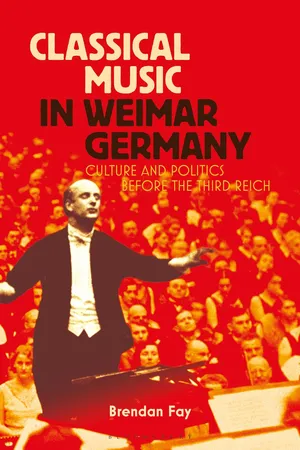
Classical Music in Weimar Germany
Culture and Politics before the Third Reich
- 216 pages
- English
- ePUB (mobile friendly)
- Available on iOS & Android
eBook - ePub
About this book
Information
1
(Re)Composing the Nation: Music, War, and the German Inflation, 1918–1924
“Sonate, que me vuex tu?”—“Sonata, what do you want of me?” This phrase, attributed to the musical essayist Bernard le Bovier de Fontenelle (1657–1757), is often taken as a logical starting point for any investigation into the origins of music criticism in Europe and with good reason. First, its French formulation serves as an important reminder of French and Italian dominance of musical Europe around 1800, both on the stage and within aesthetics and music criticism. Second, the phrase’s frustrated tinge illustrates the rather low regard in which contemporaries held music, instrumental music in particular. Fired by the principles of Enlightenment philosophy, contemporary observers from Rousseau to Kant decried the non-representational quality of music that, unlike literature and visual art, left little for the listener to reflect upon. Music’s uncertain sources of inspirational and ephemeral nature consigned it to a relatively lowly position in relation to the other arts. In a telling 1779 treatise on the arts, the French philosopher Boyé spoke for many when he declared music to be little more than “a pleasure of the senses and not of the intelligence.”1
This was a situation that German music, Romanticism, and its supporters did much to change. Although its roots stretched back to the late eighteenth century, German music criticism experienced a golden age during the first half of the nineteenth century as writers such as E. T. A. Hoffmann, Adolph Bernhard Marx, and Robert Schumann blazed new trails in how contemporaries talked about and reflected upon music and established German as musical Europe’s lingua franca. Their ideas were articulated and disseminated in music journals such as the Allgemeine musikalische Zeitung, established by Friedrich Rochlitz, which would become one of the century’s most important venues for reviewing new music, announcing the discovery of hitherto lost letters and manuscripts of popular composers, and other affairs of interest to music lovers across German-speaking Europe, providing a model for subsequent journals to emulate. By the end of the nineteenth century many of Europe’s most important figures in music criticism, from Eduard Hanslick and Heinrich Schenker to Guido Adler and Hermann Kretzschmar, were German speakers whose pupils would later figure prominently in Weimar’s leading music journals. The turn of the century saw the appearance of new journals such as Die Musik, the most esteemed and widely respected music periodical of the new century, which featured contributions from an assortment of German-speaking Europe’s leading critics, such as Julius Kapp, Adolf Weissmann, and Paul Bekker. Seeking to professionalize their field and insulate the ranks of full-time critics from outsiders, Bekker, together with Hermann Springer, Alfred Heuss, Wilhelm Klatte, and others, would join together in 1913 to help found the Society of German Music Critics (Verband deutscher Musikkritiker). Given that newspapers required no formal credentials or training on the part of their musical contributors, music criticism had long been vulnerable to dilettantes and amateurish interlopers. Thus, in addition to raising the profile of its members and the occupation of professional music critic more generally, the major impetus behind the Verband’s founding was to create a pool of qualified and perceptive writers from which newspapers could draw in the future.2 During Weimar, as debates and conflicts between critics grew more heated and the tone more acerbic, the Verband founded a committee to intervene in cases where attacks crossed a line and did violence to a critic’s professional reputation.3 However, for the most part the body merely assumed an advisory role and efforts to further professionalize the organization along similar lines as organizations such as the Imperial Federation of German Journalists (Reichsverband der Deutschen Presse)—which took a leading role in securing legal protections and relief aid for its members—never fully got off the ground.4
As with every other facet of Germany society, the outbreak of war exacted a toll within the realm of music criticism. Die Musik was forced to cease publication altogether in September 1915 just as wartime disruptions to travel and solidarity severed ties between German critics and their colleagues in the wider world. Cooperative bodies such as the International Music Society were shuttered due to lack of funds and disruptions to international travel.5 The war had a radicalizing effect on some leading figures such as the composer Hans Pfitzner, who emerged from the conflict as a full-blown nationalist and played a prominent role in Weimar’s major cultural debates. Despite the war’s real costs, however, some critics held out hope that the destruction of the old imperial order presented Germans with a clean slate and the opportunity to implement educational and civic reforms to the country’s musical life. A 1919 article in the Neue Musik Zeitung suggesting a raft of proposals, such as overhauling the approach to music education in German schools and creating new government ministries with a special emphasis on cultural affairs, drew the signatures of several eminent critics, theater directors, and musicologists.6 The critic Paul Bülow fantasized about a future where German youth would not only listen to the music of German masters but also read their prose writings that he romantically likened to “rich, neglected treasures lying in a forgotten castle waiting for a kingdom to bring them into the light to shine resplendently before the entire Volk.”7
Still, 1918 marked a sea change within German music criticism from the world that came before for two overarching reasons. First, the war established Berlin as German-speaking Europe’s unquestioned musical capital. In fin de siècle Europe, Vienna was arguably the most important musical center on the continent in art and literature as much as in music. As Carl Schorske showed in his seminal Fin-de-Siècle Vienna: Politics and Culture, Vienna was a hotbed of modernist movements and thinkers, from the dramatists Arthur Schnitzler and Hugo von Hofmannstahl to the artists Oskar Kokoschka and Gustav Klimt.8 The city’s musical life was no less iconoclastic as composers from Gustav Mahler and Anton Webern injected new musical languages into Europe’s sonic landscape while Arnold Schoenberg’s first forays into atonal and serialist methods of composition date from his pre–First World War years in Vienna. With the collapse of the Austro-Hungarian monarchy in 1918, countless artists and thinkers left this old world behind and saw Berlin as the city where Europe’s musical and artistic future would be decided. Even the most celebrated performers hard-pressed to call one city “home” given their dizzying travel schedules had to admit Berlin’s towering importance. The celebrated pianist Walter Gieseking, one of the most active touring artists across Europe and the United States in this period, recalled the gravitational pull of Berlin that remained, in his view, the “undisputed cultural epicentre of [musical life] in Europe.”9 A partial listing of the musical migrants alone who left Vienna for Berlin gives some sense of the monumental shift in Europe’s musical center of gravity: Franz Schreker, Hanns Eisler, Erich Kleiber, Fritz Kreisler, Edmund Meisel, Arthur Schnabel, Ernst Toch, Mischa Spoliansky, and Arnold Schoenberg would all make Berlin their new home. Even composers who decided to stay in Vienna, such as Alban Berg, Erich Korngold, and Egon Wellesz, understood that if they were to keep abreast of modern musical currents and maintain contacts with music’s leading lights, regular commutes would be necessary.10
Despite this broader shift, it is worth remembering that while Germany and a newly independent Austria remained separate political entities on the map, Europe’s musical boundaries looked far different. Austrian composers—from Mozart and Schubert to Haydn and Bruckner—had long secured a place in the German canon. Many of Germany’s preeminent musicologists had studied under Guido Adler, Max Graf, and other leading Austrian scholars while German and Austrian music critics alike read and engaged in lively debates within the major music journals of German-speaking Europe. Like Volga Germans, Sudeten Germans, and other members of the German diaspora, ordinary Austro-Germans retained a special affinity for their kindred neighbor to the North with large majorities favoring unification with Germany following the war. Although these collective hopes were quickly dashed by Allied policymakers wary of a resurgent supra-German state in central Europe so soon after the cataclysm of the First World War, cultural ties between the two states remained strong, prompting the Austrian writer Stefan Zweig to wonder whether it was the first time a state would be forced to be independent against the wishes of its own people.11 Among music critics, many still saw Germany and Austria as part of the same Kulturnation and held out hope for a future where political fortunes might catch up with cultural realities. As the critic Anton Reichel remarked in an article titled “The Austro-German Cultural Mission,” “without union with Germany, Austria can no longer remain ‘Austria’; but Germany can also not abide permanent disunion without also allowing German culture as a whole to suffer!”12
Second, the newly liberalized atmosphere ushered in by the collapse of the imperial order saw a proliferation of new periodicals devoted to music of every stripe. Amid the economic dislocations and political violence of the interwar period, composers produced an astonishing amount of new and daring works requiring review and analysis by music critics. “All this material offered enough for glosses, longer notes and formal essays that accrued on my work desk,” recalled the critic H. H. Stuckenschmidt.13 Weimar democracy thus introduced a second important shift from the prewar world for the way in which it opened up a space for new voices within the ranks of German music criticism. Leading advocates of modernist music partnered with Universal Edition, a publisher of several contemporary composers, to launch the journal Musikblätter des Anbruch in 1919 whose editor Paul Bekker was a tireless devotee of modern music. Universal in particular went to great lengths to secure new music a proper hearing, partnering with Bekker to invite music critics who remained ambivalent to performances of new music.14 Dedicated to championing modernist music and staffed with a number of leading Jewish thinkers and essayists—from Theodor Adorno and Paul Pisk to Rudolf Réti and Paul Stefan—the journal would contribute significantly to the association between Jewishness and musical modernism, as the Austrian composer Ernst Krenek later discovered.15 In 1934 Krenek attempted to lay claim to the notion that the modernist aesthetic was “intrinsically Austrian” in nature, only to meet resistance from, among others, Josef Lechthaler, director of music within the Austrian Catholic Church, who claimed that public skepticism toward new music stemmed from the fact that it was “exclusively composed by Jews for Jews and therefore only purposeful in diverting ‘an exotic minority.’”16 Next to Anbruch, the other major periodical devoted to modern music was Melos founded in Berlin in 1920 by the conductor Hermann Scherchen. Both journals were devoted to reviewing performances of new music, publishing short biographies on young, emerging composers, and other issues relating to modern music before being shuttered following the Nazi “seizure of power” in 1933.
The coverage of modern music by Anbruch and Melos was more than balanced out by conservative journals committed to preserving the music of the more distant past.17 These outlets, many of whose contributors were skeptical toward modern music and fearful...
Table of contents
- Cover
- Halftitle Page
- Title Page
- Contents
- Illustrations
- Acknowledgments
- Introduction: German Music and the Nazi Past
- 1. (Re)Composing the Nation: Music, War, and the German Inflation, 1918–1924
- 2. Radios and Records: Image and Reality in Weimar Technology
- 3. Internationalism, Nationalism, and the Case of Hans Joachim Moser
- 4. Wagner under Weimar
- 5. Judging Performance, Performing Judgments: Race and Performance in Weimar Germany
- Epilogue: Rethinking Tradition
- Select Bibliography
- Index
- Imprint
Trusted by 375,005 students
Access to over 1.5 million titles for a fair monthly price.
Study more efficiently using our study tools.
Frequently asked questions
Yes, you can cancel anytime from the Subscription tab in your account settings on the Perlego website. Your subscription will stay active until the end of your current billing period. Learn how to cancel your subscription
No, books cannot be downloaded as external files, such as PDFs, for use outside of Perlego. However, you can download books within the Perlego app for offline reading on mobile or tablet. Learn how to download books offline
Perlego offers two plans: Essential and Complete
- Essential is ideal for learners and professionals who enjoy exploring a wide range of subjects. Access the Essential Library with 800,000+ trusted titles and best-sellers across business, personal growth, and the humanities. Includes unlimited reading time and Standard Read Aloud voice.
- Complete: Perfect for advanced learners and researchers needing full, unrestricted access. Unlock 1.5M+ books across hundreds of subjects, including academic and specialized titles. The Complete Plan also includes advanced features like Premium Read Aloud and Research Assistant.
We are an online textbook subscription service, where you can get access to an entire online library for less than the price of a single book per month. With over 1.5 million books across 990+ topics, we’ve got you covered! Learn about our mission
Look out for the read-aloud symbol on your next book to see if you can listen to it. The read-aloud tool reads text aloud for you, highlighting the text as it is being read. You can pause it, speed it up and slow it down. Learn more about Read Aloud
Yes! You can use the Perlego app on both iOS and Android devices to read anytime, anywhere — even offline. Perfect for commutes or when you’re on the go.
Please note we cannot support devices running on iOS 13 and Android 7 or earlier. Learn more about using the app
Please note we cannot support devices running on iOS 13 and Android 7 or earlier. Learn more about using the app
Yes, you can access Classical Music in Weimar Germany by Brendan Fay in PDF and/or ePUB format, as well as other popular books in History & 20th Century History. We have over 1.5 million books available in our catalogue for you to explore.