eBook - ePub
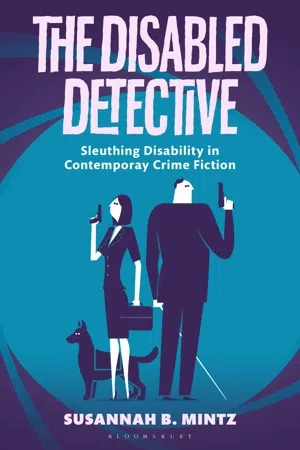
The Disabled Detective
Sleuthing Disability in Contemporary Crime Fiction
- 224 pages
- English
- ePUB (mobile friendly)
- Available on iOS & Android
eBook - ePub
About this book
The first book of its kind, The Disabled Detective explores representations of disability in crime fiction, from the earliest days of the genre to contemporary television drama. Susannah B. Mintz examines detective heroes with such conditions as blindness, deafness, paralysis, Asperger's, obsessive compulsive disorder, addiction, war trauma and many other impairments. Examining a wide range of texts, from Arthur Conan Doyle's Sherlock Holmes stories and the works of Agatha Christie to contemporary crime writers such as Jeffrey Deaver and Michael Collins and television dramas such as Monk, this book highlights how often characters with disabilities have been the heroes of crime fiction and how rarely this has been discussed in contemporary criticism.
Trusted by 375,005 students
Access to over 1.5 million titles for a fair monthly price.
Study more efficiently using our study tools.
Information
1
Introduction: Sleuthing Disability
When I first told people I was writing a book about disabled detectives, a surprisingly frequent response was, “Are there any?” In fact, there are many—a category all their own in a genre defined by its numerous offshoots and subtypes. Since Arthur Conan Doyle’s dazzlingly brilliant Sherlock Holmes first confounded Dr. Watson with his wild fluctuations of addiction and mood, the list of fictional detectives-with-disabilities has grown surprisingly long. One website lists eighty different single books or series featuring disability in some prominent way,1 including blind and one-eyed detectives; amputee detectives; detectives impaired and shell-shocked in war; detectives with autism, Asperger’s, and obsessive-compulsive disorder; detectives recovering from stroke; para- and quadriplegic detectives; deaf and hearing-impaired detectives; and at least one investigator missing a lung. Some have amnesia; others are of short stature. One detective struck by lightning can sense the location of dead people; another, violently concussed, visualizes crimes through the “eyes” of perpetrators. Three different contemporary novels concern synesthesia. Television similarly abounds with sleuths characterized by some form of physical or mental impairment, from the wheelchair-using lawyer Ironside in the 1970s to the more recent leads of Monk (OCD), House (chronic pain), Homicide (stroke), Perception (schizophrenia), and the original CSI (otosclerosis). “Nearly every detective character,” Gary Hoppenstand and Ray B. Browne wrote in the early 1980s, “seems burdened with some sort of personal abnormality” (1).
What is the meaning of this array of disabled sleuths? What kinds of questions are authors exploring when the protagonists of their stories are disabled, given that disabled characters have rarely been the heroes of literature—or, as in the case of anti-heroes like Shakespeare’s Richard III and Melville’s one-legged Captain Ahab, when disability has so often been used as the harbinger of undoing? In historian Paul Longmore’s words, “deformity of body symbolizes deformity of soul. Physical handicaps are made the emblems of evil” (133). What then is the connection between disability, in its many forms, and the narrative form of crime and mystery? This trend, impressive in its sheer voluminousness, has largely been ignored by scholars of both detective fiction and disability literature. Hoppenstand and Browne introduced their collection of pulp magazine “defective detectives” in 1983; a year later, sociologist Irving Zola described crime-mystery as “a major perpetuator” of stereotypical images of disability and cited a lack of structural or social analysis of disability in detective fiction. Yet neither of these works initiated any concerted exploration of the phenomenon. And as the quote from Hoppenstand and Browne above suggests, interest in the trope of disabled detection may in fact betray entrenched prejudice against impairment as a “burden,” an abnormality, an exotic defect or characterological quirk. A few more recent articles and websites both advertise and seek to understand the social and generic importance of the disabled detective, but the figure and its function remain something of a mystery.
The Disabled Detective: Sleuthing Disability aims to address these questions and absences. My goal is to explore the meaning of disability when aligned with criminal prosecution in the context of a far more common literary and narrative convention of disability as a mark of criminal deviance. Is the plethora of disabled detectives just “romanticized excess,” as disability scholars Frederic W. Hafferty and Susan Foster complain (194), a parade of “unrealistic, distorted, or otherwise sanitized” characters (187)? Or does it indicate, especially recently, that mystery writers have been ahead of the curve in terms of disability awareness and activism? By definition, detective fiction addresses matters of social justice, (in)equality, and cultural conflict; given its basic concern with social order and the interpretation of signs and clues, primarily physical, the genre is well positioned to engage the social model of disability, which holds that the hardships of disability are produced by cultural bias and prejudice rather than being inherent in individual bodies. The detectives to be considered in this study are capable and professional, usually dependable and courageous, often extremely smart, always full of gumption. Do they then, as a group, shift the way disability is typically assessed and understood?
To some extent, the answer is disappointingly no. In “The Detective as Other,” Michael Cohen declares that “mystery fiction is very fond of cultural difference,” but only because “otherness” heightens narrative tension (150). Both detectives and criminals, Cohen argues, “are constructed as foreign to ordinary experience” (153): “To be a detective is to be separate because of incorruptibility or genius or an extraordinary capacity for thinking like a criminal or any number of other distinguishing mental or spiritual features. Frequently authors add distinguishing physical or behavior features to their detectives to complement the other differences” (154). Through disability, then, as Cohen implies, the “dreadful otherness” of villains is “displace[d]” onto, and “emphasiz[ed]” by, that of the detective (156), whose anomalous body or mind thus symbolizes the ability to root out evil—which is otherwise masked in people who look “just like” us (153). That Cohen does not interrogate those “distinguishing physical or behavior features” as anything more than ornaments of the detective’s cognitive skill suggests that impairment works according to what disability scholars would call a prosthetic logic, helping the narrative along but insignificant in its own right.2
The classic figure of the detective is formed, of course, in the crucible of pathology, wherein crime-busting avenges the sleuth’s own trauma and deductive genius assuages private pain by triumphing over lawlessness and upheaval, if not over disability. Detectives are often described as identifying with criminals precisely because they share some sense of being damaged, and they may in turn tread a thin line between lawfulness and illegality in their investigative methods. (Both Sherlock Holmes and Edgar Allan Poe’s detective C. Auguste Dupin were notoriously credited for being able to think so “like” the criminals they pursued that even arch-nemeses like Moriarty and the Minister D– stood little chance of besting them.) Consider this remark from Vera Caspary’s 1943 suspense classic Laura: “The lame, the halt, and the blind have more malice in their souls, therefore more acumen. Cherishing secret hurt, they probe for the pains and weaknesses of others. And probing is the secret of finding” (17).3 At least in part, then, the disabilities of many detectives perpetuate the metaphorical use of impairment to signify something “broken” in those characters that solving crime somehow helps to heal, rehearsing a centuries-old equivalence of body problems to problems of self—indicative of, rather than incidental to.
Disability serves a purpose, in other words, in pointing readers toward whatever is out of whack and worthy of notice. In a discussion of Poe’s “The Purloined Letter” and “Murders in the Rue Morgue,” the two stories credited with inaugurating modern detective fiction, Charles J. Rzepka writes that “even the most ‘analytical’ mind cannot identify with another’s train of thought without observing his bodily movements” and that “it is impossible to achieve empathy with the criminal mind … without paying close attention to the physical activity displayed by the body attached to that mind” (81). For Rzepka, this keen attention to corporeal detail relates to Poe’s rejection, rather than his endorsement, of inductive reasoning, in that bodily clues do not readily coalesce in answers to the problem of crime without the use of “our imaginations” in thinking “outside the locked room of common sense” (81; my italics). Mere plodding analytics are not enough, Rzepka says of Poe’s Dupin; the detective must develop more creative and empathic habits that do not rely so heavily on a positivist—read, middle-class—notion of evidence. “Ordinary” cunning, according to Dupin, did not “take into account the mind of the criminal,” and would thus devolve into “mechanical calculation” (78). Physical shape and movement are understood in this formulation to be stably interpretable because the body carries out the mind’s intentions: the detective gains access to what might otherwise be an incomprehensible or impenetrable criminal consciousness through the observable data of the criminal’s physical acts and gestures.
The imaginative leap Dupin prized was a teleological one that emerged from a historical moment in which anatomy was increasingly enlisted in arguments about human nature and the consequences of evolutionary theory for humanity. Where Poe’s Dupin privileges “the speculative potential of philosophy and poetry” over the more purely “scientific” method of Holmes, to quote Martin A. Kayman (45), both sleuths assume that corporeality is knowable—indeed, that it is significant insofar as it provides reliable information about what cannot be visually determined.4 The one-to-one correspondence that had historically defined impairment as both cause and effect of a person’s moral and temperamental state takes only slightly different shape in early crime fiction in faith in fingerprints and physiognomy (and later DNA) as the sure mark of identity. Shifting this same notion to a disabled detective’s body suggests that audiences are offered access to the sleuth’s inimitable deductive powers through the metaphor of exaggerated corporeal difference. Reading blind sleuth Max Carrados’s fingers as they absorb the meaning of newsprint ink or PI Fred Carver’s limping traversal of a parking lot provides an imaginative overlay whereby physical action (whether magical or effortful) externalizes the process of the detective’s thinking; marveling at the one, we glimpse the magnitude of the other. Impairment in this sense is meant to be read past; it may be interesting, but only because it ultimately points elsewhere, toward the detective’s mental powers.
“Formula fiction,” writes Sally R. Munt, entails a “regurgitation of stereotypes,” “collud[ing] with dominant definitions of Others” (103). That crime is “a predictable, highly formalized genre offering pleasure and release of tension through the affirmation of received and uncontested meanings,” in Munt’s words (175), is taken by many scholars as a given. John Scaggs, for example, remarks that crime fiction “is in many ways a revealingly defensive and paranoid genre” that restores order “through containment of the ‘other’” (75)—the “instant morality” (44) of punishing denouements (whether explicit or implied), as well as largely homogenous landscapes in which racial and gendered others are casually denigrated or from which they are unrealistically excised. Their characterization depends on stereotyped beliefs readers are assumed to have about particular impairments, so that in seeming to “overcome” a bodily adversity that is nonetheless inconvenient and ever-present, these sleuths enact, in their persons as much as in their work, a satisfying containment of upheaval.
Yet it is also a truism of crime fiction that the form can never achieve its own ends. The argument I will make in the chapters to follow is that detective fiction, even as a literary form with explicit and enduring parameters and seemingly defined by the fantasy of managing chaos, poses a serious challenge to clichés about impairment. What Andrew Pepper and Laura Marcus independently contend, that the genre is inherently “shot through” with contradiction (Pepper, 211), suggests that its very neatness—going all the way back to the classic puzzle tales of the Golden Age—betrays an inability to secure “unproblematic control and closure.” A genre dependent upon the recurrence of mayhem cannot pretend to a guarantee of social coherence, even if some pleasure is obtained in the temporary resolution of confusion at the end of a given story. The idea that it is only in 1970s feminist and black detective fiction that the governing templates of the genre undergo significant revision assumes too much consistency across earlier works as well as too much stability within stories whose narrative worlds are by definition troubled by threat. In other words, closure has always been a fantasy. Even sleuths who dependably restore order in the tamest of ways (Agatha Christie’s benign Jane Marple comes to mind) tend to exceed the outlines of the very normative lifestyles their sleuthing would seem designed to protect. The unmarried, geographically mobile, intellectually fierce Miss Marple, for instance, might remind us of itinerant religious women whose unmooring from roles of wife and mother disrupted the patriarchal landscape of early modern England; and how dependable is official power if its dominance is constantly evacuated by the trope of amateur, and often marginal, investigators? Not only in parodic, postmodern work by authors like Umberto Eco, Alain Robbe-Grillet, and Paul Auster, then, is ideological tension built into the form.
As Pepper argues in the context of black crime fiction, it is possible for detectives who do not occupy hegemonic subject positions to “consciously subvert the values of a dominant, white culture while simultaneously securing its not so fluid boundaries” (223). Disabled detectives, similarly, perform what Stephen Soitos names, recalling W.E.B. Dubois, “double-consciousness detection” (33–37), charged with upholding the laws and regulations of social hierarchy with bodies that by definition problematize the fundamental ableism of that structure. For most of the sleuths I will explore, in this study, that challenge is functional more than intentional—which is to say, a kind of passive resistance to ableism may be effected simply by virtue of the presence of disability in characters who have narrative power, however unattuned to disability issues an author might otherwise be. “Disability crime fiction” does not, for the most part, comprise a generic counter-movement in the manner of black or lesbian detective series in which the tradition is explicitly (if imperfectly) critiqued, in part because most of the novels and TV series in question are not written by people who themselves are disabled. Disabled detection nonetheless represents an important counterpoint to traditional ways of understanding the very nature of detecting, of “solution,” provoking us to interrogate the normative mechanisms of knowledge that obtain in social order and relationships, in bodily and architectural spaces. As I hope to demonstrate, disabled detection is by definition a matter of integrated knowing, where cognition is an embodied process and sensory encounters with the world are inherently perceptual and therefore epistemological. As detectives with atypical bodies and minds negotiate the physical spaces of crime and the social, interpersonal, cognitive, communicative spaces of figuring it all out, they enact intriguing alternatives for how to think, inquire, and understand.
Poe’s emphasis on “a new epistemological synthesis,” to quote Kayman again (45), interests me for what it might mean to the relationship between a detective’s disabled bodymind—the phrase is Margaret Price’s—and his or her manner of processing information.5 My claim throughout this study is not that disabled detectives are the offspring of Dupin in any direct way, but that their non-normative bodyminds manifest Dupin’s intellectual flexibility in surprisingly disabled ways. To take Rzepka’s argument further, “in making Dupin a psychic chameleon Poe also emptied out the traditionally male role of detective … and opened the door to its gradual re-occupation, first by the strong man’s non-male, and eventually by his non-white and non-Western”—to which we must add non-able—“counterparts” (88). In this new “tradition,” disability becomes a mode rather than a signifier, not a noun but a verb, not proof but process. The insistent focus in scholarship on where crime stories end up, on culmination, misses the pleasure of suspension in possibility as the forward motion of solution slowly aligns with the backward motion of what happened. (The vague—or acute—sense of let-down after suspense ends, and we find out whodunit and why, will not be unfamiliar to many readers of this book.) If the genre of crime demands linearity and closure, the figure of the disabled sleuth—whose condition does not get “better”—tells us that we’re fetishizing the wrong kind of resolution, or makes impossible the kind of resolution we crave. Disabled detectives literally think outside the box.
Discussions of detective fiction invariably emphasize one of two signature spatial realms whereby writers and their texts are classified: the geographical spaces where crime occurs (city or country house, public or private, work or bedroom; England or France, the United States, Latin America) and the psychological spaces where crime is solved (is the sleuth a realist, an intuitionist, a hard-boiled disillusionist, a forensic specialist?). (To these we can add the interior space of the unconscious, where the motivation for crime might be said to originate.) Robert A. Rushing writes that “there is more than one kind of space” in detective fiction; “there is always epistemological space, the space of detection” (42). As I will explore throughout the chapters to follow, space is demarcated by a sleuth’s capacity to pursue perpetrators through cognitive process as well as physical investigation. Spaces both mental and architectural become meaningful insofar as they contain evidence, clues; as masters of observation and data collection, the best fictional detectives are porous figures, agents of penetration and sites of receptivity. Detecting—insofar as the investigator must visit the scenes of crime, enter criminal settings to canvass or interview, and ultimately achieve physical capture of the villain somewhere (locations that may be no more sinister than a cruise ship or a simulation of Mars6)—requires both physical movement across thresholds and imaginative, verbal, performative, and intersubjective leaps of understanding.
Such refractory interpenetrations—of entities of all kinds—recall two important concepts articulated by philosophers Gilles Deleuze and Félix Guattari in A Thousand Plateaus: The rhizome and territorialization. ...
Table of contents
- Cover
- Halftitle Page
- Title Page
- Contents
- Acknowledgments
- 1 Introduction: Sleuthing Disability
- 2 Seer Detectives
- 3 Deafness and the Penetrating Detective
- 4 The Crip Sleuths
- 5 The Missing Arm of the Law
- 6 Detection and the Mind’s Private Eye
- Epilogue
- Works Cited
- Index
- Imprint
Frequently asked questions
Yes, you can cancel anytime from the Subscription tab in your account settings on the Perlego website. Your subscription will stay active until the end of your current billing period. Learn how to cancel your subscription
No, books cannot be downloaded as external files, such as PDFs, for use outside of Perlego. However, you can download books within the Perlego app for offline reading on mobile or tablet. Learn how to download books offline
Perlego offers two plans: Essential and Complete
- Essential is ideal for learners and professionals who enjoy exploring a wide range of subjects. Access the Essential Library with 800,000+ trusted titles and best-sellers across business, personal growth, and the humanities. Includes unlimited reading time and Standard Read Aloud voice.
- Complete: Perfect for advanced learners and researchers needing full, unrestricted access. Unlock 1.5M+ books across hundreds of subjects, including academic and specialized titles. The Complete Plan also includes advanced features like Premium Read Aloud and Research Assistant.
We are an online textbook subscription service, where you can get access to an entire online library for less than the price of a single book per month. With over 1.5 million books across 990+ topics, we’ve got you covered! Learn about our mission
Look out for the read-aloud symbol on your next book to see if you can listen to it. The read-aloud tool reads text aloud for you, highlighting the text as it is being read. You can pause it, speed it up and slow it down. Learn more about Read Aloud
Yes! You can use the Perlego app on both iOS and Android devices to read anytime, anywhere — even offline. Perfect for commutes or when you’re on the go.
Please note we cannot support devices running on iOS 13 and Android 7 or earlier. Learn more about using the app
Please note we cannot support devices running on iOS 13 and Android 7 or earlier. Learn more about using the app
Yes, you can access The Disabled Detective by Susannah B. Mintz in PDF and/or ePUB format, as well as other popular books in Literature & Literary Criticism. We have over 1.5 million books available in our catalogue for you to explore.