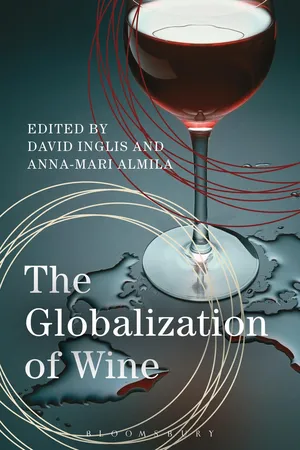
The Globalization of Wine is a one-stop guide to understanding wine across the world today. Examining a broad range of developments in the wine world, it considers the social, cultural, economic, political and geographical dimensions of wine globalization. It investigates how large-scale changes in production, distribution and consumption are transforming the wine that we drink.
Comprehensive background discussion is complemented by vivid case study chapters from a variety of international contributors. Many different countries and regions are covered, including China, the USA and Hong Kong, as are key themes, debates and controversies in contemporary wine worlds.
Innovative, up-to-date and interdisciplinary, The Globalization of Wine illustrates the diversity and complexity of wine globalization processes across the planet, both in the past and at the present time. It is essential reading for academics and students in food and drink studies, sociology, anthropology, globalization studies, geography and cultural studies. It also provides a jargon-free resource for wine professionals and connoisseurs.
- 224 pages
- English
- ePUB (mobile friendly)
- Available on iOS & Android
eBook - ePub
The Globalization of Wine
About this book
Information
1 Introduction: The Travels and Tendencies of Wine
We walk into a shop that sells wine, located in a city somewhere in north-western Europe. We scan the shelves, which contain wines that have travelled to this country from all over the world. They range from well-known regions like Burgundy to emerging (or re-emerging) areas like Georgia. We seek out what we hope will be an interesting white wine to go with dinner that evening. A bottle from the north-east of Italy catches the eye, not just because it is proclaimed to be organic but also because of a striking label design: a plain white background with a large image of a hashtag. Next to the image is a line where you can write in your own name or anything you feel like putting. On the reverse label, at the bottom, there is a small message in English. It says that the wine is the alter ego of the winemaker, who gives his name, a typically ‘Italian’-sounding one. Purchasers of the bottle are politely requested to send photos of them enjoying the wine to a telephone number registered with the Whatsapp social media app. We go back home and while cooking dinner we send via the app a picture of us drinking the wine in the kitchen, adding in a message that we like the wine a lot. A little later we get a cheerful response from the winemaker, thanking us for sending the photo and saying that he hopes that we enjoy the wine. We finish it off and then open another bottle, this time a Pinot Noir from Chile. It is much more basic in character but goes well with the food. There is no winemaker to contact this time, which is the usual case with almost any wine we have ever bought. It gets us thinking about why there is not usually some mechanism mentioned on bottle labels for consumers directly to get in touch with winemakers if they want to …
Wine is today ‘one of the most widespread and complex commodities produced globally’ (Huber 2011: 89). An ‘ordinary’ bottle of wine that middle-class drinkers across the Developed World may open on any given day is in some ways just like other comestibles consumers regularly buy from supermarkets: the green beans in their evening meal may have come from Kenya, the strawberries might have come from Mexico. This is part of much broader trends in agricultural globalization, involving significant levels of dietary ‘de-localization’, whereby what we eat may have travelled tens of thousands of miles, having negative impacts on the environment while on the way (Murray 2007). What could be more apparently delocalized than enjoying a glass of Chilean wine in, for example, northern Finland? But the label on the bottle wants to assure the consumer that it came from somewhere very ‘local’ indeed. This is a re-localizing move upon a delocalized commodity, seeking to assure the buyer that this product has true character and ‘provenance’ (see Smith Maguire in this volume) and is not just any old faceless and characterless globalized entity.
The real-life vignette above captures some of the dynamics and phenomena of the globalization of wine (or wine globalization, if you prefer), which this book is concerned with. Some of the factors involved in wine globalization, which are pursued throughout this book, can be summarized under these headings: wine production (involving a globalization of ‘wine world(s)’), wine consumption (involving globalization of ‘wine culture(s)’) and wine discourse (involving globalization of ‘wine field(s)’).
Wine production
- The long-distance and transnational movement of both wines and the containers they come in, moving through complex financial systems and distribution channels.
- The spread in multiple ways, and at various scales and levels, of wines and wine-related entities, practices and ideas, across multiple sorts of borders, including geographical, political and cultural boundaries, and the reworking of those borders themselves.
- The increasing intricacy of trans-oceanic and cross-continental networks, linkages and partnerships.
- Interactions between the so-called ‘Old’ and ‘New’ Worlds, and their increasing complexification and mutual influencing of each other.
- The presence of both massive companies and tiny boutique producers, as well as a range of more medium-sized businesses.
- Wine as both bulk, undifferentiated, mass market commodity, and as hyper-differentiated, singularized, elite object of desire.
- Partnerships between firms located in disparate regions of the planet, and ‘clusters’ of businesses located in certain regions and endowed with diverse forms of knowledge and expertise.
- The appearance of new economic actors, some of which are interested in diverse forms of investment, ploughing money into both established and start-up wineries.
- The integration of winemaking facilities into the global(ized) tourist economy and leisure industries.
- The various roles that scientific knowledges and technological forms of know-how play in how wine is made.
- Globally recognizable classifications of quality standards and price levels, such as the widely-used nomenclature that divides wines into Basic, Premium, Super Premium, Ultra Premium and Icon categories.
- Various counterblasts to what some regard as the overly technologized orientations of much contemporary winemaking, and the creation of alternative, apparently more ‘natural’ ways of making wine.
- Controversies about how winemaking impacts both on natural environments and on the workers whose labour, usually in the vineyards, wine depends on; the effects of climate change on winemaking activities.
Wine consumption
- The efforts of wine producers, located across ever more diverse parts of the planet, to enchant consumers sufficiently that their wares will be purchased, this being done through multiple mechanisms of promotion and marketing, including how bottles are labelled and how wines are packaged.
- The tastes, purchasing power, impacts on wine production, and sociopolitical sensibilities of (primarily) middle-class consumers (Koo 2016) – who may be culturally ‘omnivorous’ or younger, more ‘hipster’-style drinkers – located across the Developed World (and increasingly elsewhere too).
- The creation of transnational, ‘cosmopolitan’ drinking cultures, which spread similar forms of wine-related thought and practice across the richer parts of the world.
- The apparent democratization of wine drinking, making it less of an elitist pursuit than before in some ways, but at the same time affording opportunities for new forms of social division, elite arrogance and snobbery.
- Buying wines at auctions and other locations for reasons of financial speculation.
- The mutation and transnationalization of cultural intermediary roles, such as wine critics and sommeliers, who sell and represent wines to consumers.
- A ubiquitous ‘shopping list’ of stock words and phrases to describe scents, colours and flavours, which is a kind of global – and globalized – wine talk.
- Retail display mechanisms that can be found practically anywhere where wine is sold to private customers (the cheapest bottles at the bottom of the racks, the most expensive at the top, the bottles the seller wants consumers to trade up to located at eye level).
- Widely available styles of glassware, including those designed by leading companies like Riedel, to enhance flavours and scents, aimed both at wine professionals and at more discerning amateurs across all countries.
- The apparently inevitable presence of certain brands, such as Champagne marques like Veuve Clicquot, in putatively ‘upscale’ retail outlets the world over, alongside other generic, branded commodities like ‘designer’ perfumes and sunglasses (Ritzer and Ryan 2002).
Wine discourse
- The transnational diffusion of globalized models of how to make and appreciate wine, and multiple indigenizing adaptations of these by people in many different places.
- The operation of a globalized wine cultural industry, involving mass-market books, magazines, courses for non-professionals, tours and vacations, all of which do not just sell wine but also help to frame and stabilize judgements among consumers as to what wine ‘is’, how it should be part of one’s lifestyle, which wines and regions are the best or the most trendy, what environmentally conscious drinkers should be interested in, etc.
- The construction and contestation of regimes of valuing and legitimation, as well as ‘good’ and ‘bad’ taste.
- The construction and reconfiguration of what counts in wine terms as ‘old’ and ‘new’, ‘virtuous’ and ‘pernicious’, etc.
- Defences and inventions of ‘tradition’ and ‘locality’. The interplay between constructions and defences of what counts as the ‘local’ and ‘locality’ in winemaking, and reconfigurations of what is ‘local’ and of what counts as indigeneity, authenticity and provenance. The perception of threats to locality deriving from senses that wine globalization is a massive force tending towards a global homogenization of wines and winemaking styles.
- Disputes over the highly contentious term terroir (Ulin and Black 2013).
- The influence of often controversial cultural politics of wine on legislation, both national and transnational, and vice versa, the negotiation and contestation of different legal apparatuses by diverse sorts of actors.
- The roles played in constructing the value of wines, and choosing which wines to buy, by such ‘judgement devices’ (Karpik 2010) as the reviews and scores offered by influential critics – such as Robert Parker and his globally transportable, comprehensible and influential 100-point scale (McCoy 2005).
- The influence of publications such as Decanter magazine, and the transnational influence of the quality and other sorts of judgements made in them.
Mapping wine globalization
The categories above are in some ways artificial classifications. All the factors listed above impact upon all the others in myriad ways. One task of the social scientist is therefore to map this multi-level and poly-causal complexity. Different schools of thought narrate the history of wine globalization in differing but overlapping ways, especially as regards the New World coming to challenge the Old World. Institutionalist economists, for example, focus on how New World companies reduced transaction costs by closely aligning grape-growing, processing, marketing and distribution in strategies of vertical integration, giving them significant advantages over Old World competitors. Regulationist economists, meanwhile, emphasize how changes in the wine world are often responses to broader structural and demographic changes nationally and transnationally, such as changes in consumption habits due to lifestyle shifts among the middle classes across the Developed World. Actor Network Theory-inspired scholars tend to focus on how new marketing strategies connected New World producers to Old World consumers, taking market share away from European companies (for the different paradigms, see Itçaina et al 2016). In what follows here and in Chapter 2, we will draw selectively on these models.
Wine consumers like to imagine – and are very much encouraged by people in the wine business to believe – that a particular person called a ‘winemaker’ made what they drank, and that they made it in a particular place, and that the wine somehow reflects and expresses the nature of that location. But when one investigates who is ‘responsible’ for the wine, it is almost always never just a single person, even if a singular (meaning rhetorically ‘singularized’) person is the public face of the wine and its winery. Those ‘responsible’ for the wine, in one way or another, include not only those who actually turn the grapes into what is conventionally called ‘wine’, but also the people who grew the grapes, who pick them, who own the fields and the wineries, who invent and disseminate the scientific knowledges and the technologies that inform the winemaking process, and many others too, especially those involved in shipping and marketing. Wine is a collective and distributed product, made by different sorts of people, all acting in tandem, and sometimes interacting in conflictual ways too.
Put very schematically, the kinds of actors involved in the physical making, distributing and consuming of wine across borders look like this (following Simpson 2011):
Growers (of grapes) – Makers/producers (of wine) – Technical specialists (e.g. scientists, advisors, marketers) – Merchants – Importers – Retailers – Consumers.
As changes occur in the various relations connecting the various types of people in the chain, so too may the nature of the participants themselves change. For example, when new means of transportation of wine arrive on the scene, they may help to change what existing producers and consumers do, while possibly helping to create new types of producer and consumer.
Different relations between the various groups indicated above have pertained at different times and places. Sometimes a single company can play more than one role in the chain. For example, in the nineteenth century, in much of the so-called New World (primarily North and South America, South Africa, Australasia), growers often owned winemaking facilities, and so the grower and maker roles were combined, whereas in much of Europe (the so-called Old World), growing was often separate from production, which in turn was often separate from marketing. Merchants would blend the grapes of small family producers and sell it to consumers under their names rather than those of the producers. In this way, the consumer learnt to trust and like brands that did not reveal who grew the grapes or made the wine. However, a counter-trend also developed, whereby producers, who were sometimes also growers, sought to market their wine to consumers under their own name, reducing the power of the merchants and importers.
One of the major features of wine globalization today is a tendency towards very large companies being involved in, and thus being able to control, multiple parts of the chain. These outfits may control everything, from what is grown in vineyards and how it is grown, to the placing of the bottles on the shelves of shops. Major actors here include massive drinks conglomerates and certain large supermarkets, especially British ones like Tesco and Asda. Both these sorts of companies have the financial clout to control what wine gets made, how it is distributed, and how it is sold. They have great influence upon which wines get to consumers and which wines consumers find palatable and worth paying for (Veseth 2012).
Globalization processes have complicated the collective and distributed nature of wine production, drawing into the web that makes wine and wine drinking possible in the first place, ever more variant types of people, who are located, in complex but patterned ways, across large swathes of the planet. Examining the sorts of social relationships that exist between all these different kinds of people involves attending to things that are cultural, economic, political and spatial in nature, or blends and hybrids of these. One might therefore more precisely define the globalization of wine as the increasing social, cultural, economic, political and spatial complexification across the planet of how wine is made, how it is distributed, how it is drunk, and what people think it means to them.
The globalization of wine never involves just one single big process. Instead, wine globalization is made up of multiple processes, all overlapping and affecting each other but not necessarily cohering or heading in any one unified direction. The globalization of wine is made up of clashing and contradictory processes, and it is precisely that which means things usually becoming more complicated over time. The globalization of wine is also always tied up in all sorts of ways with wider processes of globalization, themselves being social, cultural, economic, political and spatial in nature. Wine globalization is strongly shaped by these factors and the ways in which they intertwine, as well as to some degree acting upon them in turn too.
There is of course no one accepted definition among scholars as to what ‘globalization’ is and involves, and which theoretical and empirical accounts of it should be deployed. Yet wine globalization is of far too great a complexity for the di...
Table of contents
- Cover
- Halftitle Page
- Title Page
- Dedication Page
- Contents
- List of Contributors
- 1 Introduction: The Travels and Tendencies of Wine
- 2 Wine Globalization: Longer-term Dynamics and Contemporary Patterns
- 3 Reflexive Imbrications: Burgundy and the Globalization of
- 4 Building and Sustaining Legitimacy in an Emerging Wine Region: The Case of North Carolina, USA
- 5 From Post-Socialist to Pre-EU: The Globalized Transformation of the Republic of Macedonia’s Wine Industry
- 6 Globalization and Reputation Dynamics: The Case of Bordeaux Wines
- 7 Fluid Modernity: Wine in China
- 8 The Globalization of the Wine Industry in Hong Kong: A Local and Global Perspective
- 9 Enduring Wine and the Global Middle Class
- 10 Natural Wine and the Globalization of a Taste for Provenance
- 11 Wine, Women and Globalization: The Case of Female Sommeliers
- Index
Trusted by 375,005 students
Access to over 1.5 million titles for a fair monthly price.
Study more efficiently using our study tools.
Frequently asked questions
Yes, you can cancel anytime from the Subscription tab in your account settings on the Perlego website. Your subscription will stay active until the end of your current billing period. Learn how to cancel your subscription
No, books cannot be downloaded as external files, such as PDFs, for use outside of Perlego. However, you can download books within the Perlego app for offline reading on mobile or tablet. Learn how to download books offline
Perlego offers two plans: Essential and Complete
- Essential is ideal for learners and professionals who enjoy exploring a wide range of subjects. Access the Essential Library with 800,000+ trusted titles and best-sellers across business, personal growth, and the humanities. Includes unlimited reading time and Standard Read Aloud voice.
- Complete: Perfect for advanced learners and researchers needing full, unrestricted access. Unlock 1.5M+ books across hundreds of subjects, including academic and specialized titles. The Complete Plan also includes advanced features like Premium Read Aloud and Research Assistant.
We are an online textbook subscription service, where you can get access to an entire online library for less than the price of a single book per month. With over 1.5 million books across 990+ topics, we’ve got you covered! Learn about our mission
Look out for the read-aloud symbol on your next book to see if you can listen to it. The read-aloud tool reads text aloud for you, highlighting the text as it is being read. You can pause it, speed it up and slow it down. Learn more about Read Aloud
Yes! You can use the Perlego app on both iOS and Android devices to read anytime, anywhere — even offline. Perfect for commutes or when you’re on the go.
Please note we cannot support devices running on iOS 13 and Android 7 or earlier. Learn more about using the app
Please note we cannot support devices running on iOS 13 and Android 7 or earlier. Learn more about using the app
Yes, you can access The Globalization of Wine by David Inglis, Anna-Mari Almila, David Inglis,Anna-Mari Almila in PDF and/or ePUB format, as well as other popular books in Politics & International Relations & Agricultural Public Policy. We have over 1.5 million books available in our catalogue for you to explore.