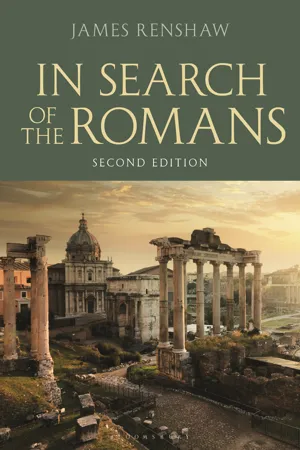
In Search of the Romans is a lively and informative introduction to ancient Rome. Making extensive use of ancient sources and copiously illustrated with photographs, drawings, maps and plans, now for the first time in colour, its opening two chapters guide the reader through the events of Roman history, from the foundation of the city to the fall of the empire. Subsequent chapters introduce the most important aspects of the Roman world: the army and the provinces, religion, society, and entertainment; the final two chapters focus on Pompeii and Herculaneum, the two cities destroyed by Vesuvius. New to this edition are sections on the Augustan principate, on the Roman army, on life in the provinces and on engineering innovations, while the existing text is revised throughout. The narrative includes descriptions of many individuals from the Roman world, drawn from a variety of social settings. Activity boxes and further reading lists throughout each chapter aid students' understanding of the subject. Review questions challenge students to read further and reflect on some of the most important social, political and cultural issues of ancient Rome, as well as to compare them with those of their own society. The new edition is supported by a website that includes images, maps and timelines, further reading and related links.
- 456 pages
- English
- ePUB (mobile friendly)
- Available on iOS & Android
eBook - ePub
In Search of the Romans (Second Edition)
About this book
Information

Rome was not built in a day.
This saying is so well known that it is easy to forget the truth behind it. The first settlements in the region of Rome were established in the late Bronze Age, and later Romans liked to believe that the city itself was founded in 753 BCE, but it was not for another four centuries that the city began to extend its power beyond central Italy. Its first overseas conquest came in 264 BCE, and over the next three centuries Rome established one of the largest empires in the ancient world by conquering swathes of Europe, North Africa and the Near East. By the early 1st century CE, the Romans ruled from Britain in the north to Egypt in the south, and from Portugal in the west to Iraq in the east.
This chapter aims to give an overview of the first half of ancient Roman history, up to the moment in 31 BCE when Augustus became the sole ruler of the Roman Empire and the man regarded as its first emperor. Chapter 2 then continues the narrative from this point, examining Rome under the emperors until the fall of the western empire in the 5th century CE.
Sources for Early Roman History
It is difficult to piece together with confidence a detailed history of Rome before 300 BCE. The archaeological evidence is limited by the fact that the city has been built over so many times. Each new building project has dug through and destroyed archaeological layers below, which also means that there are few available places to dig up and find out about the city’s earliest stages. None the less, the archaeological evidence for Rome’s early history that we do have gives an overview of the main developments.
The written tradition of Rome’s early history provides a more difficult set of problems. The two earliest recorded Roman historians are Fabius Pictor and Cincius Alimentus, who wrote in the late 3rd century BCE. Neither of their works has survived beyond fragments, but they were used as sources by later historians whose works have survived. How reliable could the accounts of Pictor and Alimentus have been? The two writers would have been able to conduct research about events in the two or three generations before their time by talking to people about their memories and those of their parents and grandparents. This would stretch back to about 300 BCE; but any further back in time than this, their accounts must have moved quickly from history to legend.
Despite this, it is clear that by the time of Pictor and Alimentus the Romans were telling an elaborate history of their city. They believed that the Trojan warrior Aeneas had led refugees to Italy in the 12th century BCE, and that his descendent Romulus had founded Rome in the middle of the 8th century – 753 being the most commonly accepted date. There was then a detailed narrative of Roman history down to their own day. Modern scholars agree that this literary narrative should be regarded as a set of legends rather than accurate history – it is sometimes referred to as the ‘literary tradition’.
How did this narrative develop? It seems that it was a complex mixture of Roman tradition handed down by word of mouth, interwoven with Greek history and legend. In the 3rd century BCE, Greek culture was starting to have a significant influence on the Roman world, and this influenced Pictor and Alimentus enormously; despite being Roman senators, both men wrote in Greek for a Greek audience, to whom they sought to justify Rome’s rise to power in the western Mediterranean. Both seem to have drawn heavily upon celebrated Greek historians, such as Herodotus and Thucydides, who had written in the 5th century BCE. Indeed, a number of stories in the Roman literary tradition seem to have been patterned on an equivalent set of events in Greek history.
Livy and Dionysius of Halicarnassus
Titus Livius, or Livy, and Dionysius of Halicarnassus have left us our most detailed surviving accounts of early Roman history, although there are references to the literary tradition in many other authors too. Livy (59 BCE–17 CE) came from Patavium in northern Italy, and set out to write, in Latin, a history of Rome from its foundation up until his own day. It consisted of 142 books, 35 of which still survive complete, including those that cover the city’s earliest history. It is significant that Livy was writing during the reign of the first Roman emperor, Augustus, who wished to promote the traditions of the Roman past (see p. 77). Livy believed in the new Augustan regime, and for him history writing was primarily about providing moral lessons for his readership.
Dionysius came from Halicarnassus, a Greek city on the south-west coast of Asia Minor (a region roughly equivalent to the western two-thirds of modern Turkey). A contemporary of Livy, he came to Rome in 30 BCE to teach rhetoric. His Roman Antiquities were written in Greek for a Greek audience, and covered the years from the foundation of the city down to 264. Only the first eleven books of twenty have survived complete, covering events down to 449. Although Dionysius is often long-winded compared to Livy, he assumes that his Greek readership has a limited knowledge of the Roman world and so provides helpful additional information. Moreover, his account of some events differs from that of Livy, suggesting that the earlier Roman sources themselves were sometimes at odds with one another.
How should the modern historian interpret the Roman literary tradition? Two approaches can usefully be applied. One is to recognise that the stories of early Roman history are legendary, but to assume that they have some basis in real events. The task is then to work out how much truth lies behind each story. It is on this point that scholars tend to debate and disagree. A second approach is to recognise that the literary tradition was a key part of the development of a Roman identity. Since these stories therefore give us insight into fundamental Roman cultural values, beliefs and anxieties, they give us a deeper understanding of how the Romans saw themselves.
There is a further reason why the stories of early Roman history remain important today, which is that they have been a source of inspiration for artists and writers from the European Renaissance onwards. For example, both Botticelli and Titian painted the story of Tarquin and Lucretia, Shakespeare wrote a play about Coriolanus, while Purcell composed an opera entitled Dido and Aeneas. These stories are entwined in the western cultural heritage, and an awareness of them gives the modern reader a deeper cultural literacy.
I Origins and Kingdom
In considering the development of Rome down to 509 BCE, the literary tradition and the archaeological evidence will be examined separately.
1 The Literary Tradition
There are two complementary legends about how the city came to be founded, one which traces Roman origins back to the heroic age of the Trojan War in Greek mythology (which was believed to have happened in the early 12th century BCE), the other which is based in native Roman folklore.
Aeneas
The legend of the Trojan War had been a key part of storytelling in the Greek world for hundreds of years. It recounted the abduction of Helen of Sparta by the Trojan prince Paris, which provoked a huge Greek armada to sail to Troy to win her back. The legend tells of many great heroes, both Greek and Trojan, including Achilles, Hector, Agamemnon and Odysseus. The two great Homeric poems, the Iliad and the Odyssey, tell respectively of events in the final year of the war and of the challenging journey home of Odysseus in its aftermath. One relatively minor character in the Iliad is Aeneas, a member of the Trojan royal family; he is the son of the goddess Aphrodite and of a mortal man, Anchises. At one point in the poem, the god Apollo justifies rescuing him from certain death in a duel against Achilles so that the Trojan race (whose founder was Dardanus) might live on:
Aeneas is destined to live on, so that Dardanus’ race itself might survive, Dardanus whom Zeus loved above all his children by mortal women. The Son of Cronos [Zeus] has come to hate Priam’s line, and mighty Aeneas will be the Trojan king, as his descendants will in time to come.
Homer, Iliad, 20.302–308
This prophecy gave other storytellers plenty to work with, and a tradition soon grew up that Aeneas had escaped during the sack of Troy and led Trojan survivors to Italy.
Dionysius of Halicarnassus refers to several early Greek traditions which made Aeneas the founder of Rome or ancestor of the later Romans: they claimed that he had settled his people in Latiu...
Table of contents
- Cover
- Half Title
- Series Page
- Title Page
- Contents
- Introduction
- 1 From Kingdom to Republic
- 2 The Emperors
- 3 Running an Empire
- 4 Roman Religion
- 5 Roman Society
- 6 Roman Entertainment and Leisure
- 7 Pompeii
- 8 Herculaneum
- 1 Roman Currency Values
- 2 Roman Clothing
- 3 Roman Names
- 4 Roman Time
- Glossary
- Sources of Quotations
- Sources of Illustrations
- Index
- Copyright
Trusted by 375,005 students
Access to over 1.5 million titles for a fair monthly price.
Study more efficiently using our study tools.
Frequently asked questions
Yes, you can cancel anytime from the Subscription tab in your account settings on the Perlego website. Your subscription will stay active until the end of your current billing period. Learn how to cancel your subscription
No, books cannot be downloaded as external files, such as PDFs, for use outside of Perlego. However, you can download books within the Perlego app for offline reading on mobile or tablet. Learn how to download books offline
Perlego offers two plans: Essential and Complete
- Essential is ideal for learners and professionals who enjoy exploring a wide range of subjects. Access the Essential Library with 800,000+ trusted titles and best-sellers across business, personal growth, and the humanities. Includes unlimited reading time and Standard Read Aloud voice.
- Complete: Perfect for advanced learners and researchers needing full, unrestricted access. Unlock 1.5M+ books across hundreds of subjects, including academic and specialized titles. The Complete Plan also includes advanced features like Premium Read Aloud and Research Assistant.
We are an online textbook subscription service, where you can get access to an entire online library for less than the price of a single book per month. With over 1.5 million books across 990+ topics, we’ve got you covered! Learn about our mission
Look out for the read-aloud symbol on your next book to see if you can listen to it. The read-aloud tool reads text aloud for you, highlighting the text as it is being read. You can pause it, speed it up and slow it down. Learn more about Read Aloud
Yes! You can use the Perlego app on both iOS and Android devices to read anytime, anywhere — even offline. Perfect for commutes or when you’re on the go.
Please note we cannot support devices running on iOS 13 and Android 7 or earlier. Learn more about using the app
Please note we cannot support devices running on iOS 13 and Android 7 or earlier. Learn more about using the app
Yes, you can access In Search of the Romans (Second Edition) by James Renshaw in PDF and/or ePUB format, as well as other popular books in History & Roman Ancient History. We have over 1.5 million books available in our catalogue for you to explore.