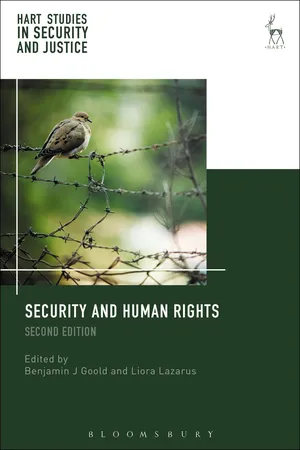
This is the second edition of the acclaimed Security and Human Rights, first published in 2007. Reconciling issues of security with a respect for fundamental human rights has become one of the key challenges facing governments throughout the world. The first edition broke the disciplinary confines in which security was often analysed before and after the events of 11 September 2001. The second edition continues in this tradition, presenting a collection of essays from leading academics and practitioners in the fields of criminal justice, public law, privacy law, international law, and critical social theory. The collection offers genuinely multidisciplinary perspectives on the relationship between security and human rights. In addition to exploring how the demands of security might be reconciled with the protection of established rights, Security and Human Rights provides fresh insight into the broader legal and political challenges that lie ahead as states attempt to control crime, prevent terrorism, and protect their citizens. The volume features a set of new essays that engage with the most pressing questions facing security and human rights in the twenty-first century and is essential reading for all those working in the area.
- 240 pages
- English
- ePUB (mobile friendly)
- Available on iOS & Android
eBook - ePub
Security and Human Rights
About this book
Information
1
Security and Human Rights: Finding a Language of Resilience and Inclusion
Security and Human Rights was first published in 2007, six years after the events of 9/11. We argued then that liberal democracies, if they were to withstand growing calls for exceptionalism, needed to find a way to reconcile the demands of security with a respect for fundamental human rights. With the benefit of hindsight, and having witnessed the steady rise of populism over the last ten years, this call now appears both prophetic and increasingly urgent. Today there is little doubt that populism constitutes a central challenge to liberal democratic norms, preying as it does on existential fear while promoting nationalist paranoia and stoking racial and religious division.1 In this ‘politics of fear’, the threat of insecurity has been hyper-inflated and exploited to justify a pernicious authoritarianism.2 It is against this backdrop that many academics, policy actors, and human rights activists have found themselves vilified as out-of-touch elitists or naïve experts and their calls for a thoughtful balance between security and rights dismissed as mere ‘virtue-signalling’ rhetoric.
The threat of this security populism is now so profound that core values of human rights, constitutionalism, and tolerance are under acute pressure in democracies throughout the world. At the time of writing, the signs of this pressure are all around us. The withdrawal of the United States from the UN Human Rights Council, the support of the US Supreme Court for President Donald Trump’s travel ban, the separation of children from their parents at the US border, the purging of the Polish Constitutional Court, the undermining of the rule of law and academic freedom in Hungary, Russia’s constitutional amendment undermining the status of decisions from the European Court of Human Rights (ECtHR), the consolidation of emergency power in Turkey, the continuing rejection by the Right in the United Kingdom of the legitimacy of the European human rights regime, and the increasing political strength globally of anti-immigrant and racist right-wing populism are only a few examples of this dramatic and disturbing trend. Almost every day we hear news of another executive action aimed at rolling back the human rights advances of the last half century. As David Rieff has argued, ‘the global balance of power has tilted away from governments committed to human rights norms and toward those indifferent or actively hostile to them.’3
There is no denying, however, that the erosion of fundamental rights and the consolidation of executive power in pursuit of security took (and takes) place under the watch of self-identified ‘liberal’ leaders. While the state of emergency in France was initiated in 2015 after attacks in Paris, it continued for six months after Emmanuel Macron came to power in 2017, and the issues of emergency powers and lethal force have recently arisen again in response to the gilets jaunes protests.4 Austria, France, Belgium, and Denmark have all banned religious dress covering the face,5 while the US targeted killing programme expanded significantly during the presidency of Barack Obama. The contradictions within ‘liberalism’, whether expressed through the pursuit of security at the expense of rights or as a blunt ideological commitment to secularism, have served only to exacerbate a pre-existing scepticism towards the liberal project in countries across Europe and in the United States. These contradictions are nothing new: the counternarratives of slavery and colonialism have long been sublimated alongside celebrations of so-called liberal values.6 Defending liberalism in the face of both its historical legacy and its more recent failure to balance security with rights, remains a fundamental challenge for human rights advocates.
In times of such pressure, there is a strong temptation to jettison human rights, or even constitutionalism, as a failed paradigm,7 on the grounds that it is little more than a liberal façade or a thin veil of legality behind which the dirty work of security is carried out.8 As in the months immediately following 9/11, there are increasing signs that human rights proponents are experiencing profound self-doubt.9 During such moments, however, it is imperative for those engaged in the promotion and protection of human rights to return to fundamental values. While critical evaluation is essential and is certainly present in this volume, it is also important to remind ourselves of what human rights stand for, as well as the achievements of human rights and the constitutional paradigm.
While many states continue to undermine human rights norms, their efforts have thankfully been met with stubborn resistance, sometimes resulting in successful appeals to justice. Recently, the UK Parliamentary Intelligence and Security Committee published a report damning British intelligence agencies and the Foreign Secretary for their involvement in the torture and kidnap of terrorist suspects after 9/11.10 This report is the most recent of a series of inquiries across jurisdictions and institutions11 and key judicial decisions12 relating to the use of CIA-led torture and kidnapping as part of extraordinary rendition processes post-9/11. While exposure of these practices came far too slowly for rendition victims, and impunity in respect of those actors who committed torture remains a serious concern,13 there is little doubt that the absolute prohibition on torture under international and domestic human rights law played a part in this process and will continue to have ramifications for those involved in the years to come.14 Similarly, protections against arbitrary detention have enabled courts to gradually overturn laws that sought to allow for indefinite detention without trial in the United States and Britain in the wake of 9/11. In many ways, the right to habeas corpus has grown in stature thanks to its role in the dismantling of the early regimes at Guantanamo Bay and Belmarsh.15 Talk of a jus cogens status for the right against arbitrary detention is now even being acknowledged in UK courts.16
On the other hand, some human rights protections have shown a disturbing elasticity when confronted with novel security measures. Just as the right to a fair trial has ‘adapted’ to allow for the admission of certain forms of secret evidence,17 privacy jurisprudence has shown considerable flexibility in the face of steady expansions in state surveillance.18 Similarly, there has been a notable rise in the use of immigration law as a weapon of counterterrorism, with citizenship deprivation at the most extreme end of these policies.19 Set outside the procedural safeguards of the criminal law and the full jurisdictional protections of human and constitutional rights, immigration law is a fertile ground for human rights limitations, and courts have been alarmingly slow to intervene when individuals have been left without the ‘protections of nationality’.20 Indeed, the tendency of supposed liberal democracies to ‘export’ the dirty work of counterterrorism is a major concern.21
Similarly concerning is the erosion of the right to life through the continued use of targeted killing programmes. Here the reach for legal justification by democratic states, most notably Israel and the United States, has stretched international law paradigms relating to armed conflict and the proportionality of lethal force.22 In this pursuit, President Obama did little to constrain the executive power awarded to the Presidency by his hawkish predecessors. Targeted killing, as with extraordinary rendition and indefinite detention, radically undermines any claim to the moral high ground by the United States and its allies purporting to uphold ‘Western’ democratic values.23 The stain of this programme remains indelible, especially as the victims’ families have had almost no human rights recourse or vindication. Notwithstanding vocal condemnation by human rights institutions such as the Special Rapporteurs and NGOs24 and the recent condemnation of the North Rhine Westphalia Higher Administrative Court on the legality of drone operations conducted in Germany,25 no effective remedy is available to those communities that have lost innocent lives.26
Along with the erosion of fundamental rights across the globe, there has been a corresponding movement to make security the object of human rights protections. National security concerns, once seen in tension with fundamental rights, have come to be embodied within new ‘coercive human rights’, which centre on the protective obligations of states in relation to victims or potential victims of private violence – rather than being understood as a limitation on state action.27 The turn to security from within human rights discourse is indicative of a broader shift towards securitisation, whereby even the concept of the rule of law and the ambition of economic development are seen as mere preconditions to the security of individuals rather than as substantive goods in themselves.28 While two decades ago we might have referred to a ‘right to food’ we now speak of ‘food security’; while the ‘rule of law’ used to refer to the absence of arbitrary state power, it is now gradually being replaced by ‘security, law, and order’ rhetoric.29
This shift towards protection or coercion can be viewed in a variety of ways. On the one hand, it can be argued that this move runs counter to the ever-growing perception or caricature that human rights and the rule of law limit the pursuit of order and security; and the elision of human rights with security is an appropriate response to the increasing threat of private violence. On the other hand, it also signals the corrosive influence of security politics within international political discourse. Ultimately, what these trends signal is the capacity of human rights to be co-opted and transformed by national and international narratives about security. The adaptability of rights discourse may be both its most significant protection and its most dangerous threat.
While human rights have shown themselves both adaptable and vulnerable to the pressures associated with the pursuit of security, the landscape of security has also evolved significantly since the first edition of this book, with many of the ‘threats’ targeted by hawkish states showing signs of persistence and intractability. There is little doubt that security interventions and rights violations have themselves helped to entrench the very threats to security that states have sought to counter: one need only look at the rise of ISIS after the illegal invasion of Iraq to find a clear example of how security overreach can undermine its stated objective. The cycle of terrorism has thus continued, with fatalities rising globally.30
In the Global North, the response to recent terrorist attacks has been complex. Despite encouraging signs that the centrist public is growing tired of securitised rhetoric and instead turning to discourses of resilience,31 terrorism in some metropolitan cities in Europe has resulted in the application of emergency conditions32 and led to a surge in Islamophobic rhetoric and violence.33 The uneven nature of political reactions and media treatment of different types of violence and aggression has itself become a point of contention.34 Certainly, the immediate and unequivocal labelling of the Christchurch mosque massacres as ‘terrorism’ by New Zealand Prime Minister Jacinda Adern stood in sharp contrast to the denialism of President Donald Trump when he has been queried about the actions of white supremacists and other right-wing extremists. In many ways, the manner in which security threats are named and explained has now become a conscious political marker in an increasingly polarised environment.
One clear point we can draw from the last decade is that governments that suggest they can ‘end’ insecurity, ‘terminate’ threats, or ‘bring this carnage to an end today’ are unlikely ever to deliver on their promises.35 Far more likely is that such governments will play the politics of security, just as they have always done, to shore up their own political power. This security populism, which is premised on the vilification of outsider groups and has increasingly relied on systemic Islamophobia, is now showing its real face. Instead of more security, right-wing terrorism has risen, with devastating effects.36 While the shock of the recent attacks in Christchurch is still reverberating around the globe, right-wing terrorist violence has also occurred over the last three years in Quebec, Ajaccio, Munich, Dresden, Duma, Zurich, London, Portland, Jefferstown, and Pittsburgh. These are only a few examples of a clear trend that also encompasses increasingly open expressions of anti-semitism. As the Anti-Defamation League has reported in the context of the United States, ‘extremist-related murders in 2018 were overwhelmingly linked to right-wing extremists’.37 As a consequence, there have been signs that such threats are now on the radar of counterterrorism efforts in the United States and elsewhere.38
As the years since 9/11 have repeatedly shown, the claim that greater security can be achieved if we are willing to accept an erosion of rights is clearly false. Yet human rights and security continue to be placed in opposition to one another, as proponents of both rights and security are repeatedly drawn into the interstices of an intractable campaign against a permanent threat. In this complex and interrelated world, human rights are increasingly tested by populists who both grossly underplay the gains to be made by safeguarding human rights and seriously underestimate the harms to security that result from their breach. Similarly, the inevitably of risk in a free and globalised society has been downplayed in favour of unrealistic claims about achieving security in order to justify nationalism and autarchism, which in turn are inherently connected to the vilification of others.
Balancing security and human rights will thus re...
Table of contents
- Cover
- Title Page
- Acknowledgements
- Contents
- About the Contributors
- 1. Security and Human Rights: Finding a Language of Resilience and Inclusion
- PART I: RELIGION, IDENTITY, AND CITIZENSHIP
- PART II: RIGHTS, ACCOUNTABILITY, AND THE STATE
- PART III: PRIVACY, ANONYMITY, AND DISSENT
- PART IV: EXCEPTIONALISM, RISK, AND PREVENTION
- Index
- Copyright Page
Trusted by 375,005 students
Access to over 1.5 million titles for a fair monthly price.
Study more efficiently using our study tools.
Frequently asked questions
Yes, you can cancel anytime from the Subscription tab in your account settings on the Perlego website. Your subscription will stay active until the end of your current billing period. Learn how to cancel your subscription
No, books cannot be downloaded as external files, such as PDFs, for use outside of Perlego. However, you can download books within the Perlego app for offline reading on mobile or tablet. Learn how to download books offline
Perlego offers two plans: Essential and Complete
- Essential is ideal for learners and professionals who enjoy exploring a wide range of subjects. Access the Essential Library with 800,000+ trusted titles and best-sellers across business, personal growth, and the humanities. Includes unlimited reading time and Standard Read Aloud voice.
- Complete: Perfect for advanced learners and researchers needing full, unrestricted access. Unlock 1.5M+ books across hundreds of subjects, including academic and specialized titles. The Complete Plan also includes advanced features like Premium Read Aloud and Research Assistant.
We are an online textbook subscription service, where you can get access to an entire online library for less than the price of a single book per month. With over 1.5 million books across 990+ topics, we’ve got you covered! Learn about our mission
Look out for the read-aloud symbol on your next book to see if you can listen to it. The read-aloud tool reads text aloud for you, highlighting the text as it is being read. You can pause it, speed it up and slow it down. Learn more about Read Aloud
Yes! You can use the Perlego app on both iOS and Android devices to read anytime, anywhere — even offline. Perfect for commutes or when you’re on the go.
Please note we cannot support devices running on iOS 13 and Android 7 or earlier. Learn more about using the app
Please note we cannot support devices running on iOS 13 and Android 7 or earlier. Learn more about using the app
Yes, you can access Security and Human Rights by Benjamin J Goold,Liora Lazarus in PDF and/or ePUB format, as well as other popular books in Law & International Law. We have over 1.5 million books available in our catalogue for you to explore.