eBook - ePub
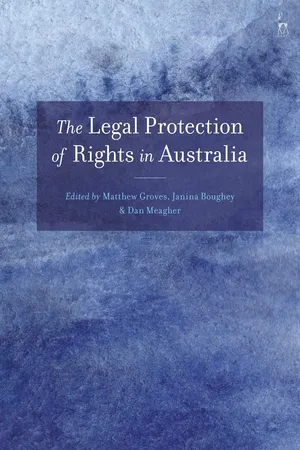
The Legal Protection of Rights in Australia
- 304 pages
- English
- ePUB (mobile friendly)
- Available on iOS & Android
eBook - ePub
The Legal Protection of Rights in Australia
About this book
How do you protect rights without a Bill of Rights? Australia does not have a national bill or charter of rights and looks further away than ever from adopting one. But it does have a range of individual elements sourced from common law, statute and the Constitution which, though unsystematic, do provide Australians with some meaningful rights protection. This book outlines and explains the unique human rights journey of Australia. It moves beyond the criticisms long made of the Australian position – that its 'formalism', 'legalism' and 'exceptionalism' compromise its capacity for rights protection – to consider how the many elements of its novel legal structure operate. This book analyses the interlocking legal framework for the protection of rights in Australia. A key theme of the book is that the many different elements of a fragmented scheme can add up to something significant, albeit with significant gaps and flaws like any other legal rights protection framework. It shows how the jumbled influences of a common law heritage, a written constitution, differing paths taken by jurisdictions within a single federal state, statutory and common law innovations and a strong dose of comparative legal influences have led to the unique patchwork of rights protection in Australia. It will provide valuable reading for all those researching in human rights, constitutional and comparative law.
Information
1
Rights, Rhetoric and Reality: An Overview of Rights Protection in Australia
MATTHEW GROVES, JANINA BOUGHEY AND DAN MEAGHER
In his description of the arrival of the first Europeans to Australia, the famed art critic and some-time historian Robert Hughes recounted many natural features that astounded European eyes, such as trees that shed their bark instead of their leaves.1 The natural environment of Australia, and perhaps more than a few of its people, remain an object of curiosity to the rest of the world but one in particular provides an apt metaphor for this book. That is the platypus. When the first specimens of this shy and still largely unknown mammal were sent to Britain, they were widely suspected to be a hoax. How else could such a strange creature be explained? It had the webbed feet of a duck, the soft fur of a young bear, the tail of a beaver and the bill of an exotic bird. The female laid eggs. The male had a venomous spur. The platypus was eventually accepted to be genuine,2 but the fact of its existence makes it no less odd. The same might be said of the legal framework for the protection of rights in Australia.
Australia has become an outlier in the common law world because it lacks a national bill or charter of rights, either within its written constitution or as a freestanding instrument. The Australian Constitution does expressly protect a handful of ‘rights’; but they are an odd mix, are very limited, and are often couched as limits on Commonwealth power rather than personal or individual rights. For instance, section 117 protects the right to equal treatment between residents of different states,3 and section 51(xxxi) provides that the Commonwealth Parliament’s power to compulsorily acquire property is limited by a requirement that it provide compensation ‘on just terms’.4 Section 80 provides people charged upon indictment with a right to trial by jury in the state where the offence was allegedly committed but this can easily be circumvented.5
The very absence of things often makes them the subject of intense speculation. Rights within the Australian context are no exception. While he was Solicitor-General of Australia, now Justice Gageler of the High Court of Australia noted that, despite the apparent silence of the Constitution, the ‘place of human rights in the structure of our nation’s institutions has been debated from the very beginning’ since its inception as a federal nation.6 That reference to a ‘place’ points to a longstanding reality about rights in Australia. Much of the debate about rights in Australia has long proceeded on the assumption that they deserve a place in Australian law – the difficult question is where. The answer of this book might appear to be the somewhat unsatisfactory one of ‘all over the place but nowhere in particular.’ Yet the more subtle conclusion suggested by this book is that the absence of a comprehensive, single bill or scheme of rights within the Australian Constitution or legislation is not the end of the story but only its beginning.
The lack of detailed rights within the Australian Constitution has provided the impetus for a multi-layered conception of rights. One is implication. In the absence of express constitutional rights, the High Court has identified a limited collection of what some refer to as ‘rights’ within Australia’s Constitution.7 Properly understood, these implied rights are not really ‘rights’ at all, but limits on the powers of legislatures and governments which are necessary to protect the structure of government established by the Constitution. For example, the implied ‘right’ to freedom of political communication is not a right belonging to individuals, but a limit on the power of Australian legislatures to enact laws which undermine the ability of voters to communicate freely about political matters – a freedom which is necessary in order to protect the system of representative democracy and responsible government that the Constitution establishes.
The other main source of rights is statutory. What is not done directly by the Constitution can largely be done by parliaments. The many statutory rights examined in different chapters of this book suggest that statutes have become the preferred vehicle for the recognition and protection of rights in Australia.8 Within Australia’s federal structure, three jurisdictions have enacted statutory charters of rights. These are each modelled upon on the equivalent instruments of New Zealand, Canada and the UK but each also contains their own modest variations.9 The influence of those foreign instruments upon Australian charters of rights draws attention to a modern variation of the common law methodology that has long been central to Australian law. That methodology is traditionally conceived as a judicial one, in which courts may consider similar principles from similar common law jurisdictions in the development of legal principle. The charters of rights adopted within Australia reflect a statutory equivalent of that process. They are inspired by and draw heavily from similar instruments that exist in similar common law jurisdictions. These statutes also draw attention to a central theme of this book – constitutional restriction can often give rise to statutory innovation.
I.The Constitutional Context – Exceptionalist but also Unexceptional
The aim of this book is to provide a holistic account, as far as is possible, of the novel patchwork of statutes, institutions and discrete bodies of law that comprise Australia’s scheme of rights protection. That approach proceeds on the assumption that the Australian system is somewhat unique, but that characteristic can easily become distracting for Australians. When Professor Taggart analysed the exceptionalism of Australian public law, he cautioned that the Australian Constitution should not continue to be regarded as a ‘conversation stopper’ that was offered as an answer to virtually every question about the past, present and future of Australian public law.10 He decried the routine and reflexive references to constitutional principles such as the relatively strict Australian conception of the separation of powers as ‘too simplistic.’ The reason, he explained, was that:
Like so much Australian constitutional talk it is actually grounded in a more universal common law constitutionalism, which owes much to the writings of A V Dicey.11
Taggart’s insightful observation was that many of the doctrinal limitations attributed to the Australian Constitution may in fact be more explicable by reference to the influence of the ideas of Dicey upon the development of the Constitution, and to Australian public law more broadly. The absence of express rights in the Australian Constitution is a clear example of that influence and perhaps no surprise. At the time Australia’s Constitution was drafted and enacted, nations within the Commonwealth were approaching what nowadays might be termed ‘peak Dicey’.12 One consequence of the influence of Dicey was that the Australian Constitution eschewed the American model, which identified and protected individual rights, and was instead ‘built upon confidence in a system of parliamentary Government with ministerial responsibility.’13 There are three foundational concepts within the system of government created by the Australian Constitution – federalism, the separation of powers and representative government.14 The obvious omission is rights. The Australian Constitution contains no unifying theory or vision about rights. The Diceyan explanation for this omission was given by Dawson J, in a case where his Honour dissented against the recognition (or perhaps creation) of the implied freedom of political communication. His Honour explained:
Those responsible for the drafting of the Constitution saw constitutional guarantees of freedoms as exhibiting a distrust of the democratic process. They preferred to place their trust in Parliament to preserve the nature of our society and regarded as undemocratic guarantees which fettered its powers. Their model in this respect was not the United States Constitution, but the British Parliament, the supremacy of which was by then settled constitutional doctrine.15
This argument has a long political pedigree that is now often forgotten. It was present at the nation’s founding when the framers deleted a number of rights provisions which formed part of the 1891 original draft of the Australian Constitution. They did so due to their deep (Diceyian) scepticism about formal rights guarantees. And in the late 1960’s when much of western society was experiencing a renaissance of rights and activism, the nation’s longest serving Prime Minister, Sir Robert Menzies, explained how the talk of modern ‘nonsense’ such as rights was wisely avoided by the drafters of the Australian Constitution because they had realised:
… to define rights is to limit them – for in the long run words must be given some meaning – or to express them so broadly that the discipline which is inherent in all government and ordered society becomes impossible.16
As with most later references to the wisdom and intention of the authors of the Australian Constitution, these remarks may reveal much more about their own author than the those of the Constitution. The importance of Menzies’ remarks and the attitude they embody lies in the strong influence they have exerted over conservative political culture in subsequent decades. Talk about rights in Australia has long assumed a largely partisan political posture. Just as the advancement of rights has become an important part of progressive politics, resistance to rights, whether by their judicial recognition, legislative creation or treaty ratification, has long been equally important to conservative politics.
That same focus has informed two key elements of the modern Australian resistance to any kind of national bill or charter of rights. One is a belief that parliaments are the ‘proper institutions under our system to decide what rights should be further developed or qualified by competing interests.’17 From a theoretical perspective, this argument echoes Dworkin’s distinction between courts and parliaments in which he saw the former as the place for arguments about matters of principle, while the latter was the place for more utilitarian matters such as policy.18 One consequence of this scheme was the concern that ‘rights’ might override the community interests as determined by parliaments, hence Dworkin’s longstanding concern that rights as applied in the courts might ‘trump’ those interests recognised by parliaments. In many common law jurisdictions, Dworkin’s thesis is essentially rejected by arguments that parliaments can, and often do, carefully weigh different interests in pursuit of a common good.19 A variation of this argument underpins the persistent Australian refusal to adopt a bill or charter of rights at the federal level. Opponents of such a step implicitly claim that this refusal is a considered, sensible decision of the Parliament rather than the product of political inertia. There is no better modern example in Australia of that inertia than the struggle for marriage equality that is traced by Gabrielle Appl...
Table of contents
- Cover
- Title Page
- Foreword
- Table of Contents
- List of Contributors
- 1. Rights, Rhetoric and Reality: An Overview of Rights Protection in Australia
- 2. Australia’s Constitutional Design and the Protection of Human Rights
- 3. Chapter III of the Constitution and the Protection of Due Process Rights
- 4. The High Court’s Implied Rights Experiment
- 5. The Reception of International Law in Constitutional Litigation – The Al-Kateb Battle and its Aftermath
- 6. International Law, Administrative Powers and Human Rights: The Legacy of Teoh
- 7. The Australian Human Rights Commission
- 8. The Human Rights (Parliamentary Scrutiny) Act 2011 (Cth): A Failed Human Rights Experiment?
- 9. The Nature and Limitations of Commonwealth Anti-Discrimination Law
- 10. ‘Culture, What Culture?’ Why We Don’t Know if the ACT Human Rights Act is Working
- 11. The Victorian Charter: A Slow Start or Fundamentally Flawed?
- 12. International Human Rights Treaties and Institutions in the Protection of Human Rights in Australia
- 13. The Recognition and Protection of Indigenous Rights
- 14. Federalism, Public Interest Advocacy and Marriage Equality in Australia
- 15. Freedom of Religion
- 16. A Fair Trial for Accused Terrorists
- 17. A Search for Rights: Judicial and Administrative Responses to Migration and Refugee Cases
- 18. Proportionality and the New Postwar Juridical Paradigm: A Challenge to Australian Exceptionalism?
- 19. A Common Law Bill of Rights
- 20. Against a Constitutional Bill of Rights in Australia
- 21. Designing an Australian Bill of Rights: The Normative Trade-offs
- Index
- Copyright Page
Trusted by 375,005 students
Access to over 1.5 million titles for a fair monthly price.
Study more efficiently using our study tools.
Frequently asked questions
Yes, you can cancel anytime from the Subscription tab in your account settings on the Perlego website. Your subscription will stay active until the end of your current billing period. Learn how to cancel your subscription
No, books cannot be downloaded as external files, such as PDFs, for use outside of Perlego. However, you can download books within the Perlego app for offline reading on mobile or tablet. Learn how to download books offline
Perlego offers two plans: Essential and Complete
- Essential is ideal for learners and professionals who enjoy exploring a wide range of subjects. Access the Essential Library with 800,000+ trusted titles and best-sellers across business, personal growth, and the humanities. Includes unlimited reading time and Standard Read Aloud voice.
- Complete: Perfect for advanced learners and researchers needing full, unrestricted access. Unlock 1.5M+ books across hundreds of subjects, including academic and specialized titles. The Complete Plan also includes advanced features like Premium Read Aloud and Research Assistant.
We are an online textbook subscription service, where you can get access to an entire online library for less than the price of a single book per month. With over 1.5 million books across 990+ topics, we’ve got you covered! Learn about our mission
Look out for the read-aloud symbol on your next book to see if you can listen to it. The read-aloud tool reads text aloud for you, highlighting the text as it is being read. You can pause it, speed it up and slow it down. Learn more about Read Aloud
Yes! You can use the Perlego app on both iOS and Android devices to read anytime, anywhere — even offline. Perfect for commutes or when you’re on the go.
Please note we cannot support devices running on iOS 13 and Android 7 or earlier. Learn more about using the app
Please note we cannot support devices running on iOS 13 and Android 7 or earlier. Learn more about using the app
Yes, you can access The Legal Protection of Rights in Australia by Matthew Groves, Janina Boughey, Dan Meagher, Matthew Groves,Janina Boughey,Dan Meagher in PDF and/or ePUB format, as well as other popular books in Law & Administrative Law. We have over 1.5 million books available in our catalogue for you to explore.