Peter Brett (1918–1975), Alice Erh-Soon Tay (1934–2004) and Geoffrey Sawer (1910–1996) are key, yet largely overlooked, members of Australia's first community of legal scholars. This book is a critical study of how their ideas and endeavours contributed to Australia's discipline of law and the first Australian legal theories. It examines how three marginal figures – a Jewish man (Brett), a Chinese woman (Tay), and a war orphan (Sawer) – rose to prominence during a transformative period for Australian legal education and scholarship.
Drawing on in-depth interviews with former colleagues and students, extensive archival research, and an appraisal of their contributions to scholarship and teaching, this book explores the three professors' international networks and broader social and historical milieux. Their pivotal leadership roles in law departments at the University of Melbourne, University of Sydney, and the Australian National University are also critically assessed.
Ranging from local experiences and the concerns of a nascent Australian legal academy to the complex transnational phenomena of legal scholarship and theory, Free Hands and Minds makes a compelling case for contextualising law and legal culture within society. At a time of renewed crisis in legal education and research in the common law world, it also offers a vivid, nuanced and critical account of the enduring liberal foundations of Australia's discipline of law.
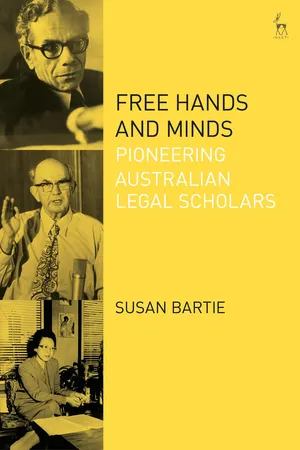
- 288 pages
- English
- ePUB (mobile friendly)
- Available on iOS & Android
eBook - ePub
About this book
Trusted by 375,005 students
Access to over 1.5 million titles for a fair monthly price.
Study more efficiently using our study tools.
Information
1
Introduction
This book reveals the distinctive ideas and endeavours which accompanied the birth and early growth of Australia’s modern legal academy. Through a series of life histories, it illuminates the serious intellectual and enterprising attempts made to shape the discipline of law and its contribution to Australian society. This is a study of three key – yet largely overlooked – figures: Peter Brett (1918–1975), Professor of Jurisprudence at the University of Melbourne; Alice Erh-Soon Tay (1934–2004), Professor of Jurisprudence at the University of Sydney; and Geoffrey Sawer (1910–1996), Head of the Department of Law in the Research School of Social Sciences (RSSS) at the Australian National University (ANU).
All three professors were part of the first community of legal scholars who established the enduring liberal-progressive foundations of Australia’s discipline of law.1 This book is a vivid, nuanced and contextual account of those foundations. By undertaking this study, I set out to challenge the persistent myth that members of this community are unimportant to understandings of Australian law, legal culture and society, and unremarkable when compared with leading scholars in other common law nations.
Drawing on in-depth interviews with former colleagues, family members and students, extensive archival research, and an appraisal of their contributions to scholarship2 and teaching, I explore the three professors’ international networks and broader social and historical milieux. I also identify some of the central qualities of the first Australian legal theories and explain how Australian scholars engaged with English, American and other foreign ideas. Ranging from local experiences and the concerns of a nascent Australian legal academy, to the complex transnational phenomena of legal scholarship and theory, I make a case for contextualising law and legal culture within society. Further, my exploration of how Australian scholars adopted and adapted US theory also lends weight to recent revisionist accounts of American jurisprudence.
This is a study of intellectuals rather than abstract ideas. I examine not only the contributions made by Brett, Tay and Sawer to scholarship, but also their contributions to institution building, administration, law making, public debate and advocacy. I explain their efforts to shape the professional identity of lawyers and to counter attempts to treat law as separate from politics. For example, focusing on the Department of Jurisprudence at the University of Sydney and the Department of Law within the RSSS at ANU, allows me to critically examine how Tay and Sawer ran two novel institutions that had the potential to radically change the discipline’s identity and culture. I scrutinise their decisions to capitalise on some opportunities while rejecting others, and consider how the discipline might have changed had they managed their departments differently.
This book also counters fatalist accounts of the legal academy by telling the personal stories of three unlikely marginal figures: a Jewish man (Brett); a Chinese woman (Tay); and a war orphan (Sawer). All three rose to prominence within the academy and overcame various obstacles and opposition to create novel roles for themselves and their successors. By choosing one woman and two men as my subjects, I also very consciously explore the role of women within the academy.
In essence, my goal for this study is to make a strong contribution to understandings of a critical phase in the history of the common law and legal education. I hope to provide an important foundation for new lines of inquiry and exploration that will provoke novel ways of thinking about Australia’s legal academy and law schools. I therefore dedicate this book to current and future generations of pioneering Australian legal scholars, in the hope that it will be read by those scholars as well as by foreign observers, and also those interested more generally in Australia’s intellectual history, the history of Australian universities, jurisprudential movements and legal education.
History and Legal Education
The motivation for this study was my strong curiosity about earlier generations of Australian legal scholars and by my suspicion that existing accounts did not sufficiently examine their activities. In other portrayals, this generation of scholars has either been subsumed under vague labels, such as ‘narrow positivists’,3 or swept up within larger social phenomena, such as ‘modernisation’.4 Conventional wisdom holds that early Australian scholars were narrow, conservative and doctrinal in orientation, that they primarily served the interests of the profession, and that there was no distinctively Australian jurisprudence or legal theory to speak of.5
Almost from the time of their inception in the 1960s and 1970s, the more radical law schools – those offering alternative visions – came under attack, from both outside and within. The ongoing impact of this friction has been significant and negative, both in terms of stifling the diversity of legal education, and stunting or, even more disturbingly, cutting short individual careers. To provoke change, it seemed necessary for subsequent generations of legal scholars to condemn or ignore earlier generations.
While we might sympathise with the objectives underpinning these critiques of the old order, we can lament the ways that the history of legal education is being enlisted. Many historians would object to any strategic use of history. However, my objections to the accounts that have been made of Australian legal scholars are of a different kind: I argue that that they create caricatures, straw men (they do not mention many women), that present as slogans or propaganda rather than lessons. As a result, we learn nothing. The purpose of this work is not to glorify this early generation of legal scholars, but to provide a balanced and probing account of their contributions to the legal academy.
Even in the United States, historians continue to provide new explanations for the origins and growth of modern university legal education which challenge conventional wisdom. For example, during the conception of this project David Rabban made some important and startling discoveries about a founding period of American legal education. These discoveries demonstrate the dangers of making assumptions about who, or what, is important in legal education. He notes that biographers of one of his subjects, Henry Adams, have attached little importance to the seven years Adams spent as an academic at Harvard.6 By contrast, Rabban argues, this period is crucial to any explanation of the field of American legal history and that ‘Adams and his students virtually created the field and provided a model for subsequent legal historians in England as well as in their own country’.7 Given the attention that American legal scholars have received, it is both startling and telling that such new and important insights could be revealed by approaching these scholars through the lens of legal education; by seeking to understand scholars based on their placement in law schools at a particular moment, rather than by the way their work was subsequently remembered and incorporated into works of legal scholarship. Rabban’s work makes a compelling case for testing conventional wisdom about the history of law schools and the discipline of law through open-minded exploration.
Several fundamental lessons emerge from histories of university legal education which are crucial to the health of the discipline. Most obviously, they demonstrate that in the past universities, law professors and law schools have fulfilled roles and engaged in activities that are very different from those pursued today.8 Acknowledging these alternatives may prompt current legal scholars to question whether their priorities and activities are in fact central to universities, and to reject the sense that the current arrangements accord with a natural order. Sometimes, histories of both law schools and universities are presented in a linear fashion to suggest that both grew in maturity over the course of the twentieth century. As Hannah Forsyth explains in her history of the modern university, for Australian universities this maturity is demonstrated by the post-1950s emphasis on, and eventual commodification of, research.9 This research emphasis initially did not gain much traction in the field of law. Yet, by the end of the twentieth century, the rise in the number of PhDs in law, increased pressures for legal scholars to seek research funding, and a growing emphasis on publication of monographs and articles rather than textbooks, confirm the penetration of these broader university trends. In linear histories, these changes are presented as evidence of the growing sophistication of the discipline. The earlier central emphasis on teaching is treated as misguided and a product of narrow thinking that reflected the supposed early doctrinal and positivist emphasis. In other words, it is symptomatic of an outmoded belief that law ought to be studied as an autonomous discipline. This linear history approach reinforces the idea that law schools should reject earlier traditions and practices on the basis that they are misguided (and therefore irrelevant), and instead place primary emphasis on research over scholarship and teaching. Standing in opposition to these ideas, this study suggests that earlier debates and thinking about the role of universities, law schools and law professors remain relevant to the current – and ostensibly more mature – age.
Many criticisms could be levelled at previous (and present) generations of Australian legal scholars, but the use of linear histories to dismiss the efforts of their predecessors limits the range of alternatives that might be considered by current professors and managers. In the process, it provides greater force to the status quo. Better understandings of the efforts and endeavours of our predecessors – examining their ambitions and priorities – provides material which may be used to challenge dominant narratives and values, and encourages legal academics to develop an appreciation of a broader range of activities, perhaps with the ultimate goal of liberating law schools and universities from current ways of thinking about their role in society. As the father of English legal history opined over a century ago, this approach has the potential to ‘free [current and future legal scholars] from superstitions and teach them that they have free hands’.10 As I have argued elsewhere, the underlying assumption behind writing the life history of a legal scholar
is that how a scholar balanced their personal desire to succeed, along with their learning and their own altruistic notions of the discipline’s best interests, mattered to the future of law schools. This in turn suggests that a current legal scholar’s current daily musing on such things also matters to the future of law school.11
Histories of Christopher Columbus Langdell, for example, not only bring to light the strategic motivations behind his appeals to ‘science’, but also the absence of any empirical basis for his claims that his approach to legal education would reform the profession.12 They demonstrate how a very intelligent lawyer may advance fundamentally flawed ideas that have an enormous impact on the nature and advancement of law. They also illustrate the importance of caution and humility in the running of law schools and in the exercise of academic leadership. In a similar vein, institutional accounts of law schools, such as those led by Robert Stevens and Brian Tamanaha, show that law professors are mere mortals: they can be seduced by the prospect of elevated status and financial gain to lead law schools in ways that are largely self-serving.13 Rather than reach for a utopia, history encourages a frank appraisal of circumstances and possibilities, and an awareness that bright legal academics may advance both worthwhile and fundamentally flawed agendas, sometimes simultaneously.
This book, therefore, is a call to develop greater curiosity and to better understand the past decades of Australian university legal education in order to think with greater ingenuity, optimism and depth about the opportunities and problems of the present.
The university’s prioritisation of attracting research funding over other pursuits, and the growth in size of the student body, as well as the number of law schools, raises critical questions about the role of law schools and legal academics that ought to attract the attention of the discipline’s brightest minds. Each year thousands of young, and not so young, Australian and international students invest considerable sums of money and time, along with their hopes, into Australian law schools. Dramatic changes in the nature of lawyering affect our graduates’ prospects of employment and the role that they, and the law more generally, will play in society. All these forces require changes to existing law school models, which should be driven by intelligent, pioneering and creative legal scholars.14 It is a desire to search for leaders within the academy and seek out an intellectual and, perhaps also, a moral core (or cores) for the discipline that drives this exercise in introspection.15 A discipline that has little history or tradition and no real understanding of its identity or where it came from is vulnerable to external policies that fail to thoughtfully respond to the needs of society. It is at greater risk of losing its sense of self.16
Brett, Tay and Sawer
Rather than provide a survey of groups within the legal academy to add to the broad generalisations and vague labels, I have limited my study to three scholars in order to closely investigate the whole of their careers and thickly describe their principal innovations.17 This has meant concentrating on their experiences within three institutions. Australia’s federal character and the geographical isolation of its major cities mean that experiences vary between different states. In each part, the local conditions are explained.
Peter Brett
Peter Brett began his academic career at the University of Western Australia in 1950 and held the Chair of Jurisprudence at the University of Melbourne from 1964 to 1975. Born Isidore Peter Bretzfelder to Jewish parents in England, Brett began practising law at the age of 16, studied law part-time, worked at the Treasury Solicitor’s Office, and served in the British Army during the Second World War. Despite his considerable achievements and his contributions to the Australian legal academy, Brett is not well known and very little has been written about him.18
Brett’s commitment to reforming Australian legal culture bordered on obsession. He was a man of boundless energy, great industry and frank speech, who believed that complacency and elitism within the legal prof...
Table of contents
- Cover
- Dedication
- Title Page
- Foreword
- Acknowledgements
- Table of Contents
- 1. Introduction
- 2. Australian Legal Academics: A Short Intellectual History
- PART A: PETER BRETT
- PART B: ALICE ERH-SOON TAY
- PART C: GEOFFREY SAWER
- Appendix A: List of Peter Brett’s Publications
- Appendix B: List of Alice Erh-Soon Tay’s Publications
- Appendix C: List of Geoffrey Sawer’s Publications
- Bibliography
- Index
- Copyright Page
Frequently asked questions
Yes, you can cancel anytime from the Subscription tab in your account settings on the Perlego website. Your subscription will stay active until the end of your current billing period. Learn how to cancel your subscription
No, books cannot be downloaded as external files, such as PDFs, for use outside of Perlego. However, you can download books within the Perlego app for offline reading on mobile or tablet. Learn how to download books offline
Perlego offers two plans: Essential and Complete
- Essential is ideal for learners and professionals who enjoy exploring a wide range of subjects. Access the Essential Library with 800,000+ trusted titles and best-sellers across business, personal growth, and the humanities. Includes unlimited reading time and Standard Read Aloud voice.
- Complete: Perfect for advanced learners and researchers needing full, unrestricted access. Unlock 1.5M+ books across hundreds of subjects, including academic and specialized titles. The Complete Plan also includes advanced features like Premium Read Aloud and Research Assistant.
We are an online textbook subscription service, where you can get access to an entire online library for less than the price of a single book per month. With over 1.5 million books across 990+ topics, we’ve got you covered! Learn about our mission
Look out for the read-aloud symbol on your next book to see if you can listen to it. The read-aloud tool reads text aloud for you, highlighting the text as it is being read. You can pause it, speed it up and slow it down. Learn more about Read Aloud
Yes! You can use the Perlego app on both iOS and Android devices to read anytime, anywhere — even offline. Perfect for commutes or when you’re on the go.
Please note we cannot support devices running on iOS 13 and Android 7 or earlier. Learn more about using the app
Please note we cannot support devices running on iOS 13 and Android 7 or earlier. Learn more about using the app
Yes, you can access Free Hands and Minds by Susan Bartie in PDF and/or ePUB format, as well as other popular books in Law & Law Theory & Practice. We have over 1.5 million books available in our catalogue for you to explore.