eBook - ePub
An Ever-Changing Union?
Perspectives on the Future of EU Law in Honour of Allan Rosas
- 352 pages
- English
- ePUB (mobile friendly)
- Available on iOS & Android
eBook - ePub
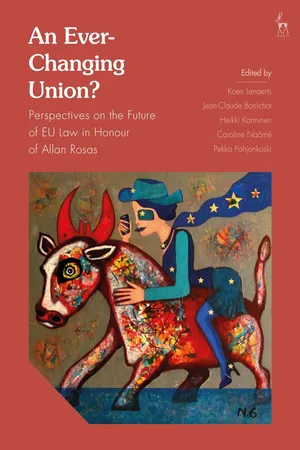
An Ever-Changing Union?
Perspectives on the Future of EU Law in Honour of Allan Rosas
About this book
Allan Rosas is one of the leading European Union jurists of his generation. His impact on the legal landscape of the EU has been immense. This collection brings together colleagues from the worlds of the judiciary, academia and practice to grapple with one of the key questions underpinning his contribution: is the trajectory of EU law one of ever-changing union? With essays exploring a range of topics from national identity and European construction to Brexit, this collection is a fitting tribute to an unrivalled EU law career.
Information
PART I
The Changing Union
1
The Court of Justice of the European Union and the Refugee Crisis
KOEN LENAERTS*
Between 2015 and 2016, Europe witnessed the largest inflow of applicants for international protection since World War II. This was in large part due to the war in Syria, which has displaced over 5 million people. As a result of the application of the ‘irregular crossing’ criterion set out in the Dublin III Regulation, that massive and sudden inflow of applicants for international protection put the asylum systems of Greece and Italy under enormous pressure.1 The impossibility of those two Member States coping with such a massive inflow of people gave rise to secondary movements towards northern Europe, prompting Member States such as Germany, Austria, France, Denmark and Sweden to reinstate temporary border controls within the Schengen Area.2
The EU and its Member States’ response to the crisis comprised both an internal and external dimension. Internally, the Council adopted two decisions that established a temporary emergency relocation scheme whose objective was to help Greece and Italy to deal with the sudden and massive inflow of migrants that took place in 2015. Those two decisions provided for the relocation from Italy and Greece of 160,000 newly arrived asylum-seekers to other Member States in accordance with a system of quotas. Whilst the first Council decision provided for a system of voluntary quotas in respect of 40,000 persons,3 the second laid down a system of mandatory quotas for the relocation of an additional 120,000 people (the ‘mandatory relocation scheme’).4 Externally, the EU-Turkey statement of 18 March 2016 provided that all new irregular migrants crossing from Turkey to Greece who had not lodged an asylum application, or whose application had been declared unfounded or inadmissible, were to be returned to Turkey.5 That statement also established the ‘1:1 resettlement scheme’: it was agreed that for every Syrian being returned to Turkey from Greece, another would be resettled from Turkey to the EU, taking into account the UN Vulnerability Criteria. That resettlement scheme was, however, limited to 72,000 persons and was, on the EU side, to take place on a voluntary basis. Furthermore, those two dimensions were intertwined: the mandatory relocation scheme was subsequently amended so as to deduct from the mandatory quotas the number of people whose relocation took place under the 1:1 resettlement scheme.6
As to the persons seeking international protection who did not fall within the scope of application of any of the measures mentioned above, the Common European Asylum System (the ‘CEAS’), in general, and the Dublin III Regulation, in particular, continued to apply. This was because no major overhaul of the CEAS was undertaken as regards the way in which the Member State responsible for examining the application for international protection was to be determined.
Accordingly, the role that the Court of Justice of the European Union (the ‘Court of Justice’ or the ‘Court’) was called upon to play during the refugee crisis was twofold. On the one hand, in Joined Cases Slovakia and Hungary v Council and in NF, NG and NM v Council,7 the Court of Justice and the General Court were respectively asked to exercise their powers of judicial review in order to determine whether the mandatory relocation scheme and the EU-Turkey statement were valid. On the other hand, national courts asked the Court of Justice to interpret existing EU legislation on asylum, notably the Dublin III Regulation, in situations where hundreds of thousands of applicants for international protection crossed the Member States located on what was known as the ‘western Balkans route’8 or arrived in the EU via the central Mediterranean route.9
In examining that role, I wish, by means of the present contribution, to pay special tribute to my friend and colleague Allan Rosas, whose extensive work, as both a judge and an academic, is of immense value for the legal community. The chapter is divided into two sections. Section I examines the way in which the EU Courts reviewed the legality of the measures adopted to counter the crisis. Section II focuses on the interpretation of EU law on asylum in times of crisis. The conclusion that will be drawn on the basis of that analysis taken as a whole is that the role of the EU Courts is to ensure that justice within the EU neither bends nor breaks in such times.10
I.Judicial Review of the EU’s Response to the Crisis
It is important to note at the outset that, in Slovakia and Hungary v Council, on the one hand, and NF, NG and NM v European Council, on the other, the EU Courts examined different questions. In the former cases, the Court of Justice looked at the way in which the Council may exercise its ‘emergency powers’ to derogate, albeit temporarily and in a circumscribed way, from the Dublin system. By contrast, in the latter cases the question examined was whether the EU-Turkey statement was an act attributable to the European Council establishing an international agreement between the EU and Turkey, or whether it was attributable to the Heads of State or Government of the Member States.
A.The Mandatory Relocation Scheme
In Slovakia and Hungary v Council, those two Member States each brought an action – which was ultimately unsuccessful in both cases – for annulment of Council Decision (EU) 2015/1601 establishing the mandatory relocation scheme (the ‘contested decision’), in which they called into question, inter alia, the choice of Article 78(3) TFEU as the legal basis for that decision11 as well as its proportionality.12
i.Article 78(3) TFEU as Legal Basis
Slovakia and Hungary both argued that the contested decision was, in fact, a legislative act adopted under a non-legislative procedure. In their view, Article 78(3) TFEU did not provide the proper legal basis for the adoption of legislative measures, let alone for the adoption of measures that derogated from a legislative act such as the Dublin III Regulation, as this would amount to a circumvention of the legislative procedure provided for in Article 78(2) TFEU. At the outset, the Court of Justice held that only acts adopted on the basis of a Treaty provision that expressly refers either to the ordinary legislative procedure or to the special legislative procedure are to be considered legislative acts. This was not the case of Article 78(3) TFEU which contains no such reference, meaning that the contested decision was not a legislative act.13
Moreover, relying on a literal, systematic and teleological interpretation of Article 78(3) TFEU, the Court held that provisional measures adopted under that Treaty provision could indeed derogate from legislative acts. First, nothing in the wording of Article 78(3) TFEU suggests that the concept of ‘provisional measures’ is to be interpreted as being limited to accompanying measures taken in support of a legislative act adopted on the basis of Article 78(2) TFEU.14 Second, Article 78(2) TFEU and Article 78(3) TFEU pursue different objectives, each having its own conditions of application.15 Third, a restrictive interpretation of the concept of ‘provisional measures’ would undermine the effectiveness of Article 78(3) TFEU as that concept must be sufficiently broad in scope so as to allow the Council to respond effectively and swiftly to a sudden inflow of third-country nationals. Fourth and last, there is no risk of circumventing Article 78(2) TFEU as both the temporal and material scope of the provisional measures that may be adopted under Article 78(3) TFEU must be circumscribed: those measures may not replace or amend legislative provisions either permanently or generally. No such risk existed in respect of the contested decision, since it only applied for a two-year period and in respect of 120,000 nationals of certain third countries who met a series of specific conditions.16 In contrast to ex-Article 64(2) EC, which previously limited the validity of provisional measures to six months, Article 78(3) TFEU is silent in that regard, affording the Council broad discretion to determine the temporal scope of provisional measures.17 Since it was reasonable to take the view that the relocation of a large number of persons required time for preparation and implementation, the Court found that the Council did not manifestly exceed the bounds of its discretion.18
The Council was also right to qualify as ‘sudden’ a sharp increase in the inflow of third-country nationals heading for Greece and Italy over a short period of time, as occurred in the summer of 2015, despite the fact that statistics showed that in 2013 and 2014 the number of third-country nationals heading for these Member States had already seen a steady increase.19 Although Article 78(3) TFEU requires that there must be a sufficiently close link between the emergency situation and the sudden inflow of third-country nationals, the Court rejected the submission that any such link could be called into question because of structural weaknesses in the Greek and Italian asylum systems. It pointed out that the inflow of 2015 was on such a scale that it would have disrupted any asylum system, even one without those weaknesses.20 Article 78(3) TFEU was therefore the proper legal basis for the contested decision.
ii.The Principle of Proportionality
Slovakia called into question the appropriateness of and necessity for the contested decision. It argued that the mandatory relocation scheme was not capable of redressing the structural deficiencies in the Greek and Italian asylum systems. It argued that the small number of relocations that had actually been carried out showed that the contested decision had been unsuitable for attaining the intended objective from the start. Moreover, in its view, the objective pursued by the contested decision could have been achieved just as effectively by other measures that were less intrusive for national sovereignty, such as the system of temporary protection set out in Directive 2001/55.21
For its part, Hungary argued that, although it was no longer included among the Member States benefiting from the mandatory relocation scheme, it should not be subject to compulsory relocation quotas, given that its asylum system continued to face an emergency situation after the contested decision was adopted. In addition, intervening in support of Hungary, Poland argued that those compulsory quotas had a disproportionate effect in a number of Member States that had to make far greater efforts and bear far heavier burdens than other host Member States. That was the case of Member States, such as Poland, which were ‘virtually ethnically homogenous’ and whose population was different, from a cultural and linguistic point of view, from the migrants to be relocated on their territory.
Regarding the suitability of the contested decision, the Court of Justice noted, first, that any asylum system would have been seriously disrupted by the unprecedented influx of migrants that occurred in Greece and Italy in 2015.22 Second, that scheme formed part of a broad array of measures – such as the provision of operational and financial support – that aimed not only to relieve pressure on the Greek and Italian asylum systems but also to improve the capacity, quality and effectiveness of those asylum systems.23 Third and last, judicial review of the contested decision could not amount to a retrospective assessment of its effectiveness. In other words, the Court would be overstepping the limits of its jurisdiction if it were to assess the legality of the contested decision in the light of current events. On the contrary, judicial review must be limited to examining whether the prospective analysis carried out by the Council was manifestly incorrect in the light of the information available at the time when the contested decision was adopted. In that regard, the Court observed that the analysis of the Council relied on a detailed examination of the statistical data available at that time.24 In addition, the small number of relocations so far carried out pursuant to the contested decision could be explained by a series of factors that the Council could not have foreseen at the time when the decision was adopted, including, in particular, the lack of ...
Table of contents
- Cover
- Title Page
- Editors’ Preface
- Contents
- List of Contributors
- PART I: THE CHANGING UNION
- PART II: THE EU’S JUDICIAL ACTORS: EVOLVING ROLES
- PART III: RIGHTS OF THE INDIVIDUAL IN TIMES OF CHANGE
- PART IV: EU EXTERNAL RELATIONS AND NEW HORIZONS
- Index
- Copyright Page
Trusted by 375,005 students
Access to over 1.5 million titles for a fair monthly price.
Study more efficiently using our study tools.
Frequently asked questions
Yes, you can cancel anytime from the Subscription tab in your account settings on the Perlego website. Your subscription will stay active until the end of your current billing period. Learn how to cancel your subscription
No, books cannot be downloaded as external files, such as PDFs, for use outside of Perlego. However, you can download books within the Perlego app for offline reading on mobile or tablet. Learn how to download books offline
Perlego offers two plans: Essential and Complete
- Essential is ideal for learners and professionals who enjoy exploring a wide range of subjects. Access the Essential Library with 800,000+ trusted titles and best-sellers across business, personal growth, and the humanities. Includes unlimited reading time and Standard Read Aloud voice.
- Complete: Perfect for advanced learners and researchers needing full, unrestricted access. Unlock 1.5M+ books across hundreds of subjects, including academic and specialized titles. The Complete Plan also includes advanced features like Premium Read Aloud and Research Assistant.
We are an online textbook subscription service, where you can get access to an entire online library for less than the price of a single book per month. With over 1.5 million books across 990+ topics, we’ve got you covered! Learn about our mission
Look out for the read-aloud symbol on your next book to see if you can listen to it. The read-aloud tool reads text aloud for you, highlighting the text as it is being read. You can pause it, speed it up and slow it down. Learn more about Read Aloud
Yes! You can use the Perlego app on both iOS and Android devices to read anytime, anywhere — even offline. Perfect for commutes or when you’re on the go.
Please note we cannot support devices running on iOS 13 and Android 7 or earlier. Learn more about using the app
Please note we cannot support devices running on iOS 13 and Android 7 or earlier. Learn more about using the app
Yes, you can access An Ever-Changing Union? by Koen Lenaerts, Jean-Claude Bonichot, Heikki Kanninen, Caroline Naômé, Pekka Pohjankoski, Koen Lenaerts,Jean-Claude Bonichot,Heikki Kanninen,Caroline Naômé,Pekka Pohjankoski in PDF and/or ePUB format, as well as other popular books in Law & Public Law. We have over 1.5 million books available in our catalogue for you to explore.