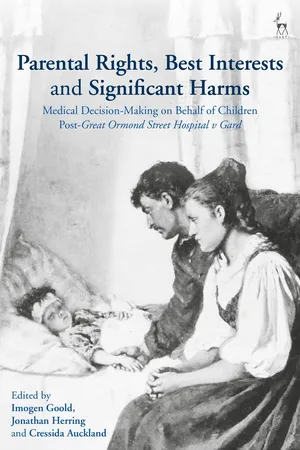
eBook - ePub
Parental Rights, Best Interests and Significant Harms
Medical Decision-Making on Behalf of Children Post-Great Ormond Street Hospital v Gard
- 256 pages
- English
- ePUB (mobile friendly)
- Available on iOS & Android
eBook - ePub
Parental Rights, Best Interests and Significant Harms
Medical Decision-Making on Behalf of Children Post-Great Ormond Street Hospital v Gard
About this book
This timely collection brings together philosophical, legal and sociological perspectives on the crucial question of who should make decisions about the fate of a child suffering from a serious illness. In particular, the collection looks at whether the current 'best interests' threshold is the appropriate boundary for legal intervention, or whether it would be more appropriate to adopt the 'risk of significant harm' approach proposed in Gard. It explores the roles of parents, doctors and the courts in making decisions on behalf of children, actively drawing on perspectives from the clinic as well as academia and practice. In doing so, it teases out the potential risks of inappropriate state intrusion in parental decision-making, and considers how we might address them.
Information
1
Setting the Scene – Supporting and Informing Shared Decision-Making at the Bedside
Avoiding and De-escalating Conflict between Clinicians and Families
1.Introduction
Modern paediatric care is practised in an environment where we are seeing increased survival at the extremes of viability, and enticing new therapies that push back the boundaries of possibility. Patients and their families also have unprecedented access to information via Internet searches and support groups on social media. Despite well-publicised advances in medical science, it remains an uncomfortable truth that there are many situations in which we are able to use invasive mechanical technology to keep a child alive, for whom there is yet no prospect of a meaningful ‘cure’. The most difficult decisions faced by families, and those healthcare professionals supporting them, tend to arise in this gap between being able to sustain life with aggressive organ support and having a realistic treatment option offering the prospect of a recovery with an acceptable quality of life. The withdrawal of mechanical ventilation in situations considered ‘medically futile’, where intensive care is likely to represent a burden without realistic benefit, has historically produced the highest number of high-profile cases of conflict, as exemplified by the recent cases of Alfie Evans and Isaiah Haastrup. In addition, the information age has given earlier public access to claims of ‘medical breakthroughs’, many of which will not yet have been through the usual process of peer review. This leads to the second most significant source of medical conflict: immediate access to novel therapies. This ranges from demands for early access to emerging evidence-based treatments, catalysed by media hyperbole, to requests for the use of molecules not fully tested in man, as is relevant to the case for Charlie Gard.
Fortunately, guidance exists for clinicians1 about how best to share information to support the making of difficult decisions in partnership with families. There is evidence that early multidisciplinary discussions with careful information-sharing allows effective advance care planning. This in turn reduces the likelihood of significant dispute. Recognisable patterns of behaviour exist among both clinicians and families in the early stages of conflict.2 Where these are acknowledged and addressed, resources such as impartial second opinions, Patient Advice and Liaison Services (PALS), clinical ethics committees, chaplains and medical mediation specialists can help maintain or reopen channels of communication.3 Although it will always be necessary for some cases to be put before a court,4 there is genuine potential for early intervention with a less adversarial approach.5 In truth, a range of reasonable options are likely to exist in the gap between ‘best interests’ and ‘significant harm’, covering many shades of grey rather than a single black and white solution. These are discussed in detail elsewhere in this book.
Most chapters in this book focus on the legal response to these cases. This chapter will take a different perspective, looking at the challenges to professionals and parents before the issue reaches court. It will look at the measures taken by professionals and family members to navigate the complex and challenging ethical issues that arise in current paediatric practice. It should be remembered that the vast majority of cases involving very sick children do not reach courts and it is possible to achieve consensus between family members and medical professionals. This chapter will explain how this is achieved.
First, a detailed understanding of the perspectives of parents will be offered.6 Second, the chapter considers the perspective of professionals by looking at the scientific advances that have created the options which can generate disputes and the professional guidance they act under. Third, the chapter describes the guidance available to clinicians on identifying early signs of conflict escalation and strategies for early intervention.
2.Setting the Scene from the Parents’ Perspective
In the boxes below, the reflections of two bereaved parents are shared in their own words.7 The clinical cases are very different, but the experiences resonate in many ways. Both situations could very easily have produced damaging conflict. The ways in which this was avoided are illustrated.
Nadia and Ana
Following a diagnosis of a serious fetal heart condition very late in pregnancy, Ana and her partner had been offered a range of ‘choices’, from the delivery of their baby in a cardiac centre with immediate connection to a heart-lung bypass system, to a late termination of the pregnancy. They felt challenged by the initial ‘choices’ offered to them, a situation that left them feeling conflicted and bewildered. Without access to multiprofessional specialist care planning, these feelings could easily have turned to anger and resentment, reducing their chances to make a balanced and well-informed decision about Nadia’s ongoing care. Interestingly, although a very interventionist approach had been offered at diagnosis, there seemed to be very little optimism for the outcome; something which added to their confusion, as did the apparent lack of a palliative/supportive choice.
The following is an extract from one of the articles subsequently published by Ana:
‘There is no easy way to say this, but your baby is very, very sick.’ I was 37 weeks pregnant, and they had just found our baby had severe dilated cardiomyopathy. The doctor thought she would die within days. Then he sat with us, and they told us that we had to make a choice. We could get in an ambulance and go to Southampton, where I would have a caesarean, [Nadia] would be put on life support, but would likely still die. The alternative path would be to ‘put her to sleep’ with a needle to the heart, after which her birth would be induced and it would all be over. He suggested injecting potassium in her heart, to be certain that she would not survive terribly impaired. She kicked and squirmed inside me as I tried to wrap my mind around this, stunned with shock. It made no sense to take action. Could we not simply let her die in peace? He said this was not an option. But later – perhaps because I asked – we found palliative care mentioned in the discharge note. And so at our next appointment we were greeted by two paediatricians who wanted to talk to us. They asked us what was going on. It felt natural to tell them our story. They listened intently, and I realised the purpose of this questioning much later: they wanted to get a sense of us first. ‘What would you like to happen?’ I choked up in tears. I hadn’t told anyone about my wish to meet her, to hold her while she was dying. They said my wish was common, and a knot of tightness in my chest unravelled. ‘And what do you fear most?’ I was afraid how this would affect my relationship with my partner. He feared that our son might develop the same heart condition. ‘What would you like to know?’ What she will look like when she’s born, if she’s not alive. I desperately needed to know all the details. Both doctors referred to our baby Nadia by name, showing us they knew how real she was to us. One of the doctors said that parents experience this short time spent with their terminally ill infants as meaningful and important. She explained how Nadia would be fed and her pain relief administered. Precise words again. ‘Keeping her comfortable’, the most common sentence we encountered when enquiring about palliative care, was too vague for me. The doctors were at ease with our tears. In the space of a couple of hours they had transformed what we were going through from something dreadful to something potentially meaningful. She could be a person, a person whom we might not have the chance to meet properly, but a someone nevertheless.
Ana’s eloquent reflections give insight into the multitude of emotions that are contained within the decisions to accept or decline aggressive medical intervention in the face of a very poor prognosis. Her desire to meet her baby was a prime concern, but she also understandably worried about the impact of this on her relationship with her partner – highlighting the very real possibility of parents having differing or opposing views, something which can often worsen conflict situations. She wanted to know what her baby would look like and whether it would be a positive experience for her young son to meet his sister. She also needed to understand very practically what Nadia’s care would involve. This demonstrates the limitation of an evaluation made purely on the basis of a balance sheet of perceived ‘best interests’. In a situation where the unique ‘best interests’ of an unborn baby are unclear, understanding what the parents most fear, and that for which they still retain hope can be very helpful to finding the way forward and in preventing the emergence of conflict.
Richard and Joseph
Extract from ‘Unfathomable Price of Flesh’ by Richard GT Gipps (Unpublished Essay and Sketches)
The excerpts below were written by a bereaved father, who had made a carefully considered decision to withhold invasive surgery and airway support, after his one-year-old son suffered life-changing injuries in a car accident, which also killed his partner. Joseph’s ‘best interests’ were very challenging to weigh, with disagreement even among the numerous experienced consultants involved. Decision-making in the face of diverging views both within the treating teams and the family was eventually aided by an ethics committee review within the hospice.
Joseph, who was 14 months old at the time, received varying prognoses at the hospital: at first that he would die, then that he would most likely recover, and then again when he failed to breathe by himself after several attempts, that he would die. Finally, after 17 days in the hospital, I myself turned off his life support. However he then managed to breathe by himself, and we went together to Helen House children’s hospice in our home town of Oxford.
Joseph’s injuries were all to his brain and spinal cord – a consequence of the sudden jolt of the impact. The principal damage was to his brainstem – that part of the base of the brain which controls animal functions like breathing and swallowing. Because he stopped breathing after the accident he also suffered secondary hypoxic brain damage to his cortex.
Over the weeks and months in the hospice Joseph gradually regained his cortical abilities – he could once again see, hear, point, bang a drum, pick up a toy animal, sit on my lap to read a book. It was astonishing over these few months witnessing him gradually being ‘born again’ – moving from an insensate and immobile state to one of being able to communicate and play. He could not move his trunk, however, nor maintain a sitting posture without support. Nor could he swallow or vocalise. As a consequence he was fed by a naso-gastric tube; he also learnt a few words of sign language.
As time passed it became clear that, whilst Joseph had made good cortical recovery, his brain stem damage was such that he would need significant operations for him to survive. He would need surgery both so he could in future be fed straight into his stomach and to prevent reflux of material from his stomach into his lungs. He would also need a tracheostomy to aid his breathing. Even with these operations he would still have very significant difficulties with moving, posture, and spasticity. He would require full-time care, and would not be able to enjoy so many of the activities (running, exploring, eating and drinking) that enable a child to play, and eventually to live independently.
Opinions were divided within the medical and nursing professions, and also within the family, about what was the right thing to do for Joseph. One experienced consultant said that he felt that the ethics of Joseph’s case were the hardest he had encountered. As for myself, I believed it would be wrong to subject my son to a life of extreme disability, frequent hospitalisation, massive ongoing care needs; to damage his body further to prolong his life; and to put the all-too-easily reached-for consideration ‘quality of life’ above more fundamental concerns regarding human dignity, integrity and wholeness. As a result, the nurses and I cared for Joseph in the hospice – taking him around the garden, playing with musical instruments and toy farm animals, reading books, going in the spa together, having music, physio and communication therapy, taking trips to nearby farm centres, etc. – and life-prolonging surgery was ruled out. The love and care he and I received from the hospice staff was extraordinary. When Joseph was 19 months old he succumbed to a lung infection; he died whilst I was holding him, quietly, in his room at the hospice.
I have no strong evidence either way, but it is my belief that what most kept me sane was a relentless pursuit of the truth of what had happened. Whereby ‘pursuit of the truth’ I mean both a quiet ungrasping acknowledgement of the medical facts and, more importantly, a willingness to frequently take the ethical temperature of this extreme event, to roll with each punch of the news of Joseph’s next prognosis, and to try to keep ‘thinking’ what had happened in its extremity.
What also kept me sane were the kindnesses of particular others, and I want to write something about this here to urge the importance, for anyon...
Table of contents
- Cover
- Title Page
- Foreword by Victoria Butler-Cole QC
- Contents
- List of Contributors
- Introduction
- 1. Setting the Scene – Supporting and Informing Shared Decision-Making at the Bedside: Avoiding and De-escalating Conflict between Clinicians and Families
- 2. Evaluating ‘Best Interests’ as a Threshold for Judicial Intervention in Medical Decision-Making on Behalf of Children
- 3. Parental Decisions and Court Jurisdiction: Best Interests or Significant Harm?
- 4. The Legal Basis of the Court’s Jurisdiction to Authorise Medical Treatment of Children
- 5. In Defence of a Conditional Harm Threshold Test for Paediatric Decision-Making
- 6. The Harm Threshold: A View from the Clinic
- 7. Beyond Best Interests: A Question of Professional Conscience?
- 8. Preserving the Therapeutic Alliance: Court Intervention and Experimental Treatment Requests
- 9. Futility
- 10. Vulnerability and Medical Decisions Concerning Children
- 11. Resolving Disagreements about the Care of Critically Ill Children: Evaluating Existing Processes and Setting the Research Agenda
- Index
- Copyright Page
Trusted by 375,005 students
Access to over 1.5 million titles for a fair monthly price.
Study more efficiently using our study tools.
Frequently asked questions
Yes, you can cancel anytime from the Subscription tab in your account settings on the Perlego website. Your subscription will stay active until the end of your current billing period. Learn how to cancel your subscription
No, books cannot be downloaded as external files, such as PDFs, for use outside of Perlego. However, you can download books within the Perlego app for offline reading on mobile or tablet. Learn how to download books offline
Perlego offers two plans: Essential and Complete
- Essential is ideal for learners and professionals who enjoy exploring a wide range of subjects. Access the Essential Library with 800,000+ trusted titles and best-sellers across business, personal growth, and the humanities. Includes unlimited reading time and Standard Read Aloud voice.
- Complete: Perfect for advanced learners and researchers needing full, unrestricted access. Unlock 1.5M+ books across hundreds of subjects, including academic and specialized titles. The Complete Plan also includes advanced features like Premium Read Aloud and Research Assistant.
We are an online textbook subscription service, where you can get access to an entire online library for less than the price of a single book per month. With over 1.5 million books across 990+ topics, we’ve got you covered! Learn about our mission
Look out for the read-aloud symbol on your next book to see if you can listen to it. The read-aloud tool reads text aloud for you, highlighting the text as it is being read. You can pause it, speed it up and slow it down. Learn more about Read Aloud
Yes! You can use the Perlego app on both iOS and Android devices to read anytime, anywhere — even offline. Perfect for commutes or when you’re on the go.
Please note we cannot support devices running on iOS 13 and Android 7 or earlier. Learn more about using the app
Please note we cannot support devices running on iOS 13 and Android 7 or earlier. Learn more about using the app
Yes, you can access Parental Rights, Best Interests and Significant Harms by Imogen Goold, Jonathan Herring, Cressida Auckland, Imogen Goold,Jonathan Herring,Cressida Auckland in PDF and/or ePUB format, as well as other popular books in Law & Family Law. We have over 1.5 million books available in our catalogue for you to explore.