Founding moments are landmark events that break ties with the ancien régime and lay the foundation for the establishment of a new constitutional order. They are often radically disruptive episodes in the life of a state. They reshape national law, reset political relationships, establish future power structures, and influence happenings in neighbouring countries.
This edited collection brings together leading and emerging scholars to theorise the phenomenon of a founding moment. What is a founding moment? When does the 'founding' process begin and when does it end? Is a founding moment possible without yielding a new constitution? Can a founding moment lead to a partial or incomplete transformation? And should the state be guided by the intentions of those who orchestrated these momentous breaks from the past? Drawing from constitutions around the world, the authors ask these and other fundamental questions about making and remaking constitutions.
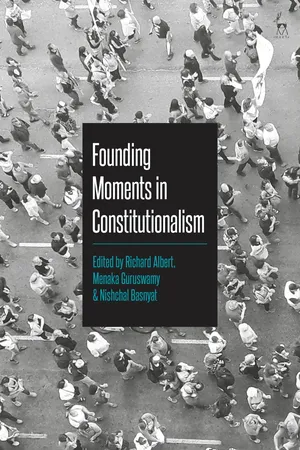
eBook - ePub
Founding Moments in Constitutionalism
- 272 pages
- English
- ePUB (mobile friendly)
- Available on iOS & Android
eBook - ePub
Founding Moments in Constitutionalism
About this book
Information
1
Between Fact and Norm
Narrative and the Constitutionalisation of Founding Moments
MING-SUNG KUO
I.Introduction
The character and identity of a constitutional regime (or simply constitutional identity) is not a novel concept in constitutional theory, but has seen a resurgence in recent scholarship.1 Such anthropomorphic references to the issues resulting from the continuity and change of constitutional orders have proliferated on both sides of the Atlantic and beyond over the past three decades.2 On this view, a constitution has its genesis. Far from being a unitary construct, the genesis of a constitution has generated a set of topics for further investigation in constitutional theory. The subject who gives birth to a constitution is one; the time when a constitution comes into being is another. Both being part of the multifarious construct of the genesis of a constitution, the constituent power (subject) and the founding moment of constitutional orders (time) are intertwined. Bringing the crucial role of momentous constitutional politics in understanding a constitutional order to the fore, Bruce Ackerman’s theory of constitutional moment is an exemplar.3 Yet, as many of his critics have pointed out, how the construct of constitutional moment is related to the constitution itself is unclear. Is it a function of the exiting constitutional order or a manifestation of extra-constitutional power? Is it norm or merely fact? Is it situated within or without the constitutional order?4
Although these issues have been at the centre of scholarship on constituent power, they also speak to ambiguities about the relationship between the founding moment and its ensuing constitutional order in constitutional theory. Yet, there is a fundamental difference in character that makes the question of the constitutional status of the founding moment more complex than the idea of constituent power. In contrast to the idea of constituent power, the founding moment is more than a conceptual construct; rather, the founding moment of a constitutional order points to the series of historical events that lead to the adoption of the constitution.5 This difference suggests that beneath the relationship between the founding moment and its ensuing constitutional order are questions about the identity of constitutional theory itself. Is the historical founding moment relevant to the theorisation of the constitution at all? If so, how is the originary moment being considered in constitutional theories? Is the state of the art satisfactory? Can we rethink the question of the founding moment in constitutionalism beyond current theoretical positions?
This chapter takes up these issues at the core of constitutional theory by examining the question of the founding moment in constitutional scholarship in light of the antinomy between fact and norm. I argue that contemporary constitutional theories fail to account for the role of the founding moment in the constitutional order because they are absorbed in the narrow question of constitutional interpretation at the expense of making sense of the constitutional order. Drawing upon Robert Cover’s concept of nomos,6 I contend that with an eye to the understanding of the constitution beyond the interpretation of constitutional norms, the constitutional order needs to be recast as a constitutional nomos. As a constitutional nomos operates not only on constitutional norms but also on the enriching narratives about the birth and growth of a constitutional order, the founding moment is pivotal to the discovery of constitutional meaning in this broad sense. Through narratives, the founding moment is related to its ensuing constitutional order and thus ‘constitutionalised’, suggesting a broader understanding of interpretation in constitutional theory than contemporary constitutional theories assume. On this view, the founding moment is neither a mere historical fact nor a placeholder for universal norms, but rather serves as the reference point for constitutional redemption that renders the constitutional order ‘jurisgenerative’.7 Narratives about the founding moment concern more the invigoration of the existing constitutional order than its original foundation. This observation further suggests an alternative attitude towards the unsettling concept of constituent power:8 the constituent power’s appeal does not so much lie in the substitution of a new constitutional order for the existing one as in its rejuvenation of the latter, since it is reincarnated in the narratives-mediated constitutionalised founding moment.
My argument proceeds as follows. In the first place, I shall establish that two opposite views dominate current constitutional scholarship on the question of the founding moment. As I shall explain, under the historicist view, the founding moment is fact only;9 under the normativist view, it is absorbed into constitutional norms. Neither is satisfactory as the question of the founding moment in constitutionalism is reduced to a methodological debate about constitutional interpretation among specialists (section II). Taking issue with this jurispathic rendering of the founding moment in contemporary constitutional theories, I shall continue to propose a relational approach to the constitutionalisation of the founding moment by drawing upon Cover’s ideas in ‘Nomos and Narrative’.10 Situated between fact and norm and mediated by narratives, the founding moment conceived of this way will turn the enterprise of constitutional interpretation into one of nomos-building that invites revitalising narratives from citizens in the discovery of the meaning of the constitutional project. Thus, the narratives-mediated constitutionalisation of the founding moment also entails an alternative account of the constituent power (section III). To conclude, I shall underline the implications of the relational approach to the constitutionalisation of the founding moment to constitutional theory in terms of substance, process and structure (section IV).
II.Fact or Norm? Founding Moments Envisaged in Constitutional Theory
As the question of the founding moment in constitutional theory concerns how to fit historical facts into the conceptualisation of a normative order, I follow in the footsteps of those who have utilised the antinomy between fact and norm as the analytical framework for manifold legal and constitutional issues.11 Situating theories of the founding moment in constitutionalism in this antinomy, I begin with a discussion of historicist theories in which the founding moment is regarded as fact. Unveiling the interpretive character of constitutional theory, I note that historicist theories oscillate between disregard and fidelity in their attitude towards the founding moment as a matter of fact. Then I turn to the normativist strain. In contrast to the historicist oscillation between disregard and fidelity, normativists effectively equate the founding moment with the original values that underlie constitutional provisions. After disclosing the historicist and normativist views of the founding moment, I discuss why neither is satisfactory as both reflect the gap in constitutional imagination that contemporary constitutional theories of the founding moment help create.
A.When Founding Moments are Historical Facts Only: Disregard, Fidelity and the Identity of Constitutional Theory
A new constitutional order is mostly established in response to the failure of the existing regime. The founding moment of a new constitution is thus a moment of crisis when the old constitutional order breaks down as a result of national liberation movement, civic uprising, military defeat, economic breakdown or other precipitous events.12 Antipathy towards foreign or colonial regimes,13 resistance against repressive rulers,14 anger at failed war plans and strategic blunders,15 discontent with socio-economic justice,16 and other socio-psychological responses are usually recorded in crises leading up to the founding of a new constitution. To be sure, these reactions to the tumultuous situation in which a new constitutional order originates are not the only occurrences in the founding moment that are recorded. The debates over how to respond to the failure of the old regime, the wrangling over the process and substance of the new constitutional order, and the tabulation of the votes cast in the convention or the referendum on the adoption of the new constitution are also part of the historical record of the founding moment of a constitutional order.17 All of them are fact. Thus, the accuracy of how they are documented and presented underlies the study of the founding moment as a matter of fact.
Driven by the pursuit of historical truth and its accurate representation, scholars of the founding moment dig deeper and deeper into the details of its constitutive episodes. On this view, the founding moment is a historical object to be faithfully represented.18 Yet, the accurate, specific, comprehensive representation of the founding moment does not tell us much about the relationship between the founding moment and its ensuing constitutional order. Instead, it is a question of how the founding moment as a matter of fact is seen in the eyes of constitutional theory, raising the question of the identity of constitutional theory.
The task of constitutional theory is to provide a language that gives expression to the political life under the constitution.19 To make sense of the constitutional order as a political project is what constitutional theory is all about. Interpretation (vis-à-vis explanation) underpins the enterprise of making sense of the constitutional order.20 Noticeably, one defining character of contemporary constitutional theories is the fascination with the question of what norms in the constitutional ‘text’, which extends beyond the codified constitutional document, mean.21 This predilection for interpreting norms is not without reason, especially in light of the new frontiers of constitutional scholarship. Studies of constitutional orders have long extended beyond the exegesis of the constitution to issues about how constitutional norms are implemented, what explains the gap between precept and practice, the extent to which the practice has displaced or amended the norms etc.22 Yet, none of them can be addressed without confronting the question of what constitutional norms mean. For example, the question of how constitutional norms are implemented is predicated on the cognisance of what to implement. This obtains only when the radius of what constitutional norms stipulate has been determined through interpretation. Interpretation remains indispensable to constitutional studies that centre on the explanation of the gap be...
Table of contents
- Cover
- Title Page
- Table of Contents
- List of Contributors
- Introduction: Mapping the Founding
- 1. Between Fact and Norm: Narrative and the Constitutionalisation of Founding Moments
- 2. The Role of Courts in Advancing Constitutional Moments: Constitutionalising the Constitution in Singapore and Hong Kong
- 3. Foundation and Revolution: Hannah Arendt and the Problem of Legitimacy and Stability in Constitutional Consolidation
- 4. I am Not Your (Founding) Father
- 5. ‘And Then They Begin to Look after the History of Their Founders’: (Re)configurations of the Founding in the Early Republic
- 6. Under the Shadow of the Constitutional Revolution? Revisiting Israel’s Founding Moments
- 7. Path-Dependency in Soviet and Russian Constitution-Making
- 8. ‘Founding Moments’ in Latin America? The Brazilian and Chilean Constitutional Histories and the Rise of the Forgotten People
- 9. We the Taiwanese People: A Constitution with Two Antagonistic Constitutional Identities
- 10. What’s in a Founding? Founding Moments and Pakistan’s ‘Permanent Constitution’ of 1973
- 11. A Founding Moment in Iraq: A Gender Perspective
- Conclusion: Rethinking Founding Moments
- Index
- Copyright
Trusted by 375,005 students
Access to over 1.5 million titles for a fair monthly price.
Study more efficiently using our study tools.
Frequently asked questions
Yes, you can cancel anytime from the Subscription tab in your account settings on the Perlego website. Your subscription will stay active until the end of your current billing period. Learn how to cancel your subscription
No, books cannot be downloaded as external files, such as PDFs, for use outside of Perlego. However, you can download books within the Perlego app for offline reading on mobile or tablet. Learn how to download books offline
Perlego offers two plans: Essential and Complete
- Essential is ideal for learners and professionals who enjoy exploring a wide range of subjects. Access the Essential Library with 800,000+ trusted titles and best-sellers across business, personal growth, and the humanities. Includes unlimited reading time and Standard Read Aloud voice.
- Complete: Perfect for advanced learners and researchers needing full, unrestricted access. Unlock 1.5M+ books across hundreds of subjects, including academic and specialized titles. The Complete Plan also includes advanced features like Premium Read Aloud and Research Assistant.
We are an online textbook subscription service, where you can get access to an entire online library for less than the price of a single book per month. With over 1.5 million books across 990+ topics, we’ve got you covered! Learn about our mission
Look out for the read-aloud symbol on your next book to see if you can listen to it. The read-aloud tool reads text aloud for you, highlighting the text as it is being read. You can pause it, speed it up and slow it down. Learn more about Read Aloud
Yes! You can use the Perlego app on both iOS and Android devices to read anytime, anywhere — even offline. Perfect for commutes or when you’re on the go.
Please note we cannot support devices running on iOS 13 and Android 7 or earlier. Learn more about using the app
Please note we cannot support devices running on iOS 13 and Android 7 or earlier. Learn more about using the app
Yes, you can access Founding Moments in Constitutionalism by Richard Albert, Menaka Guruswamy, Nishchal Basnyat, Richard Albert,Menaka Guruswamy,Nishchal Basnyat in PDF and/or ePUB format, as well as other popular books in Derecho & Derecho comparado. We have over 1.5 million books available in our catalogue for you to explore.