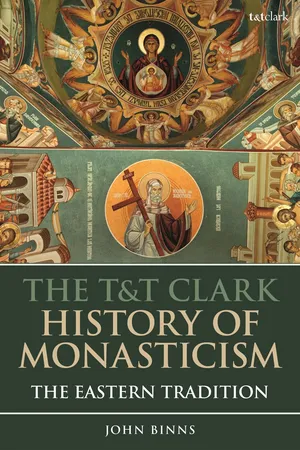
Despite its rich history in the Latin tradition, Christian monasticism began in the east; the wellsprings of monastic culture and spirituality can be directly sourced from the third-century Egyptian wilderness. In this volume, John Binns creates a vivid, authoritative account that traces the four main branches of eastern Christianity, up to and beyond the Great Schism of 1054 and the break between the Catholic and Orthodox churches.
Binns begins by exploring asceticism in the early church and the establishment of monastic life in Egypt, led by St Anthony and Pachomius. He chronicles the expansion, influence and later separation of the various Orthodox branches, examining monastic traditions and histories ranging from Syria to Russia and Ethiopia to Asia Minor. Culminating with both the persecution and the revival of monastic life, Binns concludes with an argument for both the diversity and the shared set of practices and ideals between the Orthodox churches, creating a resource for both cross-disciplinary specialist and students of religion, history, and spirituality.
- 272 pages
- English
- ePUB (mobile friendly)
- Available on iOS & Android
eBook - ePub
About this book
Information
Part One
Monasticism before Monasticism: Up to 320
1
From Asceticism to Monasticism
Introduction
The gospels begin with a proclamation of the kingdom of God. ‘From that time on Jesus began to proclaim “repent for the Kingdom of Heaven has come near”’.1 As the gospels continue we are shown that this kingdom is a new way of being, making radical demands and inviting the hearer to a change of life. This change is called repentance.
The call to repentance has been lived out in many different ways through the history of the church. These often involve some form of turning away from a former life and a renunciation of secular values. This is seen in the way that Jesus lived. He left his home and travelled across the region, with ‘nowhere to lay his head’. He had reached the age of thirty without being married, as would have been expected of a young Jewish man. His followers were called and ‘left everything and followed him’. When they set out to preach the gospel they travelled light, without food or money or a change of clothes, sleeping wherever they were offered a place to stay. They left their possessions behind them or gave them to others. They held money in common with, as the passion narratives relate, one of them – Judas – given the responsibility of acting as steward. The provision of food was erratic and often they did not know where the next meal was coming from. Sometimes this lack of foresight was rewarded by a miraculous provision of food. All these are familiar themes in the gospels and many further references could be added. They will become familiar themes of monastic discipline.2 They show that the message and call to discipleship make radical demands for a change in lifestyle which challenges the standards and values of the wider society around.
This is not to claim that monasticism, as it developed in later ages, is a precise imitation of the kind of discipleship practised in New Testament times. There were, after all, no monks among the disciples of Jesus. The gospels are rooted in the daily life of the local community and Jesus enjoyed the company of all sorts and conditions of persons.3 There were meals, conversations and friendships. The stories and parables are drawn from a wide set of circumstances in daily life. The life and teaching of Jesus are rooted in human society, affirmed the goodness of human living and presented by illustrations and images familiar to the audience, often told with imagination and humour. The message has been lived out with an infinitely wide and varied set of responses. No one form of Christian living can claim to be authentic discipleship to the exclusion of others.
Although there was variety within New Testament lifestyles, an ascetic life had a place from the beginning. An approach to faith which has come to be known as ascetic was rooted in the teaching of the gospels. It is an approach also found in other religious traditions of the time and was developed in the early centuries of the history of the church. It belongs within the tradition of faith and was to give to later monasticism some of its ideals and methods. Among this asceticism, there were several forms of discipline which are found in the New Testament and became a regular part of Christian living from where they passed into monastic living. These are, first, the need and longing to withdraw in order to find a deeper experience of God; leading to the formation of communities of people who often resolved to live a celibate life; then the practice of fasting as well as prayer in providing a structure for a shared life style. We will trace the thinking about these in the society of the time; the teaching and practice of the Bible; the development through the early centuries of the history of the church; then the shaping of monasticism. This development demonstrates how monasticism grows out of earlier disciplines and belongs within the ascetic style of Christian discipleship.
First ascetic theme: Withdrawal
Jesus began his public ministry with a forty-day period of withdrawal into the desert. The silence and solitude which is experienced in the desert continued to punctuate Jesus’s public engagement. He retreated to the tops of mountains in the early mornings, sought out places of quiet and then, before the crucifixion, he went into a garden to pray.
Deserts and wilderness have a seminal role in the discovery and formation of faith. For Jews, the forty-year wandering through the Sinai desert was the experience which began the covenant relationship of the children of Israel with their God, with the giving of the Ten Commandments to Moses seen as a foundational moment. Some centuries earlier a young Indian prince called Gautama retired to the forests of north India when he was thirty-five years of age and came to his famous enlightenment while sitting under a bodhi tree, which led to the teaching of Buddhism. The prophet Muhammad used to spend periods of prayer in a cave in the mountains where he received his revelations from the angel Gabriel. Each of these deserts was different in character but each provided that physical space where God was found and faith took shape.
In the Palestine of Jesus, the desert was very near, just over the hill. A parable of the New Testament describes a traveller who journeyed from Jerusalem to Jericho was set upon by robbers and helped by a passing Samaritan. He would have left the city and then travelled through a varied landscape in the course of the fifteen-mile stretch of road to Jericho which drew him progressively deeper into desert. He would have passed through distinct and different environments. Once our traveller has left the city and passed over the ridge of the Mount of Olives, he finds himself in a Southern European style terra rossa geological landscape, where the red soil is suited to olive and grape cultivation. Then as he descends down the declining gradient to the depression of the Dead Sea, the landscape changes and becomes the pastoral steppe land of Asia, an Irano-Turanian soil type, which supports some vegetation but is more suited to the pastoral life of sheep and goat herding. Then about half way along the road, there is another change and he enters an African desert with a Saharan type of soil. Finally, along the shores of the Red Sea the geological landscape resembles that of the Sudan.4
This was the land where John the Baptist and many others retreated and where they made their home. It later enabled the monks of the Judaean desert to develop the practice of leaving their monastery to spend Lent in a more barren and arid part of the desert.5 The inhabitants of Palestine lived alongside both city and desert, and this ever-present tension shaped the way they approached and understood faith. It was the place where faith was formed and where God was encountered. The attraction of the desert led to the formation of communities of those who were repelled by the materiality of city life and looked for a deeper experience of God and a purer form of faith.
In the Judaism of the Old Testament, this urge for desert living and withdrawal not only was an individual longing for silence but became a form of life followed by communities, who followed special paths of dedication. These practised disciplines of fasting and abstaining from certain foods. In passages of the Old Testament we read of the Nazirites who were consecrated and set apart. The Nazirites vowed to avoid wine and anything made out of grapes and, after a ritual of shaving of the head, not to cut their hair. Samson was a Nazirite, and later the prophet Amos criticizes those who tempt the Nazirites away from their chosen path by offering them wine. This choice of lifestyle set them apart from wider society. It would not necessarily require a physical withdrawal into desert. Another group were the Rechabites, the descendants of Jonadab son of Rechab, who not only avoided wine but chose to settle in desert living in tents rather than houses.6
Groups of devout Jews continued to choose to seek a deeper level of purity and dedication in New Testament times. The Roman writer Pliny the Elder (d. 79) described communities of Essenes living near the Dead Sea, ‘remarkable among all other tribes in the whole world, as it has no women and has renounced all sexual desire’.7 The Jewish writers Josephus and Philo of Alexandria also knew about the Essenes, adding further details that they did not use money, ate only bread and water and even then only twice a day. They also shared their property among themselves. Philo said they were ‘lovers of the need for little, who turn away from luxury as an illness of body and soul’.8 There is also evidence for ascetic groups who are described in the Dead Sea Scrolls, a set of documents discovered at Qumran in 1947. These were groups of devout Jews who set up a ‘house of perfection and truth in Israel’, ‘seeking God with a whole heart and soul, and no longer following a sinful heart’. Some members remained celibate, forming a camp of ‘perfect holiness’. Excavations in the cemetery at Qumran provide further evidence of these, with the discovery of the bodies of over a thousand men but only eleven women and children. It seems that celibacy was valued and respected, with many male members of the community electing to live celibate lives.9
These are communities within communities that showed a longing to draw closer to God and a determination to live a more holy and perfect life. The evidence is fragmentary and the passages have provoked debate. It is unclear whether the Essenes which Pliny, Josephus and Philo were familiar with are the same community as the ‘Community of Righteousness’ described in the documents found at Qumran. However, these references make clear that withdrawal into the desert was a way of following the path of perfection sought by many of these ascetic groups.
The life of withdrawal attracted Jews of the diaspora too. In his work De Vita Contemplativa, Philo of Alexandria describes the community of Therapeutae, which can be translated as ‘worshippers’ or alternatively ‘those being healed’.10 These, he says, are numerous and widely scattered, especially in an area just to the south of Alexandria near Lake Mareotis. The Therapeutae long for an immortal and blessed existence and so have left their possessions to various other family members and have fled ‘taking up their abode outside of walls and gardens, seeking for a desert place’. They live in small houses carefully placed so as to be neither too near or too far from others. Each house has a shrine or ‘monastery’ within it, which suggests that prayer was solitary, where they retire to ‘perform all the mysteries of a holy life’. These mysteries include prayer in the morning and evening and study of God’s law in between. They fast until evening – or, in the case of the most determined, all day – except on the sabbath when there is a common shared meal. In this society there are men and women who live in separate areas and there are no slaves.
The Therapeutae have also been much discussed. Philo describes a way of life and does not say what is the faith of the Therapeutae. Some researchers think that they never actually existed but were described by Philo to give a picture of a community life which existed as an ideal to be admired and emulated. Others have suggested that the Therapeutae were Christians rather than Jews and in that case they could be early experiments in communal Christian living. Or they might be groups of observant Jews, living a similar form of life to the Essenes and others. Philo does not say.
The best way to make sense of Philo’s portrait of the ideal community of the Therapeutae – which may or may not have existed as he describes – is to read it alongside another of his ascetic writings, the Life of Moses. Philo describes Moses as the philosopher king who excelled in the virtues taught by Greek philosophy. Moses is close to God and has subjected the ‘violent affections’ of the soul to the governance of reason. These affections are compared to a restive horse, in a reference to a passage in Plato’s Phaedrus. Moses controlled his eating, drinking of wine, po...
Table of contents
- Cover
- Halftitle Page
- Title Page
- Dedication
- Contents
- List of Illustrations
- Foreword
- Introduction
- Part One Monasticism before Monasticism: Up to 320
- Part Two The Formation of the Tradition: The Period of the Ecumenical Councils
- Part Three The Forms of Monastic Tradition: After Iconoclasm
- Part Four The Meaning and Purpose of Monastic Life
- Part Five Resistances and Renewals: After 1453
- Conclusion
- Bibliography
- Index
- Imprint
Trusted by 375,005 students
Access to over 1.5 million titles for a fair monthly price.
Study more efficiently using our study tools.
Frequently asked questions
Yes, you can cancel anytime from the Subscription tab in your account settings on the Perlego website. Your subscription will stay active until the end of your current billing period. Learn how to cancel your subscription
No, books cannot be downloaded as external files, such as PDFs, for use outside of Perlego. However, you can download books within the Perlego app for offline reading on mobile or tablet. Learn how to download books offline
Perlego offers two plans: Essential and Complete
- Essential is ideal for learners and professionals who enjoy exploring a wide range of subjects. Access the Essential Library with 800,000+ trusted titles and best-sellers across business, personal growth, and the humanities. Includes unlimited reading time and Standard Read Aloud voice.
- Complete: Perfect for advanced learners and researchers needing full, unrestricted access. Unlock 1.5M+ books across hundreds of subjects, including academic and specialized titles. The Complete Plan also includes advanced features like Premium Read Aloud and Research Assistant.
We are an online textbook subscription service, where you can get access to an entire online library for less than the price of a single book per month. With over 1.5 million books across 990+ topics, we’ve got you covered! Learn about our mission
Look out for the read-aloud symbol on your next book to see if you can listen to it. The read-aloud tool reads text aloud for you, highlighting the text as it is being read. You can pause it, speed it up and slow it down. Learn more about Read Aloud
Yes! You can use the Perlego app on both iOS and Android devices to read anytime, anywhere — even offline. Perfect for commutes or when you’re on the go.
Please note we cannot support devices running on iOS 13 and Android 7 or earlier. Learn more about using the app
Please note we cannot support devices running on iOS 13 and Android 7 or earlier. Learn more about using the app
Yes, you can access The T&T Clark History of Monasticism by John Binns in PDF and/or ePUB format, as well as other popular books in Theology & Religion & Biblical Studies. We have over 1.5 million books available in our catalogue for you to explore.