eBook - ePub
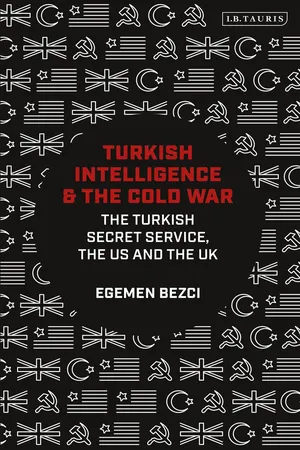
Turkish Intelligence and the Cold War
The Turkish Secret Service, the US and the UK
- 304 pages
- English
- ePUB (mobile friendly)
- Available on iOS & Android
eBook - ePub
About this book
Turkish Intelligence and the Cold War examines the hitherto unexplored history of secret intelligence cooperation between three asymmetric partners – specifically the UK, US and Turkey – from the end of the Second World War until the Turkey's first military coup d'état on 27 May 1960. The book shows that our understanding of the Cold War as a binary rivalry between the two blocs is too simple an approach and obscures important characteristics of intelligence cooperation among allies. Egemen Bezci shows that a pragmatic approach offers states new opportunities to protect national interests, by conducting ''intelligence diplomacy' to influence crucial areas such as nuclear weapons and to exploit cooperation in support of their own strategic imperatives. This study not only reveals previously-unexplored origins of secret intelligence cooperation between Turkey and West, but also contributes to wider academic debates on the nature of the Cold War by highlighting the potential agency of weaker states in the Western Alliance.
Information
1
Machinery in Comparison
Any historical research on the Turkish-Western intelligence relationship during the early Cold War depends on a sound understanding of the organizational and functional roles of the intelligence communities in the respective countries. It is important to have an insight into the machinery because of two important and interlinked dimensions. Ryan Bock, deriving his lesson from the study of Anglo-Soviet intelligence cooperation during the Second World War, argues that the regime type of the countries shapes the depth of intelligence cooperation.1 It is particularly true for a study of Turkish-Western intelligence diplomacy, since intelligence cooperation between Turkey and her Western partners during the early Cold War was a far from smooth process, even though all perceived the same target as the source of threat, the Soviet Union.
In order to reveal how the regime type shaped the intelligence cooperation, it is imperative to conduct a comparative analysis of Turkey, the United States and the United Kingdom. As Glenn P. Hastedt asked the same question more than two decades ago, it is important to define ‘what is to be compared’ for a comparative study of secret intelligence.2 How does the definition of intelligence differ between Turkey, the United States and the United Kingdom? How are institutions shaped? What is the relationship between the intelligence service and policy makers? What is the legal framework in each country? If these questions are not answered properly, ‘then one’s analysis could produce misleading comparisons between dissimilar intelligence organisations’.3 The paucity of previous historical or organizational research on the intelligence services outside of the Anglosphere makes the study of the Turkish case particularly original in the field.4 Moreover, Damien Van Puyvelde and Sean Curtis’s recent qualitative study on the intelligence literature, analysing the field’s two flagship journals, Intelligence and National Security and the International Journal of Intelligence and Counterintelligence, revealed that intelligence studies are indeed not diverse.5 Their findings suggest that the field is dominated by Anglo-American male researchers who work on Western-centric topics.6 Due to the dearth of accumulated knowledge on the topic, particularly on Turkish intelligence, which is outside of Europe but part of the Western Alliance, a comprehensive research on the topic needs a detailed understanding of the differences in the intelligence culture. As Richard Aldrich and John Kasuku point out, ‘Comprehension of what intelligence culture might be will have value only when it is derived from close observation of real behaviour and when we have enough substantive data to undertake meaningful comparisons.’7 Therefore, it is essential to provide an analytical framework of comparison on the Cold War origins of the American, Turkish and British intelligence communities. By doing so, both the characteristics of intelligence diplomacy will be better understood, and a new path will be opened in intelligence studies out of the Anglo-American-dominated literature.
Gearing the machinery
In the Anglo-American sphere, different departmental institutions and independent intelligence organizations usually conduct single-source intelligence collections according to their specialization, such as using human assets abroad or electronic and signal sources such as radar, signal interceptions or satellites to gather intelligence. Usually, however, all intelligence is analysed and processed in a multi-sourced institution to provide a finished result for policy makers. Moreover, the duties and powers of these institutions are stated in a legal framework, with the limits of their powers and responsibilities in the domestic political arena clearly drawn, so that they do not jeopardize the domestic political processes of their countries. On either side of the Atlantic, though, the meaning of intelligence varies. In the United States, the term ‘intelligence’ refers to a broader concept in government, covering the clandestine collection of information as well as the analysis of this information. In the UK, however, the assessment process was not a part of the intelligence picture until the formation of the JIC. More precisely, ‘in the United States “information” is a component of “intelligence” while in the UK, “intelligence” is a particular type of information’.8 In the Turkish context, the equivalent of the word intelligence is İstihbarat. İstihbarat, a word derived from Arabic, means actively gathering ‘unknown news’, and there is an element of intrigue that the word itself connotes. In contrast to the Anglo-American experience, a look at the Turkish intelligence community suggests that such a division of labour does not exist and that a clear distinction of the duties and responsibilities regarding which department does what to gather information is not stated.
The reports prepared by MAH and the Turkish military during the Second World War suggest that in Ankara there was a constant debate among military and civilian organizations about the role of the country’s intelligence agency in peacetime activities. An internal army briefing from 1944, prepared by one Major Kılıç, suggested that intelligence focusing solely on military-war time preparedness was not enough for Turkey’s needs. The briefing suggested that other aspects of intelligence, such as establishing permanent agents abroad, acquiring psychological warfare techniques, being aware of the increasing importance of SIGINT activities and dealing with possible defectors/refugees were new areas that the intelligence community should prioritize.9 The briefing also mentions the importance of undercover human assets abroad to assist the work of military attachés. However, the briefing clearly reflects a military point of view and, given Turkey’s position during the war era, its priorities reflect the desire to protect Turkish security at home, rather than planning offensive espionage/intelligence missions abroad. Lastly, as we will see in Chapter 2, during the Second World War Turkey was a target of both Axis and Allied intelligence operations. Moreover, the poor security of information – in particular, problems with adequately securing the channels of Turkish military and civilian communication from outside interception – resulted in major leaks from Turkish agencies. Thus, the briefing warned that Turkish officers should tightly adhere to secrecy guidelines and not compromise confidential information by communicating via non-secure channels.
However, in another briefing prepared by MAH, the Turkish civilian secret intelligence service, on strategic intelligence techniques and methods, in 1945, special emphasis was given to possible operations abroad.10 This difference between the two agencies does not reflect a division of labour among the organizations, but rather reflects different attitudes among various agencies within the Turkish intelligence community. The army was traditionally hesitant about risky operations, whereas the secret intelligence agency has been more prone to risky behaviour and more aligned towards clandestine operations. As we will see in Chapter 6, which deals with an empirical case study concerning covert operations in Syria, the interplay between the military and civilian branches of the Turkish intelligence community not only conducted operations, but also influenced Turkish decision makers when it came to diplomatic and intelligence cooperation too. As a negative consequence of this inter-departmental rivalry, both MAH and the military focused on creating their own intelligence assessments to gain greater influence over policy makers. However, since the Turkish policy makers were rather more interested in intelligence concerning domestic dissidents who might challenge their power, both the MAH and the military intelligence’s gendarmerie branches diverted their energy and attention to ‘tailing’ a small handful of communists in Turkey.11 As a result, the necessary attention to capacity-building in foreign intelligence activities was hampered.
The American intelligence community
In the American experience, especially due to rising tensions between the Americans and Soviets after the Potsdam Conference of July–August 1945, the perceived need for a centralized American foreign intelligence agency became a pressing issue.12 The wartime intelligence organization, the Office of Strategic Services (OSS), is described as having ‘demonstrated … the usefulness of a central body to process materials from every source of information. Its experiences indicated that a single authority ought to have charge of collecting secret information outside of the United States’.13 However, it was a wartime agency, to be liquidated by September 1945. Thus, the OSS spymaster General Bill Donovan drafted a plan for creating a new intelligence agency to ‘take over the valuable assets created by OSS and aid the nation in the organization and maintenance of peace’.14
The closure of the OSS seriously compromised American clandestine intelligence capabilities in the early post-war period. The Strategic Services Unit (SSU), its much-reduced successor, was hard pressed to maintain established collection programmes, let alone embark on new operations. To supplement its collection efforts, SSU relied to a significant extent on liaison with friendly European intelligence services who shared some of the results of their espionage against Soviet targets.15 Not surprisingly, Britain’s MI6 was the major partner, but smaller services, particularly the Danish, Italian, Turkish and Swedish services, also helped the Americans.
During this transition in Washington from a wartime to a permanent peacetime intelligence agency, intense debate surrounded Donovan’s plan to establish a centralized intelligence apparatus directly reporting to the president. Criticisms of the plan emerged mostly from the State Department and the military, who believed that a ‘single intelligence agency could not manage the complex array of civilian and military departments’.16 Upon the dissolution of the OSS, aside from the powers vested in the SSU, some duties were split between the State Department (under the Research and Analysis Branch) and the War Department (including the employment of Special Forces). But President Harry Truman agreed to a proposal from the Joint Chief of Staff (1181/5) that he should form a centralized body, in January 1946, to coordinate national intelligence activities, known as the Central Intelligence Group.17 It was recognized that the coordination of peacetime strategic intelligence activities could not be achieved via cooperation between departmental one-source intelligence agencies. Moreover, Truman was convinced that ‘strategic intelligence requires knowledge of economic, social and political forces within the structure of a nation that are not so readily ascertainable in swift reconnaissance as in deliberate research’.18
However, in order to fulfil such a duty, the Central Intelligence Group required more capabilities and resources: as originally constituted, it operated without its own funds and personnel. Hoyt Vandenberg, who led the Central Intelligence Group between June 1946 and May 1947, was ‘certain that the Central Intelligence Group could not meet its primary obligation to produce strategic intelligence unless it had better arrangements for collecting the raw materials for such intelligence’.19 Moreover, Vandenberg considered that ‘in order to produce strategic intelligence efficiently, the group should have independent funds that could be spent as desired without dependence upon or accountability to some other agencies’.20
The Central Intelligence Agency (CIA) was officially created as a new independent national intelligence body in the September 1947 National Security Act. It is importan...
Table of contents
- Cover
- Halftitle Page
- Title Page
- Contents
- Acknowledgements
- List of Abbreviations
- Introduction: Dark Origins of the Turkish-British-American Alliance
- 1 Machinery in Comparison
- 2 Historical Background, 1923–45
- 3 (Dis)Trusting Your Allies: NATO and CENTO
- 4 Spies, Atoms and Signals
- 5 Counter-Subversion: Our Common ‘Enemies’
- 6 Covert Action: The Turks’ Hidden Hand in Syria
- Conclusion: Keeping up with the Alliance
- Bibliography
- Index
- Imprint
Trusted by 375,005 students
Access to over 1.5 million titles for a fair monthly price.
Study more efficiently using our study tools.
Frequently asked questions
Yes, you can cancel anytime from the Subscription tab in your account settings on the Perlego website. Your subscription will stay active until the end of your current billing period. Learn how to cancel your subscription
No, books cannot be downloaded as external files, such as PDFs, for use outside of Perlego. However, you can download books within the Perlego app for offline reading on mobile or tablet. Learn how to download books offline
Perlego offers two plans: Essential and Complete
- Essential is ideal for learners and professionals who enjoy exploring a wide range of subjects. Access the Essential Library with 800,000+ trusted titles and best-sellers across business, personal growth, and the humanities. Includes unlimited reading time and Standard Read Aloud voice.
- Complete: Perfect for advanced learners and researchers needing full, unrestricted access. Unlock 1.5M+ books across hundreds of subjects, including academic and specialized titles. The Complete Plan also includes advanced features like Premium Read Aloud and Research Assistant.
We are an online textbook subscription service, where you can get access to an entire online library for less than the price of a single book per month. With over 1.5 million books across 990+ topics, we’ve got you covered! Learn about our mission
Look out for the read-aloud symbol on your next book to see if you can listen to it. The read-aloud tool reads text aloud for you, highlighting the text as it is being read. You can pause it, speed it up and slow it down. Learn more about Read Aloud
Yes! You can use the Perlego app on both iOS and Android devices to read anytime, anywhere — even offline. Perfect for commutes or when you’re on the go.
Please note we cannot support devices running on iOS 13 and Android 7 or earlier. Learn more about using the app
Please note we cannot support devices running on iOS 13 and Android 7 or earlier. Learn more about using the app
Yes, you can access Turkish Intelligence and the Cold War by Egemen Bezci in PDF and/or ePUB format, as well as other popular books in History & European History. We have over 1.5 million books available in our catalogue for you to explore.