eBook - ePub
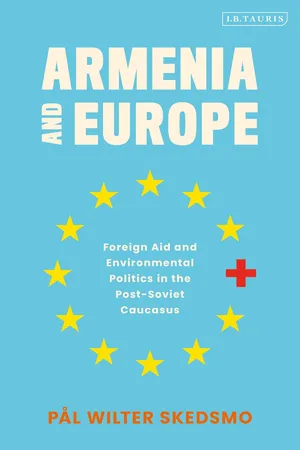
Armenia and Europe
Foreign Aid and Environmental Politics in the Post-Soviet Caucasus
- 280 pages
- English
- ePUB (mobile friendly)
- Available on iOS & Android
eBook - ePub
Armenia and Europe
Foreign Aid and Environmental Politics in the Post-Soviet Caucasus
About this book
Armenia receives one of the highest levels of international aid per capita in the Western world, and among the highest of the post-Soviet states. This ethnographic study, based on new primary research, looks at aid in the South Caucasus, and its role in Armenia's relationship with Europe. In particular, Skedsmo argues that the Aarhus Convention, which entitles citizens of Europe to access information and participation in decision-making in environmental matters has allowed Armenian citizens to adapt and control the direction of their country's political future in various ways – whether through protest activism or legal challenges. A new examination of aid and development, and the structures these create, Europe and Armenia will be an essential case study for scholars of development, for regional specialists in the post-soviet area (especially South Caucasus), social anthropologists, students of post socialism and development (postcolonialism). In addition, the book will be of interest for practitioners and European policy-makers, transnational organizations and others involved in development policies and projects in the region.
Information
1
Development and ‘transition’ in Armenia: Contexts and concepts
I was introduced to Armenia in September 2006, when I found myself at a holiday resort in the Armenian mountains participating at a seminar discussing how Armenia could honour its ‘international obligations’ in its management of the environment. The project was funded by the Norwegian Ministry of Foreign Affairs (MFA), while the FNI was the implementing party. During the five-day seminar, lectures were given on topics related to the various multilateral environmental agreements (MEAs) Armenia had ratified, lessons Norway had learned from implementing MEAs and an international perspective on implementation practices and experiences. The role civil society might have in this process was also discussed.
Three days earlier, I had arrived in Armenia on my first ever visit to the country. On the flight from Moscow, passengers clapped as we landed at Zvartnots International Airport and I soon discovered that this small, landlocked country is quite different from Russia, although they share a common Soviet past. After checking in at the university guest house, I decided to have a look at the city. I went down the main boulevard – Mesrop Mashtots Street – and found a street café opposite the opera. While waiting for a bottle of the local Erebuni beer and barbeque – khorovats – I looked out on the bustling street with its congested traffic. Soviet-era cars such as Volgas and Zhigulis were nearly outnumbered by European SUVs and the occasional Iranian-made Khodro. Looking up the climbing street, I saw a statue in front of an impressive building and on the hilltop behind a giant statue of a woman holding a sword in her hands.
I did not know it then, but the first of these statues was of Mesrop Mashtot, the inventor of the Armenian and Georgian alphabets. The Armenian alphabet was created in ad 405, making Armenian one of the first languages the Bible was translated into. Preceding this, Armenia was the first state to adopt Christianity and the Armenian Apostolic Church thus traces its history back to 301. The building behind the statue of Mashtot is the Matenadaran, a museum of old Armenian manuscripts built during the Khrushchev-era thaw when Armenia was a Soviet republic. The statue on the hilltop is of Mother Armenia, erected in 1967, replacing a statue of Josef Stalin that stood on the same spot until 1962. Had it not been for the opera building and the smog, I would have been able to see Mount Ararat in the distance where, according to biblical legend, Noah’s ark came to rest. One of his sons – Hayk – is considered by Armenians to be their forefather. Hence, Armenians call their land Hayastan – land of Hayk.
Hayastan
Armenia – or Hayastan – is geographically located at the very fringes of Europe. As a modern-day political entity, its official name is the Republic of Armenia and it gained its independence on 21 September 1991, after some seventy years of Soviet rule, which obviously left its mark politically, economically, structurally, socially and culturally. Armenia is a mountainous, landlocked republic located in the South Caucasus, with 2.94 million inhabitants.1 The map in Figure 1.1 shows the internationally recognized political entities and borders in the region.

Figure 1.1 Map of Armenia. Copyright: Library of Congress, Geography and Map Division.
Source: US Central Intelligence Agency. Armenia. (Washington, DC: Central Intelligence Agency, 2002) Map. Retrieved from the Library of Congress, https://www.loc.gov/item/2002625531/ (accessed 15 February 2018).
Armenia covers approximately 30,000 square kilometres and has a continental highland climate with fairly harsh and cold winters and hot summers. No point is below 390 metres above sea level and at its highest point – Mount Aragats in the Aragatson province north-east of the capital Yerevan – it rises 4,090 metres above sea level. Yerevan is approximately 1,000 metres above sea level, with the fertile Ararat valley sloping south-eastwards to the Arax river, the border with Turkey.
When the Soviet Union was formed in 1922, Armenia was one of the three founding members of the Transcaucasian Socialist Federative Soviet Republic (TSFSR), together with Azerbaijan and Georgia. That republic lasted until 1936, when it was split into three separate Soviet republics.
Independence and crisis in Armenia
The first post-Soviet years were extremely traumatic for the Armenian population with Armenia warring with Azerbaijan over the Armenian-dominated autonomous republic of Nagorny Karabakh, situated within Azerbaijan. The war led to the 1993 blockade by Azerbaijan and Turkey, hindering the direct import of most goods into Armenia, including gas for heating. Most of the armed conflicts that followed the collapse of the Soviet Union took place in the Caucasus and of them the war over Nagorny Karabakh was definitely the bloodiest.2 The actual number of casualties is hard to verify since both sides tend to exaggerate their own losses and downplay those of their opponents. According to different sources, however, casualties range between 17,000 and 25,000, with roughly two-thirds on the Azerbaijani side. The number of internally displaced persons (IDPs) in Azerbaijan is around 750,000 and around 350,000 Armenians fled Azerbaijan.3
In 1994, a fragile ceasefire came into force in Nagorny Karabakh. Armenian forces and freedom fighters (fedayehin) now controlled most of the former autonomous republic Nagorny Karabakh and the Azerbaijani provinces situated between it and Armenia proper. Due to the conflict – which prompted Azeris living in Armenia to flee for Azerbaijan – Armenia is now an ethnically homogeneous state; 98 per cent of the population is Armenians. Armenia has never formally recognized the Republic of Nagorny Karabakh despite it being the quasi-republic’s only trading partner. The frozen conflict casts a long,4 dark shadow over Armenian political discourse. The political climate in both countries is at such a low ebb that any sign of willingness to compromise by either part would be seen as betrayal, even though the political elites in both countries doubtless realize the necessity of doing so. The wars have benefited key political and economic figures in the various conflicts in the post-Soviet area.5 In Armenia, the separatists of the 1990s became state builders and the mother republic’s heads of state and ‘state-like entities’6 like Nagorny Karabakh gained legitimacy and influence as functioning de facto republics.7 The hold of the ‘Karabakh clan’ on Armenian politics is evident: two former presidents are originally Karabakh Armenians and both held senior positions in Karabakh during the war: Robert Kocharyan (1998–2008) led the separatist Arthsakh movement and was the first president of Nagorny Karabakh (1994–7). Like Kocharyan, president Serzh Sargsyan (2008–18) was born in Stepanaekert, Nagorny Karabakh, and fought in the war over Nagorny Karabakh. He became minister of defence in Armenia in 1993, prior to the 1994 ceasefire. In addition, Kocharyan’s predecessor and Armenia’s first president, Levon Ter-Petrosyan (1991–8), led the Karabakh movement from Yerevan.
When Armenia gained independence in 1991, it was still struggling with the aftermath of the severe 1988 magnitude 7.0 earthquake in north-western Armenia whose epicentre was close to the town of Spitak. The hardest hit city was the second largest in the country, Gyumri (at the time known as Leninakan), where more than half of the taller-frame stone buildings collapsed, leaving half a million people homeless. Around 24,000 people are estimated to have died following the earthquake and as of 2015, around 1,000 families are still living in the ‘temporary’ shipping containers set up after the earthquake in Gyumri. Yet another 1,000 families are living in severely damaged buildings.8 Another consequence of the earthquake is that Armenia’s only nuclear power plant – Metsamor some 50 kilometres from Gyumri – was closed for security reasons from early 1989 to 1993. It was restarted to compensate the loss of fuel caused by the Azerbaijani and Turkish blockade.
As in most other post-Soviet republics, Armenia saw the establishment of many non-governmental organizations (NGOs) following independence. Many of them came as a response to the many aid programmes funded by the West. The first environmental NGO in Armenia was reportedly the perestroika-era Green Union of Armenia, established as Goyapahpanutyun in 1985.9 For the most part, these NGOs are limited in size and impact mostly because their most important connections are with their international donors. They therefore have few incentives to work together at the local level.10
Literature on civil society in the post-Soviet area often focuses on the unwanted or unintended effects of democratization initiatives funded by western donor agencies and governments.11 According to Armenians, there are three types of NGOs in Armenia: genuine, ‘grant-eaters’ (grantagerner) and pocket (grbanayin) NGOs.12 The popular impression in Armenia is that many NGOs are established by the political elite for their own economic benefit. The sheer volume of western development interventions in Armenian civil society may in fact have ‘turned democracy into a project and civil society into NGOs’.13 The growth of NGOs following the dismantling of the Soviet Union was largely a response to western donor priorities such as fostering civil society in the wake of the Soviet collapse. Whereas Armenia had 44 registered NGOs in 1994, it only took two more years to bring the number up to 1,500. At the time of fieldwork, Armenia had more than 3,300 registered NGOs.14 Civil society and NGOs were held to be the ‘magic bullet’15 or ‘connective tissue’16 between state and society. The result, well documented with regard to Russia,17 was a proliferation of NGOs mainly preoccupied maintaining a ‘special relationship’ with their donors and their donor priorities in a fashion that did not foster domestic cooperation within civil society. Further, the proliferation of this kind of organization, mostly small set-ups run by ‘NGO professionals’, inspired a view of NGOs as mostly concerned about taking care of themselves.
Making Armenia European
The various processes in the field of environmental management and international development in Armenia can be understood as a (post-Soviet) process of Europeanization. By Europeanization I mean processes that in different ways are intended to bring Armenia and other former Soviet republics closer to Europe via institutional set-ups, changes in governance and law. They take place under umbrellas such as the Eastern Partnership (EaP), a joint initiative involving the European Union, Armenia, Azerbaijan, Belarus, Georgia, the Republic of Moldova and Ukraine. Negotiations on a new agreement between Armenia and the EU were opened in 2015, to replace the old ...
Table of contents
- Cover
- Half-title Page
- Title Page
- Contents
- Figures
- Preface
- Abbreviations
- Introduction
- 1 Development and ‘transition’ in Armenia: Contexts and concepts
- Part One Environmental rights and politics in the post-Soviet Caucasus
- Part Two Foreign aid in the post-Soviet Caucasus
- Conclusion
- Appendix 1 Excerpt from the Aarhus Convention text
- Appendix 2 Statement from Teghut Conference
- Notes
- Bibliography
- Index
- Copyright Page
Trusted by 375,005 students
Access to over 1.5 million titles for a fair monthly price.
Study more efficiently using our study tools.
Frequently asked questions
Yes, you can cancel anytime from the Subscription tab in your account settings on the Perlego website. Your subscription will stay active until the end of your current billing period. Learn how to cancel your subscription
No, books cannot be downloaded as external files, such as PDFs, for use outside of Perlego. However, you can download books within the Perlego app for offline reading on mobile or tablet. Learn how to download books offline
Perlego offers two plans: Essential and Complete
- Essential is ideal for learners and professionals who enjoy exploring a wide range of subjects. Access the Essential Library with 800,000+ trusted titles and best-sellers across business, personal growth, and the humanities. Includes unlimited reading time and Standard Read Aloud voice.
- Complete: Perfect for advanced learners and researchers needing full, unrestricted access. Unlock 1.5M+ books across hundreds of subjects, including academic and specialized titles. The Complete Plan also includes advanced features like Premium Read Aloud and Research Assistant.
We are an online textbook subscription service, where you can get access to an entire online library for less than the price of a single book per month. With over 1.5 million books across 990+ topics, we’ve got you covered! Learn about our mission
Look out for the read-aloud symbol on your next book to see if you can listen to it. The read-aloud tool reads text aloud for you, highlighting the text as it is being read. You can pause it, speed it up and slow it down. Learn more about Read Aloud
Yes! You can use the Perlego app on both iOS and Android devices to read anytime, anywhere — even offline. Perfect for commutes or when you’re on the go.
Please note we cannot support devices running on iOS 13 and Android 7 or earlier. Learn more about using the app
Please note we cannot support devices running on iOS 13 and Android 7 or earlier. Learn more about using the app
Yes, you can access Armenia and Europe by Pål Wilter Skedsmo in PDF and/or ePUB format, as well as other popular books in Politica e relazioni internazionali & Politica ambientale ed energetica. We have over 1.5 million books available in our catalogue for you to explore.