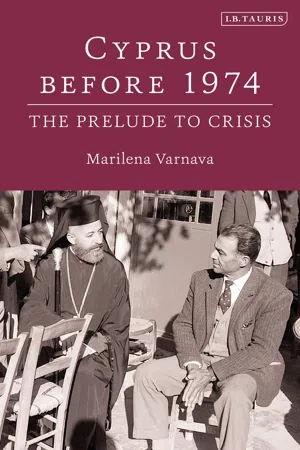
Focusing on the period from September 1964, when Senor Galo Lasso Plaza assumed the UN mediatory role, to the coup d'etat and the Turkish invasion ten years later, Cyprus Before 1974 seeks to unpick the internal conflicts which led to the failure of the peace process in Cyprus. Marilena Varnava studies three phases: Plaza's mediation of 1964-1965; the negotiating impasse on the island during the period 1965-1967; and finally the inter-communal talks of 1968-1974. Varnava argues persuasively that each of these successive phases, particularly the latter two, were inextricably tied to political and social developments within the two main communities on the island itself.
In particular, Cyprus before 1974 focuses on the events of 1968 - when the Greek-Cypriot political leadership, and the President of the Republic of Cyprus Archbishop Makarios III, failed to grasp the nature of the changes within the island's post-independence arena. Recurrent attempts within both communities during the talks of that year to create faits accomplis favourable to their own bargaining positions served to heighten the barriers to a stable and peaceful outcome. This study enlarges our understanding of the underlying issues which the Turkish invasion of 1974 were to throw into stark relief and is essential reading for all those who study the Cyprus problem and conflict resolution.
- 288 pages
- English
- ePUB (mobile friendly)
- Available on iOS & Android
eBook - ePub
About this book
Information
Part One
1964–1967
1
Galo Plaza Report, 1964–1965
The events of December 1963 indicated that the Zurich–London Agreements not only failed to produce a lasting and peaceful solution to the Cyprus question, but on the contrary triggered a new unstable era. The internal turmoil led to a complex situation that widened the perceptions’ gap about the optimal settlement between the two communities. Since the initiation of the peacemaking effort in March 1964, the United Nations (UN) officials had been well aware that the variables surrounding the Cyprus question included elements such as the interests at stake of various important players, a fragile balance which threatened the region’s peace and an already precarious co-existence of the two communities. In addition, the latter’s lack of trust and genuine will to compromise progressively shaped a very difficult and challenging task for any prospective mediator. Although himself not optimistic on arrival, the second UN Mediator in Cyprus, Senor Galo Plaza Lasso, still felt able to say that he saw some ‘rays of hope’.1
A few months later, on 26 March 1965, Plaza submitted his report, containing what he characterized as ‘directions which they themselves should explore in the search for a peaceful solution and an agreed settlement’.2 By clarifying that these directions were to be considered neither as recommendations nor as concrete suggestions, he highlighted the need for the immediate initiation of direct talks between the two communities.3 However the parties’ perceptions, regarding not only the nature of these directions but their content as well, were diametrically different to Plaza’s view. Although this report sought to bring the parties towards a constructive basis for direct negotiations, it drove them further apart. A ‘comfortable’ impasse for both leaderships – that is, one which both could see as not hindering their respective long-term aims – was then created, which unavoidably led to the acceleration of the separate political and social evolution of the two communities on the island.
In order to have a clear insight into the situation and the determining nature of the mediator’s report for the later evolution of the Cyprus question, it is important to identify the reasons that led to Plaza’s failure in 1965. This chapter, therefore, initially examines the prevailing atmosphere upon his assuming of the mediator’s post in Cyprus, along with the negotiating objectives and agendas of the conflicting parties. Subsequently, Plaza’s assessments are identified along with the reactions raised by the conflicting parties and the aftermath of his short-lived mediation. Before these, however, it is important to sketch out a brief background to the appointment of Galo Plaza in September 1964.
The new mediator in Cyprus
In terms of reaching a functional settlement, the Cyprus question is inevitably perceived as one of the conspicuously unsuccessful missions of the UN. It is for that reason that this problem has usually been characterized as the ‘diplomat’s graveyard’. Perhaps it was indeed a bad omen the sudden death of the first such mediator, the Finnish Diplomat Sakari Tuomioja, on 9 September 1964, only a few months after his assignment to Cyprus. Finding a suitable mediator back in March 1964, acceptable to all of parties concerned, was not an easy task for the UN secretary-general. U Thant, in particular, admitted that he was ‘completely stuck’.4 After the new wave of inter-communal clashes in August 1964, the failure of Acheson’s initiative and Washington’s gradual disengagement from the active efforts to broker an agreement, there was again a pressing need for the UN secretary-general to recapture the initiative over the mediation efforts, not least by finding a suitable successor of Tuomioja.
Having previously been the political advisor of United Nations Force in Cyprus (UNFICYP), apparently familiar with all the peculiarities and complexities of the Cyprus problem, and without any other viable options, U Thant believed that Plaza was the natural alternative after Tuomioja’s death. As the political advisor of the peacekeeping operation, Plaza’s main task had been to effectively manage the daily tensions that occurred between the two communities, to negotiate short-term solutions with Greek-Cypriot and Turkish-Cypriot officials separately, and above all to head off any fresh recourse to violence.5 Besides his previous post in Cyprus, Galo Plaza was an ex-president of Ecuador and an ‘old hand at UN troubleshooting’.6 He was assigned in 1958 as a chairman of a UN observation group in Lebanon and two years later as a chairman of a study group on the Congo problems.7 He, therefore, had a good deal of experience of deeply divided and even collapsed societies.
Nevertheless, the name of the new mediator drew mixed reactions within the Turkish-Cypriot community and Turkey. Although generally considered as a skilled UN official, the Turkish side perceived that Plaza, through his UNFICYP post, thus far tended to favour the Greek-Cypriots. Besides, his Latin-American background made him instinctively anti-colonial and strongly supportive of the principle of self-determination. For that reason, before U Thant made public his final decision, Ankara discreetly but unsuccessfully lobbied in order to ward off Plaza’s appointment.8 Nonetheless, the British had convinced the Turks that U Thant’s choice was perhaps the only viable alternative at that critical juncture. Turkey, therefore, grudgingly agreed to the latter’s assignment, and on 16 September 1964 Galo Plaza officially succeeded the late Sakari Tuomioja. Nevertheless, the impartiality or otherwise of the new mediator continued to constitute a great source of concern for Turkey and Turkish-Cypriots, and from their perspective the final outcome of the report seemed to prove them right.
Lessons from Dean Acheson’s mediation of summer 1964
I am not going into this blindfolded. I am very much aware of the difficulties involved in this complex task. However, if it is believed that I am in a position to make a positive contribution to the cause of peace, I find it a moral obligation to accept the assignment. If I fail, I will move on and let a better man to take over. Mediators must be understood to be expendable.9
With these words Galo Plaza opened on 17 September a new chapter in the peacemaking of the Cyprus problem. He knew that if he wanted to produce any concrete results, he had to follow a totally new approach to that of his predecessor. The developments that took place throughout the summer of 1964 and particularly the failure of the US mediation with Dean Acheson in Geneva gave important lessons that all parties had to take now under serious consideration. Primarily, the Cyprus problem was not an exclusively Greco-Turkish affair, and thus a solution on the basis of Enosis with territorial exchanges for Turkey was not as feasible as Britain and the United States believed.10 Although after the summer of 1964 Enosis was still regarded by the West as the only solution that would guarantee stability in the area, the UN continued to seek out possible middle ground between the two communities and their motherlands. It should be stated that although Plaza sought American and British diplomatic support and their help to exert moderate influence on the parties, he also requested that they accept that mediation would be an exclusively UN initiative which only he would take responsibility for, if it failed.11 The Anglo-Americans consented and decided to shelve the Enosis option for the moment, let the UN take the lead in seeking a solution that would focus first on preserving independence on the island and, above all, put a stop to any further destabilization.12
The most important lesson for Plaza was that Makarios and the Cyprus Government had to be maintained at the centre of the negotiating attempts since anything else was a recipe for failure.13 Makarios had made plain that he was not going to accept any solution that would seem to be imposed from the outside, regardless of its benefits.14 The Republic of Cyprus was a sovereign state, and, in principle, a solution had to be sought within the island according to Security Council Resolution 186 and with the UN in the driving seat. Besides, Makarios’ political manoeuvres during the Geneva negotiations of Acheson provided evidence, not for the first time, of the falsity of the British, American and Turkish belief that Greece had the necessary leverage to force Makarios to accept a solution in the making of which he had not been involved.15 It should be stressed, however, that throughout the following decade Turkey never really accepted this counter-thesis, while Greece tried unsuccessfully to reverse it by constantly trying to strengthen its military presence and political influence on the island.16 Nonetheless, after Geneva the Greek Government, ostensibly at least, decided to follow a common line with the Cyprus Government, refused to have bilateral discussions with Turkey and argued that a solution should first be sought on the basis of independence.17
Despite all the above, the most important ‘side effect’ for the West of the Geneva negotiations was that it reinforced Makarios’ turn to the Soviet Union. In August 1964 Makarios secured not only military support but also a diplomatic ‘shield’, with a statement confirming that ‘if a foreign armed intervention takes place in Cyprus the Soviet Union will help Cyprus to defend its freedom and independence’.18
Acheson’s mediation, meanwhile, had a negative effect on Turco-American relations. Following the diplomatic humiliation in June 1964, when President Johnson prevented Ankara from intervening in Cyprus,19 the Turkish Government believed that Washington was letting them down again. Ankara was coming under fire at home for being too subservient to the Western alliance, including over Cyprus. In these circumstances, Enosis in any form became impossible for Turkey.20 While never abandoning the belief that Cyprus was a matter to be dealt primarily between Greece and Turkey, the Turkish Government now seemed willing to go along with UN mediation, while harbouring misgivings about Plaza.21 It hedged its bets, however, on making fresh declarations about the inviolability of the Zurich–London Agreements and, at the same time, on arguing that any new constitutional arrangement in Cyprus had to be a federal one.
Having all these realities in mind, in taking up the reins, Plaza’s basic idea was to concentrate principally on the leaders of the two communities with the concept of thrashing out a solution without an absolute winner or absolute loser.22 Absoluteness, however, remained the nub of the matter. Plaza soon began to discover that each of the Cypriot parties was not pre-occupied with an urgent agreement to sooth existing discontents, but rather with gaining time to strengthen their own negotiating positions through outside alliances and, most essentially, a series of faits accomplis on the island. Meanwhile, polarization of their public opinion was essential for this ‘game’.23 The American ambassador in Ankara caught the essence in November 1964 reporting that
despite Galo Plaza’s inveterate optimism and political virtuosity, including close rapport with Makarios, his multiple conversations with all parties concerned have not resulted in any narrowing of gap […] but instead have served [to] reveal that gap greater than was thought.24
The parties’ agendas
It could be argued that the developments of the first half of 1964 had nonetheless secured the diplomatic preponderance of the Greek-Cypriot community vis-à-vis the Turkish-Cypriots. The Security Council debate in March 1964 saw the Cyprus Government in its purely Greek-Cypriot synthesis henceforth and thus the Greek-Cypriot position broadly victorious. The Greek-Cypriots controlled the state’s machinery enjoying the international recognition given to them by the Resolution 186, while the Turkish-Cypriot leaders who withdrew from the Cyprus Government were internationally isolated, without any official voice in the government and fully dependent on Ankara’s diplomatic, and even potentially physical, support.
Nevertheless, a second diplomatic battle within the UN was anticipated by both sides. Particularly, after September 1964 both sides were getting prepared for a General Assembly debate. Their preparation activities, however, to some extent, overshadowed Plaza’s negotiations.25 At this point, we shall briefly define the objectives of each party and the mechanisms employed in order to achieve them during Plaza’s mediation.
First, Greek-Cypriot leaders agitated in favour of an independent, unitary, integral, demilitarized and sovereign State with adequate safeguards for minority rights and respect for the legitimate right of the people of Cyprus to determine their future without outside interventions.26 There should be, however, a particular emphasis on the latter part of this assertion. The respect of the right of self-determination for the Greek-Cypriot leadership naturally meant that as soon as unfettered independence was consolidated, the Greek-Cypriots should have the right to pursue freely unification of the island with Greece. Nevertheless, this Enosis was very different from the one that the Greek Government and the West had sought.27 For the Cyprus Government it meant primarily unconditional Enosis, without any territorial exchanges to Turkey and, second, that Cyprus would enjoy a special status within Greece’s administration, since it would not be bound by any of the latter’s international commitments.28 Makarios already knew that this was indeed impractical. Nevertheless, he could not openly admit that Enosis, which was still...
Table of contents
- Cover
- Halftitle Page
- Title Page
- Contents
- Acknowledgements
- Abbreviations
- Introduction
- Part One 1964–1967
- Part Two 1968–1974
- Conclusion
- Appendix I
- Notes
- Sources and Bibliography
- Index
- Imprint
Trusted by 375,005 students
Access to over 1.5 million titles for a fair monthly price.
Study more efficiently using our study tools.
Frequently asked questions
Yes, you can cancel anytime from the Subscription tab in your account settings on the Perlego website. Your subscription will stay active until the end of your current billing period. Learn how to cancel your subscription
No, books cannot be downloaded as external files, such as PDFs, for use outside of Perlego. However, you can download books within the Perlego app for offline reading on mobile or tablet. Learn how to download books offline
Perlego offers two plans: Essential and Complete
- Essential is ideal for learners and professionals who enjoy exploring a wide range of subjects. Access the Essential Library with 800,000+ trusted titles and best-sellers across business, personal growth, and the humanities. Includes unlimited reading time and Standard Read Aloud voice.
- Complete: Perfect for advanced learners and researchers needing full, unrestricted access. Unlock 1.5M+ books across hundreds of subjects, including academic and specialized titles. The Complete Plan also includes advanced features like Premium Read Aloud and Research Assistant.
We are an online textbook subscription service, where you can get access to an entire online library for less than the price of a single book per month. With over 1.5 million books across 990+ topics, we’ve got you covered! Learn about our mission
Look out for the read-aloud symbol on your next book to see if you can listen to it. The read-aloud tool reads text aloud for you, highlighting the text as it is being read. You can pause it, speed it up and slow it down. Learn more about Read Aloud
Yes! You can use the Perlego app on both iOS and Android devices to read anytime, anywhere — even offline. Perfect for commutes or when you’re on the go.
Please note we cannot support devices running on iOS 13 and Android 7 or earlier. Learn more about using the app
Please note we cannot support devices running on iOS 13 and Android 7 or earlier. Learn more about using the app
Yes, you can access Cyprus Before 1974 by Marilena Varnava in PDF and/or ePUB format, as well as other popular books in History & European History. We have over 1.5 million books available in our catalogue for you to explore.