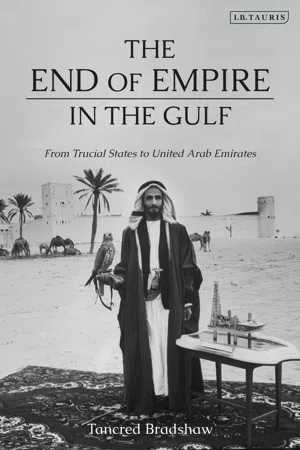
With the end of the British Raj in 1947, the Foreign Office replaced the Government of India as the department responsible for the Persian Gulf, and would proceed to manage relations with the Trucial States (now the United Arab Emirates, UAE) until British withdrawal in 1971. This work is a comprehensive history of British policy in the region during that period, situated for the first time in its broad historical and political context.
Tancred Bradshaw – an academic historian with extensive experience in the region – sheds light onto the discovery of oil in Abu Dhabi in the 1950s, Foreign Office attempts to instigate a long-term development policy in the region, the slow end of the British Empire, the origins of the UAE and – most importantly – the British legacy in this geopolitically crucial region today. The book relies on 40,000 pages of archival material, much of it previously unused, and will be of interest to Imperial historians, as well as anyone working on the history and politics of the Middle East and the Persian Gulf.
eBook - ePub
The End of Empire in the Gulf
From Trucial States to United Arab Emirates
- 272 pages
- English
- ePUB (mobile friendly)
- Available on iOS & Android
eBook - ePub
About this book
Information
1
Benign neglect
The Government of India’s legacy in the Gulf
This chapter discusses the context of Britain’s long role in the Gulf – the Trucial States as well as Bahrain, Kuwait, Qatar and Oman. Britain’s position in the Trucial States originated in the early nineteenth century. The East India Company (EIC) and the Government of India (after 1858) dominated the Gulf region for over a century. The policies adopted by the Indian government had a major impact on the evolution of British policy in the Gulf until the demise of the British role in 1971. The Government of India’s policy in the Gulf was determined by commercial and strategic considerations. Several agreements and treaties heavily influenced relations with the rulers of the Trucial States, Bahrain, Kuwait and Qatar. The Pax Britannica in the Gulf was characterised by the maintenance of peace at sea, and the prevention of what the British regarded as piracy.
The Government of India and the Foreign Office relied on a small number of officials and locally recruited agents in the Gulf. The Political Resident in the Persian Gulf was the key British official in the Gulf. During the post-Second World War era, the number of British officials serving in the Gulf gradually increased. This was a consequence of the Foreign Office’s growing intervention in the region. The Political Resident and the British Political Agents enjoyed extensive formal and informal powers. Their most important role was the maintenance of cordial relations with the rulers of the Trucial States.
Sheikhly rule was the dominant form of political organisation in the Trucial States. The Government of India rarely intervened in the internal politics of the sheikhdoms, and the British acted as the sheikhs’ guarantor. The Government of India’s non-intervention in the Gulf resulted in the hereditary ruling families dominating the politics of the Trucial States, Bahrain and Qatar. The British were determined to secure their interests in the Gulf, but they neglected to introduce any economic, political and social reforms. The Arabian littoral of the Persian Gulf was an imperial convenience, and by the demise of the British Indian Empire in 1947, the population of the Trucial States had very little to show for the British presence, apart from not being incorporated by Saudi Arabia. The Foreign Office continued to support the rulers in the post-Second World War era because there was no viable alternative to sheikhly rule.
India and the Gulf States
The East India Company’s commercial and strategic interests evolved over time.1 The EIC had perennial strategic interests in the Gulf, which included preventing rival European powers, such as the French, from exerting their influence in the region.2 The EIC’s political and strategic interests on the Arabian shore of the Gulf originated at the beginning of the nineteenth century. During the early nineteenth century, the Company initiated a series of operations in the Persian Gulf in order to counter what it regarded as piracy. Attacks on shipping in the Gulf continued unabated and, in December 1819, British and Omani forces attacked the Qawasim at Ras Al Khaimah, leading to the destruction of the town and of villages nearby.3 Forts were demolished and the Qawasim fleets were destroyed.4 The most significant long-term impact of this operation was that the tribal chiefs along the coast signed a General Treaty of Peace in 1820 with the EIC.5 Under the Treaty, the rulers and their subjects were bound to abstain from ‘plunder and piracy’, and the Indian authorities tried to ensure that acts of piracy would not go unnoticed and unpunished. The General Treaty was important because it established the basis of subsequent treaties and marked the onset of Britain’s primacy in the Gulf that lasted until 1971.
As the head of a naval confederacy, the British regarded themselves as the guarantor of maritime truces and the suppression of piracy. The British believed that their superior strength made them the arbiter of regional power. The British Resident was instructed to abstain from interfering in land wars, and instructed that every opportunity should be taken to persuade the rulers to remain at peace and that acts of piracy would be punished.6 There were exceptions to this policy of non-interference on land when British interests were threatened. Subsequently, the rulers signed a series of agreements with the Company in 1835 and 1842, and in 1853 they agreed to a Perpetual Treaty of Maritime Truce.7 As a result of these agreements, the sheikhdoms of the Lower Gulf became known as the ‘Trucial States’.
In 1858, the Government of India assumed responsibility for the Trucial States. The British position in the Gulf rested on custom rather than law because there had been no need to define it since no international power challenged British supremacy. In 1892, the rulers of the Trucial States signed an Exclusive Agreement that stipulated: (1) ‘that I will on no account enter into any agreement or correspondence with any Power other than the British Government’; (2) ‘that without the assent of the British Government I will not consent to the residence within my territory of the agent of any other Government’; and (3) ‘That I will on no account cede, sell, mortgage or otherwise give for occupation any part of my territory, save to the British Government.’8 This agreement remained the basis of Britain’s relations with the Trucial States until 1971. The rulers of the Trucial States also signed during the twentieth century agreements concerning the Prohibition of the Traffic in Arms,9 and the exploitation of natural resources. In 1922, the rulers agreed not to grant oil concessions ‘to anyone except to the person appointed by the High British Government’.10 During the 1930s, the rulers signed agreements for landing rights for the RAF (at Abu Dhabi and Dubai) and Imperial Airways (at Dubai and Sharjah). In return, the rulers received an annual subsidy and a landing fee, but their external sovereignty was significantly constrained.11 These agreements symbolised greater Indian interference in the internal affairs of the sheikhdoms, which the rulers resented.
The Government of India also signed agreements and treaties with the other Gulf States. Bahrain signed treaties that closely resembled the agreements with the Trucial States. The ruler of Bahrain signed the General Treaty of 1820, but was not included in the 1853 Maritime Truce. However, in 1861, the ruler of Bahrain signed a ‘Friendly Convention’ with the Government of India, whereby he agreed to ‘abstain from all maritime aggressions of every description’, as long as he received ‘the support of the British Government in the maintenance of the security of’ his ‘possessions against similar aggressions directed against them by the Chiefs and tribes of this Gulf’.12 As Rosemary Hollis notes, Bahrain was therefore accorded an explicit guarantee of its independence by the British, which was not the case in the Trucial States.13 In 1880, Bahrain signed the first Exclusive Agreement with the British, and signed the same agreement as the rulers of the Trucial States in 1892.14 The rulers of Bahrain also signed agreements in 1898 to suppress the arms trade and in 1912 to establish a wireless station, and in 1914 Bahrain agreed not to sign an oil concession without consulting the Political Agent at Bahrain.15
The British also signed agreements with the rulers of Qatar. In 1868, the ruler of Qatar signed an agreement not to breach the maritime peace. However, Qatar only joined the Trucial system in 1916, when Sheikh Abdullah bin Jassim signed a treaty that was similar to the treaties with the Trucial States. In return, the British guaranteed protection ‘from aggression by sea’ and offered its ‘good offices’ in the event of aggression by land or sea, as long as such aggression was not provoked.16
The Government of India’s treaty relations with Kuwait and Oman were different. The Kuwaitis had a more independent relationship with the British on account of Kuwait’s historic orientation with the Arab world and its relations with the Ottoman Empire. In January 1899, Sheikh Mubarak bin Salah Al Sabah, the ruler of Kuwait, signed an Exclusive Agreement with a view to forestalling Russian action in the Gulf. Sheikh Mubarak agreed not to receive the agent or representative of a foreign government or power without the previous agreement of the British government. He also agreed not to cede, sell, lease, mortgage or give for occupation any portion of his territory without the prior consent of the British. The agreement implied British support for Sheikh Mubarak’s rule and Kuwait’s independence, but it remained secret. In 1901, Sheikh Mubarak requested British protection in the face of a Turkish invasion, which was declined. However, Colonel Kemball, the Political Resident, gave the ruler a ‘qualified assurance of support, conditional on his continuing to observe the Agreement of 1899’.17 The Kuwaitis made similar undertakings as Bahrain and the Trucial States on pearls in 1911 and, in 1912, ...
Table of contents
- Cover
- Half-Title Page
- Dedication
- Title Page
- Contents
- List of Illustrations
- Acknowledgements
- Introduction
- 1 Benign neglect: The Government of India’s legacy in the Gulf
- 2 The neo-Raj: British policy in the Trucial States during the 1950s
- 3 The consolidation of British influence: The Conservative Government and the Trucial States, 1960–4
- 4 Responsibility without power: The vicissitudes of British policy in the Trucial States, 1964–7
- 5 All politics and no strategy: The withdrawal from the Gulf
- 6 Epilogue: The British legacy in the Gulf
- Conclusion
- Notes
- Bibliography
- Index
- Copyright
Trusted by 375,005 students
Access to over 1.5 million titles for a fair monthly price.
Study more efficiently using our study tools.
Frequently asked questions
Yes, you can cancel anytime from the Subscription tab in your account settings on the Perlego website. Your subscription will stay active until the end of your current billing period. Learn how to cancel your subscription
No, books cannot be downloaded as external files, such as PDFs, for use outside of Perlego. However, you can download books within the Perlego app for offline reading on mobile or tablet. Learn how to download books offline
Perlego offers two plans: Essential and Complete
- Essential is ideal for learners and professionals who enjoy exploring a wide range of subjects. Access the Essential Library with 800,000+ trusted titles and best-sellers across business, personal growth, and the humanities. Includes unlimited reading time and Standard Read Aloud voice.
- Complete: Perfect for advanced learners and researchers needing full, unrestricted access. Unlock 1.5M+ books across hundreds of subjects, including academic and specialized titles. The Complete Plan also includes advanced features like Premium Read Aloud and Research Assistant.
We are an online textbook subscription service, where you can get access to an entire online library for less than the price of a single book per month. With over 1.5 million books across 990+ topics, we’ve got you covered! Learn about our mission
Look out for the read-aloud symbol on your next book to see if you can listen to it. The read-aloud tool reads text aloud for you, highlighting the text as it is being read. You can pause it, speed it up and slow it down. Learn more about Read Aloud
Yes! You can use the Perlego app on both iOS and Android devices to read anytime, anywhere — even offline. Perfect for commutes or when you’re on the go.
Please note we cannot support devices running on iOS 13 and Android 7 or earlier. Learn more about using the app
Please note we cannot support devices running on iOS 13 and Android 7 or earlier. Learn more about using the app
Yes, you can access The End of Empire in the Gulf by Tancred Bradshaw in PDF and/or ePUB format, as well as other popular books in Historia & Historia del siglo XX. We have over 1.5 million books available in our catalogue for you to explore.