- 288 pages
- English
- ePUB (mobile friendly)
- Available on iOS & Android
eBook - ePub
About this book
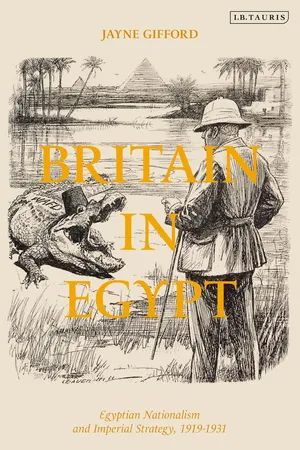
Egypt under the British tends to be looked at now through a post-Suez lens – an inevitable disaster and the last puncturing of a doomed empire. But in fact Egypt for many years was the cornerstone of British success across the Middle East and North Africa. This image of empire was shattered after the First World War by the development of nationalism in Egypt – the foundation and growth of the nationalist Wafd party led by Saad Zaghlul and the creation of the Muslim Brotherhood in 1928. Throughout this period Britain continued to control the Nile Valley – under Field Marshal Allenby and then George Lloyd – through a policy of deliberate containment of nationalism and a slow relinquishing of powers (culminating in the Anglo-Egypt Treaty of 1936). This book will be the first to study that process in the Nile Valley in any great detail and contains previously unpublished primary sources.
Information
1
Between Two Worlds: Britain and Egypt in Africa and the Middle East
The nature of British rule
British involvement in Egypt was long-standing. August 1882, and the arrival of British troops in Egypt, signalled the inception of British domination of the country. Britain was to enjoy this supremacy in a number of guises until after the Second World War. The various political and military organizations that were established as a result of the British occupation ensured that throughout Britain’s ‘moment in the Middle East’, no other foreign power could exert the same degree of influence over Egyptian affairs as Britain. An examination of Egypt’s position within the British imperial system presents an almost schizophrenic picture – Egypt, at once a product of the Scramble for Africa, was also a vital piece of the strategic puzzle in the Middle East helping Britain to maintain a wider imperial reach.
The construction of the Suez Canal, begun in the 1850s under Ferdinand de Lesseps, a former French consul in Egypt–turned-engineer, marked the first considerable penetration of Egypt by foreign capital. The Suez Canal Company was formed in Paris, largely with French money, and floated its 800,000 shares in 1858. Khedive Sa’id Pasha (1854–63 as Khedive) purchased 353,204 shares while French shareholders procured 400,000 and other European interests bought 46,796 shares.1 During this period, Egypt also became an important market for goods produced by British industrialization and as a supplier of raw materials, such as cotton and grain, vital since the American Civil War had disrupted cotton supplies. This provided further incentive for investment in the infrastructure of Egypt, such as the construction of railway lines between Cairo and Alexandria, and Cairo to Suez, in order to facilitate the transportation of goods.2 In attempting to model Egypt on Western lines, Khedive Ismail Pasha (1863–79 as Khedive) embarked upon a number of other ambitious construction projects. These included heavy expenditure not only on his court and surroundings but also on 8,400 miles of irrigation canals, 5,000 miles of telegraph communications, the construction of 430 bridges, the Alexandria harbour and the docks at Suez, the completion of 15 lighthouses and 64 sugar mills, and the area of arable land was increased from 4 million to nearly five and a half million acres. To finance these schemes, often suggested and undertaken by British capitalists, Egypt borrowed heavily and by 1874 Egypt’s foreign debts amounted to £19,917,160. Servicing the interest on the debts, approximately £6 million, took the majority of Egypt’s revenue which amounted to less than £10 million a year.3
It was unsurprising then that Egypt’s finances soon reached a state of insolvency. Moreover, it is still less surprising that British and French experts were willing to offer their services when the details of the loans are examined. For example, the contractors for the three loans of 1862, 1864 and 1866 were the firm of Frühling & Goschen, of which Charles Hermann Goschen, a director of the Bank of England, was senior partner, and George Joachim Goschen, later Chancellor of the Exchequer, was a member.4 The first example of direct British interference in Egyptian affairs came in 1875 when British creditors forced the Khedive to sell his shares in the Suez Canal for £4 million.5 British and French financial missions furthered Anglo-French interference with the establishment of the Caisse of Public Debt in May 1876 and dual control was extended over Egypt through the appointment of two executive Controllers-General: Mr Romaine, a former Judge Advocate of the Indian Army, for revenue, and Baron de Malavet for expenditure. Captain Evelyn Baring, formerly Secretary to the Viceroy of India, was appointed to the post of Commissioner on the Caisse.
This financial quagmire provided the backdrop to the political opposition that erupted in the form of the National Revolution in 1881–82 under the leadership of Colonel Ahmed Arabi.6 Stirrings of unrest among Egyptians over foreign financial control had already manifested itself in 1876 with Sadik Pasha’s, Ismail’s Minister of Finance, opposition to dual control. As conditions worsened a further outbreak of protest occurred in 1879 when a group of Egyptian officers seized the Egyptian Prime Minister, Nubar Pasha, and the British Finance Minister, Sir Rivers Wilson, and detained them in the Finance Ministry. Although the officials were immediately released on the orders of the Khedive, this event had several significant consequences: it demonstrated that the Khedive still possessed a certain amount of authority; it signalled the beginning of a widespread revolt against foreign control among the upper- and middle-class sections of Egyptian society; and, most importantly, it prompted Ismail to form an Egyptian ministry, headed by Sherif Pasha, to displace the European ministry. The new Cabinet was to be responsible to an elected assembly and the Cairo correspondent of The Times described how ‘foreign assistance which came to regenerate the country has only given birth to a national party distinctly opposed to all rule from outside and avowedly working from the standpoint of Egypt for the Egyptians’.7
Egyptian failure to meet the required debt repayments in full and the deposition of Khedive Ismail in favour of his eldest son, Prince Muhammad Tawfiq (Khedive 1879–92), by the Ottoman Sultan and at the behest of the European powers, allowed the Controllers a role within the Egyptian Cabinet. The army, the only indigenous institution remaining within the state apparatus, now became the centre of discontent at foreign controls. Under Arabi, a protest movement began over the non-payment of salaries and the unfair system of promotion within the army itself and grew into a nationalist programme that included the dismissal of the whole ministry, the granting of a constitution and an increase in the strength of the army to the full 18,000 permitted.8 Arabi’s agitation was successful in attracting different sections of the population from landlords who objected to the foreign exploitation of Egypt’s new resources to fellahin soldiers who were increasingly burdened by taxation in order to satisfy Egypt’s foreign debtors. S Huffaker points out that ‘as the ambitions and aims of Arabi and his supporters increasingly came into conflict with British business and government interests […] the Victorian periodical and newspaper press came to portray him in increasingly negative terms’.9 Arabi became the ‘ultimate representative of Egypt and Egyptians’ as the Anglo-Egyptian crisis grew.10
The struggle for dominance between the Khedive, Arabi and the European powers against the ambivalent influence of the Ottoman Sultan reached fatal consequences on 11 June 1882 when riots erupted in Alexandria. The exact cause remains unknown, but it resulted in several hundred people being killed or injured, including fifty Europeans. Charles Cookson, Acting British Consul, was badly wounded and a petty officer from HMS Superb was killed.11 This was against the backdrop of a deteriorating situation in Ireland and M E Chamberlain has argued that since Arabi was either unable or unwilling to control the situation the security of the Suez Canal was at risk and this therefore justified the occupation of Egypt. Huffaker maintains that the representation of Arabi in the Victorian press was ‘interwoven with a hegemonic world-view, which supported Britain’s imperial role and increasingly masked other motivations for the invasion’.12 The riots in Alexandria were critical in influencing the British occupation of Egypt. Predisposed by the deteriorating situation in Ireland, the massacre ‘convinced the waverers, including Gladstone himself, that law and order had broken down, that the Egyptian army led by Arabi was either unable or unwilling to control the situation, that European lives were in danger and that, in a longer view, the safety of the Suez Canal could not be guaranteed’.13
In view of the events in Alexandria, the French called for a joint conference of the six powers with interests in Egypt – Britain, France, Italy, Germany, Austria and Russia. The conference convened at Constantinople on 23 June 1882, and a self-denying protocol was agreed. This was an undertaking ‘not to seek any territorial advantage, nor any concession of any exclusive privilege, nor any commercial advantage for their subjects other than those which any other nation can equally obtain’.14 It was also agreed that none of the Powers should undertake isolated action in Egypt, except in case of special emergency and that an appeal should be sent to the Sultan to dispatch troops to restore the status quo in Egypt. However, despite these agreements, sixteen days later, the British fleet bombarded Alexandria. The pretext for the attack was Arabi’s refusal to halt the construction of batteries and the placement of guns at Alexandria which could be used against the British fleet. This bombardment was followed by a landing of British troops, with the support of the Khedive, to restore order. As the British occupation progressed, pressure was exerted on the Ottomans to issue a decree declaring that Arabi had led a mutiny against the Khedive. Once this was achieved, the support of the Islamic and Arab world for Arabi rapidly declined as his main defence was that he was protecting the Sultan’s rights.15 Arabi and his followers were defeated at Tel-el-Kebir and Cairo was occupied by the British two days later. On 17 September the Khedive disbanded the army and established a new force under the auspices of the British.16 The British occupation of Egypt was now an economic, political and military fact.17
Egypt and the scramble for Africa
The British occupation was an important development since Egypt now took on a whole new strategic dimension. The opening of the Suez Canal in November 1869 had overnight supplanted the Cape of Good Hope’s advantage in freight carried between Europe and the Far East. The Canal, at just over a hundred miles in length, shortened the distances from the Port of London to Bombay by 4,543 miles, to Calcutta by 3,667 miles and to Melbourne by 645 miles. The Canal therefore acquired increasing importance for British trade. Before 1914, India accounted for over half of the Canal’s traffic; trade with the Far East increased tenfold, and high volume exports from Australia became possible. By 1928, exports to Britain from India and Burma formed 35.1 per cent of south-north traffic whilst British flagged ships constituted the largest users of the Canal.18
Despite Britain’s obvious economic interests in the Canal and the fact that it formed the shortest route to the ‘jewel in the imperial crown’ – India – the Canal did not make the British occupation of Egypt a foregone conclusion. William Gladstone, writing in 1877 and whose government occupied Egypt five years later, opposed Edward Dicey’s view that Britain should occupy a bankrupt Egypt.19 Gladstone believed that it would draw Britain into creating a vast British Empire in Africa:
Our first site in Egypt, be it by larceny or be it by exemption, will be the almost certain egg of a North African Empire, that will grow and grow until another Victoria and another Albert, title of the Lake – sources of the White Nile, come within our borders: and till we finally join hands across the Equator with Natal and Cape Town, to say nothing of the Transvaal and the Orange River on the South, or of Abyssinia or Zanzibar, to be swallowed by way of viaticum on our journey.20
Gladstone argued that such an Empire would drag Britain into:
Consequent embroilments with France and the other Powers. There would be no limit to the responsibilities Britain would have to undertake, dealing with all oppression, and undertaking the entire taxation. It would end forever the realisation of that lofty aim, the founding not of a terrestrial but moral empire – the enthronement of this idea of public right as the governing idea of European policy.21
Indeed, M Thomas and R Toye have recently argued that we should examine the dynamics of British party politics of the time and the role that attitudes towards France played in influencing the British government’s approach to Egypt.22 Domestically, Gladstone’s rhetoric during the ‘Midlothian Campaign’ of 1879–80 was centred upon the ‘allegedly sinister and autocratic system of government’ with which Disraelian ‘Imperialism’ was ‘intimately entwined’.23 For Gladstone it was the ‘governing style’ that was at the centre of the debate as opposed to territorial expansion.24 Indeed, ‘it was the relationship between morality and national self-interest that marked the fault-line between Gladstonian and Conservative imperial views’.25 As Thomas and Toye outline ‘for high-minded Liberals, improvements in native welfare, to be worked for as part of a sacred trust that had been bequeathed them, were the only justification for an empire which Britain, in the last analysis, did not actually need for her survival’.26 The Conservatives, on the other hand, possessed ‘their own concept of imperial “duty” – albeit a duty to develop British character much more than one to improve native welfare’.27
From the beginning, there existed a moral opposition to the British occupation of Egypt. It was argued that ‘expansion provided careers, or profits, for privileged groups at British taxpayers’ cost’.28 One such example was Seymour Keay’s Spoiling the Egyptians: A Tale of Shame (1882), which depicted the Cabinet simply as pawns to bondholders and financiers.29 This was countered by explorers or pro-consular figures who emphasized the ‘need to forestall competitors or lose trade, and to “civilise” Africans’.30 A Milner’s England in Egypt (1892) perceived Britain’s task in Egypt following Arabi’s defeat at Tel el-Kebir as ‘one of the most thankless roles thrust upon an unwilling actor’.31 To Milner and his imperial compatriots, British control of Egypt was necessary for two reasons. Firstly, Britain’s substantial and increasing commercial interests within Egypt were an important consideration and were vulnerable to indigenous Egyptian mismanagement. More significantly, Milner argued that Egypt’s strategic position within the British Empire warranted attention to her internal political makeup. He believed that Britain had nothing to gain by annexing Egypt, but a great deal to fear if it fell into the possession of another power. To avoid this possibility, Milner advocated pro...
Table of contents
- Cover
- Halftitle Page
- Title Page
- Contents
- Acknowledgments
- Introduction
- 1 Between Two Worlds: Britain and Egypt in Africa and the Middle East
- 2 Riots and Resistance: Britain and Egypt, 1918–1922
- 3 Negotiating at Home and Abroad: The CID, Labour and the Egyptian Nationalists, 1924
- 4 The ‘Colonized Colonizer’: The Anglo-Egyptian Sudan
- 5 The Assassination of Sir Lee Stack: The British Lion’s Final Roar?
- 6 ‘I Wish Austen Were Less of an Old Woman and Less Occupied with His Tea Parties in Geneva’: The Conservative Government and the Anglo-Egyptian Treaty Negotiations
- 7 ‘The Two Ends Just Didn’t Meet’: The Labour Government and Anglo-Egyptian Treaty Negotiations
- Conclusion
- Notes
- Bibliography
- Index
- Imprint
Trusted by 375,005 students
Access to over 1.5 million titles for a fair monthly price.
Study more efficiently using our study tools.
Frequently asked questions
Yes, you can cancel anytime from the Subscription tab in your account settings on the Perlego website. Your subscription will stay active until the end of your current billing period. Learn how to cancel your subscription
No, books cannot be downloaded as external files, such as PDFs, for use outside of Perlego. However, you can download books within the Perlego app for offline reading on mobile or tablet. Learn how to download books offline
Perlego offers two plans: Essential and Complete
- Essential is ideal for learners and professionals who enjoy exploring a wide range of subjects. Access the Essential Library with 800,000+ trusted titles and best-sellers across business, personal growth, and the humanities. Includes unlimited reading time and Standard Read Aloud voice.
- Complete: Perfect for advanced learners and researchers needing full, unrestricted access. Unlock 1.5M+ books across hundreds of subjects, including academic and specialized titles. The Complete Plan also includes advanced features like Premium Read Aloud and Research Assistant.
We are an online textbook subscription service, where you can get access to an entire online library for less than the price of a single book per month. With over 1.5 million books across 990+ topics, we’ve got you covered! Learn about our mission
Look out for the read-aloud symbol on your next book to see if you can listen to it. The read-aloud tool reads text aloud for you, highlighting the text as it is being read. You can pause it, speed it up and slow it down. Learn more about Read Aloud
Yes! You can use the Perlego app on both iOS and Android devices to read anytime, anywhere — even offline. Perfect for commutes or when you’re on the go.
Please note we cannot support devices running on iOS 13 and Android 7 or earlier. Learn more about using the app
Please note we cannot support devices running on iOS 13 and Android 7 or earlier. Learn more about using the app
Yes, you can access Britain in Egypt by Jayne Gifford in PDF and/or ePUB format, as well as other popular books in History & Middle Eastern History. We have over 1.5 million books available in our catalogue for you to explore.