In the early Islamic world, Arabic erotic compendia and sex manuals were a popular literary genre. Although primarily written by male authors, the erotic publications from this era often emphasised the sexual needs of women and the importance of female romantic fulfilment.
Pernilla Myrne here explores this phenomenon, examining a range of Arabic literature to shed fresh light onto the complexities of female sexuality under the Abbasids and the Buyids. Based on an impressive array of neglected medical, religious-legal, literary and entertainment sources, Myrne elucidates the tension between depictions of women's strong sexual agency and their subordinated social role in various contexts. In the process she uncovers a great diversity of approaches from the 9th to the 11th century, including the sexual handbook the Encyclopedia of Pleasure (Jawami' al-ladhdha), which portrayed the diversity of female desires, asserting the importance of mutual satisfaction through lively poems and stories. This is the first in-depth, comprehensive analysis of female sexuality in the early Islamic world and is essential reading for all scholars of Middle Eastern history and Arabic literature.
eBook - ePub
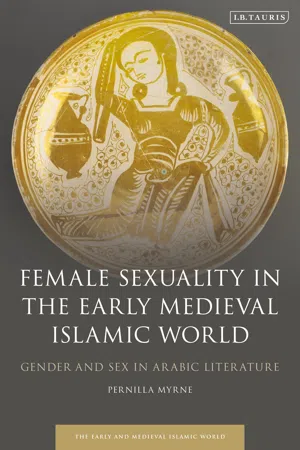
Female Sexuality in the Early Medieval Islamic World
Gender and Sex in Arabic Literature
- 240 pages
- English
- ePUB (mobile friendly)
- Available on iOS & Android
eBook - ePub
Female Sexuality in the Early Medieval Islamic World
Gender and Sex in Arabic Literature
About this book
Information
Part One
Discourses on Female Sexuality
1
Sexuality, Pleasure and Health
Burjān and Ḥabāḥib were two wise women and advisors to a king in a book written by the ninth-century author Abū Ḥassān al-Namlī, one of the ‘cultured and affable’ men at the court of the caliph al-Mutawakkil.1 Al-Namlī, who was a buffoon and a drinking companion of the caliph, also wrote books on lesbianism and passive male homosexuality. The books are lost, but extensive quotations from Burjān and Ḥabāḥib in the erotic manual Jawāmiʿ al-Ladhdha reveal that it was a humorous and slightly irreverent exposition of different aspects of female sexuality, mixed with erotic stories and anecdotes. In the frame story, the king asks the two women questions on a variety of topics and they answer with examples from their own life. On one occasion, he asks them who has most sexual appetite (shahwa), women or men.2 Their answer, ‘the woman with the weakest sexual appetite overpowers the man with the strongest appetite’, did probably not surprise al-Namlī’s audience, as in this genre (erotic literature) women are often represented as entirely driven by their desire. They choose men based on the size of their genital organs and their performance in bed, and they love them as long as they get satisfaction. Burjān and Ḥabāḥib illustrate their claim with a dubious evidence in the crude style of mujūn (‘sexual comedy’): ‘A group of men is not necessarily enough to satisfy one woman, whereas one single woman can satisfy a group of men.’ The king follows up with another question, ‘Why then have women less semen than men have, when their sexual appetite is so much stronger?’ The two women reply with an answer informed by medical theory and natural philosophy. The reason for this, they say, is that the female semen comes from the brain whereas the male semen comes from the back; because of the longer distance the female sperm has to flow, women have slower orgasm and lesser amount of seminal fluid.3
The idea that both men and women have semen was common medical knowledge at the time of al-Namlī, and some of the medical authorities whose works were translated from Greek to Syriac and Arabic maintained that the brain and the spinal cord were influential in the production of semen. According to Plato’s Timaeus, which was available in an Arabic translation, desire is aroused when the sperm descends from the brain and passes down through the neck and the back. The earliest author of a medical compendium in Arabic, ʿAlī ibn Sahl al-Ṭabarī, maintained that the sperm comes from the whole body, but that the best sperm is produced in the brain; this sperm is white and has a balanced composition. ʿAlī ibn Sahl was a court physician of al-Mutawakkil and his ideas must have been familiar to al-Namlī, who was active in the same court. So was another influential early physician; Ḥunayn ibn Isḥāq, the most important translator of Greek works, whose circle translated Galen’s summary of Timaeus as well as Proclus’ commentary on it.4 Al-Namlī’s book about Burjān and Ḥabāḥib seems to have been written as a mocking commentary of the Greek medical ideas introduced by his peers. It was also a play with the wisdom genre; the frame story with a king and two wise individuals who advise him in various matters and answer all his questions makes it a mirror for princes in mujūn style on the subjects of sex and women. It might have been inspired by one of the earliest full-scale mirrors for princes in Arabic, Kitāb al-Tāj, which was written for al-Fatḥ ibn Khaqān, who had a high position in al-Mutawakkil’s court.5
The example from Burjān and Ḥabāḥib illustrates the influence of Greek learning and Middle Persian literature on the cultural centres of the early Abbasid Empire. Sexuality and reproduction were topics that everybody could relate to, and the sophisticated medical ideas conveyed by the texts translated by Ḥunayn and others were probably discussed in wider circles. The emerging medical literature in Arabic was theoretical, yet the theories had impact on clinical practice and must have been at least to some extent comprehensible for non-professionals. Several aspects of sexuality were discussed by the medical authors, including topics such as sexual differentiation, fertility, reproductive and sexual health. The physical differences inspired thinkers to search for explanations for visible and imagined differences between the sexes. Greek writers offered several explanations for how some bodies become female and some male, how these bodies differ and how women and men contribute to reproduction. In this chapter, I mention these theories as long as they had impact on early Arabic-Islamic medicine. Influenced by Greek medicine, Islamic medical authors developed the field of sexual health. Compared with the former, they focused more on pleasure and contributed especially to the field of pharmacology, which they enriched with many new and complicated recipes, not the least pleasure-enhancing therapies.
Background: Islamic medical authors
Ḥunayn ibn Isḥāq was the most prolific translator of Greek medical works, not the least by Galen, under the patronage of elite circles in Baghdad and Samarra. He was a Nestorian Christian who studied in the Byzantine Empire, and was later successful in Baghdad, where he started as a student of the court physician Yuḥannā ibn Māsawayh (d. 243/857). He served several caliphs as court physician, among others al-Mutawakkil (r. 232–247/847–861) and al-Muʿtamid (r. 256–279/870–892).6 Among his numerous writings is a treatise on coitus, apparently based on a treatise by the Greek physician Rufus of Ephesus (fl. c. 100), which was translated at this time.7 Citations from Ḥunayn’s lost works are found in the medical compendium al-Ḥāwī fī al-Ṭibb by the later physician al-Rāzī (see below). Al-Rāzī often quotes Ḥunayn regarding aphrodisiac and other methods for stimulation.
Ḥunayn’s contemporary, the philosopher al-Kindī (d. after 256/870), also wrote a treatise on coitus, and so did the younger Qusṭā ibn Lūqā (d. 298/910).8 Qusṭā ibn Lūqā was a Melkite Christian from Baalbek who came to Baghdad around 246/860, when al-Kindī was the front figure of a circle of intellectuals.9 Al-Kindī was close to the caliphs al-Maʾmūn (r. 218–227/833–843) and al-Muʿtaṣim (r. 218–227/833–842) and wrote almost 250 treatises, according to Ibn al-Nadīm, on a wide range of topics; apparently he was well acquainted with Greek, Persian and Indian science and wisdom.10 His extant tract on sexuality is very short: he probably wrote more that is lost. He is, for example, credited with a medical explanation for the origin of lesbianism (see Chapter 6), although the attribution is dubious.
Later Islamic medical authors wrote large medical compendia; so did Ibn Sīnā, the most famous Muslim physician and medical theorist. One of the oldest medical compendia in Arabic was written by ʿAlī ibn Sahl Rabban al-Ṭabarī, who was a court physician and served at least three Abbasid caliphs in the then capital Samarra. He came from Tabaristan, a historical Persian province on the Caspian Sea. His father Sahl was also a physician; al-Ṭabarī quotes some of his recipes in his medical compendium, Firdaws al-Ḥikma (Paradise of Wisdom). He worked as a secretary to Māzyār ibn Qārin, who was governor of Tabaristan, until Māzyār instigated a rebellion and was executed on the order of caliph al-Muʿtaṣim in 225/840. ʿAlī ibn Sahl al-Ṭabarī was then invited to the court of the caliph al-Muʿtaṣim in Samarra, where he stayed at least until the reign of al-Mutawakkil, whose drinking companion he became.11 According to al-Qifṭī, Sahl was Jewish, and the name Rabban was the same as the title Rabbi.12 Nevertheless, ʿAlī ibn Sahl al-Ṭabarī was a Christian for most of his life and completed Firdaws al-Ḥikma in 235/850, probably before he converted to Islam. He related himself that he converted to Islam when he was seventy years old. ʿAlī ibn Sahl devoted the first part of Firdaws al-Ḥikma to Greek medicine; apparently, he relied on Syriac translations.13 The second part treats Indian medicine. Both parts include sections that treat female sexuality and reproduction, women’s physiology and health.14
The major Islamic medical author from this early period is Muḥammad ibn Zakariyyā al-Rāzī (d. 313/925 or 320/932). He was born in the city of Rayy (Rey), near Teheran in the region called Jibāl. His medical writing, especially the compendium Ḥāwī, relies on the many Arabic translations of Greek sources that were available at this time, but he probably also read the sources in their original language and reportedly translated from Greek himself.15 Compared to the earlier generations of scientists writing in Arabic, he did not only give accounts of the ideas of the predecessors, he also challenged them.16 He combined this interest in medical theory with his own clinical observations and thorough experience in medical practice.17
Like other medical authors, al-Rāzī was associated with the elite. He was a friend of the Samanid prince Abū Ṣaliḥ al-Manṣūr ibn Isḥāq, governor of Rayy 290–302/903–914, and dedicated a medical work to him, Kitāb al-Manṣūrī fī al-Ṭibb (The Book for al-Manṣūr on Medicine). He dedicated another work, Kitāb Ṭibb al-Mulūkī (The Book on Medicine for Kings), to ʿAlī ibn Wahsūdhān, governor of Rayy in 307/920...
Table of contents
- Cover
- Half-Title Page
- Series Page
- Title Page
- Contents
- Acknowledgements
- Introduction
- Part 1: Discourses on Female Sexuality
- 1 Sexuality, Pleasure and Health
- 2 A World of Pleasure
- 3 Women and Sexual Rights
- Part 2: Women’s Words and Preferences
- 4 Female Strategies and Verbal Battles
- 5 Sexual Comedy and Women’s Bodies
- 6 Sisters and Lovers
- Conclusion
- Notes
- Bibliography
- Index
- Copyright
Trusted by 375,005 students
Access to over 1.5 million titles for a fair monthly price.
Study more efficiently using our study tools.
Frequently asked questions
Yes, you can cancel anytime from the Subscription tab in your account settings on the Perlego website. Your subscription will stay active until the end of your current billing period. Learn how to cancel your subscription
No, books cannot be downloaded as external files, such as PDFs, for use outside of Perlego. However, you can download books within the Perlego app for offline reading on mobile or tablet. Learn how to download books offline
Perlego offers two plans: Essential and Complete
- Essential is ideal for learners and professionals who enjoy exploring a wide range of subjects. Access the Essential Library with 800,000+ trusted titles and best-sellers across business, personal growth, and the humanities. Includes unlimited reading time and Standard Read Aloud voice.
- Complete: Perfect for advanced learners and researchers needing full, unrestricted access. Unlock 1.5M+ books across hundreds of subjects, including academic and specialized titles. The Complete Plan also includes advanced features like Premium Read Aloud and Research Assistant.
We are an online textbook subscription service, where you can get access to an entire online library for less than the price of a single book per month. With over 1.5 million books across 990+ topics, we’ve got you covered! Learn about our mission
Look out for the read-aloud symbol on your next book to see if you can listen to it. The read-aloud tool reads text aloud for you, highlighting the text as it is being read. You can pause it, speed it up and slow it down. Learn more about Read Aloud
Yes! You can use the Perlego app on both iOS and Android devices to read anytime, anywhere — even offline. Perfect for commutes or when you’re on the go.
Please note we cannot support devices running on iOS 13 and Android 7 or earlier. Learn more about using the app
Please note we cannot support devices running on iOS 13 and Android 7 or earlier. Learn more about using the app
Yes, you can access Female Sexuality in the Early Medieval Islamic World by Pernilla Myrne in PDF and/or ePUB format, as well as other popular books in Storia & Storia mediorientale. We have over 1.5 million books available in our catalogue for you to explore.