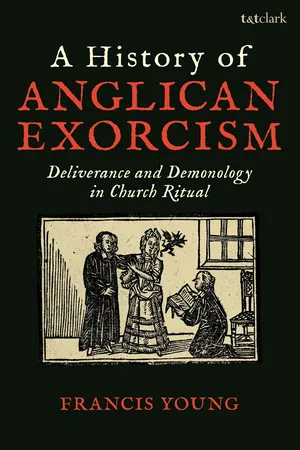
Exorcism is more widespread in contemporary England than perhaps at any other time in history. The Anglican Church is by no means the main provider of this ritual, which predominantly takes place in independent churches. However, every one of the Church of England dioceses in the country now designates at least one member of its clergy to advise on casting out demons. Such `deliverance ministry' is in theory made available to all those parishioners who desire it. Yet, as Francis Young reveals, present-day exorcism in Anglicanism is an unlikely historical anomaly. It sprang into existence in the 1970s within a church that earlier on had spent whole centuries condemning the expulsion of evil spirits as either Catholic superstition or evangelical excess.
This book for the first time tells the full story of the Anglican Church's approach to demonology and the exorcist's ritual since the Reformation in the sixteenth century. The author explains how and why how such a remarkable transformation in the Church's attitude to the rite of exorcism took place, while also setting his subject against the canvas of the wider history of ideas.
- 272 pages
- English
- ePUB (mobile friendly)
- Available on iOS & Android
eBook - ePub
About this book
Information
CHAPTER 1
The Church of England and the Reformation of Exorcism, 1549–1603
The sixteenth-century Church of England enjoyed a paradoxical relationship with exorcism of the demonically possessed. England had no medieval tradition of clerical exorcism, which was introduced for the first time by ministers of the Elizabethan established church in the 1560s. By the 1590s, however, most bishops had turned decisively against the practice of dispossession by prayer and fasting. Bishops made strenuous efforts to suppress godly exorcists such as John Darrell and the controversy over exorcism became intense in the last five years of the reign of Elizabeth I (1598 – 1603). The controversy resulted in the enactment of Canon 72 by the Convocation of Canterbury in 1604, which prohibited any dispossession by prayer and fasting without a licence from the bishop. Although the Canon did not entirely end the practice of exorcism (as will be shown in Chapter 2), it ensured that an anti-exorcistic tradition would dominate the Church of England until the twentieth century.
Thomas Freeman, in his influential study of the Protestant exorcist John Darrell, has argued that the bishops suppressed exorcism ‘because it magnified those aspects of puritan worship which the ecclesiastical authorities most feared – its anti-hierarchical tendencies, its strong sense of communal solidarity and its potential as a vehicle for protest’.1 Keith Thomas claimed that most demoniacs belonged (or had belonged) to the ‘godly’ minority,2 and historians usually describe those Elizabethan clergy who performed exorcisms as puritans, or even ‘presbyterians’.3 Without denying that exorcism mattered to puritans, this chapter challenges the labelling of all Protestant exorcisms in England as puritan per se, since this overlooks the fact that some exorcisms were episcopally authorised. Furthermore, exorcisms often involved whole communities and included people of a variety of theological hues.4 It is important to avoid the circular error of defining exorcists as puritans because exorcism by prayer and fasting was a puritan practice.
Exorcism cannot be written off as a sectarian activity of a puritan ‘church within a church’ inside the Church of England, since the practice enjoyed the support and toleration of senior clergy in the 1560s and 1570s, and sometimes even later. ‘Puritanism’ was not a Christian denomination in the modern sense; indeed, it was not even a coherent movement with a single agreed-upon theology within the Tudor church.5 Not all Protestant exorcists were puritans, and very many puritans opposed exorcism. It is equally misguided to see Richard Bancroft, Samuel Harsnett and their supporters as an ‘Anglican party’6 of sceptics whose views foreshadowed the Enlightenment scepticism that dominated the eighteenth-century Church of England.7 History must not be read backwards, and if the likes of Bancroft and Harsnett were disbelievers in possession and exorcism it was for religious and political (rather than ‘scientific’ or ‘rational’) reasons.
Bishops such as Bancroft defined exorcists and demoniacs as theological deviants, but this does not necessarily mean that exorcism lay outside the mainstream of Elizabethan conformist Protestantism, or that exorcists themselves thought their ministry was subversive. Marcus Harmes’s characterisation of exorcisms as ‘sites of religious contestation between different religious factions vying for power’ is not altogether helpful.8 It is not possible to identify all exorcists and participants in exorcisms as members of a definable ‘faction’, and there is little evidence to suggest that exorcists acted with political motives or wished to seize power from bishops. Rather, in many cases the exorcists simply desired a space within which to continue their ministry.
The place of exorcism in the Elizabethan Church of England was contested from the very beginning, but neither the exorcists nor their opponents could claim a completely decisive victory in either affirming or eliminating exorcism as a legitimate ministry of the church. This chapter advances the argument that, until the late 1590s, exorcism was a mainstream rather than a sectarian phenomenon within the Elizabethan Church of England. Exorcists were interested in bringing the bishops around to their way of thinking rather than wilfully defying them, and exorcisms were a response to popular demand as well as an opportunity for puritans to advance their theological agenda. Indeed, given the prevailing scepticism of Calvinists throughout Europe towards miracles, exorcism by prayer and fasting represented a significant compromise that can be set alongside other Elizabethan compromises with popular religion that, together, created the Church of England’s characteristic via media.
However, as Nathan Johnstone has argued, cultural compromise with an ongoing demand for dispossession is not enough to explain the ‘enthusiasm of many Protestants for exorcism by prayer and fasting’. Dispossession provided an opportunity for a dramatic confrontation with the devil that showcased the resistance to temptation expected of the Calvinist Protestant,9 which was enshrined in the language of the Elizabethan Prayer Book. Exorcism ‘contributed to the rebuilding of the kudos of the ministry on Protestantism’s own terms’, and was much more than just a reaction to the competing challenge of Catholic exorcists.10 The historical puzzle of the last two decades of Elizabeth I’s reign is not why exorcism was so popular and significant to the Church of England, but why the practice was so vehemently opposed by bishops that it did not, in the end, become part of the Church of England’s via media.
THE MEDIEVAL BACKGROUND
No established tradition of clerical exorcism of demoniacs existed in medieval England,11 a fact that makes the flourishing of the practice in post-Reformation England especially remarkable. England experienced for much longer than many other European countries what André Goddu called the ‘crisis of exorcism’, whereby clergy lost confidence in their ability to expel evil spirits from the bodies of the possessed.12 Belief in demonic possession was as strong in England as anywhere else in Christendom, but medieval English demoniacs did not go to priests for liturgical help. Instead, they made pilgrimages to the shrines of saints particularly associated with dispossession or sought access to their relics.
By the end of the fifteenth century the two most popular locations of pilgrimage for demoniacs were St Bartholomew’s Hospital in Smithfield (where pilgrims would sleep at the shrine in the hope of receiving a healing vision of St Bartholomew in their sleep) and the shrine of King Henry VI at Windsor, whom Henry VII made strenuous efforts to have canonised after 1485.13 Several saints were also famous for their supposed exploits as exorcists in their lifetimes, such as St Dunstan and Sir John Schorne, the Buckinghamshire folk-saint who was reputed to have confined the devil in a boot.14 When Jane Wentworth displayed symptoms of possession at the shrine of Our Lady of Grace in Ipswich in 1516, the ecclesiastical dignitaries who visited her made no attempt to exorcise her, and Wentworth eventually claimed to have been freed by the Virgin Mary herself.15
The late medieval church tolerated demoniacs carrying stones and herbs on them as a means of relief,16 and although the rite for the exorcism of a demoniac continued to be copied dutifully into English pontificals throughout the Middle Ages, there is no evidence that it was used. When liturgical exorcisms were deployed they were therapeutic and directed against physical illness, and often involved exorcisms of individual afflicted body parts, a tradition that derived from the Anglo-Saxon church.17 The clergy continued to exorcise infants at baptism, of course, and to exorcise salt, oil and water, but by the late Middle Ages the terms ‘exorcism’ and ‘blessing’ had become virtually synonymous – so much so that when the Lollards attacked the practice of exorcism in the fourteenth century they referred only to the exorcism of things.18 Similarly, the Protestant exile Nicholas Nicastor attacked Catholic exorcism of water and salt in 1554 but made no mention of exorcisms of the possessed.19 In 1547 the physician Andrew Boorde classed the ‘Demoniacus’ with lunatics and maniacs and prescribed no remedy for demoniacs, advising only ‘kepe them in a sure custody’.20
While medieval England had no substantial tradition of clerical exorcism of the possessed, it did have a longstanding tradition of ‘ghost-laying’ by priests, which was a kind of exorcism. Ghost-laying was intimately tied to belief in purgatory and the need to pray for the dead, although early instances were more ‘hands on’ and involved the gruesome physical mutilation of reanimated corpses (revenants).21 Protestant controversialists were persistently puzzled as to why the Reformation failed to eradicate belief in ghosts, which they invariably connected to belief in purgatory.22 Yet a preoccupation with ghosts would remain (and remains) an abiding feature of English popular culture and would go on to have a significant impact on the development of the Church of England’s approach to exorcism.
The almost complete absence of clerical exorcism of the possessed from medieval England meant that there was no tradition of exorcism for sixteenth-century reformers to reject, other than exorcism of objects and dispossession by the power of shrines and relics. Ironically, the end of pilgrimages led to an increased focus on the clergy (as well as other practitioners such as cunning-folk) as a source of deliverance. The Elizabethan clergy enjoyed a prestige as exorcists that their medieval predecessors could only have dreamed of, at a time when the Protestant clergy was seeking a new professional raison d’être.23 The same was also true of Roman Catholic missionary priests in England after the Reformation, who were in high demand as exorcists outside the Roman Catholic community until the late seventeenth century (and in some cases even later).24
In 1585–6 the Jesuit William Weston led the first major campaign of Counter-Reformation-style Roman Catholic exorcisms in the Thames Valley, working with a team of priests to free demoniacs in Catholic recusant households.25 Weston worked with the deliberate intention of proselytising by exorcism until he was captured by the authorities, and the Church of England’s response to exorcism from 1586 onwards must be seen against the background of a perceived threat from Catholic priests prepared to make use of exorcism to prove the superiority of their church. Protestants were forced to choose between playing the Catholics at their own game and rejecting exorcism altogether. However, the dominant anti-Catholic strategy of the established church was to expose Catholic ‘superstition’ as fraud,26 so it was an uphill struggle for Protestant exorcists to convince the bishops they had a place in the church.
EXORCISM AT BAPTISM
Perhaps because it was so marginal in the pre-Reformation church, dealing with exorcism was a low priority for English reformers. This is most clearly evident in the survival of...
Table of contents
- Cover
- About the author
- Title Page
- Dedication
- Contents
- Preface
- Chronology of Key Events
- Introduction
- 1. The Church of England and the Reformation of Exorcism, 1549 – 1603
- 2. Exorcism Marginalised, 1604 – 1852
- 3. Spiritualism and the Return of Exorcism, 1852 – 1939
- 4. The Rise of the Anglican Exorcists, 1939 – 1974
- 5. Anglican Exorcism Normalised, 1975 – 2000
- 6. Anglican Exorcism in the Twenty-First Century
- Appendix: Accessory Material for the Book of CommonPrayer taken from the Danish Church (1711)
- Abbreviations
- Notes
- Bibliography
- Index
- eCopyright
Trusted by 375,005 students
Access to over 1.5 million titles for a fair monthly price.
Study more efficiently using our study tools.
Frequently asked questions
Yes, you can cancel anytime from the Subscription tab in your account settings on the Perlego website. Your subscription will stay active until the end of your current billing period. Learn how to cancel your subscription
No, books cannot be downloaded as external files, such as PDFs, for use outside of Perlego. However, you can download books within the Perlego app for offline reading on mobile or tablet. Learn how to download books offline
Perlego offers two plans: Essential and Complete
- Essential is ideal for learners and professionals who enjoy exploring a wide range of subjects. Access the Essential Library with 800,000+ trusted titles and best-sellers across business, personal growth, and the humanities. Includes unlimited reading time and Standard Read Aloud voice.
- Complete: Perfect for advanced learners and researchers needing full, unrestricted access. Unlock 1.5M+ books across hundreds of subjects, including academic and specialized titles. The Complete Plan also includes advanced features like Premium Read Aloud and Research Assistant.
We are an online textbook subscription service, where you can get access to an entire online library for less than the price of a single book per month. With over 1.5 million books across 990+ topics, we’ve got you covered! Learn about our mission
Look out for the read-aloud symbol on your next book to see if you can listen to it. The read-aloud tool reads text aloud for you, highlighting the text as it is being read. You can pause it, speed it up and slow it down. Learn more about Read Aloud
Yes! You can use the Perlego app on both iOS and Android devices to read anytime, anywhere — even offline. Perfect for commutes or when you’re on the go.
Please note we cannot support devices running on iOS 13 and Android 7 or earlier. Learn more about using the app
Please note we cannot support devices running on iOS 13 and Android 7 or earlier. Learn more about using the app
Yes, you can access A History of Anglican Exorcism by Francis Young in PDF and/or ePUB format, as well as other popular books in Theology & Religion & Christian Denominations. We have over 1.5 million books available in our catalogue for you to explore.