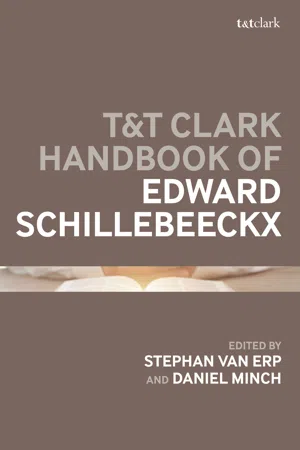
Written by leading experts on both the thought of Edward Schillebeeckx and modern theology, this handbook offers the first comprehensive study of the historical, philosophical, political and theological aspects of Schillebeeckx's work. As one of the most influential Catholic theologians of the twentieth century, he played a key role in the preparations for the theological revolution of the Second Vatican Council and the debates of the post-conciliar era. His engagement with critical theory, hermeneutics, and biblical scholarship culminated in his groundbreaking Christological trilogy, which marked Schillebeeckx as one of the most significant and innovative thinkers of his time.
By building an overview of recent research into Schillebeeckx's writing, the contributors shed new light on his influence and ongoing relevance in contemporary theology. Beginning with the roots of Schillebeeckx's views on metaphysics, spirituality and faith, the essays then move to his work during and after the Second Vatican Council, and then to his engagement with new directions in philosophy and his renewal of classical topics such as creation, theological and soteriological anthropology, and eschatology. Culminating with an analysis of theology and culture, this handbook thoroughly explores the implications of Schillebeeckx's theology for a contemporary readership.
eBook - ePub
T&T Clark Handbook of Edward Schillebeeckx
- 480 pages
- English
- ePUB (mobile friendly)
- Available on iOS & Android
eBook - ePub
T&T Clark Handbook of Edward Schillebeeckx
About this book
Information
Chapter 1
Introducing Edward Schillebeeckx
A Theologian for Our Time
The Flemish Dominican, Edward Cornelis Florent Schillebeeckx, began his life during the German occupation of Belgium in 1914. Neutral Belgium once again became the battlefield of Europe, and the site of some of the most intense fighting as well as the first large-scale poison gas attacks. As a young man, Schillebeeckx joined the Dominican Order and thereby became a part of a long tradition of theology in the Catholic world. He himself contributed greatly to the Catholic theological tradition, especially during and after the Second Vatican Council. He became an internationally renowned scholar, a bestselling author in multiple languages, a controversial flashpoint, and a representative of the Catholic Church in the Netherlands all at once. It is no exaggeration to say that he is one of the most influential Christian thinkers of the twentieth century, and certainly one of the most important post-conciliar Catholic theologians in the world. This is to say that Schillebeeckx is clearly a worthy subject for a T&T Clark Handbook. His theological oeuvre is both broad and deep, and there is an international community of scholars who continue to carry on his work, both explicitly through “Schillebeeckx studies” and implicitly after having been influenced by him. The present is also an opportune time for this volume to appear.
There are two “forerunners” of sorts to this volume, but neither has the same aims nor quite the same scope as what we have brought together here. Most well known, of course, is the revised and expanded second edition of The Praxis of the Reign of God, edited by Mary Catherine Hilkert and Robert J. Schreiter.1 This “Introduction” to Schillebeeckx’s theology has the distinct advantage of bearing Schillebeeckx’s own Imprimatur in the form of a theological prologue.2 It provides eleven chapters that indeed introduce the main themes in Schillebeeckx’s work which were considered most crucial at the time. Second, there is the volume Edward Schillebeeckx and Contemporary Theology, edited by Lieven Boeve, Frederiek Depoortere, and Stephan van Erp.3 This volume markedly contains a brief but inspirational note from Schillebeeckx to the scholars who attended a conference in his honor on December 3–6, 2008.4 He had been too ill to attend himself, and he died just over a year later, on December 23, 2009. Edward Schillebeeckx and Contemporary Theology is less of an overview of Schillebeeckx’s own work than a constructive application of his theological legacy to the contemporary context, such as it was in 2009.
Times change, and so do the needs and interests of theologians. The previous volumes represent the collective efforts of what we can broadly call “first generation” and “second generation” Schillebeeckx scholars. The first generation—represented especially by Erik Borgman and two former holders of the Edward Schillebeeckx Chair at Radboud University Nijmegen, Robert Schreiter and Mary Catherine Hilkert—studied with Schillebeeckx or were also active in the last decades of his scholarly career. The second generation—which includes many notable theologians, including one of the editors of the current volume and current holder of the Schillebeeckx Chair, Stephan van Erp—came of age in the 1990s and early 2000s, during a period when Schillebeeckx’s theological legacy was being called into question or somewhat suppressed by the ecclesial climate of the time. Today, a new generation of Schillebeeckx scholars is just now finding their footing in the world of theology. This “third generation” of young theologians represents both continuity and discontinuity with their mentors and teachers, including Schillebeeckx himself. Like the previous generations, they generally share concern for fundamental theological issues, as well as the environment, the role of women in the church, and the advancement of social liberation for all peoples. However, they have also been shaped by the global War on Terror, the uncertainty of the Great Recession, the ongoing sex abuse crisis and accompanying crises of authority and faith, and now the seemingly global resurgence of xenophobia, racism, and authoritarianism. This volume can certainly not address all of these issues, but we should be aware that these things lay behind and between the lines for many of the authors.
Above all, it is important that this volume represents all three generations of scholarship. Schillebeeckx himself never intended to found a “theological school,” but it appears that one has grown quite organically on its own. It is therefore opportune to include everyone in a conversation about Schillebeeckx’s theology and his relevance for the twenty-first century. This volume seeks to look back at the sources and trends that influenced Schillebeeckx, to carefully examine the content and development of his theology, and to meaningfully point the way toward the future and the ongoing reception of his work. We have been aided in this task by the recent publication by Bloomsbury of the Collected Works of Edward Schillebeeckx series, edited by Ted Schoof and Carl Sterkens with Robert Schreiter and Erik Borgman. The eleven volumes that have been published to date present amended translations of many of Schillebeeckx’s most important works, including his Christology. These updated volumes have given English-speaking scholars a sturdy point of reference for their work, and even newly published material that was previously available only in Dutch.5 Hopefully this series will continue to collect and make Schillebeeckx’s work more widely available in several different formats.
As scholars who stand in the tradition of Edward Schillebeeckx, we also look beyond him to the wider and deeper waters of the Catholic faith tradition. The great Dominican family influenced him, and it is notable that several Dominicans are authors here—from Dominican sisters to lay Dominicans (formerly the “third order”) and young friars. Both lay and religious scholars are represented, as well as scholars of many nationalities working on different continents. The American contingent is quite strong, both because this is a volume aimed at the English-speaking world and because the reception of Schillebeeckx’s work has historically been very extensive in the United States and Canada.
I. A life in church and theology: Edward Schillebeeckx (1914–2009)
Before we turn to the structure and content of this volume, it is important to first speak about who Edward Schillebeeckx was and how he became one of the most important theologians of the modern age.
Edward Schillebeeckx was born on November 12, 1914 in Antwerp, Belgium. He was the sixth child in a large Catholic family of fourteen. In those days, such large families were quite common in Catholic circles, and the church played a central role in the life of the Schillebeeckx family. Even in primary school, young Edward was already an excellent student, and it was decided early on to send him to the Jesuit college and boarding school in Turnhout. For his further education, he chose the Dominicans who, as he put it, were “an order of grace and reason,” and he entered the Dominican friary in Ghent.6 Growing up in such a religious context did not, however, mean that the events in the world passed him by. He had strong views on the role of the church in the world, and, according to his biographer Erik Borgman, these views were actually what drew him to the Dominican Order in the first place. He chose a religious order that saw its role not so much over-against the world, but rather completely in and for the world.7 It is precisely young Edward’s orientation toward the world that caused Borgman to argue that the leitmotiv of his theology was a “theology of culture”—a theology of the world and its history.
Schillebeeckx studied philosophy and theology, a combination that was and still is quite common for seminarians. His philosophical teacher was Dominicus De Petter, the founder of the Tijdschrift voor Filosofie. In those days, De Petter was a well-known philosopher in the Low Countries thanks to his article “Impliciete Intuïtie” in which he confronted neo-Thomist philosophy—at that time still the “official” philosophy of the church—with the modern philosophies of Descartes and Kant.8 De Petter taught Schillebeeckx about classical metaphysics and Thomas’s epistemology, but he also presented these in the context of the philosophical debates on knowledge and the role of the subject conducted by Edmund Husserl and the existentialist philosophers. Schillebeeckx was fascinated by philosophy, in particular that of Thomas Aquinas, and much of his earlier work was of a much more a philosophical nature. Thomas was a vital and indispensable part of the Dominican tradition, and philosophers like De Petter pointed out the need to rid his philosophy of neoscholastic misinterpretations. De Petter was also clear about the need for a modern interpretation of Aquinas. Schillebeeckx played an important part in this effort by writing about Thomas’s philosophy of God, knowledge, and language and, in keeping with Dominican tradition, mainly reading Thomas himself rather than later interpretations of his work.9 In that sense, Schillebeeckx was typical of his age. Theology was undergoing a process of development that could be characterized as both ressourcement and aggiornamento.
This combination of ressourcement and aggiornamento would also determine his approach in his dissertation on Thomas’s doctrine of the sacraments. The subtitle of this rather impressive academic treatise can be translated as “a theological reflection on St. Thomas’s teaching on the sacraments in light of the tradition and contemporary sacramental problematic” (Theologische bezinning op S. Thomas’ sacramentenleer in het licht van de traditie en van de hedendaagse sacramentsproblematiek). The dissertation is a first indication of the main thrust of his later theology: trying to interpret the encounter with God, between tradition and situation.10 Even this dissertation already shows Schillebeeckx’s major talent for being able to first engage in a thorough historical an biblical analysis of the concept of “sacrament” before he moves on to a consideration of the Thomist theology of the sacraments. He then opens the way to the reformation of liturgical praxis that so many longed for in his days. He would elaborate on his insight with regard to the sacraments in his later books on marriage and Christology.11 Schillebeeckx used “sacrament” as the impetus to come to philosophical, theological, and liturgical-practical innovations. He raised important questions, such as the difference between Platonic and Aristotelian interpretations of the sacraments and the historical Incarnation as the foundation for liturgical symbolic acts.
In 1958, Schillebeeckx was appointed as Professor of Dogmatics and the History of Christianity at the Catholic University of Nijmegen in the Netherlands (now Radboud University Nijmegen). This was a period in which the Catholic Church in Flanders and the Netherlands flourished, an age sometimes referred to as “the abundant Roman-Catholic life” (“Het Rijke Roomsche Leven”), an indication of the fact that Catholic identity was still a strong determining factor in the life of ordinary Catholics.
This was also the period in which the church announced that it would take time to reflect on the challenges of the modern age by means of an ecumenical council: the Second Vatican Council (1962–1965). The expectations that many people had for this Council led to a theological enthusiasm which, among other things, moved Schillebeeckx in 1961 to start a new theological journal for Flanders and the Netherlands: Tijdschrift voor Theologie. In the introduction to the very first issue, he wrote: “There is much talk of what is new in Catholic theology these days. This should not baffle us or raise our suspicion. What is meant is not a different theology, but the old theology of the church itself which has possessed itself more strongly of the realities of faith.”12 This first issue also contained a visionary document by the Dutch bishops on the challenges of the Council which they expect would bring an “internal renewal and reformation of catholic life.”13 The document concludes by explicitly mentioning “professor dr. E. Schillebeeckx” and thanking him for his contributions to this text, which are indeed unmistakable. He would go on to play an important role as advisor to the Dutch bishops.14
Eventually, Schillebeeckx would have both words of praise and criticism for the Council. In particular, he praised the church’s openness to the world and the modern age, the importance of scripture as a symbol of the church, the recognition of freedom of religion, and the theological emphasis on salvation for people within history—all of which he believed were important gains. But he was also critical because he feared that the Council would become an excuse to shy away from real and enduring innovations, or that the dogmatic implications of the Council documents would not be examined further. He feared that instead the main emphasis would be given to the “pastoral” aspects of the Council, but in the wrong sense of the word: merely “pastoral” as psychological and consoling. He also suspected that some would abuse the Council documents, and thereby lead to further polarization between progressive and conservative members of the church. He believed that the Council had only been the start of something much larger, and that its documents should really form the basis for the work that had yet to be done. In 1965, together with Karl Rahner, Yves Congar, Hans Küng, and Johann Baptist Metz he founded the international theological journal Concilium to further expand on the ideas of the Council.
Schillebeeckx remained active as the Dutch bishops’ advisor during the Dutch Pastoral Council (1966–1970). The bishops hoped to use this pastoral council to consider the results of the Second Vatican Council and its implications for the Dutch Church. This council would gain national and international notoriety for its discussion on priestly celibacy, particularly when during the final session, it was decided to abandon celibacy. In the Netherlands, this would form the starting point of a far-reaching polarization between progressive and conservative Catholics. From that moment on, Schillebeeckx was seen as an exponent of the progressive side, even though he himself counseled restraint and would always point out the validity of more traditional ideas. As a result of the discussion in church and society, politics became an important subject of his the...
Table of contents
- Cover
- Halftitle Page
- Title Page
- Contents
- Notes on Contributors
- Acknowledgments
- List of Abbreviations
- 1. Introducing Edward Schillebeeckx: A Theologian for Our Time
- Part I: Sources
- Part II: The Second Vatican Council And Its Aftermath
- Part III: Theological Themes
- Part IV: Theology of Culture
- Index
- Imprint
Trusted by 375,005 students
Access to over 1.5 million titles for a fair monthly price.
Study more efficiently using our study tools.
Frequently asked questions
Yes, you can cancel anytime from the Subscription tab in your account settings on the Perlego website. Your subscription will stay active until the end of your current billing period. Learn how to cancel your subscription
No, books cannot be downloaded as external files, such as PDFs, for use outside of Perlego. However, you can download books within the Perlego app for offline reading on mobile or tablet. Learn how to download books offline
Perlego offers two plans: Essential and Complete
- Essential is ideal for learners and professionals who enjoy exploring a wide range of subjects. Access the Essential Library with 800,000+ trusted titles and best-sellers across business, personal growth, and the humanities. Includes unlimited reading time and Standard Read Aloud voice.
- Complete: Perfect for advanced learners and researchers needing full, unrestricted access. Unlock 1.5M+ books across hundreds of subjects, including academic and specialized titles. The Complete Plan also includes advanced features like Premium Read Aloud and Research Assistant.
We are an online textbook subscription service, where you can get access to an entire online library for less than the price of a single book per month. With over 1.5 million books across 990+ topics, we’ve got you covered! Learn about our mission
Look out for the read-aloud symbol on your next book to see if you can listen to it. The read-aloud tool reads text aloud for you, highlighting the text as it is being read. You can pause it, speed it up and slow it down. Learn more about Read Aloud
Yes! You can use the Perlego app on both iOS and Android devices to read anytime, anywhere — even offline. Perfect for commutes or when you’re on the go.
Please note we cannot support devices running on iOS 13 and Android 7 or earlier. Learn more about using the app
Please note we cannot support devices running on iOS 13 and Android 7 or earlier. Learn more about using the app
Yes, you can access T&T Clark Handbook of Edward Schillebeeckx by Stephan van Erp, Daniel Minch, Stephan van Erp,Daniel Minch in PDF and/or ePUB format, as well as other popular books in Theology & Religion & Christian Theology. We have over 1.5 million books available in our catalogue for you to explore.