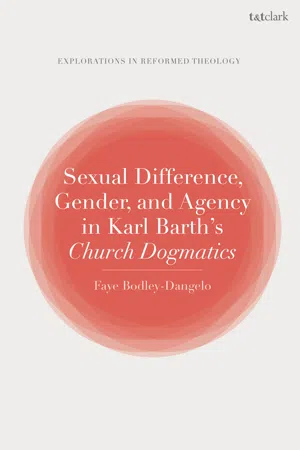
This volume is a critical and constructive analysis of the sexually differentiated self in Karl Barth's Church Dogmatic. It secures in his Christocentric pattern of human agency an untapped resource for unsettling and reimagining the heteropatriarchal structure of human fellowship at the heart of his theological anthropology.
Moving through Barth's doctrines of revelation, creation, theological anthropology, and special ethics, Faye Bodley-Dangelo locates the human agent in his broader project aimed at re-habilitating the subject of modern protestant theology. She argues the human actor comes into view as the recipient of Christ's redemptive activity, which redirects it out of self-aggrandizing isolation and into relationships of dependency, responsiveness, and ethical responsibility to multiple sites of divine and creaturely alterity. The book debates that Barth's model of human agency cannot on its own terms sustain his version of female subordination nor his repudiation of same-sex relationships. Rather, it contains ethically-oriented, critical and reflective mechanisms that resist the sexist heterosexist dimension of his theological anthropology and lend themselves to an anti-essentialist performative account of gender.
eBook - ePub
Sexual Difference, Gender, and Agency in Karl Barth's Church Dogmatics
- 208 pages
- English
- ePUB (mobile friendly)
- Available on iOS & Android
eBook - ePub
Sexual Difference, Gender, and Agency in Karl Barth's Church Dogmatics
About this book
Information
Chapter 1
REHABILITATING THE AGENT OF THEOLOGICAL DISCOURSE
Introduction
In the opening part-volume of Church Dogmatics, its prolegomenon, Barth devotes much labor, often quite subtly, to reorienting his readers on a path toward a fresh hearing of the divine address, that will encounter them if and when it chooses, and usually through the vehicle of Christian witness to Christ. Prescribing and himself enacting this proper orientation, Barth holds up biblical models for his readers to imitate as he guides them through the unlearning of self-aggrandizing epistemic habits inherited from modern Protestant theology. This pedagogical practice continues in future volumes, and in due course we will meet Barth’s models in Mary and Elizabeth, the Good Samaritan, Adam, and, eventually, the ethically vested “I” in its encounter with the sexually differentiated “Thou.”
Barth’s project requires careful self-disciplining work on the part of both dogmatician and readers alike, all of whom Barth imagines as inheritors of theological traditions that are methodologically fixated on anthropology as the starting-point of dogmatic inquiry. For Barth, these traditions present a human agent bereft of the proper object of love and reflection, caught up in the isolation of a circular self-exploration: an agent in need of divine intervention and redirection outward, on a path toward a fresh hearing of the revelatory address of the Word. Barth’s first part-volume outlines a methodology for a dogmatics that would follow this latter path.
In this chapter’s first section, I draw together some themes in Barth’s published lectures on eighteenth- and nineteenth-century Protestant theology and its philosophical influences. Produced around the time Barth was writing Church Dogmatics I/1, the published lectures are directed at the epistemic and methodological hubris that Barth finds endemic to Protestant liberal theology. Barth’s criticisms of this theology propel the rehabilitative work he attempts on his readers and himself in Church Dogmatics I, to which the second section turns. As we shall see, Barth robs the human agent of any inherent capacity for theological speech by casting it in complete dependency upon the gracious decision of the divine Word to reveal itself to humanity and to empower human words to witness faithfully to it. Humility and hope emerge as the driving virtues of the ceaseless epistemic, discursive movement that is the dogmatic project, supplanting the hubris and self-sufficiency that propel many modern theological ventures. Biblical authors and characters in particular serve to model the proper orientation toward God and others. In the third section, correspondingly, I turn to Barth’s use of the figures of Mary and Elizabeth (Luke 1) as exemplary hearers of and witnesses to the divine address, and precisely as such, models for the proclamatory work of preaching and theologizing.
Bad epistemic habits of the modern subject
Barth’s critique of modern Protestant theological trajectories (arising from Schleiermacher and Hegel, in particular) provides a backdrop against which the rehabilitative dimensions of Barth’s dogmatic project are more readily discernible.1 In his lectures on nineteenth-century Protestant theology, he laments the self-aggrandizing epistemic fantasies of autonomy and self-sufficiency that drive these theological quests for knowledge of divine and creaturely others.
The concern driving much of Barth’s critique relates to the divine prerogatives these theologians assume for themselves when securing in human faculties the capacity for the knowledge and experience of God. What Barth finds to be missing is an understanding of divine revelation as a confrontation from without—an encounter with an objectively given, divine Other, that humbles and limits a self all too inclined toward delusions of grandeur and mastery. When human faculties are attributed capacities that a proper Protestant theology should attribute to divine revelation alone, the human being becomes the central object of study and reflection, and theology becomes anthropology. Equipped with such capacities, these theologians thus assume an impossible vantage point from which to assess the movement of God within history, the relationship between history and the certainty of religious faith, the relationship between philosophy and theology, the relationship between Christianity and other religions, and so forth. They attempt to teach themselves, by way of their own resources, that which God alone can teach and make known: the nature of God and all that God has created.
Different versions of this critique appear throughout Barth’s lectures on philosophers and theologians of the eighteenth and nineteenth centuries. I am particularly interested in the general shape this critique takes in Barth’s reading of the constraints that Kant’s philosophy places upon the academically respectable Protestant theologies that followed.
In Kant’s philosophy Barth finds the self-chastening production of an Enlightenment confidence that is both humbled and emboldened by the critical exercises wherein reason comes to an understanding of itself and of the limits within which it may justifiably operate (PT, 269–71). The humility of these exercises conceals conceit, for there is no place in Kant’s philosophy for a construal of revelation under the terms Barth would have it: Kant provides no means of accounting for the reality and possibility of revelation and so refrains from any attempt at such an account (PT, 309). Theoretical reason possesses no empirical criterion by which to recognize God via sense perception, no criterion that can grant certainty that what is experienced is not illusory. Consequently, theoretical reason can admit no place for an objectively given, divine Other confronting the self from without. Practical reason assumes the role of the divine actor in the revelatory event, as it generates its own inner law and criterion by which to measure and discern right from wrong, and by which to evaluate the concrete empirical phenomena of religion in the context of the philosophy of religion (PT, 283, 304).
Such a philosophy of religion will peruse biblical texts for any claims that correspond to reason’s own workings (PT, 304), while recognizing Jesus as a human ideal of moral perfection insofar as he corresponds to reason’s production of an archetypal ideal of a human being who is pleasing to God (PT, 288). Reason thus provides its own resources by which to evaluate Scripture and religion; it needs no confrontation and reorientation from without. There is no place in this philosophy for a divine revelation that puts the human being’s judgments into question, rendering them objects of divine judgment. So Barth writes, “The true miracle of revelation, or, at least, what is the highest degree to be wondered at in the founding of the religion of reason is—reason itself in its own eyes, as moral reason” (PT, 283).
Theologians in the trajectory of Schleiermacher accept the constraints Kant sets for a philosophically sophisticated construal of religion, but they negotiate for theology the basis for an immediate knowledge of God by way of a third a priori capacity, alongside theoretical and practical reason. In religious experience, encapsulated in the feeling of absolute dependence, they secure an innate universal human consciousness of God, the historical reference point of which is the figure of Jesus. Irreducible to knowledge and action, the “feeling of absolute dependence” becomes the proper object of theological reflection, and with it religious experience itself (PT, 253–4, 306, 316, 433–9, 457–73). For Schleiermacher and his followers, then, “Christian pious self-awareness contemplates and describes itself: that is in principle the be-all and end-all of this theology” (PT, 457).
Again Barth foregrounds the hubris he finds in theologians along this trajectory: “He is as certain of his power over himself as he is certain of himself, and he is quite extraordinarily certain of himself” (PT, 572). This theologian ascends to his “lofty watchtower” (PT, 576), as “the born surveyor of the world, who can put everything neatly in its place” (PT, 573). He postures as “a complete master of Christianity, in a position, as it were, to look into it from above … able to elicit its nature and assess its value” and, with an artistic freedom, to shape and sculpt it in order to let it stand in compatible relationship to the progress of science (PT, 446). From this vantage point the theologian is confident that his own theology falls under the providential guidance that he discerns for himself in the development of doctrine throughout history (PT, 572). But such an epistemic vantage point can only be “a splendid illusion or figment of the imagination,” Barth declares (PT, 574).
In comparison to Schleiermacher’s immediacy of feeling, Barth admits his preference for Hegel’s emphasis upon the relationship between thinking and truth (PT, 415), and Hegel’s depiction of the human subject as, above all, a thinking being (PT, 396), a developing history, a continual reconstruction of itself anew in a dialectical movement (PT, 400). In this movement, Barth writes,
reason, truth, concept, idea, mind, God himself are understood as an event, and, moreover, only as an event. They cease to be what they are as soon as the event, in which they are what they are, is thought of as interrupted … God is God only in his divine action, revelation, creation, reconciliation, redemption … He is a graven image as soon as he becomes identified with one single moment, made absolute, of this activity. And reason, likewise, is unreason as soon as the process in which it is reason is thought of at any stage as something stationary, when any of the moments of its motion is identified with reason itself. (PT, 398–9)
To catch sight of the object of Hegel’s thought one has to move with it, for taking a snapshot would be an inadequate approach: a “moving film” is a better metaphor (PT, 399–400). If theology is to take anything from Hegel, Barth suggests, it will be this notion of the self and God as a history, a movement. We shall see, in due course, that in his own Church Dogmatics Barth imagines a model human agent always in motion, on its way toward an encounter with a God who is always in motion.
In Barth’s view, Hegel and his followers share the hubris of the Kantian and Schleiermachian trajectories of theology. Reason is construed as a dynamic dialectical process in which the thinking subject is identical with that which is thought, in the very performance of the act of thinking itself, and so the movement of reason comes to be identified with the God who is thought. Confidence in human thinking is therefore confidence in God, and vice versa (PT, 391). In Hegel, then, “we have a man who absolutely and undeviatingly believes in himself, who can doubt everything because he does not for a moment doubt himself, and who knows everything for the simple reason that he has complete trust in his own self-knowledge” (PT, 391). If the theologian is to appropriate this construal of reason from Hegel, “the self-movement of truth would have to be detached from the self-movement of man … to be justly regarded as the self-movement of God,” and would need to be represented instead as the act, movement, and event that interrupts an individual’s own movement of thought from without (PT, 419).
With these caricatures Barth secures the foil for a dogmatic project undertaken within the ecclesial sphere of would-be hearers of a revelatory Word that speaks (if and when it pleases) through the witness to Christ in Scripture and proclamation.2 No external and neutral epistemic vantage point is permitted the theologian who must first be taught and judged by the Word. Self-certainty must be replaced with humility and hope: with the humbling awareness that the self brings no constructive resources to the revelatory event—that God can only be known if and when God freely decides to speak; yet with the hopeful assurance that God, to whom ecclesial discourse bears witness, is eager to speak and be known. As we shall see, the shadow of this arrogant, self-centered subject of modern theology haunts Barth’s ongoing dogmatic efforts to humble and reorient his readers with various biblical depictions of the properly humbled and hopeful normative agent.
The humbled and hopeful doer of theology
Disentangling revelation from the human subject
Barth’s first part-volume of Church Dogmatics prescribes a dogmatic methodology meant to undermine the epistemic vantage point and hubris of these liberal Protestant trajectories. It attempts this by disentangling the self-revelation of God (as sole criterion of theological reflection) from the resources and capacities of the theologian and thereby locating the criterion of dogmatic reflection outside the human subject (I/1, 206–7).3 A theology benefiting from the Reformation’s renewal, Barth argues, is one that begins with the Word of God (God’s self-revelation) as the criterion by which it pursues the task of evaluating Christian discourse, and especially ecclesial proclamation. The proper object of theological reflection is not, then, the human subject and its operations but God in God’s objectivity, as revealed from beyond the self’s faculties and productions. The human subject will come into view only indirectly when the dogmatician is properly oriented.
Barth construes the source of revelation as an event detached from the operations of the human subject, a confrontation with the incarnate second person of the Trinity, whose life, death, and resurrection make God known and who witnesses to human beings in the present. God’s immediate self-knowledge, hidden in the inter-trinitarian life, becomes only indirectly knowable, first in the existence of Jesus Christ and, today, in Scripture’s witness to Christ and in the Church’s proclamation of that witness. It is a knowledge acquired only if the Holy Spirit intervenes to enable a recognition of the Word concealed in the medium of human words (II/1, 15–20; 197–9). As such, revelation is a divine address, originating beyond the sphere of human subjectivity, imposing upon the human self, interrupting that self’s epistemic operations by giving rise to a humanly impossible knowledge of a God who cannot be conflated with the knowing and experiencing self.4
With revelation so construed, Barth robs would-be hearers of the divine address of the capacity to control or manipulate the knowledge of God. For while the divine address comes to the hearer in the vehicle of language, it is not identical to that language. The revelatory Word retains its freedom to choose the speech through which it becomes present, and the Word is not bound by or to the wording of any such choice. Human language is not identical with the spoken Word (II/1, 139). Through the enabling of the Holy Spirit the writers of Scripture gave witness to Christ, prophetically in the Old Testament and through recollection in the New Testament. Likewise, only through the enabling of the Holy Spirit can individuals today hear the Word in this witness and themselves give witness (II/1, 15–20, 181). The hearer of the Word in human words cannot, then, grasp or possess the presence of this promised one, but can only respond in recollection and anticipation. Reflecting the anticipation of the Old Testament witness and the recollection of the New Testament, the would-be hearer of the Word moves ever forward, from and to a fresh hearing of the Word (I/1, 141).
In this account of revelation, we hear echoes of what Barth appreciates in Hegel:
[Theology] could let itself be reminded by Hegel that the source of knowledge of Reformation theology, at all events, had been the Word of God, the word of truth. But this also means, the event of God, the event of truth. An event that comes and goes, like a passing thunder-shower (Luther), like the angel at the pool of Bethesda, an event at which the man for whom it is to be an event must be present; an event, which by repetition, and by man’s renewal of his presence, must ever become event anew. (PT, 416; italics added)
Any thought or speech to which the hearing of the Word might give rise (theological discourse included) cannot, then, be confused with the speaking of the Word.
As the consequence of God’s free decision to make Godself known in such discrete concrete moments of encounter, the knowledge of God will humble and reorient the hearer. It will turn the hearer from judge to the one who is judged, from self-taught to one who must be taught again and again. Revelation’s content
will always be an authentic and definitive encounter with the Lord of man, a revelation which man cannot achieve himself, the revelation of something new which can only be told him. It will also be the limitation of his existence by the absolute “out there” of his Creator, a limitation on the basis of which he can understand himself only as created out of nothing and upheld over nothing. It will also be a radical renewal and therewith an obviously radical criticism of the whole of his present existence, a renewal and a criticism on the basis of which he can understand himself only as sinner living by grace and therefore as a lost sinner closed up against God on his side. Finally it will be the presence of God as the One who comes, the Future One in the strict sense, the eternal Lord and Redeemer of man, a presence on the basis of which he can understand himself only as ha...
Table of contents
- Cover
- Halftitle Page
- Title Page
- Dedication Page
- Contents
- Acknowledgments
- Introduction
- Chapter 1. Rehabilitating the Agent of Theological Discourse
- Chapter 2. Playing the Neighbor in an “Order of Praise”
- Chapter 3. Reorienting the Agent in the Doctrine of Creation
- Chapter 4. Playing Adam and Silencing Eve
- Chapter 5. Reorienting the Agent of a Theological Anthropology
- Chapter 6. An Ethic for the Sexually Differentiated Self
- Conclusion
- Bibliography
- Index
- Imprint
Trusted by 375,005 students
Access to over 1.5 million titles for a fair monthly price.
Study more efficiently using our study tools.
Frequently asked questions
Yes, you can cancel anytime from the Subscription tab in your account settings on the Perlego website. Your subscription will stay active until the end of your current billing period. Learn how to cancel your subscription
No, books cannot be downloaded as external files, such as PDFs, for use outside of Perlego. However, you can download books within the Perlego app for offline reading on mobile or tablet. Learn how to download books offline
Perlego offers two plans: Essential and Complete
- Essential is ideal for learners and professionals who enjoy exploring a wide range of subjects. Access the Essential Library with 800,000+ trusted titles and best-sellers across business, personal growth, and the humanities. Includes unlimited reading time and Standard Read Aloud voice.
- Complete: Perfect for advanced learners and researchers needing full, unrestricted access. Unlock 1.5M+ books across hundreds of subjects, including academic and specialized titles. The Complete Plan also includes advanced features like Premium Read Aloud and Research Assistant.
We are an online textbook subscription service, where you can get access to an entire online library for less than the price of a single book per month. With over 1.5 million books across 990+ topics, we’ve got you covered! Learn about our mission
Look out for the read-aloud symbol on your next book to see if you can listen to it. The read-aloud tool reads text aloud for you, highlighting the text as it is being read. You can pause it, speed it up and slow it down. Learn more about Read Aloud
Yes! You can use the Perlego app on both iOS and Android devices to read anytime, anywhere — even offline. Perfect for commutes or when you’re on the go.
Please note we cannot support devices running on iOS 13 and Android 7 or earlier. Learn more about using the app
Please note we cannot support devices running on iOS 13 and Android 7 or earlier. Learn more about using the app
Yes, you can access Sexual Difference, Gender, and Agency in Karl Barth's Church Dogmatics by Faye Bodley-Dangelo in PDF and/or ePUB format, as well as other popular books in Theology & Religion & Christian Theology. We have over 1.5 million books available in our catalogue for you to explore.