Jan A. Sigvartsen seeks to examine the immense interest in life after death, and speculation about the fates awaiting both the righteous and the wicked, that proliferated in the Second Temple period. In this volume Sigvartsen explores the Apocrypha and the apocalyptic writings in the Pseudepigrapha. He identifies the numerous afterlife and resurrection beliefs and presents an analysis that enables readers to easily understand and compare the wide-ranging beliefs regarding the afterlife that these texts hold.
A careful reading of these resurrection passages, including passages appearing in Sirach, Maccabees, the Sibylline Oracles and the Ezra texts, reveals that most of the distinct views on life-after-death, regardless of their complexity, show little evidence of systematic development relational to one another, and are often supported by several key passages or shared motifs from texts that later became a part of the TaNaKh. Sigvartsen also highlights the factors that may have influenced the development of so many different resurrection beliefs; including anthropology, the nature of the soul, the scope of the resurrection, the number and function of judgments, and the final destination of the righteous and the wicked. Sigvartsen's study provides a deeper understanding of how the "TaNaKh" was read by different communities during this important period, and the role it played in the development of the resurrection belief – a central article of faith in both Christianity and Rabbinic Judaism.
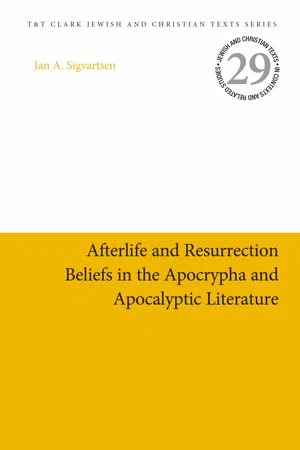
eBook - ePub
Afterlife and Resurrection Beliefs in the Apocrypha and Apocalyptic Literature
- 328 pages
- English
- ePUB (mobile friendly)
- Available on iOS & Android
eBook - ePub
Afterlife and Resurrection Beliefs in the Apocrypha and Apocalyptic Literature
About this book
Information
Chapter 1
INTRODUCTION
The Hebrew Scriptures reflect little regarding the destiny of the individual after their death. The overall impression from a study of TaNaKh1 passages relating to the afterlife is that death was not considered the start of the next life, but the end of the present one.2 The biblical writers focused on the present life and emphasized the covenant relationship between humans and God. Matthew Suriano suggests that “with the exception of Dan 12:1-3, which dates to a late stage in the Hebrew Bible’s history, there is no vetting of the dead. Instead the afterlife ideal is presented as reunion with dead kind” as illustrated in Gen. 15:15-16.3 He observes “that the concept of death was centered specifically on the treatment of the dead rather than their destiny. Death, in the world of the Old Testament writers, was a dynamic process…rather than a static event.” Thus, he argues “death as transition and the relational nature of the dead” are interconnected aspects. He writes: “In ancient Israel, early Judaism, and the Hebrew Bible, the transition of the dead did not involve the migration of an immortal soul to some otherworldly destination. It was not a question of place – heaven or hell – but of status. The biblical ideal was the status of ancestor, which provided the dead with a certain form of immortality. But his status was conditioned upon how the living interacted with the dead; hence, death was relational.”4 Suriano considers the introductory statement (Sir. 44:7-15) to the list of biblical heroes (Sir. 44:1–49:16) written by Yeshua ben Sira (second century BCE), a scribe from Jerusalem, to summarize this biblical ideal.5 It describes those who are forgotten, those who do not have a name which lives on past their death, those who seem to have “perished as though they have never existed” (Sir. 44:10), noting that they are still a part of the greater collective, thereby receiving a sense of immortality in the same manner as those who received the deity’s reward of “offspring and the blessedness of future generations.”6 Sirach 44:7-15 (NRS) reads:
7All these were honored in their generations, and were the pride of their times. 8Some of them have left behind a name, so that others declare their praise. 9But of others there is no memory; they have perished as though they had never existed; they have become as though they had never been born, they and their children after them. 10But these also were godly men, whose righteous deeds have not been forgotten; 11their wealth will remain with their descendants, and their inheritance with their children’s children. 12Their descendants stand by the covenants; their children also, for their sake. 13Their offspring will continue forever, and their glory will never be blotted out. 14Their bodies are buried in peace, but their name lives on generation after generation. 15The assembly declares their wisdom, and the congregation proclaims their praise.
The close of the First Temple period and the return of the Jews from Babylonian exile heralded much more exploration of the issues of the afterlife among the Jews during the Second Temple period. Scholars argue that increased interest in angels, the battle between good and evil, and the interest in a future bodily resurrection and judgment as seen in these Jewish writings, could be due to the influence of the Zoroastrian religion of the Persians. The belief in an immortal soul, which exists separately from the physical body after the moment of death, could be viewed as a part of the Hellenization of Judaism. It was also during this period that the problem of theodicy became more apparent for the Jews. The traditional belief that God would reward the righteous, Torah-observant Jews with a long and prosperous life while cutting short the life of the wicked needed adjustment. This was a period of foreign occupation and oppression; oppression of the righteous poor, religious persecution, and martyrdom. For the Torah-observant Jews, justice had been perverted: the righteous were receiving the curses of the wicked, while the wicked enjoyed the blessings promised the righteous. Only a belief in an afterlife could solve this acute problem. If there was an afterlife, it was argued, God could set things straight and give the righteous and the wicked their proper due.
The Jews of the Second Temple period borrowed religious and philosophical concepts from Persia and Greece and synthesized and amalgamated these views into their own religious framework. Thus, multiple afterlife beliefs developed and appeared in their literature, in an attempt to solve the problem of theodicy. By the end of this period, a belief in a bodily resurrection had become the mainstream belief in both surviving str...
Table of contents
- Cover
- Title Page
- Copyright
- Dedication
- Contents
- Acknowledgments
- List of Abbreviations
- Figures
- Tables
- Our Perennial Yearning for Postmortem Existence or Resurrection
- Foreword
- Chapter 1: Introduction
- Chapter 2: Testaments (Often with Apocalyptic Sections)
- Chapter 3: Expansions of Stories and Legends
- Chapter 4: Wisdom and Philosophical Literature
- Chapter 5: Prayers, Psalms, and Odes
- Chapter 6: The Posthumous Body and the Soul
- Chapter 7: Summary and Conclusion
- Appendix A: Classification and Anthology of Resurrection Texts
- Appendix B: Resurrection Passages in Qumran, Josephus, New Testament, and Early Rabbinic Judaism
- Bibliography
- Index of References
- Index of Authors
Trusted by 375,005 students
Access to over 1.5 million titles for a fair monthly price.
Study more efficiently using our study tools.
Frequently asked questions
Yes, you can cancel anytime from the Subscription tab in your account settings on the Perlego website. Your subscription will stay active until the end of your current billing period. Learn how to cancel your subscription
No, books cannot be downloaded as external files, such as PDFs, for use outside of Perlego. However, you can download books within the Perlego app for offline reading on mobile or tablet. Learn how to download books offline
Perlego offers two plans: Essential and Complete
- Essential is ideal for learners and professionals who enjoy exploring a wide range of subjects. Access the Essential Library with 800,000+ trusted titles and best-sellers across business, personal growth, and the humanities. Includes unlimited reading time and Standard Read Aloud voice.
- Complete: Perfect for advanced learners and researchers needing full, unrestricted access. Unlock 1.5M+ books across hundreds of subjects, including academic and specialized titles. The Complete Plan also includes advanced features like Premium Read Aloud and Research Assistant.
We are an online textbook subscription service, where you can get access to an entire online library for less than the price of a single book per month. With over 1.5 million books across 990+ topics, we’ve got you covered! Learn about our mission
Look out for the read-aloud symbol on your next book to see if you can listen to it. The read-aloud tool reads text aloud for you, highlighting the text as it is being read. You can pause it, speed it up and slow it down. Learn more about Read Aloud
Yes! You can use the Perlego app on both iOS and Android devices to read anytime, anywhere — even offline. Perfect for commutes or when you’re on the go.
Please note we cannot support devices running on iOS 13 and Android 7 or earlier. Learn more about using the app
Please note we cannot support devices running on iOS 13 and Android 7 or earlier. Learn more about using the app
Yes, you can access Afterlife and Resurrection Beliefs in the Apocrypha and Apocalyptic Literature by Jan Age Sigvartsen in PDF and/or ePUB format, as well as other popular books in Theology & Religion & Biblical Studies. We have over 1.5 million books available in our catalogue for you to explore.