eBook - ePub
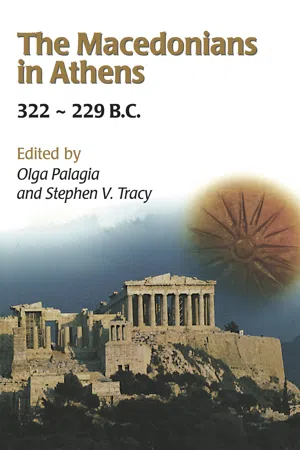
The Macedonians in Athens, 322-229 B.C.
Proceedings of an International Conference held at the University of Athens, May 24-26, 2001
- 272 pages
- English
- ePUB (mobile friendly)
- Available on iOS & Android
eBook - ePub
The Macedonians in Athens, 322-229 B.C.
Proceedings of an International Conference held at the University of Athens, May 24-26, 2001
About this book
For a century following the end of the Lamian War in 322 B.C., Athens' harbour at Pireus was almost constantly occupied by a Macedonian garrison. The Macedonian presence dealt a crucial blow to Athenian independence and Athenian democracy, initiating the first in a long and intermittent series of foreign occupations. The twenty-eight papers in this volume are based on an international conference hosted by the University of Athens in May 2001, and focus on various aspects of Athenian art, archaeology and history in the century of Macedonian domination. They consider Athens' new role as a political stepping stone for potential Successors to the throne of Macedon - Cassander, Demetrios Poliorketes and Antigonos Gonatas were each able to secure Macedonia by using Athens as a power base - and the ways in which Athenian culture was affected by the Macedonian presence. They contribute to the ongoing debate about the reasons for the Macedonian ascendancy, the degree of independence accorded Athens by their Macedonian overlords, the third-century archon list, and changes in Athenian art and architecture.
Information
Subtopic
Greek Ancient HistoryIndex
Social SciencesTradition and innovation: portraits and dedications on the early Hellenistic Akropolis
Ralf von den Hoff
“[In Athens] you will see the most beautiful sights on earth:[...] a magnificent temple of Athena, something out of this world and worth seeing, the so-called Parthenon, which lies above the theatre; it makes a great impression on sightseers.”
Herakleides 1.1 (third century B.C.)1
Studying cultural change in ancient societies requires looking not only for the historical or artistic record, but also for cultural context: for focal points of identity construction and cultural practice, such as were provided by sanctuaries in ancient Greece. The manner in which heterogeneous objects were dedicated and viewed together, and the appearance of the sanctuary as a whole can be taken as records of specific interests and patterns of behaviour and of the historical conditions that created them. In this sense, the Athenian Akropolis was always taken as a visible manifestation of the classical period of Athens in the fifth century B.C. However, its history after the death of Alexander the Great should be of more interest than recent studies suggest.2 What was happening in Athens’ most important sanctuary and what were the Athenians’ interests concerning it during the Macedonian occupation? The existing epigraphical, literary and sculptural evidence of this period has not been studied together as a record of cultural change up to now. My purpose is to do so and to develop some broader ideas concerning the significance of the Akropolis for the Athenians after 323 and into the third century. Because of the fragmentary nature of our records, the results will be preliminary and are to be understood as nothing more than a basis for further discussion. I will focus on two aspects: dedications and portrait statues on the Akropolis.
The Panathenaia – Athens’ most important festival connected to the Akropolis – seem to have provided a prime occasion for foreign rulers to demonstrate their status and piety in early Hellenistic times. Bearing witness of this are Lysimachos’ (IG II2 657 ll. 14–16)3 and Ptolemy II’s (SEG 28.60 ll. 66–70)4 donations of equipment for the Panathenaic ship, as well as the fact that images of Demetrios and Antigonos were by decree woven into Athena’s Panathenaic peplos alongside the gods shortly after 306 (Plut. Demetr. 12.2–4; Diod. 20.46).5 Thus, foreign kings were indirectly included in the traditional cult affairs of the polis. During the same period, rulers were active in the Akropolis cults as well. The sacrifice of Pyrrhos to Athena Polias in 287/6, after Athens’ liberation from Demetrios Poliorketes (Plut. Pyrrh. 12.4), was a symbolic act of reverence to the polis goddess.6 Other instances of this were armour dedications. After 334 Alexander dedicated 300 panoplies “captured from the barbarians who inhabit Asia” (Arr. Anab. 1.16.7) to Athena. Plutarch only mentions 300 shields (Plut. Alex. 16.17), but it is far from certain that they were attached to the east architrave of the Parthenon, as has often been suggested. However, the dowel holes in this architrave can be taken as tokens of similar votives, though not dated precisely.7 In 318, Alexander’s namesake, the son of Polyperchon, who had just ‘liberated’ Athens, dedicated a ceremonial panoply to Athena (IG II2 1473 ll. 6–8).8 Finally, the golden shields Lachares removed (Paus. 1.25.7) must have been parts of similar dedications, while the 1,200 suits of armour donated by Demetrios Poliorketes (Plut. Demetr. 17.1) were probably actual military equipment.9 For Alexander, the dedication of barbarian weapons had certainly been a gesture of acknowledgement of the Athenian victories over the Persians: not only a reverence for tradition but also a token of his unchallenged legacy.10 On the other hand, the role of some dedicants as liberators seems to have been important, as it must have been for Pyrrhos’ sacrifice. It appears that the foreign rulers’ claims to be Athens’ liberators were often underlined by armour dedications or sacrifices on the Akropolis. Furthermore, giving armour to Athena was in keeping with an old-fashioned trend in dedications,11 avoiding nontraditional patterns of behaviour. The Akropolis seems to have served as a focal point for the advertisement of ruler interests in traditional patterns, and so did the Panathenaia.
So far as Athenian activities are concerned, we know that the tamiai ordered silver vessels to be crafted for the Akropolis from recycled material in 321/0, 320/19 and 314/3, possibly also in 318/7, 311/0 and 307–304.12 Gold phialai were produced from a 1% tax collected by the archon of the previous year in 320/19.13 The boule dedicated a silver kanoun in 318/7.14 All these activities pursued old practices and Lykourgan interests, and it is not astonishing that Lykourgos was honoured in 307 for his diligence in preserving the kosmos of the Akropolis.15 Nevertheless, the nearly annual dedications by public institutions after 323 are a sign of sustained interest in it. Inscriptions on the objects named the source of the material, the artist and the dedicant. This practice became widespread possibly in order to demonstrate the democratic character of the procedure (and so did the inventories).16 Hence, in the late fourth century, the Athenians tried to maintain ‘business as usual’ so far as the Akropolis cult was concerned. The regular examination of the Athena Parthenos,17 the interest to maintain the regularity of the Panathenaia, the Athenians’ active engagement in the festival in addition to the above mentioned ruler activities18 and the resumption of published inventories of the Akropolis treasures around 240/3019 point in the same direction.
But what about the images on view inside the sanctuary? First of all: what about the presence of royal portraits, which could underline the kings’ interest in self-presentation or Athens’ gratitude towards them? This practice is attested in other Greek sanctuaries20 and in the Athenian Agora, where, among others, honorary statues of Lysimachos (Paus. 1.9.4), Pyrrhos (Paus. 1.11.9), Seleukos I (Paus. 1.16.1), Demetrios21 and Antigonos (SEG 25.149; Diod. 20.46.2) were set up.22 But we have no certain evidence for Hellenistic royal portraits on the third-century Akropolis.23 It seems unlikely that this lack could be due to a loss of records, because actually some statues are known, but they are ‘late-comers’, after 229. The earliest ones are the pillar monuments of the Attalids.24 The lack of royal portraits – both honorary and votive – is astonishing. It is possible that early Hellenistic kings studiously refrained from dedicating their own portraits on the Akropolis, thus respecting traditional patterns of behaviour and the monument of Athens’ past. But it seems to be more likely that the Athenians themselves tried to keep statues of kings out of Athena’s sanctuary.
In this context, it is revealing to look at portrait dedications by Athenians. So far as honorary statues are concerned, that is, statues dedicated by the demos or the boule, the images of Demetrios of Phaleron and of Olympiodoros are the only ones on the early Hellenistic ...
Table of contents
- Cover
- Title
- Copyright
- Contents
- Preface
- Program of the Conference
- Peter Green: Occupation and co-existence: the impact of Macedon on Athens, 323-307
- Robert Lamberton: Plutarch’s Phocion: melodrama of mob and elite in occupied Athens
- Brian Bosworth: Why did Athens lose the Lamian War?
- Elizabeth Baynham: Antipater and Athens
- Patrick Wheatley: Lamia and the Besieger: an Athenian hetaera and a Macedonian king
- Emmanuel Microyannakis: Aristotle and Alexander: on the gradual deterioration of their relationship
- Graham J. Oliver: Oligarchy at Athens after the Lamian War: epigraphic evidence for the Boule and the Ekklesia
- Christian Habicht: Athens after the Chremonidean War: some second thoughts
- Stephen V. Tracy: Antigonos Gonatas, King of Athens
- Ioanna Kralli: The date and context of divine honours for Antigonos Gonatas – a suggestion
- Michael J. Osborne: Shadowland: Athens under Antigonos Gonatas and his successor
- Kevin Clinton: Macedonians at Eleusis in the early third century
- Manuela Mari: Macedonians and anti-Macedonians in early Hellenistic Athens: reflections on ἀσέβεια
- Rhys F. Townsend: The Philippeion and fourth-century Athenian architecture
- Bonna D. Wescoat: Athens and Macedonian royalty on Samothrace: the Pentelic connection
- Carol L. Lawton: Athenian anti-Macedonian sentiment and democratic ideology in Attic document reliefs in the second half of the fourth century B.C
- Iphigeneia Leventi: Παρατηρήσεις στα αττικά αναθηµατικά ανάγλυφα του ύστερου 4ου και πρώιµου 3ου αι. π.Χ
- Olga Palagia: The impact of Ares Macedon on Athenian sculpture
- Hans R. Goette: Cape Sounion and the Macedonian occupation
- Petros Themelis: Macedonian dedications on the Akropolis
- Ralf von den Hoff: Tradition and innovation: portraits and dedications on the early Hellenistic Akropolis
- Peter Schultz: Kephisodotos the Younger
- Thomas M. Brogan: Liberation honors: Athenian monuments from Antigonid victories in their immediate and broader contexts
- John H. Kroll: The evidence of Athenian coins
- Susan I. Rotroff: Minima macedonica
- Dyfri Williams: Gilded pottery and golden jewellery
- Stephi Korti-Konti: Allusions to mythological sites in Macedonia in the vase-painting of the late fourth century B.C., the satirical drama and Aristotle
- Judith M. Barringer: Panathenaic Games and Panathenaic amphorae under Macedonian rule
Trusted by 375,005 students
Access to over 1.5 million titles for a fair monthly price.
Study more efficiently using our study tools.
Frequently asked questions
Yes, you can cancel anytime from the Subscription tab in your account settings on the Perlego website. Your subscription will stay active until the end of your current billing period. Learn how to cancel your subscription
No, books cannot be downloaded as external files, such as PDFs, for use outside of Perlego. However, you can download books within the Perlego app for offline reading on mobile or tablet. Learn how to download books offline
Perlego offers two plans: Essential and Complete
- Essential is ideal for learners and professionals who enjoy exploring a wide range of subjects. Access the Essential Library with 800,000+ trusted titles and best-sellers across business, personal growth, and the humanities. Includes unlimited reading time and Standard Read Aloud voice.
- Complete: Perfect for advanced learners and researchers needing full, unrestricted access. Unlock 1.5M+ books across hundreds of subjects, including academic and specialized titles. The Complete Plan also includes advanced features like Premium Read Aloud and Research Assistant.
We are an online textbook subscription service, where you can get access to an entire online library for less than the price of a single book per month. With over 1.5 million books across 990+ topics, we’ve got you covered! Learn about our mission
Look out for the read-aloud symbol on your next book to see if you can listen to it. The read-aloud tool reads text aloud for you, highlighting the text as it is being read. You can pause it, speed it up and slow it down. Learn more about Read Aloud
Yes! You can use the Perlego app on both iOS and Android devices to read anytime, anywhere — even offline. Perfect for commutes or when you’re on the go.
Please note we cannot support devices running on iOS 13 and Android 7 or earlier. Learn more about using the app
Please note we cannot support devices running on iOS 13 and Android 7 or earlier. Learn more about using the app
Yes, you can access The Macedonians in Athens, 322-229 B.C. by Olga Palagia,Stephen V. Tracy in PDF and/or ePUB format, as well as other popular books in Social Sciences & Greek Ancient History. We have over 1.5 million books available in our catalogue for you to explore.