In the spring of 1954, after eight years of bitter fighting, the war in Vietnam between the French and the communist-led Vietminh came to a head. With French forces reeling, the United States planned to intervene militarily to shore-up the anti-communist position. Turning to its allies for support, first and foremost Great Britain, the US administration of Dwight D. Eisenhower sought to create what Secretary of State John Foster Dulles called a "united action" coalition. In the event, Winston Churchill's Conservative government refused to back the plan. Fearing that US-led intervention could trigger a wider war in which the United Kingdom would be the first target for Soviet nuclear attack, the British Foreign Secretary, Anthony Eden, was determined to act as Indochina peacemaker – even at the cost of damage to the Anglo-American "special relationship".
In this important study, Kevin Ruane and Matthew Jones revisit a Cold War episode in which British diplomacy played a vital role in settling a crucial question of international war and peace. Eden's diplomatic triumph at the 1954 Geneva Conference on Indochina is often overshadowed by the 1956 Suez Crisis which led to his political downfall. This book, however, recalls an earlier Eden: a skilled and experienced international diplomatist at the height of his powers who may well have prevented a localised Cold War crisis escalating into a general Third World War.
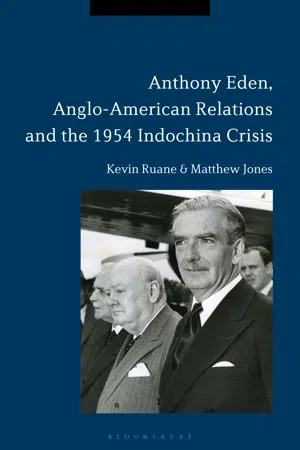
eBook - ePub
Anthony Eden, Anglo-American Relations and the 1954 Indochina Crisis
- 352 pages
- English
- ePUB (mobile friendly)
- Available on iOS & Android
eBook - ePub
Anthony Eden, Anglo-American Relations and the 1954 Indochina Crisis
About this book
Information
1
Introduction: Anthony Eden, Anglo-American Relations and the 1954 Indochina Crisis
Tuesday, 20 July 1954, was possibly the longest day in history. In Geneva, a city renowned for the production of highly accurate timepieces, the participants in an international conference tasked with ending the Indochina War – the bitter eight-year conflict between France and the communist-led nationalists of the Vietminh – found their day extended by several hours. The conference had ground on for three months, but now, thanks to French Premier Pierre Mendès-France, its climacteric drew near. On being appointed in June, Mendès-France vowed to secure peace with honour for France within a month. If he failed, he would resign, and the war, which had already cost so much French blood and treasure, would go on. In calendar terms, the Mendès-France deadline translated to midnight, 20 July.
For Anthony Eden, the British Foreign Secretary, the prospect of ongoing war in Indochina was the stuff of nightmares. Co-chair of the Geneva conference (alongside his Soviet counterpart, Vyacheslav Molotov), Eden regarded this Cold War hot war as ‘the most dangerous and acute of the problems’ confronting him during his post-war (1951–1955) Foreign Secretaryship.1 Should the peace process fail to deliver a settlement, the United States – the Republican administration of Dwight D. Eisenhower – appeared ready to intervene militarily in Vietnam, the crucible of the war, at the head of an international coalition in support of France. If that happened, Eden was convinced that the People’s Republic of China (PRC) would enter the war on the side of the Vietminh, a move that could trigger American military retaliation (conventional and nuclear) against the PRC itself. If the Soviet Union, allied to China since 1950, then became embroiled, the conditions for a possible third world war would be in place.
The Indochina War had begun in 1946 as a colonial conflict with the French seeking to retain their imperial primacy in Vietnam, Laos and Cambodia in the face of the challenge posed by the Vietminh under veteran communist revolutionary Ho Chi Minh.2 In 1950, Indochina entered the arena of the Cold War when the Chinese communists, fresh from their triumph in the Chinese Civil War, began supplying the Vietminh with arms and advice, and the United States commenced a military assistance programme to help France, its partner in the North Atlantic Treaty Organisation (NATO). Thereafter, while the French and Vietminh confronted one another as of old, the war was also a Sino-American war-by-proxy which, if it ever developed into a direct US-PRC clash, could draw in Britain, America’s closest ally, and the Soviet Union, the PRC’s powerful patron. In the event, the outbreak of the Korean War in June 1950 distracted international attention, but with the signing of a Korean armistice in July 1953, Indochina came into its own as the Asian Cold War’s most incendiary problem.
By the start of 1954, US aid to France was covering nearly 80 per cent of the cost of the French war effort, but it was the Vietminh, a formidable military force with strong “rice roots” political support, who were in the ascendant. In February 1954, the United States, the UK, France and the Union of Soviet Socialist Republics (USSR) summoned the Geneva conference with the object of converting the Korean armistice into a peace treaty. The French government, under pressure from a disillusioned public and parliament, succeeded in adding Indochina to the Geneva agenda to assess first-hand the communist world’s attitude towards a possible negotiated solution. The conference was scheduled to open on 26 April, but its purpose, from an Indochinese standpoint, was transformed in mid-March by the onset of the decisive battle of the war at Dien Bien Phu, a remote corner of north-west Vietnam where a 12,000-strong French garrison found itself surrounded by 40,000 Vietminh troops. The US government, for whom a non-communist Indochina was a national security priority, suddenly faced the possibility not just of a French defeat in the battle but a collapse of French morale and endurance elsewhere in Vietnam. Even if the line was held militarily, US policymakers worried that a disaster at Dien Bien Phu would lead to a crumbling of support for the war in metropolitan France and change Geneva from a diplomatic reconnaissance mission into a new “Munich”, the scene of a French sell-out to the Vietminh.3
Wedded to a geostrategic outlook which posited Vietnam as the starter-domino in what Eisenhower dubbed ‘the “falling domino” principle’, the US administration engaged in a frantic inter-agency investigation of options.4 On 29 March, the US Secretary of State, John Foster Dulles, announced his government’s response: ‘united action’, an American-led coalition comprising, inter alia, the UK, Australia and New Zealand, to intervene in Vietnam to shore up the French position.5 In London, this prospect set alarm bells ringing. The Conservative government of Winston Churchill was fearful lest US-orchestrated intervention prompt PRC counter-intervention, a full-scale war between the United States and the China, and even general war with the Soviet Union. British concerns were heightened by the knowledge that North America lay beyond the range of the present generation of Soviet bombers, a fact which meant that the UK and the other European NATO countries, not the United States, could pay a terrible price if American policy in choices in Asia led to global war. ‘All we hold dear’, Churchill predicted, ‘ourselves, our families and our treasures’, would be at risk of immolation if the Soviet Union ever launched an airborne nuclear assault on the British Isles.6
United action was born of the trauma of the Korean War in which US forces did the bulk of the fighting and the dying – some 34,000 killed – in a supposedly collective UN campaign.7 In March 1954, just eight months on from the Korean armistice, the Eisenhower administration and the US Congress determined that salvaging the French position in Indochina should be a genuinely shared international undertaking. With no possibility of UN ‘police’ action on the Korean model due to the nature of the struggle (part colonial, part civil, with no clear-cut external aggression present), coalition-building devolved to America and a small number of allies with an interest in Indochina and Southeast Asia. An important consequence of this decision to proceed only on a multilateral basis was the gifting of a power of veto over US policy to any ally failing to see the problem and the solution in like-minded terms.
Britain was one such ally. With the backing of Churchill, the Cabinet and the Chiefs of Staff (COS), Eden proceeded to play that veto for all it was worth. The imminent Geneva conference had to be given a chance to effect a peaceful solution, he insisted, and that meant there could be no question of UK support for diplomacy-wrecking military action. With Australia and New Zealand reluctant to enter a coalition without Britain for reasons of Commonwealth solidarity, US hopes for united action collapsed into disunited inaction and Anglo-American relations became strained almost to breaking point.8 Thereafter, in contemplating the negotiating prospects, Eden knew that a failure to end the war through diplomacy would free the United States to return to the charge in promoting a military solution with all its escalatory dangers. Against this, a successful outcome at Geneva would contain America.9
Peace, however, would not come from British desiring but from French and Vietminh readiness to compromise. For two months, from April to June, Eden despaired as the French negotiating team at Geneva proved incapable of setting never mind following a clear diplomatic course. At a harshly realistic level, the French knew that the loss of the Dien Bien Phu garrison – news of which reached Geneva on 7 May – marked the end of their imperial mission and that they should look to exit Indochina on the best terms they could get; but at an emotional, patriotic level, they blanched at the thought of so great a national humiliation and considered fighting on, albeit with the United States as a co-belligerent. French vacillation at Geneva hobbled the peace process until June when the National Assembly in Paris, reflecting the restiveness of France at large, propelled Mendès-France, a long-standing critic of the war, into the premiership. Eden was delighted by the new French leader’s tunnel-visioned approach to peace, while the Soviets and the Chinese, who had become nervous themselves about US escalation, began to lean on the Vietminh to offer concessions to France. Even so, the chances of securing a settlement within Mendès-France’s stringent deadline remained ‘on a knife-edge’, Eden recalled; on one side lay peace; on the other lay what he had feared from early on, ‘the beginning of the third world war’.10
As Mendès-France’s month played out, Eden was relieved to discover that a majority of the delegations at Geneva shared his assessment of the consequences of failure. By the time that decision day (20 July) dawned, an outline agreement, including the partitioning of Vietnam into a Vietminh north and non-communist south, had crystallized. The principal dissenters were the Americans who refused to endorse any settlement predicated (as partition was) on the surrender of people and territory to communism. However, as Geneva entered its final lap, the Americans found themselves outnumbered by the proponents of compromise. Not just Britain, but France, China, the Soviet Union and the Democratic Republic of Vietnam (DRV, the Vietminh as a state entity) agreed that peace was preferable to allowing the fighting to continue as a potential catalyst for global war. Of the Indochinese states, the quasi-independent governments of Laos and Cambodia embraced the peace agenda, but the anti-communist Vietnamese, deploring partition, sided with the United States.
As the final day of the conference wore on, a comprehensive settlement was tantalizingly close to realization, but by dusk it was clear that the finer details of the accords would not be worked out before the expiration of the Mendès-France deadline. It was an anxious moment. Was the conference – and with it the chance of peace – about to collapse? At this point, the story goes, a decision was made to stop the clocks at the Palais des Nations, the former home of the League of Nations and the venue of the conference. In effect, time stood still until the agreements were definitively concluded in the early hours of the following day, after which the clocks were reset and restarted.11 Even if the story is apocryphal, the Geneva accords ending the Indochina War were formally recorded as being reached at midnight on 20 July, a concession to Mendès-France who was able to continue in office. Closing the conference on the afternoon of 21 July, a weary but relieved Eden congratulated the assembled delegates, including some grim-faced Americans and Vietnamese, on a job well done. ‘We had stopped an eight-year war and reduced international tension at a point of instant danger to world peace,’ he told them. That ‘achievement’ was ‘well worth while’.12
As the title indicates, Anthony Eden, Anglo-American Relations and the 1954 Indochina Crisis examines the events of 1954 from the particular perspective of Eden, widely acknowledged at the time as the principal facilitator, if not architect, of the Geneva settlement. A second, complementary perspective is Anglo-American relations in that Eden’s Indochinese diplomacy pitched the so-called special relationship into a serious crisis of its own. The historical literature on 1954 is extensive, but there is little sustained attention devoted to the interaction of these two issues.13 There are, however, good reasons for taking an Eden-centric approach. History is lived forwards, not backwards, but in Eden’s case, the 1956 Suez crisis, which brought about his ignominious resignation as Prime Minister in January 1957, has cast what Anthony Adamthwaite calls ‘a retrospective blight’ over much of his earlier career.14 In modern British political word-association, ‘Eden’ invariably begets ‘Suez’ as a first response, certainly when the game is played at the level of public-historical memory – witness, in this connection, how Eden always comes bottom of media-generated league tables of Britain’s best or greatest prime minister or else tops those polls seeking to establish the UK’s worst leaders.15 This book offers a corrective to this perception by freeing Eden from the shadow of Suez. The debate about his Middle East policy after he became Prime Minister in 1955 and the dissection of his misjudgements, misapprehensions and mistakes about Egypt will go on.16 But it is important to recall another Eden – one of the dominating figures in British foreign policy from the mid-1930s to the mid-1950s, an adroit and oft-times successful Foreign Secretary in the Second World War and the early Cold War, and a statesman of international repute and respect. In terms of his skill in the cut-and-thrust of high-level and high-stakes international negotiations, Eden deserves to stand alongside the finest diplomatists to have represented the UK on the world stage.
Other than the Liberal Sir Edward Grey, Eden was the longest-serving Foreign Secretary of the twentieth century.17 Born in June 1897 to landed gentry in County Durham, Eden was educated locally before going to Eton, but what might have been a seamless transition from school to university was interrupted by the Great War. In September 1915, aged eighteen, Eden joined the British Army; serving with the 21st (Yeoman Rifles) Battalion of the King’s Royal Rifle Corps, he saw action on the Western Front, won the Military Cross for bravery and became (in 1918) the youngest Brigade Major in the Army. Eden’s Great War experience was searing for him personally (two brothers were amongst the war-dead) and critical in shaping his later foreign policy outlook, especially his commitment to peace and collective security and his faith in the war-avoiding properties of international diplomacy.18
Demobilized in 1919, Eden studied Oriental languages (specializing in Persian and Arabic) at Christ Church, Oxford, and after graduating (with a Double First) in 1922, he toyed with becoming a barrister before deciding on a career in politics. In December 1923, he entered parliament as a Conservative MP. Within three years, he was appointed Parliamentary Private Secretary to the Foreign Secretary, Sir Austen Chamberlain. In 1931, when a National coalition government was formed, he was made Under-Secretary of State at the Foreign Office, and in 1935, he entered the Cabinet for the first time as Minister for League of Nations affairs. Blessed with matinée idol good looks, easy charm, exquisite manners and impeccable dress sense, and now the highly visible embodiment of an organization on which so many people’s hopes for lasting peace rested, Eden was amongst the best known and most popular politicians in the country. However, his decorous public image hid from view some less-attractive character traits; vain, petulant, impatient and quick to anger, he was capable of spectacular histrionics. Although these private eruptions tended to subside as quickly as they arose, some who witnessed them wondered whether so thin-skinned and volatile an individual was cut out for a long-term career in the Westminster-Whitehall pressure cooker.
In December 1935, aged thirty-eight, Eden was made Foreign Secretary, the youngest holder of the office since Lord Granville in 1851. His international inheritance, though, was troubled: Nazi Germany, Fascist Italy and Imperial Japan were a growing menace in Europe and Asia, while a chain of crises (German reoccupation of the Rhineland, the Spanish civil war and escalating Japanese aggression in China amongst them) made for a testing tenure. There were also difficulties closer to home. By the start of 1938, appeasement had emerged as Prime Minister Neville Chamberlain’s preferred response to the Fascist challenge in Europe, and as Number 10 arrogated to itself important aspects of diplomacy vis-à-vis Germany and Italy, Eden grew restive. In February 1938, nine months into Chamberlain’s premiership, he resigned. Later, in his history of the Second World War, Churchill ...
Table of contents
- Cover
- Halftitle Page
- Title Page
- Dedication Page
- Contents
- Acknowledgements
- List of Abbreviations
- Map
- 1. Introduction: Anthony Eden, Anglo-American Relations and the 1954 Indochina Crisis
- 2. Indochina 1951–1952: The Chinese Dimension
- 3. Indochina 1952–1953: The Vietminh Dimension
- 4. Indochina, 1953: Dimensions Converge
- 5. Vietnam in the Shadow of the Bomb, 1953
- 6. From Bermuda to Dien Bien Phu, 1953–1954
- 7. Uniting for Action, March–April 1954
- 8. Disunited Inaction, April 1954
- 9. ‘He Lied to Me’, April 1954
- 10. 25 April 1954: ‘The Day We Didn’t Go to War’
- 11. The Geneva Conference: Opening Skirmishes
- 12. The Fall of Dien Bien Phu, May 1954
- 13. ‘The Most Troubled International Scene I Can Ever Recall’
- 14. Geneva: Phoenix Rising, June 1954
- 15. The Geneva Settlement, July 1954
- 16. SEATO, 1954–1955
- 17. Geneva Suborned
- 18. Conclusion: Eden, Indochina and Suez
- Notes
- Bibliography
- Index
- Imprint
Trusted by 375,005 students
Access to over 1.5 million titles for a fair monthly price.
Study more efficiently using our study tools.
Frequently asked questions
Yes, you can cancel anytime from the Subscription tab in your account settings on the Perlego website. Your subscription will stay active until the end of your current billing period. Learn how to cancel your subscription
No, books cannot be downloaded as external files, such as PDFs, for use outside of Perlego. However, you can download books within the Perlego app for offline reading on mobile or tablet. Learn how to download books offline
Perlego offers two plans: Essential and Complete
- Essential is ideal for learners and professionals who enjoy exploring a wide range of subjects. Access the Essential Library with 800,000+ trusted titles and best-sellers across business, personal growth, and the humanities. Includes unlimited reading time and Standard Read Aloud voice.
- Complete: Perfect for advanced learners and researchers needing full, unrestricted access. Unlock 1.5M+ books across hundreds of subjects, including academic and specialized titles. The Complete Plan also includes advanced features like Premium Read Aloud and Research Assistant.
We are an online textbook subscription service, where you can get access to an entire online library for less than the price of a single book per month. With over 1.5 million books across 990+ topics, we’ve got you covered! Learn about our mission
Look out for the read-aloud symbol on your next book to see if you can listen to it. The read-aloud tool reads text aloud for you, highlighting the text as it is being read. You can pause it, speed it up and slow it down. Learn more about Read Aloud
Yes! You can use the Perlego app on both iOS and Android devices to read anytime, anywhere — even offline. Perfect for commutes or when you’re on the go.
Please note we cannot support devices running on iOS 13 and Android 7 or earlier. Learn more about using the app
Please note we cannot support devices running on iOS 13 and Android 7 or earlier. Learn more about using the app
Yes, you can access Anthony Eden, Anglo-American Relations and the 1954 Indochina Crisis by Kevin Ruane,Matthew Jones in PDF and/or ePUB format, as well as other popular books in History & Asian History. We have over 1.5 million books available in our catalogue for you to explore.