Inspired by recent adoptions of same-sex marriage, From Sodomy Laws to Same-Sex Marriage provides international perspectives on the legal and social history of same-sex relationships from the early 19th century to the present. Its emphasis is on areas where the impetus for change has been most noticeable: Europe, the Americas, and Australasia.
From Sodom and Gomorrah to Britain's sodomy laws and continental Europe's abhorrence of sexual acts 'against nature', the history of same-sex love traditionally ranged from fire and brimstone maledictions to secrecy and scandal. Until recently, legal positions across the western world reflected the legacies of the British and French empires, as well as Christianity, particularly Catholicism. In recent years, however, there has been a revolution in attitudes towards same-sex relationships. This poses hitherto unanswered questions: what historical complexities lie behind the revolutionary shift from punitive attitudes to legal endorsement of same-sex relationships? Given the cultural variety of historical attitudes to same-sex relationships, why has their legal acceptance been so international? The essays in this volume provide answers to these questions, offering the first international overview of the topic.
While other studies have attempted to explain the change in legal and social treatment of same-sex relationships in a national context, or within a shorter time frame, this is the first volume to examine the topic from the French Revolution to the present day, bringing together a diverse array of perspectives over a range of countries. It is an important volume for students and scholars of queer history, the history of sexuality, law and sociology.
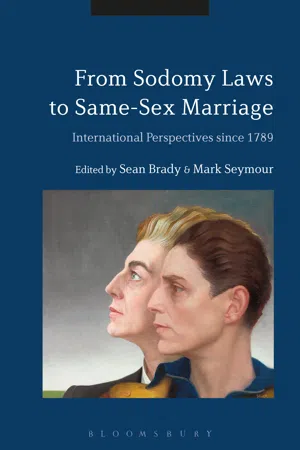
eBook - ePub
From Sodomy Laws to Same-Sex Marriage
International Perspectives since 1789
- 264 pages
- English
- ePUB (mobile friendly)
- Available on iOS & Android
eBook - ePub
From Sodomy Laws to Same-Sex Marriage
International Perspectives since 1789
About this book
Information
1
From Sodomy Laws to Same-Sex Marriage: Historical Transformations
The idea that sexual acts between members of the same sex were “unnatural” goes back to Antiquity and by the Middle Ages had been formalized in the European world through Christian doctrine and canon law. It was absorbed into the laws of a number of modern European states, and exported legislatively to much of the world through colonial expansion. Looking back from 2019, the shift from severe punitive measures for sex “against nature” to the recent introduction of same-sex marriage laws in at least twenty-five nations across five continents must rank as one of the most remarkable transformations of official attitudes in modern history. It is a change that begs many broad questions. This volume presents fresh, historically informed, international perspectives on same-sex relationships as a phenomenon poised between “nature,” religion, and state regulation, seeking to answer at least some of those questions.
Questions of “nature,” or what is unnatural, have held a consistent place in debates on sex, coupling, and marriage, even as authority in such matters has shifted from religious doctrine to medicine to social science and the law of human rights. Yet, as the same-sex marriage legislations underline, matrimony is an entirely social construct, an expression not of “nature” but of historical vicissitudes. Does legislation on same-sex marriage indicate a revolution in the sexual categories considered “natural”? Are official views on what is “natural” now finally being set aside by fundamental alterations to the concept of marriage, leaving more space for individuals to decide their own matrimonial destinies? Or, as neoliberal policies prioritize the individual over social bonds, is same-sex marriage a counter-measure, seeking to attract wayward couplers back into wider, more subtle structures of normativity? Finally, does Western legal emphasis on coupling, irrespective of the partners’ sex, now cast multi-partner relationships as the new “unnatural”?
From Sodomy Laws to Same-Sex Marriage: International Perspectives since 1789 brings together groundbreaking scholarly research around questions of same-sex coupling and relationships in history. Inspired by recent adoptions of same-sex marriage internationally, the volume provides global perspectives on the legal and social history of same-sex relationships between the late eighteenth century and the present. From Sodom and Gomorrah to Britain’s sodomy laws, from a love that “dare not speak its name” to continental Europe’s abhorrence of sexual acts “against nature,” the history of same-sex love traditionally ranged from fire and brimstone maledictions to secrecy and scandal. From the late nineteenth century the advance of scientific understandings of sexuality shifted attitudes away from religious foundations, but laid the groundwork for polarization and contest over same-sex relationships for much of the twentieth century.
Until very recently, legal positions across the Western world reflected the legacies of the British and French empires, as well as Christianity, particularly Catholicism. With the adoption of same-sex marriage across most of Continental Europe, Great Britain (excluding Northern Ireland), the Republic of Ireland, much of South and all of North America, and Australia and New Zealand, many of the global historic differences have now collapsed. But although the legal destination may have been the same, each polity took distinctive and far from linear historical paths to that point. With an emphasis on the areas where the impetus for change has been most noticeable—Europe, the Americas, and Australasia—this is the first volume to present a collection of essays that focus on the relationship between the legal and social position of same-sex relationships in jurisdictions that have moved from the abolition of sodomy laws to the adoption of same-sex marriage.
The historiography of homosexuality now has a long and highly respected scholarly history of its own, largely, but not exclusively, in the Anglophone world. Beginning in the 1970s and stimulated by the rise of radical gay and lesbian identity politics and activism in this period, debates raged among scholars about whether gay and lesbian identities, historically and contemporaneously, were social constructs, or “essential nature.” The social constructionist argument and approach was seen as highly controversial at the time, and highly problematic to gay and lesbian activists. A key element in identity politics in the 1970s and 1980s in the “British World” and the United States was the realization that homosexuality itself had a history. The identity politics of the period rationalized what appeared at first sight to be evidence of homosexuals in history, and the radically differing attitudes toward same-sex sexualized relations in cultures and contexts as diverse as Ancient Greece, Tokugawa Japan, or Victorian Britain. If homosexuality had a long history, the arguments went, how could it be either criminal or vilified by society and governments in the present? Many activists were “outraged” by the foundational work of scholars, such as Jeffrey Weeks, who appeared to deny “their history,” and “essentialist” historians sought alternative interpretations “based on fixity and permanence across time of homosexual identities.”1
Radical scholarly developments in recent decades have expanded these debates considerably. The concept that sexuality between men and between women is indeed socially constructed and different, with profoundly different meanings ascribed to sex acts and emotional relationships between members of the same sex in different cultures and societies, historically and contemporaneously, forms the basis of most scholarship today. Few historians now accept that there is a fixed homosexual identity discernible throughout history. This “queering” of gay and lesbian politics has had a further profound effect upon the ways historians and other scholars have approached questions of sexuality in history, especially since the 1990s. Queer theorists realized in the 1990s that “homosexual identity” in the present was no more fixed than it had been in the past. “Out” gay men, for example, did not represent the full spectrum of sexual experience between men in modern Western societies, as “out” gay men tended to be metropolitan, white, and middle class. The disaster of the HIV/AIDS pandemic of the 1980s and 1990s forced political activists and theorists to realize that, for example, the transmission of the HIV virus among men who had sex with other men had a much broader epidemiology than among gay men who had an “out” identity. Men from Latino and African American heritage, who predominantly or exclusively had sex with other men but eschewed with abhorrence any kind of politicized sexual identity, seemed to have no place in the quest to seek out homosexual identity in history.
The realization that the margins of sexuality and the liminal world of same-sex relations beyond groups and individuals with “out,” proud, and assertive public identities were even more revealing about the spectrum of sex and relationships between members of the same sex broadened out the scope of the historiography of homosexuality. Questions of gender, masculinities, and also full recognition of phenomena such as transsexuality and transgenderism, have in recent years given historians a seemingly limitless spectrum of possibilities to analyze in the past. Far from being a fixed binary, sexualities are fluid and mutable. Today, in the era of same-sex marriage, societies are no longer divided between vilified homosexuals and normative heterosexuals. If anything, the campaign for marriage equality, which began among religious LGBT campaigners in the 1990s in the United States, has created a new binary: hetero- and homo-normativity, centered on coupling, marriage, and ostensibly monogamy; and those who refuse, whether heterosexually or homosexually orientated in their desires, to conform to the normative married couple.
Current debates among theorists emphasize these dramatic shifts in thinking about queerness in recent decades. “Queer worlds” have moved from multiform kinds of intimacy “that bear no necessary relation to domestic space, to kinship, to the couple form, to property, or to the nation,”2 to “the couple form” moving from the “periphery to the center of queer politics, becoming the major vehicle … [for] … access to cultural and legal institutions as well as broader acceptance.”3 In historical research, this also has created a paradigm shift. Queer identities in the past have been analyzed through the stresses of the public space, or in recognizably queer spaces in the public sphere. Recent scholarship, such as Matt Cook’s Queer Domesticities: Homosexuality and Home Life in Twentieth-Century London (2014), analyzes instead “queer at home” and the formation of queer coupling and domestic space, in short the creation of queer “family life.” Cook demonstrates that far from “pretend” or non-existent, evidence of queer coupling and domesticity indeed has a history. It is the tensions between the public and legal ideologies and opprobrium of queer, the politics and culture of undomesticated queer public worlds, and the historicity of the queer couple, queer families, and the development of the institutions of same-sex marriage and civil partnership across the world that underpin the focus of this volume.
Many societies today have moved on from religious and moral objections to the existence of queer lives and accepted marriage equality readily. After all, marriage, whether it is between a man and a woman, or between members of the same sex, is a more conservative and capitalist aspiration than it is a radical one. In June 2018 in the UK, for example, opposite-sex couples won the right to civil partnerships, hitherto only available to same-sex couples. This striking development in equalities reflects a rejection of the institution of marriage by opposite-sex couples—but not rejection of the couple, or its protection in law. Indeed, the quest for marriage equality among LGBT activists around the world flies in the face of decades of feminist critiques of the institution of marriage. Marriage equality is, in its essence, a far cry from the radically experimental ideas on sexuality and sexual relations between members of the same sex as espoused by, for example, the US Gay Liberation Front of the early 1970s.
The acceptance of marriage equality around the world is indeed a revolution in social attitudes. Historians today examine same-sex relationships and queer lives firmly in their historical contexts, and focus upon queer domesticities, as well as queer coteries, communities, and same-sex phenomena where they can be found in the historical past. In many respects, the history of homosexuality has moved beyond “queers in the dock” or under the microscope of the medicalized sexologist. The chapters in this volume explore the changing boundaries between law and same-sex relationships in timely, original, and innovative ways. The very question of marriage and the quest for marriage equality around the world has stimulated the editors and authors in this volume to question the historical significance of the legal frameworks in countries and regions around the world as they shifted from sodomy laws to same-sex marriage.
The volume opens more than two centuries before such questions could have been imagined. Bryant Ragan’s chapter provides a foundation for the volume, analyzing and explaining the first modern example of the “decriminalization” of sodomy, in the wake of the French Revolution of 1789. Although a familiar fact, little is known about the reasoning of the committee that drafted France’s postrevolutionary penal code, which effectively decriminalized sodomy merely by ceasing to mention it. Part of the problem is that there are no historical records of any discussions about this decision (if indeed such discussions took place). Ragan’s chapter explains the shift with reference to the legal background of sodomy as a crime “against nature” between the high Middle Ages and the Early Modern period. It may be difficult to pin down exactly why the revolutionary penal code decriminalized sodomy, but it was not likely a result of absentmindedness on the part of the legislators. Instead, weighing the evidence carefully, Ragan argues that even if Enlightenment “savants” did not address the question of sodomy directly, they would have viewed proscriptions against it as typifying the old regime’s superstitions and tendency to barbarous punishments, even of actions that were not directly harmful to society.
The French 1791 decriminalization signaled a new climate of opinion on the role of the state and criminal law. On the other hand, Ragan cautions that it would be anachronistic to explain the decriminalization as an expression of particular concern for individual rights or privacy. History had a long way to run before those attracted to their own sex were to be thought of as a class, let alone one that might warrant protection or rights. For this reason, decriminalization did not mean an immediate end to discrimination, in either France or other places, such as Italy. However, in retrospect, France’s 1791 penal code was a first step toward the emergence of two distinct legal traditions in the Western world—those that abolished sodomy laws relatively early in the modern period and those that abolished them only well into the twentieth century.
This dissonance in legal cultures is explored in Charles Upchurch’s chapter. The clash between English and French legal traditions, and also differences in attitudes toward legislation, questions of morality, and the rights of individual male citizens, are highlighted through Upchurch’s fascinating examination of resistance to the imposition of sodomy laws in the state of Louisiana in 1814–1815. When Louisiana became a territory of the United States in 1805, new crimes appeared due to the imposition of the traditions of English common law, prevalent throughout the United States. The imposition of these new criminal statutes was condemned in a provision in the 1812 Louisiana constitution. Imposing the sodomy law, along with laws against blasphemy, Sunday trading, and other kinds of moral legislation, proceeded in other states, and was part of an evangelical-led movement after the American War of Independence to suppress the permissiveness that had been tacitly tolerated in previous generations.
In the crucible of the Battle of New Orleans, General Andrew Jackson had insisted that the Louisiana Legislature adjourn, which the Legislature refused to do until Jackson imposed martial law. This provoked a huge outcry from the Legislature’s members, who objected to the imposition of measures that would impede the rights of Louisiana’s male citizens, including the insistence that laws regarding morality be applied. The stout rhetoric of resistance to this by the Legislature was based upon defense of cherished freedoms against “fanatics” imposing new standards, which according to enlightened inhabitants of Louisiana were “ignorant, prejudiced, cold-blooded, false and cruel.” Rather than shrinking from discussion of the “unspeakable” crime of sodomy, the Louisiana elites resisted imposition of a sodomy law in a very public and articulate way. The principle upon which the refusal was based was central to their identity as independent men.
Upchurch compares the resistance in Louisiana to a small, but significant, move by some anonymous early nineteenth-century parliamentarians to refute the sodomy law in Britain. Through examination of the anonymous round-robin poem “Don Leon,” which was targeted at parliamentarians, rationalist arguments were made to convince the legislators quietly to remove the death penalty for acts of sodomy. The poem also reveals individual self-awakening where one man’s story is recounted through sexual self-awareness at university, through personal and sexual fulfillment experienced through his travels in the Eastern Mediterranean. Upchurch analyzes the ideas inherent in the poem, and thereby the small group of men that constructed its arguments, as being in the same logic as the resistance by the elite men of Louisiana to the imposition of the sodomy law. In the British case, clandestine men who did identify strongly with same-sex desire, and in the Louisiana case, men who likely did not identify with same-sex desire, based their arguments upon deeply held convictions over the nature of justice in general to defend same-sex desire and acts specifically. Upchurch argues that these early rationalist rights-based struggles against the sodomy laws place these developments in conversation with the processes that led to same-sex marriage within the United States in the early twenty-first century.
Dominic Janes’ chapter examines the full brutality of England’s sodomy laws through interpretation of the representations and meanings of the hanging of John Pratt and James Smith, who were the last couple of sodomites to be hanged in Britain in 1835. Janes investigates the relationship between such illegal sexual coupling and the degree to which sodomitical pairs were thought of as couples. From the point of view of the law what mattered was the precise sexual act that had been committed. Reform in the application of the law and punishments changed not through greater tolerance toward the sexual acts in question or the individual men who perpetrated them, but through “sentiment” and increasing squeamishness on the part of observers of public executions. However, from the point of view of reformers, both past and present, it has frequently been important to think about the nature of the relationships between men drawn to such forms of sexual behavior and thus punished.
Janes’ review of the sporadic nineteenth-century calls for penal reform of legislation in this area allows the case of Pratt and Smith to be contextualized against a wider landscape of attitudes toward the physical expression of male same-sex desire. In particular a surviving petition to the home secretary in this case is compared with the unpublished writings of Jeremy Bentham and with other materials such as Charles Dickens’ account of seeing these men in prison. The justifications, constructions, and evasions offered in these materials make for a fascinating comparison with those produced by modern gay-rights campaigners, who have either argued for the importance of connecting physical with affective coupling, or have, conversely, advocated the potential of decoupling these two elements.
Moving from capital punishment to confinement, Ben Bethell investigates official attitudes to sex between men in nineteenth-century England by using one of the few historical sources that document lengthy deliberations, if not soul-searching, on the matter: the records of those who administered the English prison system. At a time when official, legal, and scientific discourses were largely silent on the question of sex between men, prison administrators were forced to grapple with it, for fear that if the matter were ignored, some men would “taint” others, and sex among prisoners would become rife. Bethell charts the development of policies whose aim was to prevent this. His research reveals that before the emergence of modern concepts of sex and sexuality, those involved in the discussion struggled for the lack of established concepts and language to discuss the issue and classify prisoners. His chapter thus shows how prison administration was a key site for the emergence of a set of modern English discourses about sexual acts among men that paved the way not only for prison policies, but also for official attitudes in broader society that were to endure well into the twentieth century.
A very different perspective is provided by Magally Alegre Henderson’s cha...
Table of contents
- Cover
- Halftitle Page
- Title Page
- Contents
- List of Figures
- Acknowledgments
- Notes on Contributors
- Foreword
- 1. From Sodomy Laws to Same-Sex Marriage: Historical Transformations
- 2. Same-Sex Sexual Relations and the French Revolution: The Decriminalization of Sodomy in 1791
- 3. Arguing against Intolerance: Louisiana and Britain in the Early Nineteenth Century
- 4. Regarding Pratt and Smith, the Last Couple of Sodomites to be Hanged in Britain
- 5. Defining “Unnatural Crime”: Sex and the English Convict System, 1850–1900
- 6. “It Is My Husband Who Has Such Weaknesses”: A Mid-Nineteenth-Century Peruvian Divorce Case
- 7. Flappers and Felons: Rethinking the Criminal Law and Homosex in Interwar Australia, 1920–1939
- 8. Spain from Franco’s Repressive Regime to Same-Sex Marriage
- 9. Affecting Legal Change: Law and Same-Sex Feelings in West Germany since the 1950s
- 10. The Sexual (Geo)Politics of Loyalty: Homosexuality and Emotion in Cold War Security Policy
- 11. Homosexual Politics in the British World: Toward a Transnational Understanding
- 12. Gender and the Politics of Marriage in Postwar Australia and Britain
- 13. From Giarre to Civil Unions: The “Long March” for Same-Sex Relationships in Italy
- 14. “It’s Poppycock to Say Homosexuals Can Be Excused”: Rethinking the Gay and Lesbian Movement in the Republic of Ireland, 1970s–1990s
- 15. “ … Do You Want More?”: A Brief History of Same-Sex Partnerships, Family Formations, and Marriage in Twentieth-Century United States
- 16. Gay Marriage in England: After the Party
- 17. Same-Sex Unions: In Retrospect and Prospect
- Index
- Imprint
Trusted by 375,005 students
Access to over 1.5 million titles for a fair monthly price.
Study more efficiently using our study tools.
Frequently asked questions
Yes, you can cancel anytime from the Subscription tab in your account settings on the Perlego website. Your subscription will stay active until the end of your current billing period. Learn how to cancel your subscription
No, books cannot be downloaded as external files, such as PDFs, for use outside of Perlego. However, you can download books within the Perlego app for offline reading on mobile or tablet. Learn how to download books offline
Perlego offers two plans: Essential and Complete
- Essential is ideal for learners and professionals who enjoy exploring a wide range of subjects. Access the Essential Library with 800,000+ trusted titles and best-sellers across business, personal growth, and the humanities. Includes unlimited reading time and Standard Read Aloud voice.
- Complete: Perfect for advanced learners and researchers needing full, unrestricted access. Unlock 1.5M+ books across hundreds of subjects, including academic and specialized titles. The Complete Plan also includes advanced features like Premium Read Aloud and Research Assistant.
We are an online textbook subscription service, where you can get access to an entire online library for less than the price of a single book per month. With over 1.5 million books across 990+ topics, we’ve got you covered! Learn about our mission
Look out for the read-aloud symbol on your next book to see if you can listen to it. The read-aloud tool reads text aloud for you, highlighting the text as it is being read. You can pause it, speed it up and slow it down. Learn more about Read Aloud
Yes! You can use the Perlego app on both iOS and Android devices to read anytime, anywhere — even offline. Perfect for commutes or when you’re on the go.
Please note we cannot support devices running on iOS 13 and Android 7 or earlier. Learn more about using the app
Please note we cannot support devices running on iOS 13 and Android 7 or earlier. Learn more about using the app
Yes, you can access From Sodomy Laws to Same-Sex Marriage by Sean Brady, Mark Seymour, Sean Brady,Mark Seymour in PDF and/or ePUB format, as well as other popular books in History & Modern History. We have over 1.5 million books available in our catalogue for you to explore.