Illuminating thus far understudied international relations in global higher education, the book titled Internationalization of Higher Education for Development illustrates how the Brazilian government, under the presidency of Luis Inácio Lula da Silva (2003-2010), legitimized Africa-Brazil relations often referring to the presumably shared history of transatlantic slavery as the condition for solidarity cooperation and international integration. Ress reveals how this notion of history produces a vision of Brazil as a multicultural nation able to redress longstanding racialized inequalities while casting 'Africa' as the continent that remains forever in the past. She explores how this ambiguous notion was translated into curricula and classroom practices, and, in particular how it shaped international students' experiences at a newly-created university in the Northeast of Brazil. Ress demonstrates how the historicized framing in conjunction with the powerfully racialized class structures that characterize Brazilian society, the challenging material conditions surrounding the university, and the future aspirations of students created an environment that made solidarity an economic necessity while repeating the century-old colonial gesture of othering 'Africa' in new yet all too familiar ways – reworking and reemploying the idea of race in the name of Brazil's progress and development.
This book showcases in an innovative way the challenges and opportunities of building international relations in postcolonial education contexts. A much-needed advances over current scholarship analysing race, blackness, and solidarity, it offers a timely contribution to postfoundational and postcolonial studies in comparative and international education.
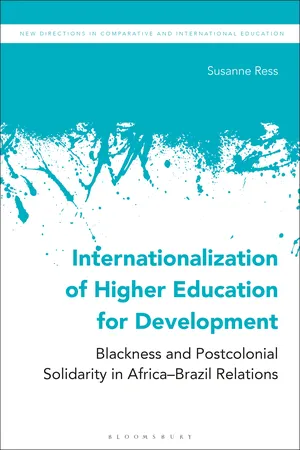
eBook - ePub
Internationalization of Higher Education for Development
Blackness and Postcolonial Solidarity in Africa-Brazil Relations
- 200 pages
- English
- ePUB (mobile friendly)
- Available on iOS & Android
eBook - ePub
Internationalization of Higher Education for Development
Blackness and Postcolonial Solidarity in Africa-Brazil Relations
About this book
Information
Table of contents
- Cover
- Half-Title Page
- Dedication
- Series Page
- Title Page
- Contents
- List of Illustrations
- List of Abbreviations
- Acknowledgements
- Series Editors’ Foreword
- Introduction
- 1 Portuguese Colonialism and its Aftermath
- 2 Internationalization of Higher Education for Development
- 3 Racialization Through Time, Space and Rank
- 4 Solidarity and Blackness in the Institutional Unfolding of UNILAB
- 5 Historical Consciousness
- 6 Producing, Performing and Evading Integration
- 7 International Students’ Lives
- Conclusion
- Appendix I
- Appendix II
- References
- Index
- Copyright
Trusted by 375,005 students
Access to over 1.5 million titles for a fair monthly price.
Study more efficiently using our study tools.
Frequently asked questions
Yes, you can cancel anytime from the Subscription tab in your account settings on the Perlego website. Your subscription will stay active until the end of your current billing period. Learn how to cancel your subscription
No, books cannot be downloaded as external files, such as PDFs, for use outside of Perlego. However, you can download books within the Perlego app for offline reading on mobile or tablet. Learn how to download books offline
Perlego offers two plans: Essential and Complete
- Essential is ideal for learners and professionals who enjoy exploring a wide range of subjects. Access the Essential Library with 800,000+ trusted titles and best-sellers across business, personal growth, and the humanities. Includes unlimited reading time and Standard Read Aloud voice.
- Complete: Perfect for advanced learners and researchers needing full, unrestricted access. Unlock 1.5M+ books across hundreds of subjects, including academic and specialized titles. The Complete Plan also includes advanced features like Premium Read Aloud and Research Assistant.
We are an online textbook subscription service, where you can get access to an entire online library for less than the price of a single book per month. With over 1.5 million books across 990+ topics, we’ve got you covered! Learn about our mission
Look out for the read-aloud symbol on your next book to see if you can listen to it. The read-aloud tool reads text aloud for you, highlighting the text as it is being read. You can pause it, speed it up and slow it down. Learn more about Read Aloud
Yes! You can use the Perlego app on both iOS and Android devices to read anytime, anywhere — even offline. Perfect for commutes or when you’re on the go.
Please note we cannot support devices running on iOS 13 and Android 7 or earlier. Learn more about using the app
Please note we cannot support devices running on iOS 13 and Android 7 or earlier. Learn more about using the app
Yes, you can access Internationalization of Higher Education for Development by Susanne Ress in PDF and/or ePUB format, as well as other popular books in Education & Comparative Education. We have over 1.5 million books available in our catalogue for you to explore.