This philosophical Mao is a fresh portrait of the mind of the ruler who changed the face of China in the twentieth century. The book traces the influences of both traditional Chinese and traditional pre-Marxist Western philosophy on the early Mao and how these influences guided the development of his thought. It reveals evidence of the creative dimensions of Mao's thinking and how he wove the yin/yang pattern of change depicted in the Yijing, the Chinese Book of Changes, into the Marxist dialectic to bring ancient Chinese philosophy to mark changes in twentieth century thought.
Mao's lifetime philosophical journey includes his interpretations of and comments on both Chinese and Western philosophers. His deep, metaphysical reflections, uncanny prognostications and pensive speculations from his early pre-Marxist period to his later philosophical years prove to be as startling as they are thought-provoking.
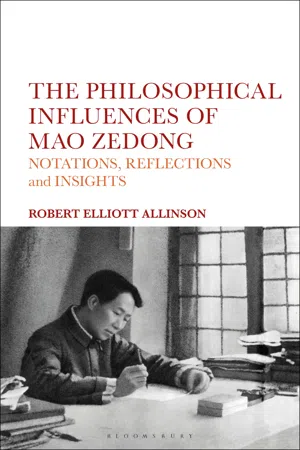
eBook - ePub
The Philosophical Influences of Mao Zedong
Notations, Reflections and Insights
- 256 pages
- English
- ePUB (mobile friendly)
- Available on iOS & Android
eBook - ePub
The Philosophical Influences of Mao Zedong
Notations, Reflections and Insights
About this book
Information
1
Introduction to the Philosophical Mao
The Good and the Bad Mao
In this approach to Mao’s thinking, the method is to attempt to discover the philosophical dimensions to his thought. My purpose is not to focus on the political ideology or actions of Mao. My purpose is to focus on the philosophical rather than the political thought of Mao. Views of the good Mao and the bad Mao have been based on evaluating his political thought in terms of its allegiance to or divergence from Marxism and/or the good that Mao brought to China versus the harm that he wreaked. There is no intention on my part to demonstrate that in the end, on balance, the good that Mao accomplished for China overweighs the evil, or the other way around.1 Accounts vary on this issue. Nick Knight writes that according to the official Chinese government account in its 1981 ‘Resolution’: if we judge his activities as a whole, his contributions to the Chinese revolution far outweigh his mistakes. His merits are primary and his errors secondary.2
Arthur Waldron reports that John K. Fairbank, upon returning from a visit to China in 1972, stated that ‘The Maoist revolution is on the whole the best thing that has happened to the Chinese people in centuries.’3
On the other hand, accounts abound that detail the human suffering and death toll that occurred as a result of Mao’s policies. It is an open question how much of this was a result of Mao’s initiative and how much was caused by excesses of local and regional leaders.4
In their Introduction to Was Mao Really a Monster, Gregor Benton and Lin Chun quote the historian Maurice Meisner, who wrote in 1999: ‘Despite all the horrors and crimes that accompanied the revolution … few events in world history have done more to better the lives of more people.’ Meisner refers to China’s subsequent economic development as ‘one of the greatest achievements of the twentieth century.’5
Lee Feigon also concludes with a favourable opinion of Mao on the whole:
Mao enriched the lives of the Chinese people.6
And,
… no one can deny that Mao was a great leader who transformed China. … his [Mao’s] own name will inspire discussion for years to come, and his influence – largely positive – will be felt in China for generations.7
Even Walder writes that despite severe problems under the surface:
In addition to these genuine accomplishments [infant mortality rates decreased from 175 per thousand births in 1953 to 45 per thousand in 1976, life expectancy at birth which was only 40 years in 1953, had risen to 64 years] which survived to the end of the Mao era, aggregate measures of China’s gross domestic product (GNP) were also impressive. Gross output of China’s industry and agriculture grew in nominal terms almost tenfold during the Mao era; industrial output grew twice as fast.8
The 70–30 view – ironically coinciding with Mao’s appraisal of Stalin – 70 per cent good and 30 per cent bad, is interpreted by John Bryan Starr to mean that ‘[Mao] is viewed as 100 per cent right for 70 per cent of his career, and close to 100 per cent wrong for the last 30 per cent.’9 It is important to bear in mind that these calculations are evaluations of Mao’s political thought and its effects, and not of his philosophical thought proper.10
The line between the philosophical and the political is sometimes difficult to draw, but it is not impossible. For example, Andrew Walder attributes Mao’s political decisions to his fixed ideas concerning the need for violence in revolution, the following of the Stalinist Party History, The Short Course, etc. These tactical political decisions and their justifications need to be distinguished from Mao’s strategic objectives, and the metaphysics and epistemology which underscored his philosophy of change.
As for his errors, Stuart Schram writes near the end of his work The Thought of Mao Tse-Tung:
It cannot be disputed that Mao’s two major policy innovations of his later years, which were also the two major innovations in his thought, the Great Leap Forward and The Cultural Revolution, were ill-conceived and led to disastrous consequences.11
It could be argued that these two disastrous policies were not related to philosophical thinking, but to agricultural theory and public policy planning. However, it has been argued that even Mao’s Great Leap Forward policies were influenced by Mao’s concepts of physics, if not philosophy.12
Lee’s views resemble those of Schram:
As I have made clear, Mao must be held responsible not only for the disaster of the Great Leap but also for many of the innocent, cruelly tortured victims of the Cultural Revolution. It is not much consolation to the victims of his campaigns that Mao, unlike Stalin, never went over the lists of people to be imprisoned or executed and was probably largely unaware of most of the egregious assaults of the Cultural Revolution. Mao also fell short in his personal life. He was, as Frederick Teiwes has put it, ‘a randy old bastard who abused his authority’ to have sex with a great many women.13
Dikötter goes further in his analysis: Insensitive to human loss, he nonchalantly handed down killing quotas in the many campaigns that were designed to cow the population.14
Suspending judgment, pending evidence for the validity of this claim that is made by Dikötter, it could be conjectured that beneath whatever excesses that ensued from Mao’s policy decisions lay an overweening trust in his own willful decision making and a view of himself as a Great Man, values that echo Mao’s early reading of Paulsen’s System of Ethics. This underlying willfulness, in my own view, a blend of his early Western philosophical exposure to Paulsen and Mao’s own personality, is for Schram, the most important negative factor of Mao’s legacy.15 A reflective illustration of this is to be found in Bill Willmott’s story of his brother’s visit to China in 2005 and his brother’s question of an old man he met in Chengdu. When he asked him what he thought of Mao, the old man’s reply was, ‘Ren buhao. Sixiang hao’ (Man not good. Thoughts good).16
Stuart Schram concludes his work The Thought of Mao Tse-Tung with a question: Was Mao a Prometheus or a Faust, ‘attempting the impossible for the sake of humanity, or a despot of unbridled ambition, drunk with his own power and his own cleverness? Even today, the final verdict, both on the man and his thought, must still remain open.’17
In an earlier book, Schram elaborates on the polar opposites that make the choice of good or bad both a staggering and an unethical assessment:
How does one weigh, for example, the good fortune of hundreds of millions of peasants in getting land against the execution, in the course of land reform and the ‘Campaign against Counter-Revolutionaries’, or in other contexts, of millions, some of whom certainly deserved to die [?!] but others of whom undoubtedly did not? How does one balance the achievements in economic development during the first Five-Year Plan, or during the whole twenty-seven years of Mao’s leadership after 1949, against the starvation that came in the wake of the Great Leap Forward, or the bloody shambles of the Cultural Revolution?18
For Kissinger, Mao was a man of contradiction:
Domineering and overwhelming in his influence, ruthless and aloof, poet and warrior, prophet and scourge, he unified China and launched it on a journey that nearly wrecked its civil society.19
Speaking of poetry, Mao is regarded by critics as a good poet, and even chose to write his poetry in one of the more sophisticated and difficult meters of the classical style. Questions have been raised as to whether others have written the poems attributed to Mao. In one case, according to an article written in the Christian Science Monitor, Chen Mingyuan has claimed that twelve of his poems were included in ‘A Collection of Chairman Mao’s Unpublished Poems’ (he states that ‘only those who are ignorant or who have ulterior motives will say Chairman Mao lifted his poems’). In any case, this claim is not identical to the claim that all of Mao’s poetry was written by others.20 Concerning the contradiction of Mao being the author of the Cultural Revolution and, at the same time, a fine practitioner of one of its most renowned classical arts, Fitzgerald makes the following comments. I find particularly suggestive the remarks Fitzgerald makes in the future perfect tense:
… by some strange twist of his psychology while condemning as outworn this aspect of the old culture, he nonetheless desired to be known as the last exponent of this particular form of it. No man is wholly consistent, and few can resist the enjoyment of practicing a difficult skill in which they know themselves to be very proficient. It is always possible that while he believed that these interests were not appropriate as an example in this stage of the just completed revolution, he did not want to discourage future generations, in a calmer age, from rediscovering the beauties of some aspects of the old culture, by then purely of historical or aesthetic importance.21
Traditional Western, Traditional Chinese Philosophy and Mao
My primary objective is to show the influence of traditional Western and traditional Chinese philosophy on the mind of Mao. There have been studies of Mao’s Marxism, but very little, in comparison, of Mao’s early acquaintance with both Western philosophy and classical Chinese philosophy, and of the dedication he brought to his philosophical studies. In order to illustrate Mao’s philosophical journey, I shall, as a whole, attempt to focus on Mao’s philosophical writings and inasmuch as is possible, not focus on his ideological writings, the purpose of which is usually to justify and persuade others to see the truth of his political actions and decisions. Although it is impossible, not to say untrue to Mao’s thinking, to completely divorce Mao’s philosophical thinking from his political theatre of action, the purpose of highlighting his philosophical ideas is to ensure that they are not lost in the immense complexity of the history of the social, economic and political changes that were taking place in China.22 Stuart Schram’s work, The Thought of Mao Tse-Tung, focuses on Mao’s political thought rather than his philosophical thought per se, linking his philosophical thinking to his political decisions and policies. As Schram notes, his [Schram’s] work focuses on mainly political concerns and not, in his words, on ‘strictly philosophical issues’:
Mao’s analysis of Chinese society, and the theoretical considerations he drew from it, lie on the other hand [from strictly philosophical concerns] at the centre of our concerns, and can serve as a convenient transition from philosophy to other aspects of Mao’s thought.23
Mao’s Individual Thought versus the Official Philosophy of Mao
What can we take as writing representing Mao’s philosophical thought? Of course, Mao’s philosophical thought changes over the course of time. Nonetheless, it is possible to point out parallels between his early and later periods of thought.24 It does not mean that there is a seamless continuity, and the transition between his pre-Marxist and Marxist periods is marked by a distinct change. There is also the distinction scholars make between Mao’s own philosophy and what is regarded as the official philosophy of Mao. Knight points out that ‘one finds in the writings of the field a distinction having to be made between Mao Zedong Philosophical Thought (that is the “scientific system” which has the official seal of approval) and the philosophical thought of Mao the individual.’ 25 Timothy Cheek refers to ‘Mao Zedong Thought’ (Mao Zedong Sixiang) as Mao’s ideological contributions and states that it is the official ideology of the CCP today.26 In what is to follow, we shall focus on the philosophical thought of Mao the individual. This is the opposite position of significant mainland Chinese scholars who consider that it is Mao Zedong Philosophical Thought which should be the proper object of study. Liu Rong, for example, points out that Mao Zedong Philosophical Thought (which includes the thought of Zhou Enlai, Liu Shaoqi and Zhu De) ‘rectifies’ errors in the thought of the early Mao. If early Chinese philosophical thought or Western traditional thought is mentioned at all, it is only in the context of exhibiting it as errors that were part of Mao’s individual philosophical thought, but disappeared after Mao’s conversion to Marxism. Liu Rong writes:
… before Mao Zedong became a Marxist in 1920, he said on more than one occasion that in his early teens he believed in gods, that he worshipped Buddha; and as a youth, he put his faith in the texts of Confucius and the dualism of Kant, and advocated anarchism.27
Of his conversion to Marxism (there was of yet no communist party in China so that Mao was not yet a communist), Mao recounts that the books (in Chinese translation) that made the deepest mark on him in 1920 were the Communist Manifesto, Class Struggle by the Jewish theoretician Karl Kautsky and a History of Socialism by Thomas Kirkup.28 On the other hand, according to Alexander Pantsov and Steven Levine, it was Kropotkin who had the greatest influence on Mao.29
It should be noted that Mao was writing about the social transformation of the masses as early as 21 July 1919, prior to his first contact with Marxism. This is evidenced by his essay, ‘The Great Union of the Popular Masses, Part I.’ 30
Schram notes that in this essay Mao’s notion is that the primary leadership is to be of students, not the proletariat. He also paid considerable attention to women and school teachers. It was the young, not the peasants who were Mao’s movers at this time.31
There has been very little work of any sustained substance that has shown the developmental link between Mao’s early thought and his later philosophical essays. The bulk of existing scholarship on Mao’s philosophical writing focuses on his Marxist period. However, as we shall see in ensuing chapters, there is far more to Mao’s philosophical development than simply his Marxist writings. Even scholars who make efforts to link the early Mao with his later period tend to view his later writing through the Marxist lens rather than taking note of how and from which pre-Marxist influences Mao formed his ideas. If they do take note of his pre-Marxist period, with notable exceptions, such as Frederick Wakeman, Stuart Schram and Maurice Meisner, they give traditional Western philosophical influences only passing reference and do not credit pre-Marxist Western philosoph...
Table of contents
- Cover
- Halftitle Page
- Title Page
- Dedication Page
- Contents
- Foreword
- Preface
- Acknowledgements
- 1. Introduction to the Philosophical Mao
- 2. Mao’s Youthful Philosophical Development
- 3. Mao in the Margins: Mao’s Philosophy of Egoism
- 4. Mao’s Early Philosophical Influences and Reflections
- 5. The Blend of the Influence of Chinese and Western Philosophy on Mao’s Thought and Parallels in China’s Social and Economic Development
- 6. Mao’s Marxist Thought and the Yijing
- 7. Mao as Metaphysician and Literatus
- 8. Mao’s Contributions to Philosophy
- Notes
- Selected List of References
- Index
- Imprint
Trusted by 375,005 students
Access to over 1.5 million titles for a fair monthly price.
Study more efficiently using our study tools.
Frequently asked questions
Yes, you can cancel anytime from the Subscription tab in your account settings on the Perlego website. Your subscription will stay active until the end of your current billing period. Learn how to cancel your subscription
No, books cannot be downloaded as external files, such as PDFs, for use outside of Perlego. However, you can download books within the Perlego app for offline reading on mobile or tablet. Learn how to download books offline
Perlego offers two plans: Essential and Complete
- Essential is ideal for learners and professionals who enjoy exploring a wide range of subjects. Access the Essential Library with 800,000+ trusted titles and best-sellers across business, personal growth, and the humanities. Includes unlimited reading time and Standard Read Aloud voice.
- Complete: Perfect for advanced learners and researchers needing full, unrestricted access. Unlock 1.5M+ books across hundreds of subjects, including academic and specialized titles. The Complete Plan also includes advanced features like Premium Read Aloud and Research Assistant.
We are an online textbook subscription service, where you can get access to an entire online library for less than the price of a single book per month. With over 1.5 million books across 990+ topics, we’ve got you covered! Learn about our mission
Look out for the read-aloud symbol on your next book to see if you can listen to it. The read-aloud tool reads text aloud for you, highlighting the text as it is being read. You can pause it, speed it up and slow it down. Learn more about Read Aloud
Yes! You can use the Perlego app on both iOS and Android devices to read anytime, anywhere — even offline. Perfect for commutes or when you’re on the go.
Please note we cannot support devices running on iOS 13 and Android 7 or earlier. Learn more about using the app
Please note we cannot support devices running on iOS 13 and Android 7 or earlier. Learn more about using the app
Yes, you can access The Philosophical Influences of Mao Zedong by Robert Elliott Allinson in PDF and/or ePUB format, as well as other popular books in Storia & Storia cinese. We have over 1.5 million books available in our catalogue for you to explore.