Drawing on a range of disciplines from within the humanities and social sciences, Multilingual Memories addresses questions of remembering and forgetting from an explicitly multilingual perspective. From a museum at Victoria Falls in Zambia to a Japanese-American internment in Arkansas, this book probes how the medium of the communication of memories affirms social orders across the globe.
Applying linguistic landscape approaches to a wide variety of monuments and memorials from around the world, this book identifies how multilingualism (and its absence) contributes to the inevitable partiality of public memorials. Using a number of different methods, including multimodal discourse analysis, code preferences, interaction orders, and indexicality, the chapters explore how memorials have the potential to erase linguistic diversity as much as they can entextualize multilingualism. With examples from Africa, Asia, Australasia, Europe, and North and South America, this volume also examines the extent to which multilingual memories legitimize not only specific discourses but also individuals, particular communities, and ethno-linguistic groups – often to the detriment of others.
eBook - ePub
Multilingual Memories
Monuments, Museums and the Linguistic Landscape
- 320 pages
- English
- ePUB (mobile friendly)
- Available on iOS & Android
eBook - ePub
Multilingual Memories
Monuments, Museums and the Linguistic Landscape
About this book
Information
Part One
Monuments
1
Forging a Nation: Commemorating the Great War
Introduction
In April 2015, the New Zealand government opened Pukeahu National War Memorial Park in Wellington, the capital city. The official opening was timed to coincide with the 100th anniversary of the Gallipoli campaign, a disastrous military operation during the First World War that in contemporary commentary is often described as a key event in forging a sense of New Zealand’s national identity.
The First World War began fewer than seventy-five years after the signing of the Treaty of Waitangi in 1840, which is generally viewed today as the nation’s founding document. While English speakers had been present in New Zealand in the form of whalers, sealers, traders and missionaries in the decades before 1840, this treaty signed between the British Crown and Māori chiefs laid the basis for systematic colonization. Within twenty years the Māori population was in the minority, and the New Zealand Wars of the 1860s resulted in the confiscation of around 1 million hectares of Māori land, laying the foundations for generations of grievance that began to be addressed only from the 1970s, when the Waitangi Tribunal was set up as a permanent commission of inquiry into actions by the Crown, such as land confiscation, that breached the Treaty of Waitangi. The establishment of the Tribunal was recognition that the Treaty carried legal weight.
Confiscated land was not the only source of grievance. By the time the Waitangi Tribunal was established, Māori language loss was a real concern. For, while the language began from a position of strength and dominance in 1840 it was followed ‘by an extended period of bilingualism, increasingly unidirectional’ (Benton 1991: 14) with ‘the process of language change [beginning] in earnest in the 1930s, although [the] results did not really become discernible until the 1950s, when the large numbers of people who had learned Māori as a second language in childhood were succeeded by a new generation with many monoglot English speakers’ (ibid: 17). Various factors have been mentioned as contributing to this shift, including broadcasting, inter-marriage and economic changes (such as the end of subsistence farming as a viable lifestyle; Benton 1981: 15), but overall the important probable causes are seen to have been urbanization and education (Benton 1991: 18). In terms of education, much has been made of the role of schools, and particularly the native schools, in contributing to the shift from Māori to English. Thus, for example, Benton (ibid.) writes that ‘punishment for speaking Māori at school had been widespread up until this time [the 1930s]’, and Fishman (1991: 242) writes of ‘public schools as well as church schools, that not only typically taught no Māori at all but that punished (“strapped”) Māori children for speaking Māori to each other on the school grounds’. While there is no dispute that such punishment did occur, it is also clear that the situation as regards the use of Māori in schools was variable:
At one extreme was draconian assimilation; at the other were close relations between school and marae, along with good education, and the encouragement of Māori identity and arts, if not language. Even the language issue has ambiguities. Often, Māori themselves wanted their children taught English because they realised that this gave them independent access to global knowledge. … Urbanisation from 1945 did much more damage to the Māori language than did the Native Schools. (Belich 2001: 203–204)
Regardless, however, of the causes, the movement for te reo Māori was towards language loss, language death. Realization of the situation led to the establishment of the first kohanga reo (a ‘language nest’ for pre-school children) in 1981, and a Māori Language Commission in 1987. With these and other initiatives a commitment to the preservation of te reo Māori was made.
As a result of these developments in the final quarter of the twentieth century, national identity in modern New Zealand is typically framed in bilingual and bicultural terms, recognizing the 1840 Treaty of Waitangi. Key elements of this framing of national identity are the relationship between Māori and government, and recognition of the Māori language which is one of two official languages, the other being New Zealand Sign Language. At the same time, census data suggests that New Zealand is becoming increasingly multilingual and multicultural, although this has not been reflected in local linguistic landscape (henceforth LL) studies to date (Macalister 2010).
Pukeahu can be read as an officially sanctioned expression of national identity. This chapter investigates the interplay between linguistic and non-linguistic elements in this landscape and the messages of inclusiveness it is designed to convey. Of particular focus are the way in which remembering the past is shaped by twenty-first-century attitudes and the way this contrasts with a similar memorial from an earlier era, the Wellington Cenotaph.
Literature review
LL research has become a fairly well-established field in a relatively short period of time, with a number of books and a dedicated journal contributing to its development. In essence, LL began as a quantitative study, counting signs in a defined area with a view to getting insight into multilingualism in that neighbourhood. Increasingly, however, researchers have challenged that characterization, with one example of such a challenge being Shohamy and Waksman (2009)’s ‘radical’ notion of extending the boundaries of LL research, taking it beyond the quantitative. They illustrated this with an examination of the Ha’apala memorial in Tel Aviv and framed it within thinking of the LL as an educational resource – ‘The main idea is the need for students to be aware and notice the multiple layers of meanings displayed in the public space’ (Shohamy and Waksman 2009: 327–328, original emphasis). Their discussion of the memorial focuses on five sources of meaning and information: the geographical location, placement and design; the photographs and their titles; the written texts; the multilingualism; the people in the place.
Perhaps their suggestion of extending the boundaries of LL research was not as radical as it may at first appear when we consider research developments in other, related fields. Blair et al. (2010), for instance, argue that the application of rhetoric – defined as ‘the study of discourses, events, objects, and practices that attends to their character as meaningful, legible, partisan, and consequential’ (p. 2) – allows interrogation beyond the linguistic level. Similarly, Jaworski and Thurlow (2010) seek to ‘complicate’ LL research by introducing the idea of semiotic landscapes, or ‘the interplay between language, visual discourse, and the spatial practices and dimensions of culture’ (p. 1). All of these approaches take LL research beyond the quantitative and the mono-modal and have influenced the approach adopted in this study of Pukeahu and the Cenotaph.
The site Shohamy and Waksman considered could be called a ‘memory place’ (Blair et al. 2010: 24), and one type of ‘memory place’ that was of interest to Blair, Dickinson and Ott in their introductory discussion of public memory places was war monuments. The ways in which the messages, the remembering of such monuments, are constructed have received attention elsewhere. For example, Bodnar (2010) focused on the ways in which one particular battle in the Philippines during the Second World War was commemorated in local and national monuments. The battle was, in fact, a military defeat for the American and Filipino troops, and in the local monuments Bodnar found ‘a strong resistance to forgetting the pain and the tragedy’ (2010: 147) whereas the national ‘works diligently to forget much of what it promises to commemorate’ (2010: 143). In another comparative study, Abousnnouga and Machin (2010) undertook a synchronic examination of eight war monuments and found both similarities and differences in English monuments over time. Changes they identified included a shift from the ideal to the real, and towards the abstract, making use of ‘complex references and cultural heritage markers’, but some features remained the same, not least the portrayal of militarism and warfare as ‘acceptable parts of our societies’ conduct’ (Abousnnouga and Machin 2010: 238). Change is also identified in the role of the Shrine of Remembrance in Melbourne, Australia, as it accommodates the demands of commemoration, education and tourism (Sumartojo 2017).
In New Zealand, monuments to war seem to form part of the landscape. Indeed, memory of wars is preserved in more than monuments; it can also be seen in the names of, as examples, libraries, hospitals and bridges. As Maclean and Phillips (1990: 9) explained in the introduction to a book on New Zealand war memorials, they ‘were simply part of the accepted fabric of our life’ and at first ‘did not seem worthy of examination – they were merely part of our world, like football fields, or lamp-posts or supermarkets’. These monuments memorialize many different wars, from the nineteenth-century New Zealand Wars, through the South African War at the turn of the last century to more recent conflicts, and including both First and Second World Wars. The focus here is on two monuments that primarily commemorate the First World War.
The conflict that began in 1914 had a tremendous impact on New Zealand. At the time the country had a population of around 1.1 million and of that almost 10 per cent, around 100,000, served abroad in the armed forces. Nearly one in five of these, mainly young, men did not return. In addition to the 18,000 dead, over 40,000 were wounded (WW100 n.d.). There was no community, and very few families, who were not affected in some way. Memorialization began early. Maclean and Phillips (1990: 69) describe the origins of the first monument.
Barely a fortnight after the evacuation from Gallipoli and with the New Zealand soldiers yet to endure almost three years of death and injury on the western front, a Māori, L. T. Busby of Pukepoto in the far north, wrote to the minister of defence, James Allen, in hesitant English to say that the local community had decided to put up a war memorial.
Despite some resistance, the community persisted and in a little over two months from Busby’s letter in January 1916, the memorial was unveiled. It would be the first of many.
Busby’s memorial was a local one. The two memorials, built in the capital city at different times, discussed in this chapter are not local but constructed for, respectively, a province and a nation. They are examined to understand how war is being remembered and the ways in which this remembering reflects ideas of national identity. From this examination, elements of disjuncture between the intended and the experienced interpretation of these memory places emerge.
Methodology
The data gathered for this study was generated at approximately the same time, mid-afternoon, on two separate days, two days apart, in summer 2016. On both occasions the approach was similar; the sites were explored and their layout sketched, linguistic and non-linguistic elements were noted and photographed. The five sources of information and meaning identified by Shohamy and Waksman (2009) were all included. Once the sites were mapped in this way, time was taken to sit and observe how people interacted with the places. This included my own reactions, both then and later, and these reactions are incorporated in the discussion below. These were monuments in my home city and, as a Wellingtonian, I had known the older of these two sites all my life; or rather, as this study revealed, I discovered the older site was familiar but not necessarily ‘known’. Subsequently, my understanding of these two sites further evolved through developing two conference presentations, and audience reaction.
In the following sections, I begin by describing the two sites and follow this with an analysis of, first, the Cenotaph, then Pukeahu. I follow this by identifying and discussing the similarities and differences between them.
Orienting to the sites
Work on the Wellington Cenotaph began in the years after the First World War, to commemorate the service and sacrifice of men and women from the Wellington province. It was unveiled on Anzac Day 1931, and for decades it was the site for remembrance, and at times protest, activities. Over time, however, it has changed; from being a triangular island bounded by three roads (Figure 1.1), it is now a pocket park, connected to Parliament grounds (Figure 1.2). It has changed in appearance, too. Subsequent wars have seen the addition of two large octagonal plagues, and perhaps most strikingly the addition after the Second World War of two large bronze lions flanking the steps leading up to the memorial, at which time bronze friezes were also added. These changes are a reminder, then, that ‘memory places themselves have histories’ (Blair et al. 2010: 30).
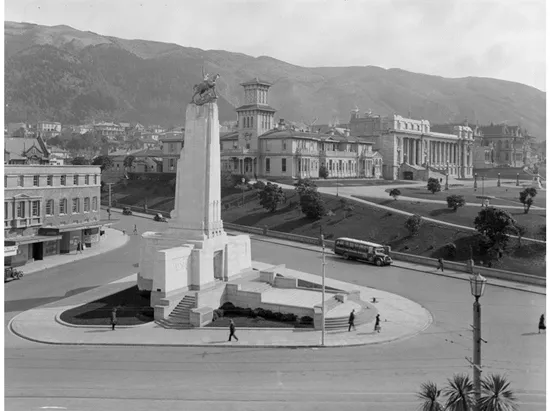
Figure 1.1 The Cenotaph in the 1930s; the Parliamentary precinct, then separated from the memorial by a road, is in the background (Source: Crown Studios Collection, Ref: 1/1–032755-F. Alexander Turnbull Library, Wellington, New Zealand. Reproduced with kind permission).
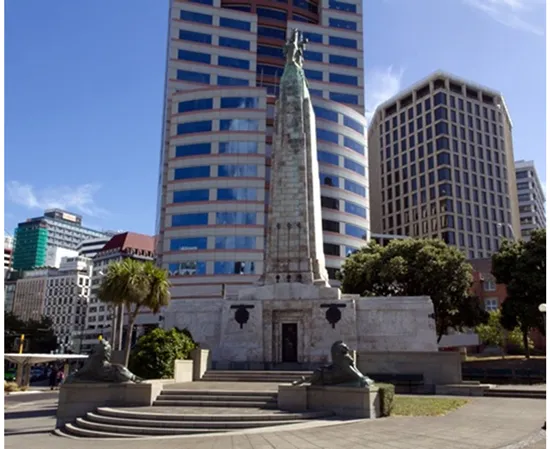
Figure 1.2 The Cenotaph today; the lions and plaques are later additions, as is the paving creating a pocket park and a physical link to the Parliamentary precinct.
Pukeahu, by contrast, is a work in progress. At the time this study was carried out, areas of the park were still under development.1 Not only is it a far newer site than the Cenotaph, it is considerably larger, and it was conceived of, by the central government, as a national site of remembrance. As described by the Ministry of Culture and Heritage:
The Pukeahu National War Memorial Park is the national place for New Zealanders to remember and reflect on this country’s experience of war, military conflict and peacekeeping, and how that experience shapes our ideals and sense of national identity.2
The involvement of government in the design of the park points to the fact that Pukeahu is an exercise in heritage politics, where decisions are made about what to select for inclusion. As Abdelhay et al. (2016) explain when discussing the historic heart of Jeddah, inclusion requires passing ‘through a set of regulatory conditions and criteria to be selected as part of the heritage record’ and as a result some elements of heritage become ‘part of the nationally shared memory while others would be erased’. Unusually perhaps, the design of Pukeahu was the creation of a new space, extending and adding meaning to an existing space; the design was not ‘complicated’ by what was already...
Table of contents
- Cover
- Halftitle Page
- Title Page
- Contents
- List of Figures
- Tables
- List of Contributors
- Acknowledgements
- Introduction
- Part 1: Monuments
- Part 2: Museums
- Part 3: Memories
- Conclusions
- Index
- Imprint
Trusted by 375,005 students
Access to over 1.5 million titles for a fair monthly price.
Study more efficiently using our study tools.
Frequently asked questions
Yes, you can cancel anytime from the Subscription tab in your account settings on the Perlego website. Your subscription will stay active until the end of your current billing period. Learn how to cancel your subscription
No, books cannot be downloaded as external files, such as PDFs, for use outside of Perlego. However, you can download books within the Perlego app for offline reading on mobile or tablet. Learn how to download books offline
Perlego offers two plans: Essential and Complete
- Essential is ideal for learners and professionals who enjoy exploring a wide range of subjects. Access the Essential Library with 800,000+ trusted titles and best-sellers across business, personal growth, and the humanities. Includes unlimited reading time and Standard Read Aloud voice.
- Complete: Perfect for advanced learners and researchers needing full, unrestricted access. Unlock 1.5M+ books across hundreds of subjects, including academic and specialized titles. The Complete Plan also includes advanced features like Premium Read Aloud and Research Assistant.
We are an online textbook subscription service, where you can get access to an entire online library for less than the price of a single book per month. With over 1.5 million books across 990+ topics, we’ve got you covered! Learn about our mission
Look out for the read-aloud symbol on your next book to see if you can listen to it. The read-aloud tool reads text aloud for you, highlighting the text as it is being read. You can pause it, speed it up and slow it down. Learn more about Read Aloud
Yes! You can use the Perlego app on both iOS and Android devices to read anytime, anywhere — even offline. Perfect for commutes or when you’re on the go.
Please note we cannot support devices running on iOS 13 and Android 7 or earlier. Learn more about using the app
Please note we cannot support devices running on iOS 13 and Android 7 or earlier. Learn more about using the app
Yes, you can access Multilingual Memories by Robert Blackwood, John Macalister, Robert Blackwood,John Macalister in PDF and/or ePUB format, as well as other popular books in Languages & Linguistics & Sociolinguistics. We have over 1.5 million books available in our catalogue for you to explore.