What role do texts play in religious practice? What is the relationship between these texts and cognition? Are some texts more successful because they are better adapted to our cognitive structures? Why is biblical interpretation necessary, and what is the cognitive process behind it? This book considers such questions, and fills the gap in research on religious texts and narratives in the cognitive science of religion.
The study of ancient religions and biblical studies are dominated by textual evidence. However, the cognitive science of religion is lacking significant research on the language and textual interpretation of this literature. This book presents a systematic attempt to redefine the interpretation of religious texts in a cognitive framework, providing concrete textual analysis on a broad selection of biblical passages. It explores the ways that cognitive approaches to language and textual interpretation expand the disciplines of the cognitive science of religion and biblical studies.
This book brings together methodology from the cognitive sciences, linguistics, philology, biblical studies, and religious studies, to offer a new perspective for biblical studies and cognitive sciences. It presents a renewed vision of textual interpretation - one that aligns hermeneutical reflection with our cognitive capacities.
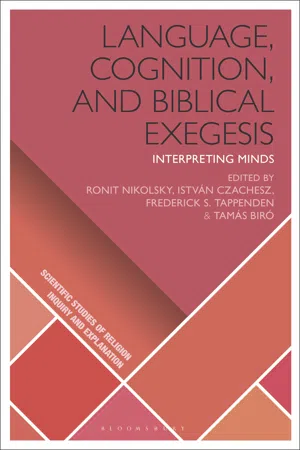
eBook - ePub
Language, Cognition, and Biblical Exegesis
Interpreting Minds
- 256 pages
- English
- ePUB (mobile friendly)
- Available on iOS & Android
eBook - ePub
Language, Cognition, and Biblical Exegesis
Interpreting Minds
About this book
Information
1
Cognitive Science and Biblical Interpretation
There are two kinds of exegetes: first, the ones who study words for the sake of matters; second, the ones who study matters for the sake of words (Jacob Grimm). They who study words for the sake of matters ask what the text can reveal about the history or the religious universe that it represents. They who study matters for the sake of words wish to use our knowledge of the history and religion of the Bible to interpret concrete texts. Biblical scholars have so far made use of cognitive approaches to religion in order to enhance our understanding of early Jewish and early Christian religion (Czachesz 2017b). These studies proceeded from concrete texts to ask questions about cognitive structures behind concepts, rituals, and moral behavior that the text mentions or that can be identified in the background of the text. It is also possible, however, to reverse the process, and ask whether our enriched knowledge about religion allows for a better understanding of the texts by shedding new light on words and their history, supporting philological and text-critical analysis, and providing new understandings of the process of transmission, as well as of the forms and functions of texts. In what follows we want to put forward a few considerations with regard to these new opportunities. We will concentrate on five domains, in particular:
1. Cognitive factors at the production of the text. What is the relation between texts and cognition? Are texts changing expressions of cognitive patterns, which remain more or less unchanged, while being realized in always new forms? How do texts influence our cognition? What kind of role do texts play in religious practice?
2. Cognitive factors at the diachronic transmission of texts. How can we account for stability and change in texts as they are transmitted? Texts are subject to evolutionary processes in different ways. Do they change so that they become accommodated to the structure of the human mind? Which tendencies of change can we observe in this process?
3. Cognitive factors at the synchronic analysis of texts. Can we understand differences between types, forms, and genres of texts in terms of cognitive categories? For example, metaphorical texts have a different relation to their referents than non-metaphorical texts.
4. Cognitive factors at the reception of the text. How can we explain the long-term success of some texts? Are some texts more successful than others because they are better adapted to human cognitive structures?
5. Cognitive factors at the meta-textual classification of texts, especially at the ascription of sacredness and “canonical” status. How do some texts become canonical? Which pre-scientific theories have the greatest chance to validate the sacred status of texts successfully and promote their acceptance?
It is important to note that whereas we suggest that our five topics offer a heuristic map for understanding the complex problem of the genesis and use of religious literature, we do not ignore overlaps or interactions among these areas. For example, the impact of the text on the reader or listener is an important factor during the formative period of the text as well as in its later history of reception, and in both phases changes can be introduced to the text as a result. However, the text can be changed to different degrees in different periods and contexts, allowing for adaptations to cognitive constraints at some point (when optimization processes are dominant), while making such changes is more difficult in other contexts and periods (when reception receives the main focus). This further directs attention to the connection between reception history and canonization, inasmuch as the canonical (or sacred) status of a text strictly limits the conditions under which it can be used or changed.
What do we mean by the “adaptation” of religious texts? Humans inherit genes, behaviors, ideas, and artifacts from their forebearers, all of which are influenced by evolution (Jablonka and Lamb 2005; Stone et al. 2006; Jablonka and Lamb 2007, 353–65). Since genetic evolution is slow, we can assume that most of the mental structures that evolved in our hominid and human ancestors, because they have helped their survival, are with us and largely determine the setup of the human mind. Naturally, we also share these structures with people living in biblical times. There are also interactions between different types of evolution. Our anatomy and physiology arguably determine the ways we can evolve in any dimension. For example, we cannot acquire just any language: we must use sounds that we can articulate and hear. It is also important that the tools and ideas we have influence our genetic evolution (Deacon 1997; Richerson and Boyd 2004). For example, evolution adapted our larynx to the use of language and the skills of our ancestors evolved further by using tools. In terms of evolution, we are both similar to and different from the people who lived in the first century Mediterranean world. Most important, similarities include maturationally natural features, which develop in children in fairly constant ways in a wide range of environmental and cultural circumstances and are therefore cross-culturally recurrent (McCauley 2000, 2011), such as the distinction we make between living and non-living things and other aspects of cross-culturally shared ontological categories (see below). Furthermore, social learning relies on such evolved abilities (e.g., speech), and the information that we learn is also fundamentally shaped by such abilities (e.g., vision, memory, ontological distinctions). Finally, differences between people living in the first-century Mediterranean and ourselves are due mostly to evolution that has taken place in other domains than in our genes.
Our suggestions proceed from the following general thesis: texts are subject to selective processes in cultural transmission and will be shaped in ways that correspond to human cognitive capacities. Texts need to be able to raise attention, be understood, be stored in cultural memory in the long run, and remain accessible for retrieval from cultural memory. The better some text fulfills these criteria, the more successful it will be in cultural transmission. Although textual transmission can be influenced by historical accidents (such as the loss of a huge number of books at the burning of the Royal Library of ancient Alexandria in 48 bc), the impact of cognitive factors will become increasingly important if we examine processes on sufficiently large timescales. Among all ancient documents that have been transmitted and read in the history of Western civilization, biblical literature inevitably belongs to the most widely known and used group of texts.
In a sense, the aim of every interpretation is to find out what happens in the authors’ and readers’ cognition as they write or read texts, respectively. The promise of a cognitive approach lies in its potential to explain such cognitive processes with reference to general models. Cognitive models are rooted in various research traditions. Modern linguistics postulates the existence of universal mental structures, which we do not acquire by learning languages (including our mother tongue), but which are maturationally natural and help us learning and understanding natural languages. Artificial intelligence research deals with cognitive processes that can be implemented as computer programs (although artificial intelligence does not have to be psychologically realistic). Evolutionary psychology and evolutionary anthropology look for adaptive patterns of thought, perception, processing, and emotion, which are trans-culturally widespread and about which we can theoretically presuppose that all people have had them in any part of the world at any time in history. Neuroimaging makes processes in our brains visible and correlates them with our behavior and experience. Psychology, since its cognitive turn, looks for internal, mental processes in humans. Before the cognitive turn, such processes were deemed to be inaccessible, and their study was not considered viable or important. A cognitive approach also provides insights about cultural variables, and therefore its application to the interpretation of texts with varied historical backgrounds is a promising perspective. It is imperative, beyond doubt, to mobilize the wealth of knowledge about cognitive processes for the interpretation of concrete, culturally shaped texts. Cognitive approaches to texts share the principal insight that describing, classifying, and analyzing physically tangible texts is not yet sufficient to understand them. We also have to come to grips with the cognitive models that govern their production and reception.
Consequently, cognitive processes are equally relevant for the interpretation of religious texts, whether we select the author, the reader, or the text itself as the focus of our interpretation. To delineate our methodology, we would like to introduce the concept of the cognigram. Evolutionary anthropologist Miriam N. Haidle (2009; 2014) introduced cognigrams to offer graphical representations of cognitive processes that underlie the production of an artifact, such as a spear. When we adopt the term to cognitive exegesis, we are looking for cognigrams that represent processes in the minds of people as they write and read texts. Without understanding such invisible cognitive processes governing text production and reception, we would be unable to understand a text, even if our visual and auditory systems could process it. Cognigrams rely on two kinds of cognitive processes. Maturationally natural cognition, which we already introduced above, develops in fairly constant ways in children in a wide range of environmental and cultural circumstances and is therefore cross-culturally recurrent. It is important to note that maturational naturalness does not simply arise from genetic inheritance but from genetic information that is activated by environmental factors during child development. Other cognitive processes that come “naturally” to us involve practiced naturalness (McCauley 2011), which is based on goal-directed learning. Riding a bicycle, for example, might come quite naturally to some of us, but it is acquired by specific practice rather than spontaneous learning. The interpretation of (religious) texts involves both types of abilities. On the one hand, linguistic communication and many cognitive structures, including religious ones, are maturationally natural; on the other hand, aesthetic judgment, scientific thinking, and many theological concepts involve practiced naturalness.1
The cognitive interpretation of religious texts explores connections between human cognition and religious documents in a two-way process. On the one hand, there is a deductive process, in which the results of cognitive science and evolutionary studies are used to interpret religious texts (biblical literature in our case). When using the results of cognitive and evolutionary science, we assume that people in antiquity shared basic cognitive structures with us, and therefore the models of cognitive science are relevant for the study of humans who lived two thousand years ago. On the other hand, ancient texts carry imprints of the cognition of human beings who lived in a different cultural environment than ours. In an inductive process, we can look for the reflection of people’s cognigrams in the artifacts they left behind, and try to use such cues to draw the cognitive profile (cognigram) of the creators and users of the texts. We can expect this profile to be partly similar to ours, but also different in some ways. Although the time that separates us from people living in antiquity is short if measured on an evolutionary timescale, culture is capable of changing in such a period of time—demonstrated, for example, by the cultural consequences of the industrial revolution. Time to time we have to ask whether the imprints of ancient minds on the texts should be interpreted in terms of pan-human cognitive factors shared by ancient people and us, or whether they reflect cultural differences. Ancient texts are therefore precious artifacts, similar to the primitive tools that paleoanthropologists use to understand the human mind of our prehistoric ancestors. In this way, the cognitive study of (ancient) religious texts can contribute to a better understanding of human cognitive processes, including both its pan-human nature and cultural manifestations.
To carry the analogy further, texts are not only products of cognition; they are also tools we think with. Religious texts have been used in rituals, provided tools for manipulating reality in magical practices, or for organizing human societies; they have been the sources of philosophical reflection and legislation. They have been instrumental in changing the course of European history in the Reformation, and in reflecting on historical traumas. Religious texts have affordances; that is, they lend themselves to particular cognitive and cultural uses.
Texts production and cognition: The place and significance of texts in religion from a cognitive perspective
From the cognitive point of view, texts are external memory stores. In religions, beliefs are stored and transmitted in two different forms: as memories (technically speaking, connection patterns of neural networks) in the brains of human beings, and as information recorded in texts as well as in other artifacts. To give examples of the latter, sacred objects, sanctuaries, ritual vestments, churchyards, and the configuration of physical space record and transmit information about the belief system and mythology of a religion. That is why we can read archaeological data as if we were reading texts and apply hermeneutical methods to them similar to the ones that we use to decipher ancient written sources. Texts are special kinds of religious artifacts, which store information using the medium of language. Artifacts, including texts, interact with beliefs stored in people’s minds. That artifacts are important in religion needs no particular explanation among biblical scholars. Taking one step further, we can easily see that texts and other artifacts are not mere recordings of people’s beliefs but constitutive parts of religious systems (Czachesz 2013a). Reformation, for example, was largely driven by interpretations of biblical literature. Protestant theology, in general, defines itself as an ongoing exegetical enterprise and regards the Bible as an active agent rather than a passive container of data. Gerhard Ebeling and Karlfried Froehlich championed the hypothesis that the history of the Church is the history of biblical interpretation (Ebeling 1947; Froehlich 1978). In evangelical churches,2 the Bible has deep influence on almost every single event on believers’ everyday lives, which has been examined from a cognitive perspective (Malley 2004). We can also think of examples from outside of the realm of Protestantism. The relics of the saints, the shroud of Turin, the Torah, or the temple of Jerusalem do not simply record and convey information from the past, but clearly play a constitutive role in the respective religious systems.
Artifacts and human memory are not entirely symmetrical parts of religious systems: human minds perform cognitive tasks that artifacts cannot. It is the reader who reads the text, and not the other way around. The point is, however, that religions (especially the ones under consideration in this volume) are unthinkable without a constant interaction between their beliefs and texts (as well as other artifacts). On a general level, human language (and material culture) has shaped the human mind as much as humans shaped their environments, in a process known as “cognitive ratcheting”(Tomasello 2009 [1999]; cf. Tomasello, Kruger, and Ratner 1993): small changes in the mind lead to small changes in the artifacts, which, in turn, initiate further changes in the mind. As our previous examples demonstrate, such mutual influence is clearly visible in many religious traditions, which often recognize it and reflect on it very explicitly.
The oldest form of representing texts is the oral medium. In a sense, oral literature is nothing else than the acoustic representation of mental representations, which makes it difficult to speak of such literary works as “artifacts” that would autonomously exist in the same way as, for example, axes and arrows exist. But an understanding of oral literature as the mere externalization of a pre-existing mental content is equally problematic. Orality studies and psychological studies of orality have demonstrated that oral literature is not something that exists in a readymade form in the heads of singers. In his Memory in Oral Traditions, David C. Rubin analyzed different types of oral literature and concluded that when people recall texts, they rely on features such as the organization of meaning, imagery, and sound patterns, the latter including rhyme, alliteration, and assonance, as well as rhythm and music (Rubin 1995, 10). The process of producing a text relies on its sequential organization: “Oral traditions, like all oral language, are sequential. One word follows another as the physical effects of the first word are lost. As the song advances, each word uttered changes the situation for the singer, providing new cues for recall and limiting choices” (Rubin 1995, 175). Oral texts are thus best understood as artifacts that are created during every performance on the spot. Every instance of oral literature is an artifact that exists only momentarily. This is not unique to oral literature: academic lectures read from notes and improvised jazz also share the short-lived nature of oral artifacts. The momentary, sequential, and improvised nature of these artifacts does not mean, however, that their actual appearance would be entirely random. Cognitive schemata, such as narrative scripts, provide blueprints for all examples of improvised artifacts. The examination of these cognitive factors and the process of the oral performance provide interesting new research perspectives for biblical scholars, who regularly deal with texts created in the oral medium.
It is widely recognized that the oral medium played a significant role in the formation of early Christian literature, to which we will return below. It would be a mistake, however, to regard early Christianity as a purely oral culture, or to limit the examination of cognitive factors to oral texts alone (cf. Kelber 2008; Czachesz 2009a). The nature of ancient literacy was such that memory played a significant role in all aspects of it. Ancients habitually read aloud, had texts read to them by slaves, or listened to public readings (Starr 1987; Johnson 2000). Owning books had the significant function of signaling social and intellectual status, and most reading was social activity: typically, books were read and discussed in bookstores or at dinners and symposia held in private homes. When listening to a text and subsequently discussing it with a group of peers, people encountered literature as an oral/aural rather than visual event (Rawson 1985; Johnson 2000, 612–15). Authoring texts also involved memory to a great extent. The use of written sources was constrained in several ways. First, books were written continuously, without punctuation or word division (scriptio continua), thus providing no visual aids that would help the eye in finding particular passages. Second, the scroll format was less than optimal for jumping across different parts of a book to find a passage or compare different passages. Third, ancients did not use desks on which they could have laid out scrolls (or later codices), which would have enabled them to use multiple sources critically (in a modern sense) when writing a new text (Downing 1992, 2000, 174–98; Houston 2014, 197–204). Again, relying on memory or having slaves to read out sources aloud (which again involved the use of memory) could provide solutions to overcome such difficulties. For the study of biblical literature it is therefore imperative to understand cognitive factors that underlie the memorization and retrieval of texts for the purpose of retelling, discussing, or authoring literature.
In addition to rethinking the relationship between beliefs and texts, a cognitive approach to biblical literature also has the potential of shedding new light on the connection between texts and rituals. On the one hand, texts reflect on rituals, giving us clues about ritual practices as well as the views that ancient people held about their own rituals, such as Paul’s discussion of the Corinthians’ ritual meal in 1 Corinthians 11. Cognitive theorizing about how people think of rituals offers new perspectives on the interpretation of these passages (e.g., Uro 2016, 128–53; Czachesz 2017a, 88–121). On the other hand, rituals provide contexts, in which texts are transmitted. This is obviously the case in oral transmission, but also literate artifacts (prominently, the Bible itself) appear in various ritual contexts and their religious use and transmission would be unthinkable without such contexts. Cognitive work on the effect of rituals on memorization is a promising perspective for studying these processes (Whitehouse 2004; Czachesz 2010c; Uro 2016, 154–77; Czachesz 2018a).
Cognitive factors at the diachronic transmission of texts: How texts change...
Table of contents
- Cover
- Halftitle Page
- Title Page
- Contents
- Notes on Contributors
- Preface
- Introduction: Cognition, Evolution, and Biblical Exegesis
- 1. Cognitive Science and Biblical Interpretation
- 2. Emotional Fear in Pentateuchal Legal Collections
- 3. Liquid Life: Blood, Life, and Conceptual Metaphors in the Hebrew Bible and the Ancient Near East
- 4. “To Love”(אהב) in the Bible: A Cognitive-Evolutionary Approach
- 5. “The Glory of the Lord Has Risen upon You”: Some Observations on the “Glory”-Language of Isa. 56–66 Based on a Cognitive Semantic Approach
- 6. The Influence of Categorization on Translation Meaning
- 7. Imaging Resurrection: Toward an Image Schematic Understanding of Resurrection Beliefs in Second Temple Judaism
- 8. Liturgical Linguistics: Toward the Syntax of Communicating with the Superhuman Agent in Judaism
- 9. Forgiveness of the Sinless: A Classic Contradiction in 1 Jn in the Light of Contemporary Forgiveness Research
- 10. Christian Beginnings and Cultural Evolution
- Notes
- Bibliography
- Index of Ancient Sources
- Index of Modern Authors
- General Index
- Imprint
Trusted by 375,005 students
Access to over 1.5 million titles for a fair monthly price.
Study more efficiently using our study tools.
Frequently asked questions
Yes, you can cancel anytime from the Subscription tab in your account settings on the Perlego website. Your subscription will stay active until the end of your current billing period. Learn how to cancel your subscription
No, books cannot be downloaded as external files, such as PDFs, for use outside of Perlego. However, you can download books within the Perlego app for offline reading on mobile or tablet. Learn how to download books offline
Perlego offers two plans: Essential and Complete
- Essential is ideal for learners and professionals who enjoy exploring a wide range of subjects. Access the Essential Library with 800,000+ trusted titles and best-sellers across business, personal growth, and the humanities. Includes unlimited reading time and Standard Read Aloud voice.
- Complete: Perfect for advanced learners and researchers needing full, unrestricted access. Unlock 1.5M+ books across hundreds of subjects, including academic and specialized titles. The Complete Plan also includes advanced features like Premium Read Aloud and Research Assistant.
We are an online textbook subscription service, where you can get access to an entire online library for less than the price of a single book per month. With over 1.5 million books across 990+ topics, we’ve got you covered! Learn about our mission
Look out for the read-aloud symbol on your next book to see if you can listen to it. The read-aloud tool reads text aloud for you, highlighting the text as it is being read. You can pause it, speed it up and slow it down. Learn more about Read Aloud
Yes! You can use the Perlego app on both iOS and Android devices to read anytime, anywhere — even offline. Perfect for commutes or when you’re on the go.
Please note we cannot support devices running on iOS 13 and Android 7 or earlier. Learn more about using the app
Please note we cannot support devices running on iOS 13 and Android 7 or earlier. Learn more about using the app
Yes, you can access Language, Cognition, and Biblical Exegesis by Ronit Nikolsky, István Czachesz, Frederick S. Tappenden, Tamás Biró, Ronit Nikolsky,István Czachesz,Frederick S. Tappenden,Tamás Biró in PDF and/or ePUB format, as well as other popular books in Theology & Religion & Linguistics. We have over 1.5 million books available in our catalogue for you to explore.