To what extent is theatre a contagious practice, capable of undoing and enlivening people and cultures? Theatres of Contagion responds to some of the anxieties of our current political and cultural climate by exploring theatre's status as a contagious cultural force, questioning its role in the spread or control of medical, psychological and emotional conditions and phenomena. Observing a diverse range of practices from the early modern to contemporary period, the volume considers how this contagion is understood to happen and operate, its real and imagined effects, and how these have been a source of pleasure and fear for theatre makers, audiences and authorities. Drawing on perspectives from medicine, neuroscience, psychology, anthropology, philosophy, law and affect theory, essays investigate some of the ways in which theatre can be viewed as a powerful agent of containment and transmission.
Among the works analysed include a musical adaptation and an intercultural variation of Shakespeare's Romeo and Juliet; a contemporary queer take on Hamlet; Grand Guignol and theatres of horror; the writings and influence of Artaud; immersive theatre and the work of Punchdrunk, and computer gaming and smartphone apps
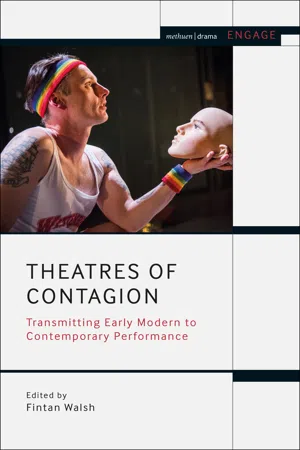
eBook - ePub
Theatres of Contagion
Transmitting Early Modern to Contemporary Performance
- 232 pages
- English
- ePUB (mobile friendly)
- Available on iOS & Android
eBook - ePub
Theatres of Contagion
Transmitting Early Modern to Contemporary Performance
About this book
Information
1
Contagious Performance: Between Illness and Ambience
The age of globalization is the age of universal contagion.
Michael Hardt and Antonio Negri, Empire (2000)
European theatre is ‘beginning to infect’ British theatre, David Hare charged in 2017, with theatre makers spoiling the health of dramatic writing and the once vigorous state of the nation play (Sweet 2017: 69). Hare’s comments built on the commonly shared belief that theatre is a contagious cultural phenomenon, in no small part due to its capacity to draw bodies closely together in the event of live performance. While on the surface Hare’s remarks were angled at theatre practice, especially at a perceived waning of dramatic writing in favour of more experimental performance modes, they were more fundamentally targeted at the globalized cultural climate that enabled international styles and models to affect and cross-fertilize more traditional British forms. Hare’s criticisms generated some media controversy at the time of their publication, when they found themselves amplified by chiming with other sentiments largely emanating from the UK and the United States. In the wake of the Brexit vote and Trump’s presidency, for instance, political discourse became dominated with calls for distinct and stable cultural boundaries, impervious to corrupting external influences, especially migrants. Theatre’s contagiousness, in Hare’s formulation, is also a matter of sociopolitical cause and consequence, insofar as it is cultivated by too much contact amongst diverse individuals, places and cultures.
In the same year, Neil Bartlett’s The Plague opened at the Arcola Theatre, London. Bartlett’s play is a theatrical adaptation of Albert Camus’s 1947 novel of the same title, set in the Algerian city of Oran, in which a mysterious illness spreads throughout the population. On a narrative level, the novel addresses the devastation of real plagues throughout history, but on an allegorical plain, it investigates the rapid spread of fascism throughout a community, likened to pathogens passing between bodies. (Indeed, Eugène Ionesco’s play Rhinoceros (1959) would later critique fascism from a similar perspective, by depicting characters metamorphosing into rhinoceroses to capture its herd-like psychological structure.) Bartlett’s play is presented as a public inquiry, in which five witnesses recall the events they have seen, from the relative safety of its aftermath. Here both plague and its fascist analogy still stand, but in erasing all references to a specific time and place, the play allows for more contemporary resonances too. We hear in Bartlett’s writing echoes of the AIDS epidemic which came well after Camus’s novel, and which aligns with the queer politics of much of Bartlett’s other work, but also a critique of populist ideologies on the rise throughout the world at the time of the play’s production as fascist germs. As the voices of characters Grand, Tarrou and Rambert resound in chorus to the question of what the plague really is: ‘Life’s a plague’ (Bartlett 2017: 66). But if life is a plague, theatre is a form in which destructive forces can be summoned for scrutiny, and epidemiology dramaturgically interpreted and modelled. As the doctor Rieux describes her own contribution to the inquiry at the end of the play, theatre can be a place to speak up and bear witness, to remember and affirm: ‘I decided to not be one of the people who keep silent, but to speak up and bear witness […] there is more to admire about people than to despise or despair of’ (Bartlett 2017: 67). With joy always under threat, as Rieux continues to observe (68), we are led to believe that theatre might even sow the seeds of collective pleasure. Here joy is pitched as a remedy for suffering, theatre as an antidote to fascism.
With these reference points, I introduce three different ideas of theatrical contagion central to this volume. In the first, via Hare, theatre is imagined as a culturally corrupting force, often spreading from the East to the West; in the second, via The Plague, theatre endeavours to represent disease and its psycho-medical impact; and in the third, by the end of the same play, it is capable of countering the worst effects of illness and any suspicions of contamination through the invigorating exchange of information, feelings and culture. These same ideas appear at different turns throughout this book, with authors testing the claims across a diverse range of theatre and performance practices, from the early modern to contemporary periods.
The primary aim of this book is to investigate theatre’s status as a contagious cultural practice by questioning its role in the spread or control of medical, psychological and affective conditions and phenomena. We might envisage these along a sliding spectrum, running from illness to ambience, the former denoting bodily disease and the latter experienced environment and mood. In between these points hover a range of physiological, psychological and affective experiences that pass – or seem to – between people, cultures and things. That they seem to is as important as any certainty that they do, for the fantasy of and desire for contagion are often as powerful as any biological or chemical fact. As many of the essays collected here demonstrate, with contagion the literal and the metaphorical, the real and suggestive, often overlap and blur.
While discrete chapters pursue specific concerns, the book is devoted to exploring a number of key questions, which weave throughout its pages: (1) how has contagion been understood to happen and operate?; (2) what are its real and imagined effects?; (3) how have these effects been a source of distress and pleasure for theatre makers, audiences and various authorities?; and finally (4) what does theatrical contagion suggest about the real and imagined work of our cultural borders and structures of social-political organization? Ultimately, arguments in the book broadly contend that theatre is a cultural practice in which all sorts of matter, behaviours, illnesses, conditions, emotions, affects, moods, ideas, social and cultural phenomena pass around and between bodies and their environments – or are imagined or willed to – and are sometimes guarded against.
In terms of touch
As a term which defies boundaries, ‘contagion’ has developed different meanings and applications across a range of disciplines. In this volume it is variously approached as metaphoric, speculative and real, drawing on perspectives from medicine, neuroscience, psychology, anthropology, philosophy, law and affect theory. Despite being a subject of wide disciplinary concern, contagion is primarily associated with the domains of medicine and biology, especially pathologies. In medicine, contagion is usually taken to mean something contracted by physical contact, while infection occurs airborne. But central to both terms is the idea that matter, whether seen or unseen, moves around and between bodies. Perhaps for this reason, the sheer idea of contagion has long held power for makers and audiences of theatre, where bodies wilfully come to encounter others in close proximity. At the theatre, some form of contagion is often what is feared as well as what is deeply desired.
While contagion is explored from different disciplinary perspectives in this book, many chapters stay close to its etymological definition, which is rooted in notions of touch. The Latin contāgiōn-em, for example, incorporates con (with, together) and tangere (to touch). Whatever its precise causation, or its seemingly positive, negative or ambivalent effects, we can agree that contagion always draws attention to the impact of touch, no matter how surface or deep. And as Roland Barthes reminds us in Camera Lucida, we do not touch only with the hand but may also do so with the eye (Barthes [1980] 1982). Indeed, all senses have this haptic potential in their capacity to draw us into closer contact with the objects of our apprehension. Priscilla Wald discusses some of the meanings which gather around contagion to argue that the word ‘tells us about the many ways in which we are in contact; it shows us whom we have touched both literally and figuratively, or more to the point, it blurs the distinction between them’ (Foreword in Nixon and Servitje 2016: vi). To think about theatre and contagion, I suggest, is always to consider their enmeshment in the realities and fantasies of touch.
To approach the world through the prism of contagion is at one level to consider how everything is constructed through the exchange of matter, and the effects and affects of that process; to think across, as Jane Bennett suggests, ‘the quarantines of matter and life’ (Bennett 2010: vii). This is a broad axiom shared by scientific disciplines from astrophysics to biology, whose modern manifestations can be traced to the Renaissance era. Astrophysics tells us this about the universe at large, and biological branches (including medicine, neuroscience and genetics) offer a similar but more schematic story of human physiology, attesting to the ways other bodies, especially genetic relatives, shape our own. In the past decade or so, theories of epigenetics have freshly posited that our genes may not just carry physical data but memories and traumas experienced by our ancestors (e.g. Yehuda et al. 2016). Scientific studies of mirror neurons have claimed that in seeing behaviours performed, our brains act as if we have performed them ourselves (e.g. Prochazkova and Kret 2017), potentially explaining a whole range of imitated behaviour which has been widely speculated about at least since Plato’s Republic (c. 380 BCE).
For much of the twentieth century, ideas of intergenerational transmission were less likely to have been heard within medicine than Freudian psychoanalysis, whose conceptualization of psychic life has always been haunted by the intersubjective and sometimes intergenerational dynamics of memory, desire, transference, doubling and repetition. In more mainstream sociology and psychology, notions of emotional contagion, imitation and imprinting form the building blocks of psycho-social life. For phenomenologists and affect theorists, what can feel like the contagious distribution of physical sensation is the effect of bodily matter bristling against worldly experience. These disciplines all accede, in different ways, to how the circulation and exchange of matter construct ourselves and our worlds, while offering a vast and varied vocabulary for understanding how contagion and its corollaries operate.
I am necessarily simplifying disciplinary complexity and nuance with this overview to fashion a working sense of how contagion is understood across different disciplines. But while this comprehension is important, these definitions alone do not account for how contagion morphs under the influence of power and desire, which are crucial to understanding cultural processes and practices. For it is only when contagion is somehow longed for or resisted that we glimpse its hold on the human imagination and societies, and the ways in which it shapes our sense of self and other(ness), particularly in terms of identity, community and belonging. Of course, theatre is created by the desire and power of multiple invested parties, and it is often also a crucible for their dissection. How power and desire shape different disciplinary understandings of contagion is central to many of the essays gathered in this volume.
While contagion’s dream is of unity and transformation, its nightmare is of indistinction and destruction. As Roberto Esposito tells us, because of its inherent concern with boundary formation and management, contagion appears as a subject across a swathe of disciplines, often to account for how ‘what was healthy, secure, identical to itself, is now exposed to a form of contamination that risks its devastation’ (Esposito 2011: 2). Thinking contagiously reminds us that we are amalgams at atomic and experiential levels and that our physiology, psychology, emotional and social lives are forever influenced by our contact with each other and the world. Thinking contagiously through theatre, we not only see disciplinary walls start to crumble, but the centrality of the body to this folding and unfolding. For this reason, contagious inquiry has the capacity to unravel both intellectual boundaries and ideas of liberal Western subjectivity that imagine the individual as autonomous, sealed and bounded.
Plagues of history
The book’s subtitle can be read in a number of ways. First, it signifies the volume’s concern with contagion as a mode of transmission within the temporal parameters of the study. Second, it marks the early modern period as a time during which contagion became a topic of heightened concern for theatre makers and audiences, and the world around them. Third, it captures the significant amount of exchange between the early modern and contemporary period, particularly evidenced via contemporary productions, adaptations or responses to early modern work invested in ideas of contagion. Part of the challenge in editing this book has been to manage interdisciplinary study across a long historical sweep, but there is no way to neatly contain contagion. As many essays reveal, any analysis of the term rapidly introduces numerous other disciplines, and many of its contemporary cultural iterations quickly draw us back to early modern concerns. At some level, contagion is always about the transmission of history.
Since the sixteenth century the word ‘contagion’ has been in regular circulation in literary and medical texts, largely as a result of outbreaks of smallpox, syphilis, typhus, malaria and especially the bubonic plague. Plague had erupted across Europe since the fourteenth century ending with the Great Plague of London in 1665–6. Its effect was not only to decimate populations but to raise awareness of the vulnerability of the body to poor hygiene and illness, as well as to death.
A number of medical and politically attuned writers responded to the plague during this time. Published in 1603 in London, Thomas Lodge’s Treatise of the Plague mapped the spread of disease throughout the city. The Italian physician, poet and scholar Girolamo Fracastoro published two treatises on the subject of contagion: the epic poem Syphilis, or, A Poetical History of the French Disease (Syphilis sive Morbus Gallicus) in 1530 and De Contagione et Contagionis Morbis et eorum Curatione Libri Tres in 1546. These texts challenged the prevailing Gallenic humoral theory of disease transmission, which held that an imbalance of the four humors created illness, by arguing that disease was communicated by the body’s intake of external infectious agents.1 In this way they prefigured advancements in nineteenth-century germ theory, which makes itself present in the work of Henrik Ibsen and George Bernard Shaw (see Kirsten E. Shepherd-Barr’s chapter). Around the same time, a number of political tracts emerged which drew analogies between the body and the state, including William Averell’s A Mervailous Combat of Contrareties (1588) and Edward Forset’s A Comparative Discourse of the Bodies Naturall and Politique (1606).
These latter texts blur medical and cultural understanding by positioning the state as an entity which requires protection from external agents, which for the incipient British Empire often included other cultures and trading partners, colonized and enslaved peoples, and foreign enemies and migrants, including the expanding Jewish community in parts of Western Europe. For this reason, Michael Hardt and Antonio Negri argue that globalization is coterminous with the advent of ‘universal contagion’ (Hardt and Negri 2000: 136). As the world became more connected than ever before in the early modern period, anxieties around the spread of illness, ideas and cultures also grew. Of course these persist in contemporary concerns around open borders and free movement, which have precipitated nationalist agendas such as Brexit and US migration policies under Trump, including the president’s promise to build a wall on the US-Mexico border. In discussing the wall, Trump routinely blurs the political, cultural and medical, describing Mexicans as being responsible for introducing ‘tremendous infectious disease’ as well as moral and criminal corruption.2 But the desire to spread and share, history teaches us, also precipitates the impulse to defend. As Esposito puts it, ‘the greater the vulnerability of the body politic must have appeared, the more urgent the need became to hermetically seal the orifices that had opened up in its frontiers’ (2011: 123).
The early modern interest in contagion, therefore, is closely connected to the appetites of empire and its entwinement with medical discourse. But as Donna Haraway has pointed out, in the paranoid colonial imagination...
Table of contents
- Cover
- Halftitle Page
- Title Page
- Contents
- List of Figures
- Notes on Contributors
- Acknowledgements
- Introduction
- 1. Contagious Performance: Between Illness and Ambience
- Part One: Infectious Bodies and Behaviours Infectious Bodies and Behaviours
- Part Two: Sites of Contamination and Containment
- Part Three: Conducting Emotions, Moods and Minds
- Index
- Imprint
Trusted by 375,005 students
Access to over 1.5 million titles for a fair monthly price.
Study more efficiently using our study tools.
Frequently asked questions
Yes, you can cancel anytime from the Subscription tab in your account settings on the Perlego website. Your subscription will stay active until the end of your current billing period. Learn how to cancel your subscription
No, books cannot be downloaded as external files, such as PDFs, for use outside of Perlego. However, you can download books within the Perlego app for offline reading on mobile or tablet. Learn how to download books offline
Perlego offers two plans: Essential and Complete
- Essential is ideal for learners and professionals who enjoy exploring a wide range of subjects. Access the Essential Library with 800,000+ trusted titles and best-sellers across business, personal growth, and the humanities. Includes unlimited reading time and Standard Read Aloud voice.
- Complete: Perfect for advanced learners and researchers needing full, unrestricted access. Unlock 1.5M+ books across hundreds of subjects, including academic and specialized titles. The Complete Plan also includes advanced features like Premium Read Aloud and Research Assistant.
We are an online textbook subscription service, where you can get access to an entire online library for less than the price of a single book per month. With over 1.5 million books across 990+ topics, we’ve got you covered! Learn about our mission
Look out for the read-aloud symbol on your next book to see if you can listen to it. The read-aloud tool reads text aloud for you, highlighting the text as it is being read. You can pause it, speed it up and slow it down. Learn more about Read Aloud
Yes! You can use the Perlego app on both iOS and Android devices to read anytime, anywhere — even offline. Perfect for commutes or when you’re on the go.
Please note we cannot support devices running on iOS 13 and Android 7 or earlier. Learn more about using the app
Please note we cannot support devices running on iOS 13 and Android 7 or earlier. Learn more about using the app
Yes, you can access Theatres of Contagion by Fintan Walsh, Enoch Brater,Mark Taylor-Batty in PDF and/or ePUB format, as well as other popular books in Media & Performing Arts & Theatre History & Criticism. We have over 1.5 million books available in our catalogue for you to explore.