- 352 pages
- English
- ePUB (mobile friendly)
- Available on iOS & Android
eBook - ePub
About this book
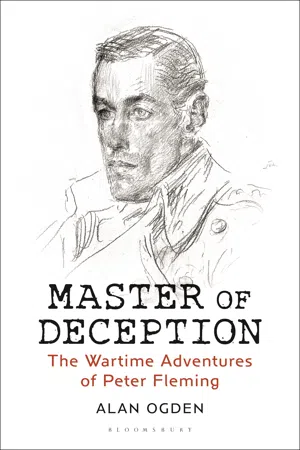
Master of Deception is a biography of Peter Fleming, elder brother of Ian Fleming, creator of James Bond. Peter Fleming worked as a travel writer and journalist, serving with distinction throughout World War II and played a crucial role in British intelligence operations in the Far East. This biography ranges from the personal life of Fleming such as his marriage to Celia Johnson, a famous actor of the time, to his extensive military intelligence career which took him from Norway and Greece to the Far East. Framed through the life of Peter Fleming this book offers an in-depth study of British intelligence operations in the Far East during World War II.
Information
Chapter 1
A new Elizabethan
Peter Fleming was born into a world of Edwardian luxury, an era when Britain was at the apogee of its imperial wealth and status. Yet his grandfather, Robert Fleming, the son of a humble bookkeeper in Dundee, had started work at the age of fourteen as an accountant with a local textile firm1 and gone on to become one of the shrewdest and most respected investors of his generation, founding both The Scottish American Investment Trust and the merchant bank, Robert Fleming & Co. His son, Valentine, naturally had a very different start in life. Educated at Eton and Oxford where he read law,2 he became Member of Parliament for Henley at the age of twenty-eight. Married to a beautiful socialite, Evelyn St. Croix Rose, and by now the father of four sons, Valentine joined the Queen’s Own Oxfordshire Hussars in 1914 and was in action on the Western Front until his death in the trenches of Guillemont Farm in France in May 1917. He was awarded a posthumous DSO. Abruptly, ten-year-old Peter now found himself head of the family. He had much to live up to. His brother, Ian, who was later to become world famous as the creator of James Bond, was away at boarding school; Richard aged six and Michael aged four were still at home.
Winston Churchill’s eulogy for Valentine Fleming was published by The Times on 25 May 1917:
Valentine Fleming was one of those younger Conservatives who easily and naturally combine loyalty to party ties with a broad liberal outlook upon affairs and a total absence of class prejudice.
He was most earnest and sincere in his desire to make things better for the great body of the people, and had cleared his mind of all particularist tendencies. He was a man of thoughtful and tolerant opinions, which were not the less strongly or clearly held because they were not loudly or frequently asserted.
He shared the hopes to which so many of his generation respond of a better, fairer, more efficient public life and Parliamentary system arising out of these trials. But events have pursued a different course.
He had everything in the world to make him happy; a delightful home life, active interesting expanding business occupations, contented disposition, a lovable and charming personality. He had more. He had that foundation of spontaneous and almost unconscious self-suppression in the discharge of what he conceived to be his duty without which happiness, however full, is precarious and imperfect. That these qualities are not singular in this generation does not lessen the loss of those in whom they shine.
As the war lengthens and intensifies and the extending lists appear, it seems as if one watched at night a well-loved city whose lights, which burn so bright, which burn so true, are extinguished in the distance in the darkness one by one.
After excelling as a scholar at Eton and winning a scholarship to Christ Church Oxford to read English Literature, when he came down in June 1929 with a ‘first’, Fleming was sent to America by his family to serve an apprenticeship with a firm of stockbrokers in preparation for joining the family bank in London. Almost as soon as he arrived, Wall Street collapsed, ushering in ‘the worst economic blizzard of the century [which] wiped out the fortunes of the rich and the savings of the poor’,3 and after managing to delay his return home by conjuring up hunting trips to the southern states and Central America, he dutifully reported to Robert Fleming & Co in the City of London. Two months in an office in a merchant bank was enough for the free-spirited young man and after a series of job interviews, he landed a position at The Spectator as assistant literary editor. At the same time, he joined the Grenadier Guards and on 29 November 1930 was commissioned second lieutenant in the Supplementary Reserve of Officers, a reservist body designed to produce in the event of war a flow of replacement platoon commanders whose life expectancy was traditionally measured in weeks rather than months.
Training with the 2nd Battalion in 1931 (June and July) and 1933 (April and May) was fitted in between journeys to Brazil4 and China.5 The genesis of the Brazilian expedition lay in an advert in The Times seeking two applicants to ‘explore rivers Central Brazil, if possible ascertain fate Colonel Fawcett’. After signing on and recruiting the artist Roger Pettiward,6 ‘very tall, with red hair and a slow quizzical drawl’,7 Fleming managed to be appointed as The Times’ special correspondent to the British Mato Grosso Expedition as it was officially and rather grandly termed. Its quest was to enquire into the mysterious disappearance of Colonel Percy Fawcett, an irrepressible explorer who deservedly lived up to the idiom ‘a legend in his own lifetime’. A friend of Rider Haggard and Arthur Conan Doyle,8 Fawcett had made seven expeditions to the interior of Brazil between 1906 and 1924, returning to duty in the First World War to command an artillery brigade on the Western Front. In 1925 he set off with his eldest son Jack and Jack’s friend Raleigh Rimell in search of the lost city of El Dorado in the Mato Grosso region. In a letter to his younger son Brian, Fawcett described the quest for the city:
I expect the ruins to be monolithic in character, more ancient than the oldest Egyptian discoveries. Judging by inscriptions found in many parts of Brazil, the inhabitants used an alphabetical writing allied to many ancient European and Asian scripts. There are rumours, too, of a strange source of light in the buildings, a phenomenon that filled with terror the Indians who claimed to have seen it.
The central place I call ‘Z’ – our main objective – is in a valley surmounted by lofty mountains. The valley is about ten miles wide, and the city is on an eminence in the middle of it, approached by a barrelled roadway of stone. The houses are low and windowless, and there is a pyramidal temple. The inhabitants of the place are fairly numerous, they keep domestic animals, and they have well-developed mines in the surrounding hills.
They all vanished, never to be seen or heard of again, and it was assumed that they had been killed by local Indians who were known to be hostile to intruders. The disappearance of the expedition created a whirlwind of speculation, including a theory the colonel had been plucked from his canoe by a giant and exceedingly ravenous anaconda snake lying in wait in a tree above the river. Another version centred on a mysterious old man with long white hair living with an Indian tribe who answered to the name of Fawcett. As lost expeditions go, it was to prove a fertile furrow to plough and promised to yield a bumper harvest of Boy’s Own adventures.
After the publication of Brazilian Adventure in 1933 as well as Variety, a collection of his humorous ‘essays, sketches and stories’ from The Spectator, Fleming suddenly found himself in the literary limelight. Two articles in The Times9 – ‘The Heart of Brazil’ – filed by Fleming as a special correspondent (29 and 30 November 1932), had done much to publicize Brazilian Adventure. He explained that their programme had been transformed from ‘a full-dress expedition into a more or less happy-go-lucky reconnaissance’ on account of a revolution in San Paolo which had put the country into ‘a state of pleasurable excitement’. Fleming described the first stage of their journey into the interior as ‘a placid, comfortable life’ until they reached unexplored territory where, from there on, their ‘entry was slapdash and unprofessional’. Weeks of paddling in canoes, manhandling boats down rapids which ‘had a much worse reputation than they deserve’ and trekking through dense jungle concluded with Fleming’s assessment that ‘I think this journey was impossible with the resources at our disposal’. If nothing else, although they ‘brought back no conclusive proof that Fawcett [was] dead … no one who has seen anything of the region in which he disappeared can entertain the possibility of his survival’, the reader was treated to a grand caper reported with a liberal dollop of understatement and laid-back insouciance.
The Daily Express enthused ‘this is the adventure book which one always dreams of reading and no one ever writes. It must enthral everybody.’ ‘An extraordinary good book’ announced The Sunday Times; J.B. Priestley agreed, writing that it ‘is the best travel book I have read for a long time’. One of the main reasons for the book’s success, Duff Hart-Davis suggested,10 was Fleming’s ‘splendidly original attitude. Until he came on the scene, travel and travel books had been treated with excessive reverence and solemnity; but then, with a single, sustained burst of self-mockery, Brazilian Adventure blew the whole genre sky-high. Readers – and reviewers – could scarcely believe that a travel book could be so funny.’ His choice of Roger Pettiward had proved inspired for ‘nothing could have exceeded the composure and resource with which he faced a series of odd and occasionally alarming predicaments’.11 There is a marked resemblance between Pettiward and ‘Boy Endover’ in Fleming’s 1951 novel The Sixth Column – ‘a tall, rather stooping young man … His frivolity was so deep-rooted in him that it partook rather of the nature of a philosophy than of a failing. He appeared to believe that all human institutions, and most human situations, had in them something inherently ridiculous, and that it was his duty to exploit this latent seam of risibility.’ At the time of Fleming’s death in 1971, over 123,000 hardback copies had been sold.
The one dissenting voice was that of Robert Byron whose book, First Russia Then Tibet, had been published two months later and achieved only modest sales. Writing to his mother from Kabul in June 1934, he confided that ‘I have just read Brazilian Adventure – or part of it. Very disappointing – in fact I have ceased to be jealous.’ On the surface, both men had much in common; both had gone to Eton and both were Times correspondents covering Russia and Central Asia. Where they parted was in their respective appreciation of architecture. Fleming confessed in One’s Company that he was ‘wholly lacking in either an historical sense or the ability to appreciate architecture’ whereas for Byron, buildings old and modern were his all-consuming passion, attracting either lofty praise or biting opprobrium.
In his essay on Evelyn Waugh in The Art of Travel, Martin Stannard includes Fleming along with Waugh, Byron and Graham Greene as part of a generation
which liked to see itself more overtly aggressive, irreverent, cosmopolitan and impatiently dismissive of “the old men” who had made the war … While in the grey light of the thirties, Europe floundered through the Depression towards yet another global disaster, these smart young men provided intelligent light reading which satisfied both political scepticism and a frustrated thirst for the exotic. Hollywood was the “cheap” answer; the new brand of travel writing represented another, more sophisticated, form of escapism which had the greater merit of ostensibly being an attack on escapism.12
The Army Reserve was now destined to take a back seat to travel writing or ‘swanning’ as Fleming described it in a self-mocking tone. Between June 1933 and September 1935, Fleming made two landmark journeys to the Far East which were published as One’s Company (1934) and News from Tartary (1936). Both confirmed his reputation as one of the most engaging writers of his generation. Vita Sackville-West in The Spectator called One’s Company ‘a travel book in a thousand’ and termed him ‘an Elizabethan spirit allied to a modern mind’; the sobriquet ‘a modern Elizabethan’ stuck. By the time it was out of print in 1946, 90,000 copies had been sold.
Of the two books, News from Tartary is the more substantial, describing a journey from Peking to Kashmir ‘not only in Marco Polo’s footsteps but at Marco Polo’s pace’13 that lasted seven months and covered about 3,500 miles. The route chosen by Fleming and his companion, the Swiss adventurer and writer Ella Maillart, took them westwards across a China torn by civil war to Xinjiang and then south to British India. It had been eight years since any foreigner had crossed Xinjiang. During that time few of those who entered it came out alive. After entering the lands of the Tartars by a little-known route and following the course of the ancient Silk Road, they reached Kashgar before crossing the Pamirs into India. The explorer Lucy Kelaart cherishes it as:
a story of pure travel – the endless waiting for permissions, evading officials, living from hand to mouth, long days in the saddle or on foot pushing on into the interior of this great unknown region, of fatigue and animal illnesses, courting the small disasters of expedition life … as well as one of bringing back news of the state of affairs in this isolated, unknown, far corner of China and the Chinese, Russian and British interests within it.14
Propelled by rave reviews such as Harold Nicolson’s verdict in the Daily Telegraph that ‘no modern writer can equal Peter Fleming as a story-teller, as an astringent narrator of romantic and dangerous voyages through unknown lands’, News from Tartary went through seven impressions in the first year.

The continuing support of The Times played a major role in promoting Fleming’s books. On his first journey to China, under his own byline, five articles15 were published in 1933 including two long articles: ‘Communism in China – a First-Hand Enquiry. How Red Areas are Controlled’ examined the history of communism in China and its present-day development; ‘Life under a Red Regime’ analysed the extent of the Chinese Communist movement and ways in which it might evolve in the future. Fleming’s conclusion was sanguine:
As long as the Nanking Government remains in office China as a whole is safe from the Reds; and as long as the Reds stay in their mountains they can defy the whole of China. It is only in some unpredictable crisis – only, say, if the Nanking Government falls and no effective successor can quickly be found – that the Reds will have their chance. Then, indeed, chaos is come again.
In an entirely different vein, ‘A Journey in China: From Shanghai to Canton, an Overland Route’ followed Fleming’s peregrinations by car, bus, sampan and train and ended with travel tips to adventurous Times readers such as ‘with enough visiting cards with the traveller’s name and status printed on them in Chines...
Table of contents
- Cover
- Halftitle Page
- Title Page
- Contents
- Charts, maps and plates
- Acknowledgements
- Preface
- 1. A new Elizabethan
- 2. Plans and more plans
- 3. To war in the frozen north
- 4. A very British guerrilla
- 5. A Greek tragedy
- 6. A summons to India
- 7. Burmese capers and haversack ruses
- 8. Global strategists and stratagems
- 9. Dining with Chinese dragons
- 10. Total Intelligence: a common sense approach
- 11. Wheeling and dealing in information
- 12. Building the organization
- 13. Sleight of hand in the order of battle
- 14. The conjurors take to the field
- 15. Feints and noises off
- 16. The double agents’ impresario
- 17. Imaginary spies and fantasy networks
- 18. The bright eye of danger: a chance with the Chindits
- 19. Enough of war crimes
- 20. Home is the hunter
- Annexes
- Notes
- Sources and selected bibliography
- Index
- Imprint
Trusted by 375,005 students
Access to over 1.5 million titles for a fair monthly price.
Study more efficiently using our study tools.
Frequently asked questions
Yes, you can cancel anytime from the Subscription tab in your account settings on the Perlego website. Your subscription will stay active until the end of your current billing period. Learn how to cancel your subscription
No, books cannot be downloaded as external files, such as PDFs, for use outside of Perlego. However, you can download books within the Perlego app for offline reading on mobile or tablet. Learn how to download books offline
We are an online textbook subscription service, where you can get access to an entire online library for less than the price of a single book per month. With over 1.5 million books across 990+ topics, we’ve got you covered! Learn about our mission
Look out for the read-aloud symbol on your next book to see if you can listen to it. The read-aloud tool reads text aloud for you, highlighting the text as it is being read. You can pause it, speed it up and slow it down. Learn more about Read Aloud
Yes! You can use the Perlego app on both iOS and Android devices to read anytime, anywhere — even offline. Perfect for commutes or when you’re on the go.
Please note we cannot support devices running on iOS 13 and Android 7 or earlier. Learn more about using the app
Please note we cannot support devices running on iOS 13 and Android 7 or earlier. Learn more about using the app
Yes, you can access Master of Deception by Alan Ogden in PDF and/or ePUB format, as well as other popular books in History & Historical Biographies. We have over 1.5 million books available in our catalogue for you to explore.