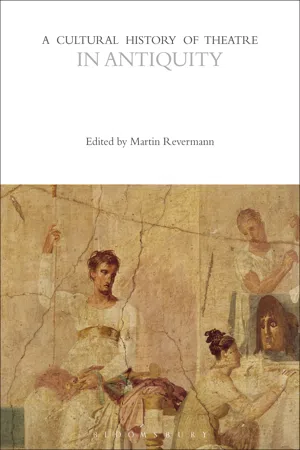
Theatre was at the very heart of culture in Graeco-Roman civilizations and its influence permeated across social and class boundaries. The theatrical genres of tragedy, comedy, satyr play, mime and pantomime operate in Antiquity alongside the conception of theatre as both an entertainment for the masses and a vehicle for intellectual, political and artistic expression. Drawing together contributions from scholars in Classics and Theatre Studies, this volume uniquely examines the Greek and Roman cultural spheres in conjunction with one another rather than in isolation.
Each chapter takes a different theme as its focus: institutional frameworks; social functions; sexuality and gender; the environment of theatre; circulation; interpretations; communities of production; repertoire and genres; technologies of performance; and knowledge transmission.
- 272 pages
- English
- ePUB (mobile friendly)
- Available on iOS & Android
eBook - ePub
A Cultural History of Theatre in Antiquity
About this book
Information
CHAPTER ONE
Institutional Frameworks
Enabling the Theatrical Event
MARTIN REVERMANN
HERO(ES), FESTIVAL, TRAGEDY: AN INTRODUCTORY CASE STUDY
In book 5 of his Histories Herodotus (5.67) tells an intriguing story involving Cleisthenes, tyrant of Sicyon from c. 595 to 575 BCE, hero cult and the re-organization of a festival:
Cleisthenes had been at war with Argos, and for one thing he put an end to rhapsodic contests in Sicyon because of the Homeric epics, which are all the time singing of Argos and the Argives. In addition, he wanted to expel from the country Adrastus son of Talaus [a former King of Sicyon and leader of the first Argive expedition against Thebes], who had and in fact still has a hero shrine in the agora of Sicyon. So he went to Delphi and asked the oracle whether he could remove Adrastus. But the Pythia replied in her oracular response that Adrastus was King of Sicyon and Cleisthenes a mere thrower of stones.1 Since the god would not give permission, he went back home and tried to devise a way of making sure that Adrastus would leave on his own. […] [Cleisthenes then decides to introduce to Sicyon a hero cult of Melanippus from Thebes, a mortal enemy of Adrastus whose brother and son-in-law had been killed by Melanippus.] When Cleisthenes had assigned him [i.e. Melanippus] the precinct, he took away from Adrastus his sacrifices and festivals and gave them to Melanippus. […] In many ways they [i.e. the people of Argos] gave honour to Adrastus, but in particular they celebrated him with tragic choruses for his sufferings. These were not in honour of Dionysus, but of Adrastus. Cleisthenes gave the choruses to Dionysus instead, and the rest of the cult to Melanippus.
This very important passage, about a period which precedes all preserved dramatic texts we have by a century or so, illustrates a number of features which are to be characteristic of the institutional frameworks within which ancient theatre will operate for the next millennium. First, there is the simple yet crucial fact that there is an institutional frame to begin with. Sicyon, like most cities in classical antiquity, surely had a host of festivals which showcased various art forms. Herodotus explicitly mentions contests of epic poetry as delivered by travelling bards (the so-called ‘rhapsodes’) and ‘tragic choruses’ as part of Adrastus’ hero cult. What exactly these ‘tragic choruses’ in Sicyon of the early sixth century would perform, and especially how much resemblance this had with what would be ‘tragedy’ (tragôidia) in Athens by the second quarter of the fifth century (when our textual evidence starts with the early plays by Aeschylus), is impossible to say with the evidence currently available. But Herodotus clearly assumes a generic similarity between those ‘tragic choruses’ at Sicyon and what he, writing in the second half of the fifth century BCE, conceptualized as ‘tragedy’.2 From the viewpoint of institutional organization, it is important to note that these are not ad hoc performances but dedicated performance slots which were integrated into an organizational framework (in this case hero cult) which secured (re)performance in stable conditions and within predictable intervals. The existence of such stable frameworks enabling performance is a defining characteristic of much of Graeco-Roman theatre, especially its canonical genres (tragedy, comedy and, in Greece, satyr play), even if less rigid, more improvisational frameworks must have existed and were in fact the norm for mime (possibly also for pantomime, especially in its early history). None of this is surprising given the nature, extent and prominence of ancient festival culture in the lives of individuals and communities (of whatever size). Theatre is an integral though not exclusive part of this festival culture.3
The second important general feature well illustrated by Herodotus’ account is the complex socio-political nature of this framework. Overtly, it is entirely religious, since the tragic choruses are part of the hero cult for Adrastus, celebrating his sufferings (presumably, for instance, the loss of his brother and his son-in-law). Secular concerns, however, are the overwhelming driving forces: Herodotus’ narrative makes it abundantly clear that under the veneer of cult and religion, the performance of tragic choruses is, or at least can very easily become, an extremely political and socially competitive business, a state affair even. By replacing Adrastus, the leader of the (first) Argive expedition against Thebes, with his Theban death enemy Melanippus, Cleisthenes’ tactical shifting of heroes and their cults is designed to make an all-too-blunt point about his relationship with hostile Argos, and the tragic choruses of the hero cult are nothing but pawns in this chess game of inter-state war politics. So are, incidentally, the gods: at the order of Cleisthenes attempting to outmanoeuvre the Delphic oracle, the tragic choruses of Sicyon are re-allocated from the hero Adrastus (who, QUA hero cult, functions as a minor deity in his own right)4 to the god Dionysus, while the rest of the cult is re-assigned to the newly created local hero cult of Melanippus. The concept of Greece as a ‘militant festival culture’, endorsed by Slater,5 seems particularly apposite in this instance. The potential for self-interested manipulation seems limitless indeed, and institutional frameworks for theatre are to remain deeply politicized throughout antiquity, no matter whether these are city-run drama competitions in fifth-century Athens, theatrical performances under the tutelage of Macedonian kings and their successors, Plautine comedies staged at a Roman festival sponsored by a high-ranking Roman official, or pantomimes performing at the villa of a wealthy Roman while also competing at a prestigious festival in honour of the Roman emperor. The strength of the nexus between theatre, power and the moneyed elite that characterizes Graeco-Roman culture is arguably second to none in Western and non-Western cultural history, and the institutional frameworks for theatre are the nodal points where these inter-connections become most clearly and visibly articulated, hence particularly interesting not just for the cultural but also the political and the economic historian.
Lastly, the Herodotus passages also at least hints at the fact that the question ‘Who enables the theatrical framework?’ often has a less straightforward answer than one might initially think. The sole ruler Cleisthenes, of course, pulls the strings here. But Herodotus also says that ‘the people of Argos’ celebrate the hero cult of Adrastus, including the tragic choruses in his honour. Theatre is a highly collaborative art form both in terms of its production and its reception, and looking more closely at the workings of any institutional framework for theatre in antiquity usually reveals complex dynamics and ongoing negotiations between individual and collective, private and public, sponsors of theatrical events and those who make them materialize, be it as actors and choruses or as spectators. This is the key reason why in the current volume this (first) chapter on institutional frameworks has as its natural complement the (seventh) chapter on ‘Communities of production’ (by Jane Lightfoot), which should be read alongside.
THEORIZING THE ANCIENT THEATRICAL FRAME
The notion of the ‘frame’ is a sociological one. It was popularized by the influential micro-sociologist Erving Goffman (1922–82), notably in his book entitled Frame Analysis: An Essay on the Organization of Experience.6 As indicated by the book’s sub-title, frames are a means of social organization and one of the prime elements which make social order possible in the first place. They therefore have, by default, a stabilizing and affirmative function which enables social cohesion.7 While Goffman was particularly interested in the discursive frames of everyday talk, he was keenly aware of the special connection shared by social frames and the theatre (exploring the theatricality of human social life is a key theme in all of Goffman’s work). He also realized that frames usually manifest themselves as frameworks, i.e. as complex clusters of organizational patterns which interact with each other as well as with the individuals or groups using them. While ‘frame’ and ‘framework’ have, for some time now, been common lingo in Theatre Studies and Cultural Studies more broadly, it is very important to bear in mind the sociological pedigree of these concepts.
Frames can be physical (a theatre building, for instance) or conceptual (that is, the frame of mind adopted when viewing theatre). The institutional frameworks which are the subject of this chapter are both. There is a physical demarcation – often the sacred space of a sanctuary, a ‘theatre temple’ or a tomb but also the profane space of a market-place or the villa of a wealthy patron – which provides the site and location of the theatrical event. And there is the conceptual frame, or ‘frame of mind’, of the performer(s) and the playgoer(s). This conceptual frame has cognitive but also socio-historical and emotional aspects to it. In the case of Graeco-Roman theatre, the very strong link between theatre and festival meant that notions of feasting, licence, worship, relaxation and socializing were powerful ingredients of any institutional framework for the theatre arts. A festival also constitutes what may be branded a ‘strong’ institutional frame: it is highly visible and socially sanctioned by perhaps the strongest of all collective bonding mechanisms, religion; its continuity and iteration are usually guaranteed, with financial resources being quite readily available; and it affords numerous opportunities for pronounced and visible social differentiation: note, for instance, the social capital gained and displayed by the sponsors (chorêgoi) of classical Greek drama, or the hierarchical seating order of theatres in Rome which put the senatorial class, with its conspicuous dress, centre-stage (literally).8 ‘Weaker’ institutional frames for theatre did exist, in the form of street or market-place performances, theatre acts done for the Roman military, or private performances in the luxury show-homes of the moneyed elite. But overall, ancient theatre stands out for the ubiquity of ‘strong’ institutional frames. These functioned as extraordinarily robust, predictable, reliable, structured and effective communicative networks of power and politics. As regulated contact zones, they helped channel, express and negotiate relations between the elite and the masses, the few and the many, the human and the divine, the past and the present, the real and the imagined, the indigenous and the foreign, the Greek and the Roman.
SOME DISTINCT FEATURES
Much of what follows in this chapter will have to be concerned with details of the taxonomy of Greek and Roman festival culture. It is therefore important to step back at this point and outline some distinct features that characterize ancient theatrical frameworks. Competitiveness, as mentioned in the Introduction, is a key defining feature of ancient theatre. It is inscribed differently into the frameworks that are attested: competitions between productions with prizes being awarded to rival playwrights and rich individual sponsors (classical Athens); actors’ prizes (Greece); peer-driven competition between sponsoring magistrates who aspire to climb the political career ladder and in effect use theatre as part of their electoral campaign (Rome); competition of theatre with rival leisure-time attractions (gladiatorial combat, horse racing etc.) which are being offered at the same occasion (Rome); and theatre art forms (mime and pantomime) that successfully exist for a long time outside of these competitive institutional frameworks before, eventually (in the late second century CE), being at least partially integrated into them. One remarkable difference between Greek and Roman theatrical frameworks is a relative shift of competitiveness, from competition between producers of parts of the theatrical event (actors, playwrights, sponsors of individual productions) to competition between the enablers of wholesale theatre festivals (the presiding magistrate, including the Emperor, trying to outspend and outdo his elite peers). This is in part to be explained by the different social standing of theatre practitioners in Rome, who were hirelings and often socially stigmatized.9 For the Roman situation, this also means that while the content of the ...
Table of contents
- Cover
- Half-Title Page
- Series Page
- Title Page
- Contents
- List of Illustrations
- Notes on Contributors
- Series Preface
- Introduction: Cultural history and the theatres of antiquity
- 1 Institutional Frameworks: Enabling the Theatrical Event
- 2 Social Function? Making the Case for a Functionless Theatre
- 3 Sexuality and Gender: Off-stage and Centre-stage
- 4 The Environment of Theatre: Experiencing Place in the Ancient World
- 5 Circulation: Theatre as Mobile Political, Economic and Cultural Capital
- 6 Interpretations: The Stage and its Interpretive Communities
- 7 Communities of Production: Pied Pipers and How to Pay Them; or, the Variegated Finance of Ancient Theatre
- 8 Genres: Drama and its Many Unhappy Returns
- 9 Technologies of Performance: Machines, Props, Dramaturgy
- 10 Knowledge Transmission: Ancient Archives and Repertoires
- Notes
- Bibliography
- Index
- Copyright
Trusted by 375,005 students
Access to over 1.5 million titles for a fair monthly price.
Study more efficiently using our study tools.
Frequently asked questions
Yes, you can cancel anytime from the Subscription tab in your account settings on the Perlego website. Your subscription will stay active until the end of your current billing period. Learn how to cancel your subscription
No, books cannot be downloaded as external files, such as PDFs, for use outside of Perlego. However, you can download books within the Perlego app for offline reading on mobile or tablet. Learn how to download books offline
Perlego offers two plans: Essential and Complete
- Essential is ideal for learners and professionals who enjoy exploring a wide range of subjects. Access the Essential Library with 800,000+ trusted titles and best-sellers across business, personal growth, and the humanities. Includes unlimited reading time and Standard Read Aloud voice.
- Complete: Perfect for advanced learners and researchers needing full, unrestricted access. Unlock 1.5M+ books across hundreds of subjects, including academic and specialized titles. The Complete Plan also includes advanced features like Premium Read Aloud and Research Assistant.
We are an online textbook subscription service, where you can get access to an entire online library for less than the price of a single book per month. With over 1.5 million books across 990+ topics, we’ve got you covered! Learn about our mission
Look out for the read-aloud symbol on your next book to see if you can listen to it. The read-aloud tool reads text aloud for you, highlighting the text as it is being read. You can pause it, speed it up and slow it down. Learn more about Read Aloud
Yes! You can use the Perlego app on both iOS and Android devices to read anytime, anywhere — even offline. Perfect for commutes or when you’re on the go.
Please note we cannot support devices running on iOS 13 and Android 7 or earlier. Learn more about using the app
Please note we cannot support devices running on iOS 13 and Android 7 or earlier. Learn more about using the app
Yes, you can access A Cultural History of Theatre in Antiquity by Martin Revermann in PDF and/or ePUB format, as well as other popular books in History & Ancient History. We have over 1.5 million books available in our catalogue for you to explore.