Historically and broadly defined as the period between the fall of the Roman Empire and the rise of the Renaissance, the Middle Ages encompass a millennium of cultural conflicts and developments. A large body of mystery, passion, miracle and morality plays cohabited with song, dance, farces and other public spectacles, frequently sharing ecclesiastical and secular inspiration. A Cultural History of Theatre in the Middle Ages provides a comprehensive and interdisciplinary overview of the cultural history of theatre between 500 and 1500, and imaginatively pieces together the puzzle of medieval theatre by foregrounding the study of performance.
Each of the ten chapters of this richly illustrated volume takes a different theme as its focus: institutional frameworks; social functions; sexuality and gender; the environment of theatre; circulation; interpretations; communities of production; repertoire and genres; technologies of performance; and knowledge transmission.
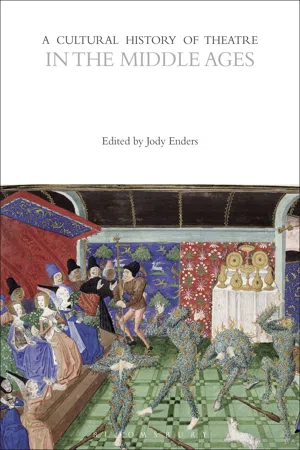
- 304 pages
- English
- ePUB (mobile friendly)
- Available on iOS & Android
eBook - ePub
A Cultural History of Theatre in the Middle Ages
About this book
Information
CHAPTER ONE
Institutional Frameworks
SEETA CHAGANTI, NOAH GUYNN AND ERITH JAFFE-BERG
In the medieval history of theatre, we might expect institutions to function as static and monolithic structures. But a more apt figure for the medieval institution would be a phrase of movement, complex and patterned: in essence, choreography. To elaborate on this assertion, we must first acknowledge the discrepancies between medieval and modern uses of the word institution itself. In many medieval languages, institution primarily signifies the act of setting a process in motion or installing a person in office. It only secondarily denotes civic, social, political and religious structures and the sets of rules they seek to impose. This is not to say that medieval social and cultural practices were never governed by entities that we would see as similar to modern institutional bodies. It is, rather, that medieval cultures were highly attuned to the fact that institutions were not simply static entities regulating behaviours and shaping beliefs. They were also living, moving organisms constituted by means of performance: modes of doing as well as being. The social theorist Michel de Certeau conveys this characteristic of the modern institution by calling it both ‘place’, meaning a physical location and cultural programme governed by imperatives of conformity and continuity, and ‘space’, meaning the unsettling of those imperatives by the unpredictable ‘actions of historical subjects’.1 But we need a different metaphor to describe the medieval institution, one that foregrounds its particular kinetic quality. As Jody Enders argues, medieval theatre existed in orchestrated motion: it impelled ‘itself through time and space before the eyes of spectators’, affording them opportunities for investing familiar places with ‘meanings old and new’ and for exposing or disrupting the ideologies attached to them.2 We might therefore characterize the medieval institution, in its relationship to theatre, as choreographic, noting that the medieval world often conceived of its institutions in terms of the mobile, even terpsichorean, elements of medieval theatre itself. Put another way, the complex kinetic patterns of medieval theatrical culture reflected the fluid mobility, intertwining oppositions, syncopated structure and other choreographic qualities of medieval institutions.
In making this claim, we challenge deterministic accounts of institutional frameworks as sites of ideological containment and of public performance as a mechanism for imposing cultural hegemony. Until fairly recently, scholarly consensus held that medieval theatre was concerned with maintaining ‘the wholeness of the social order’ and promulgating a worldview in which ‘the individual’ was subsumed ‘to the collectivity and to its conception of social morality’.3 Indeed, it is still common to read that medieval performances, including those that depict hierarchical inversion and social revolt, are ultimately oriented toward the ‘acceptance of sacrosanct values’ and the ‘restoration of the status quo’.4 The problem with such assertions is that they confuse the theatrical figuration of ideology with its actual operations, whereas (to quote Pierre Macherey) ‘no ideology is sufficiently consistent to survive the test of figuration’.5 They also rely on a theory of passive consumption that is ill suited to medieval practices of spectatorship, which were notoriously rowdy and interactive.6 Perhaps most seriously, these assertions overlook abundant evidence that medieval performances, as for Claire Sponsler, were ‘social events … within which various contested cultural issues could be acted out’;7 that, as for Carol Symes, they were (often quite literally) staged in a ‘marketplace of ideas’ that put ‘entrenched and institutionalized’ discourses in tense dialogue with a range of other discursive modes;8 that, as for Sara Beam, they ‘directly challenged the authority that religious and royal officials enjoyed’ and regularly gave rise to ‘fighting, law suits, and complaints of slander’;9 and that efforts by ruling elites to control the stage through patronage, propaganda and censorship were only ever partially effective.10 Under such circumstances, theatre could not impose values or restore a status quo; instead, it set in motion interactions between institutions and spectators, places and spaces, ideological figurations of social order and everyday tactics of consumption.
Keeping these negotiations in mind, we inquire here into a variety of institutional settings in which medieval theatre flourished. While it has been traditional in canonical criticism to confine such inquiry to Christian Europe and to neglect continental theatre in favour of English traditions, we focus on four main categories of institutions across a broad geographical and cultural ambit: sacred (including Christian and Jewish, ecclesiastical and monastic milieus); educational (by which we mean especially colleges and universities); political (notably civic, regional and royal governments); and fraternal, vocational and festive (guilds, confraternities and chambers of rhetoric, as well as parallel Jewish and Arab institutions). Our goal in documenting these institutions is to situate them socially and historically while simultaneously indicating the ways in which they escape their apparent ideological frames by bending and breaching the boundaries that contain them, effectively transforming place into space. The four categories should therefore be understood as heuristic rather than absolute. We shall emphasize this point by drawing attention to the inevitable overlap between them as well as to the ‘shadow’ institutions they incorporate but also conceal: minority groups who influenced theatrical culture but whose historic footprint is, for a variety of reasons, less effectively illuminated than it should be. This point also reminds us that our very act of writing these histories resonates with the figure of choreographed motion that we use to describe institutional dynamics. That is to say, the elusiveness, silence or invisibility of some of these institutional categories foregrounds the difficulty of recapturing this past – a quintessential historiographical dilemma – in much the same way as do the gestural, non-verbal and otherwise uncodified components of medieval performance. In each section of this chapter, we address this issue by incorporating into our analyses evidence that speaks non-verbally – including visual, architectural and bodily forms of historical witnessing.
SACRED INSTITUTIONS
If any single institution has dominated modern perceptions of medieval theatre, it is the Catholic Church, which produced virulent anti-theatrical polemics but also exploited the inherent theatricality of its sacred texts and ritual observances in order to attract audiences and earn converts. Traditional histories have often misrepresented the relationship between religion and drama, however, notably by adhering to a teleological, or, as it sometimes called, ‘evolutionary’, model of development. According to this hypothesis, medieval drama developed out of Latin liturgical tropes after a period of dormancy following the decline of the Roman Empire. As mimetic elaborations on the liturgy acquired aesthetic autonomy and self-consciousness, performers abandoned church buildings for marketplaces and courtyards, and increasingly sought independence from clerical oversight. Gradual processes of secularization, commercialization and vernacularization eventually paved the way for playwrights and performers to recover the aesthetic canons and theatrical techniques of antiquity, to translate and adapt ancient plays, and to inaugurate the truly modern drama of the Renaissance, which had divested itself of its institutional origins in the medieval Church.
Despite the fact that critics of medieval drama have long recognized the fallacies underlying this evolutionary model, its influence has persisted. Chief among these fallacies is the model’s failure to acknowledge the heterogeneous nature of the Church itself, which was hardly free of pagan, theatrical and commercial influences; which was riven with internal divisions that belie any claims to monolithic uniformity; and which exhibited all the complex, strategic patterns of mobility that allow us to define medieval institutions as choreographic. Another significant fallacy is the insistence upon what Michel Foucault calls ‘the pursuit of the origin’: ‘an attempt to capture the exact essence of things’ by disguising the reality that ‘they have no essence or that their essence was fabricated in a piecemeal fashion from alien forms’.11 As John Parker observes, the synoptic gospels and early apologetics were themselves highly adulterated cultural forms, influenced as they were by pagan antecedents and analogues, including ‘dramatic convention’.12 Although Church Fathers like Tertullian and Augustine stridently denounced pagan theatre, even they were not immune to its influence and sought ‘knowingly or otherwise … to arrogate [its authority] to Christian scripture and ritual’.13 The eventual development of a sacred drama out of the Roman liturgy in the tenth century should therefore be perceived as part of a continuous tradition rather than a radical innovation; and here, too, we should avoid a mystifying discourse of origins. There is no question that the Easter trope Quem quaeritis or Visitatio sepulchri (in which the angels at Christ’s tomb inquire of the Three Marys, ‘Whom do you seek in the sepulchre, O followers of Christ?’) contains instructional language indicating an impulse toward theatrical elaboration (see Figure 1.1); nor should we doubt that Quem quaeritis exerted pivotal influence on the liturgical drama of the Church in the Romanesque period.14
However, it is another thing entirely to assert, as does Glynne Wickham, that this liturgical drama reflects an institutionally confined culture that was ‘unsullied by any of the vulgar considerations that stem from human exhibitionism and egocentricity or from doubts about its likely audience appeal and consequent box-office receipts’.15 In fact, the liturgy (and especially the Mass) was from the outset self-consciously theatrical, and (according to Parker) so tied to mercantile practices that soteriological metaphors of cost and debt were readily literalized in ritual practice, ‘whether in the Offertory, tithes, the trade in relics, Mass stipends, or the indulgence’.16
In analyzing the theatrical culture of the medieval Church, we should thus emphasize what Parker calls ‘the hybrid genealogy ...
Table of contents
- Cover
- Half-Title Page
- Series Page
- Title Page
- Contents
- List Of Illustrations
- Notes On Contributors
- Series Preface
- Editor’s Acknowledgements
- Introduction: Medieval Theatre Makes History
- 1 Institutional Frameworks
- 2 Social Functions
- 3 Sexuality and Gender
- 4 The Environment of Theatre
- 5 Circulation: A Peripatetic Theatre
- 6 Interpretations
- 7 Communities of Production
- 8 Repertoires and Genres: Emotions at Play
- 9 Technologies of Performance
- 10 Knowledge Transmission: Media and Memory
- Notes
- Bibliography
- Index
- Copyright
Trusted by 375,005 students
Access to over 1.5 million titles for a fair monthly price.
Study more efficiently using our study tools.
Frequently asked questions
Yes, you can cancel anytime from the Subscription tab in your account settings on the Perlego website. Your subscription will stay active until the end of your current billing period. Learn how to cancel your subscription
No, books cannot be downloaded as external files, such as PDFs, for use outside of Perlego. However, you can download books within the Perlego app for offline reading on mobile or tablet. Learn how to download books offline
Perlego offers two plans: Essential and Complete
- Essential is ideal for learners and professionals who enjoy exploring a wide range of subjects. Access the Essential Library with 800,000+ trusted titles and best-sellers across business, personal growth, and the humanities. Includes unlimited reading time and Standard Read Aloud voice.
- Complete: Perfect for advanced learners and researchers needing full, unrestricted access. Unlock 1.5M+ books across hundreds of subjects, including academic and specialized titles. The Complete Plan also includes advanced features like Premium Read Aloud and Research Assistant.
We are an online textbook subscription service, where you can get access to an entire online library for less than the price of a single book per month. With over 1.5 million books across 990+ topics, we’ve got you covered! Learn about our mission
Look out for the read-aloud symbol on your next book to see if you can listen to it. The read-aloud tool reads text aloud for you, highlighting the text as it is being read. You can pause it, speed it up and slow it down. Learn more about Read Aloud
Yes! You can use the Perlego app on both iOS and Android devices to read anytime, anywhere — even offline. Perfect for commutes or when you’re on the go.
Please note we cannot support devices running on iOS 13 and Android 7 or earlier. Learn more about using the app
Please note we cannot support devices running on iOS 13 and Android 7 or earlier. Learn more about using the app
Yes, you can access A Cultural History of Theatre in the Middle Ages by Jody Enders in PDF and/or ePUB format, as well as other popular books in History & European Medieval History. We have over 1.5 million books available in our catalogue for you to explore.